Showing posts with label music. Show all posts

Sunday, 29 August 2010

The Toggery: Stockport's rock'n'roll tailor


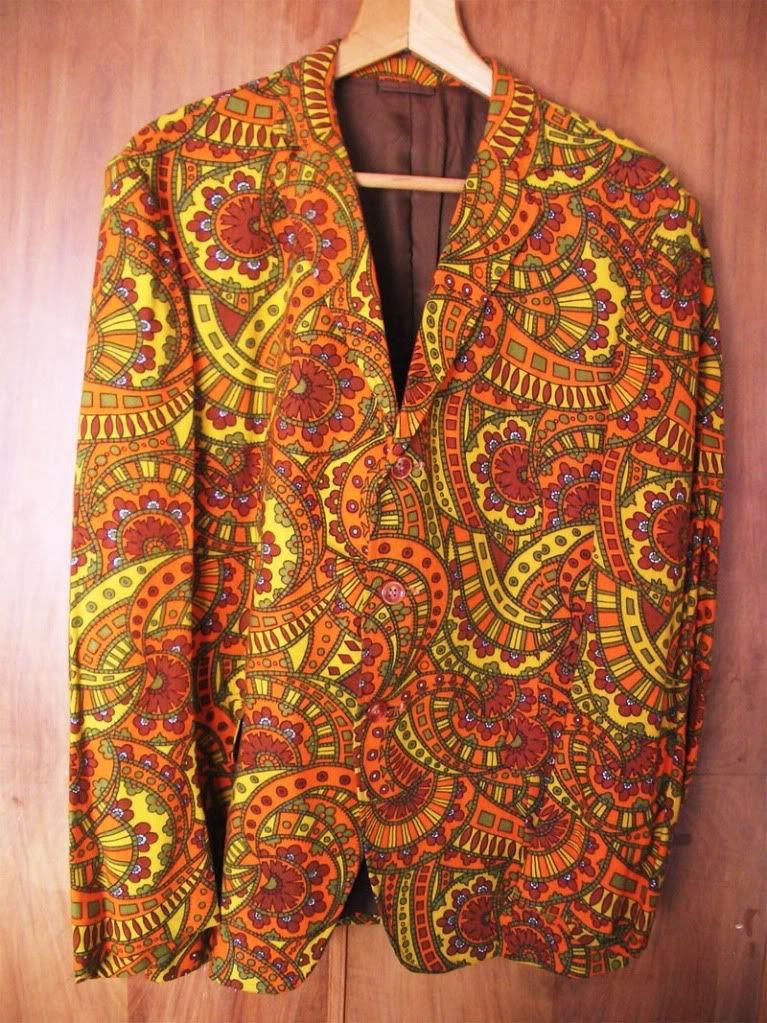
I found this jacket at Stockport's flea market about four years ago.  The stall holder told me he bought it for 13 guineas when he was 16 years old from a local menswear shop called The Toggery.  Judging by its condition, it looked like there had been few occasions (if any) when he had summoned up sufficient courage to wear it.  Its quite a piece.
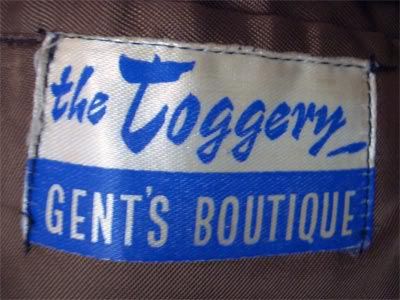


Of course, I was filled with curiousity about The Toggery so I looked it up online and most of the references I discovered related to the 1960s band The Toggery Five, managed by the proprietor of the shop, Michael Cohen, who obviously supplied their enviable wardrobes as well.  Olaf Owre has composed a very thorough account of the band's story, and there's some fabulous pictures of them on the original singer, Frank Renshaw's website.  Including this one:

The Toggery Five outside The Toggery, Mersey Square, Stockport, 1964.  Picture source The Toggery Five 1963-1966.

Graham Nash of the Hollies had worked there and, in fact, Michael Cohen went on to become their manager too.

This shop was evidently a leading source of ultra fashionable menswear in the north west during the 1960s, and supplied 'fab gear' (apologies, it seemed appropriate!) to numerous local, regional, and not so local, bands.  Including the Beatles and the Rolling Stones (allegedly) - we'll come to that soon enough.

The Toggery, it was becoming clear, was an historically significant nexus of the music and fashion scenes of the time, so how come I'd never heard of it? 

Anyway, some people I know, of a certain generation, remember The Toggery vividly.  My mum worked at a branch of Boots which was opposite The Toggery, and fondly recalls glimpsing the steady procession of handsome young men who patronised the shop.  Joe Moss remembers getting his best ever suit from The Toggery in his younger days, not to mention boots and numerous shirts.  He also has a friend called Pete Maclaine who used to work there, who was still in touch with Michael Cohen himself.

I wondered if it would be possible to interview Mr Cohen to find out more of this story, and, thanks to the kind efforts of Pete Maclaine, it turned out it was.  What follows is material drawn from an interview with Michael Cohen conducted on 5th August 2009, with Pete and Joe in attendance (and sometimes chipping in).

An aside - Pete is a significant player in the Manchester music scene himself.  As Pete Maclaine and the Dakotas (later Pete Maclaine and the Clan) he has been a musician for nearly 50 years, and is still going strong.  His band were the first from Manchester to play the Cavern in Liverpool, and he has the unusual distinction of having had the Dakotas stolen from under him by Brian Epstein, who installed Billy J. Kramer as the lead singer instead.  He has a phenomenal store of anecdotes about the music business and his adventures in it, (this article has a few good ones) not to mention an inexhaustible fund of jokes and patter.

On to the story, which follows after the jump:


Tuesday, 11 May 2010

Better Badges

I've been thinking about badges recently, and about how important they were to me in my early teenage years.

As a pupil at a school that required a uniform, badges were one of the few ways to broadcast your sophisticated taste and esoteric musical enthusiasms, and political/ethical concerns if you had any.  Of course, there were also the exuberantly biro'ed pencil cases and army surplus canvas bags but that's another story.

Crucially, they were also very cheap and made ideal pocket money purchases.

There were important distinctions in the style of badges dependent on your musical preferences.  I remember pop music badges in the 70s tended to be large and full colour - a photograph of a beaming David Essex as big as a coaster, for example.  Heavy metal fans favoured enamelled metal badges, or the later cheaper versions which were basically a metal square with a shiny plastic sticker, and the obligatory sew-on patches for their frayed denim waistcoats.

Punk and New Wave fans were more austere in their badge preferences (this was probably a result of limitations in budget and manufacturing capabilities as much as aesthetics).  Monochrome tended to be the rule, or maybe two colours at a push, and they were always small.  Bold graphic band logos tended to work best at this scale, PiL's being a particularly successful example which worked at every size from button badge to shoulder-spanning back-of-the-leather-jacket artwork. 

I filled up my school blazer lapels from a small record retailer in Lincoln called Sanctuary records, which had a black felt-covered board covered in tiny, ¾" badges from which I made my careful selections.

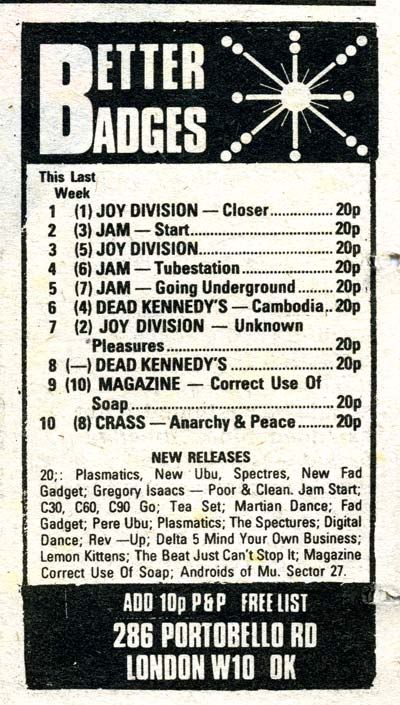
Around the same time, I began reading the NME which had a regular advertiser - Better Badges.  They placed their tiny box ad on the inside last page, always in the bottom right corner.  Happily, I've just found the remains of my NME collection (now reduced to about a dozen copies in total) dating from 1979 to 1985.  And the early ones do indeed have Better Badges ads.

Better Badges ad, NME 27th September 1980.

As you can see, they presented their top sellers in a weekly chart and it gives a wonderfully concise snapshot of the popular underground (if that's not a clumsy oxymoron) music scene of the time.  Apart from the Jam, who weren't underground at all really (despite that song title, yes I see it!)

I can imagine little teen mods satisfying their fan worship by stocking up on badges whilst they save up to buy some black and white bowling shoes, just like Paul Weller's.

Schoolkids usually don't have much money to spend.  You might buy a badge of a record before you bought the record itself.  Or you might buy the badge instead of the record, and satisfy yourself with a fuzzy tape recording of the track off John Peel.  At least you knew about it, and you could let everyone else know you knew about it too.

Better Badges was great because it was right on the money, producing little mascots of nerdy fandom exactly when you needed them.  Before 'everyone else' had heard of them.


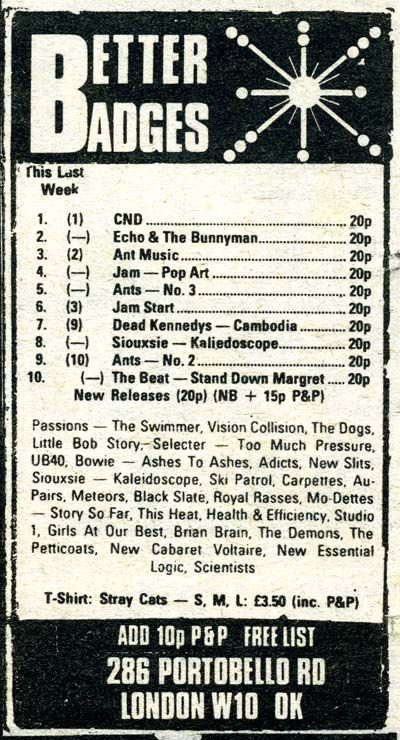
Better Badges, NME 3rd January 1981.  

This ad from January 1981 indicates a rising political awareness with the CND badge (Campaign for Nuclear Disarmament) topping the chart.  I'm sure it was around this time that I sent off for my copy of the CND booklet Protest and Survive, which scared me witless.

I honestly can't remember if I ordered badges directly from Better Badges.  Being isolated in a village in rural Lincolnshire, I regularly sent off postal orders for records and fanzines, and then raced to beat the dog to the post before she tore the packages to shreds (I still have a few records with teeth marks).  The company was also an important producer and distributor of fanzines and its very likely that some of my postal orders went to them, but I'm hazy on this.  At any rate, its certain that I wore their badges.


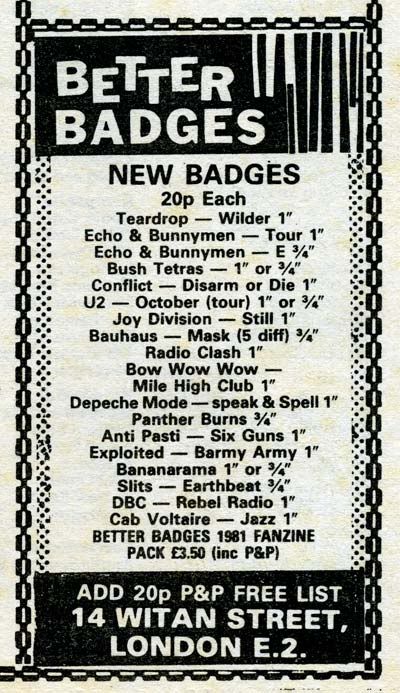
Better Badges ad, NME 19th December 1981.

By December 1981, Better Badges had dropped the chart and just listed their new productions, and the P&P had doubled to 20p.

The next year - 1982 - I left school and went to art college, and I think my badge-wearing years ended at around the same time.  Perhaps I considered them a little gauche and immature now I was a grown-up student (oh dear).  It looks like Better Badges stopped advertising in the NME shortly after this too, since my few later copies don't have their ads.

This enjoyable trawl through old NMEs has lead to a day-long scanning session because I was drawn to the clothing ads in the back pages.  So my next few posts will explore the delights of the mail order clothing companies that sold through my (then) favourite music weekly.  


Further reading

I've been very slack about doing research for this post, in fact I haven't done any in my rush to post something after quite a lull.

If you would like to learn more about Better Badges, check these links:

A short history of Better Badges and its role in badge and fanzine production and distribution.

An article by Joly MacFie, founder of Better Badges, which explores how the emergence of cheaper reproduction technologies enabled the DIY/anyone-can-do-it ethos of punk. 

A Village Voice article about Joly MacFie and punkcast.com.