Friday, 19 February 2010

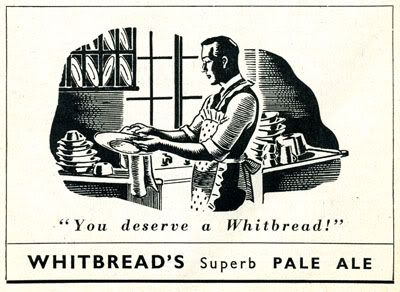
You deserve a Whitbread!

Whitbread Pale Ale advertisement in Lilliput, June 1947, page xv.

This startling advertisement appeared in Lilliput magazine's June 1947 issue. A man is pictured in a frilly apron doing the washing up, presented with no comment or indication that this is the least bit remarkable.

Taken in the context of the immediate post-war years, it did surprise me. Men were returning from fighting six long years of war and the usual story we are told is that women who had ably coped with 'men's' jobs - working in munitions and aeroplane factories during the war - were immediately pushed out of their jobs and ordered back into the home and kitchen where they belonged. It was back to 'business as usual' - the reassuring gendered division of labour with women as housekeepers and mothers, men as breadwinners, and pampered kings of the castle at home.

This ad complicates those assumptions. There's no suggestion that this man is emasculated by helping out at home, even with a frilly apron on, and the scenario is not exploited for comic effect (as it inevitably would be today). In fact he looks rather noble in his woodcut-style vignette. Perhaps gender roles in the post-war years were a little more complicated and nuanced than we have been led to believe by most popular histories.

Of course, I'm sure most women wouldn't have expected to be rewarded with a bottle of pale ale for doing household chores, so there's an indication that the man's efforts are a little bit special, although obviously not unusual.

In fact, within a few pages of the same magazine is another very similar advertisement:

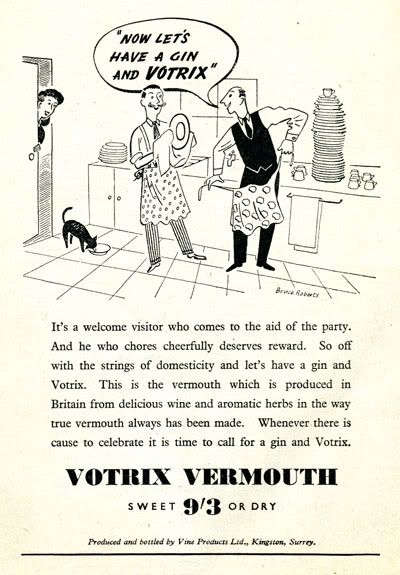
Votrix Vermouth advertisement in Lilliput, June 1947, page iii.

The occasion this time is the aftermath of a party, with two gentlemen gamely tackling the piles of dishes. They both wear feminine, patterned aprons and are again deserving of a reward in the form of an alcoholic drink. A delighted-looking wife peers through the door (and then perhaps runs off to fetch their drinks?!)

Did men do anything else around the home except the dishes, now and then? Perhaps . . .

Vactric vacuum cleaner advertisement, from Housewife, November 1947, inside back cover.

This vacuum cleaner advertisement from the same year is rather less credible ("Give him a Vactric"? Hmm) and there is a lightly ironic tone to the copy: "When the household god descends to lend a hand" is a clear indication of the 'normal' domestic power relationship, however humorously expressed.

So the idea of a man helping out with onerous domestic chores is framed in all these advertisements as a sort of special treat for their wives, who are still expected to do them most of the time. But at least its not portrayed as ridiculous or unmanly, as you might expect even to this day, and its considered unremarkable enough to be featured in mainstream advertising.

It makes me wonder how far we've progressed since then (as I contemplate the stairs that need vacuuming . . .)

Monday, 8 February 2010

The magnificent Tilly Losch


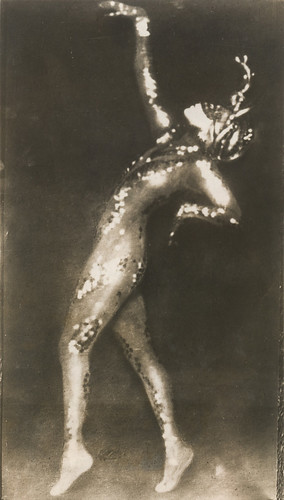
Tilly Losch, 1923, originally uploaded by Trevira.

This beautiful photograph in my collection came from the archive of the newspaper The San Francisco Examiner. There's a damaged relic of a pasted-on label on the reverse giving the title "Serpent of Hell" (the production title? Her character's name?) and a date of April 14th, 1923, which might be the publication date.

Ottilie Ethel Losch was born in Vienna on November 15th 1907, which would make her 15 years of age in this photograph. You can read a summary of her extraordinary life and career in that link over her full name, which details her first stage appearance as a dancer at the age of six with the Vienna Imperial Opera ballet school, her promotion to prima ballerina at the unusually young age of 15, and her subsequent work with Max Reinhardt as both dancer and choreographer (and much more, of course, but we'll come to that soon).

What is puzzling is that according to the Binghamton University Library, which holds Losch's papers, she didn't arrive in the United States until 1927.

Why, then, is she appearing in a popular American newspaper (owned by William Randolph Hearst, by the way) in 1923? In a costume that looks much more Max Reinhardt than something you might expect from the Vienna Imperial Opera, and a full four years before she was reported to have first been invited to perform for Reinhardt in 1927?

The remains of that label note that she was wearing "phosphorous tights" - and I sincerely hope they mean phosphorescent, by the way, or her health might have been seriously endangered.

I'm speculating wildly here - its a bad habit of mine - but perhaps either the photograph date is wrong, or there's something missing or incorrect in that summary of her life?

No matter, Tilly Losch's life was extraordinary anyway, and she is one of those 20th century figures who seems to have orbited around many of the most significant cultural figures of her times, like a female Zelig, only much more beautiful!

She married Edward James, the wealthy English art connoisseur who was a patron of Salvador Dali (he was the proud owner of the first iteration of the iconic Mae West lips sofa, which was installed in his surrealist country pile Monkton House, and was captured by Magritte in this famously baffling portrait). But their marriage ended in a scandalous divorce in 1934 - Tilly accused him of homosexuality, he in return cited just one of her numerous affairs.

Other names that crop up in her life that might still ring a bell to the modern ear include Noel Coward, Fred and Adele Astaire, Kurt Weill, Lotte Lenya, George Balanchine, Berthold Brecht, Jean Cocteau (an ardent fan), the Sitwells and Cecil Beaton.

Her career in Hollywood has left us with some appearances in films such as The Garden of Allah (1936) with Marlene Dietrich, The Good Earth (1937) and Duel in the Sun (1946). All of which I'm pretty sure are readily available on DVD.

Later she retired from dancing and acting and turned to painting, which apparently suited her reportedly shy nature, and was enobled by her 1939 marriage to the Earl of Carnavon to the status of countess. Despite their divorce after the Second World War, they remained on friendly terms and the Earl was one of the few mourners at her 1975 funeral.

But let's go back to the top of this post and contemplate that amazing vision of her as an accomplished teenage dancer making news across the Atlantic - wasn't she magnificent?

Sunday, 7 February 2010

Santos Casani - the forgotten dance master

If you've ever seen one of those archive film montages of the 'roaring twenties' in a TV documentary, there's one clip that always features. Its the one featuring a couple dancing the Charleston on top of a taxi cab driving through a London street.

That clip is at the very end of this British Pathé dance instruction film (incidentally, fashion history buffs will be delighted by Miss Jose Lennard's lower back skirt hem - a major trend in the last years of the 1920s):

THE FLAT CHARLESTON MADE EASY


The stunt was intended to demonstrate that the new 'flat' Charleston required very little space, in contrast to its original, wild form, which was a veritable whirlwind of flying heels and arms, presenting considerable danger to nearby dancers. Indeed the Charleston was banned from many dancehalls at the time.

It is ironic that this clip is now employed to symbolise the reckless, risk-taking, devil-may-care nature of the times when its original intention was actually quite the opposite.

While I could easily (and quite happily) go on about the Charleston, this post concerns the man who appeared in that film, the famous dance master - and energetic self-publicist - Santos Casani.

Mr Casani was the proprietor of "the largest school of dancing in England," wrote a column for the Daily Mail, and made numerous short dance instruction films for British Pathé's cinemagazine for women, Eve's Film Review. The film company supplied free instruction leaflets based on the dance steps Casani featured, which viewers could send off for, and as a demonstration of how popular these films were, on one occasion they had to print 20,000 leaflets to satisfy the demand (most of this information is derived from Jenny Hammerton's fascinating book For Ladies Only? Eve's Film Review Pathé Cinemagazine 1921-1933).

As an aside, its lovely to imagine a cinema audience practising dance steps under their seats as they watch the films!

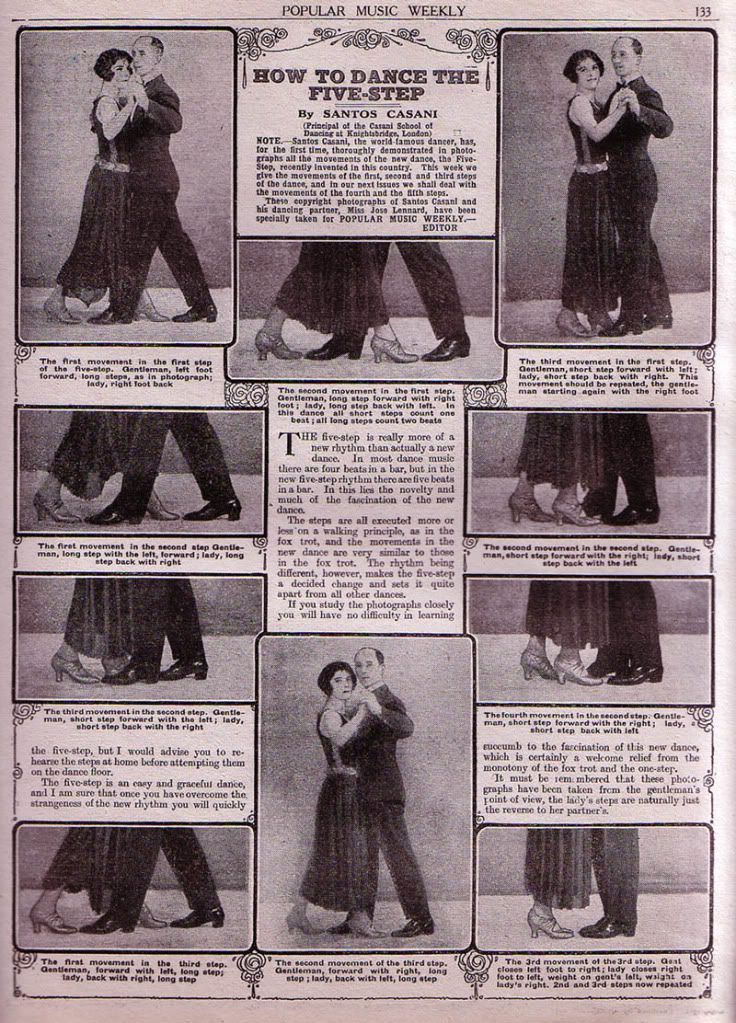
Here Casani makes an appearance in Popular Music and Dancing Weekly magazine, demonstrating the first three steps of the 'Five-Step' - steps four and five were published the following week, but unfortunately I don't have a copy of that issue (again, fashion buffs please note how remarkably long Miss Lennard's skirt was in 1924!):

"How to dance the Five-Step by Santos Casani" in Popular Music and Dancing Weekly, 7th June 1924, page 133 (click picture for a larger view).

In 1933 Casani opened his own nightclub in Imperial House, Regent Street, London and British Pathé was there to record it.

If you were to try to imagine a high-tone 1930s nightclub in the West End of London his establishment lives up to your Art Deco dreams, and this film includes footage of the renowned house band lead by pianist Charlie Kunz, a swimsuit fashion parade, an elegant rendering of the waltz by Mr Casani himself, not to mention a novelty song and a curious female contortionist. Pour yourself into a backless satin dress, shake up a cocktail and join in the fun:

LONDON'S FAMOUS CLUBS AND CABARETS NO. 10 - CASANI'S CLUB


Unlike his near contemporary Victor Silvester, Santos Casani failed to secure himself a place in dance posterity and his name is probably unknown to most people nowadays. But he was clearly a significant figure in his time - a suave, elegant man who knew how to work the media for maximum attention. In his prime, he was Mr Dance, and I'd like to salute his memory.

If you would like to see more of Santos Casani in action, there's plenty more films for you to enjoy.

Thursday, 4 February 2010

Fashion rations

Even during the dark years of the Second World War, and the long years of clothing rationing that followed it, women were expected to keep up appearances. "England's number one glamour girl" Joan Richards, a professional model, doesn't disappoint in this 1944 film where we follow Joan through a "routine day's work." From getting up in the morning with full slap (apologies to US readers - slap = makeup) and immaculate hair, through her long and busy day, she is the epitome of 1940s chic. By the way, these film links have come up as black boxes, but they will work if you click on them.

ANNE EDWARDS (aka GLAMOUR GIRL)


However, not every woman met the grade. This amusing short from September 1946 features the "Pathé Pictorial Fashion Expert" Mr Richard Buzzvine (at least, that what his name sounds like) lurking self-consciously with a newspaper on Regent Street as he casts a waspishly critical eye over young women's outfits. Although his voice isn't heard, the narrator reports his merciless judgements.

Mr Buzzvine is very hard to please, and only one girl meets with his approval, although its hard to see how she is much different from the other 'failures.' Its a useful reminder of how fraught getting dressed used to be, with all kinds of complicated rules and conventions governing what was - and was not - appropriate wear.

RIGHT AND WRONG IN FASHION

Sunday, 24 January 2010

Endorsed by Madame Schiaparelli

The fashion designer Elsa Schiaparelli presents an interesting contrast to Gabrielle 'Coco' Chanel - they were reportedly bitter rivals during the 1930s when Schiaparelli was in her prime.

Chanel, a determined social climber, was desperate to shake off the stigma of her poverty-stricken origins, whereas Schiaparelli was born into privilege as the daughter of aristocratic parents.

Chanel introduced a luxurious simplicity and practicality into high fashion, and was skilled with a needle, having trained and worked as a seamstress in her early years, whereas Schiaparelli had no formal fashion or dressmaking training but was gifted with a talent for adventurous innovation, stimulated and enhanced by her close personal association and collaboration with some of the leading avant-garde artists of her day.

There's plenty of information online (and in good, old-fashioned books!) about the careers of both designers, so there's no need to repeat it here. What interests me right now is some print evidence of Schiaparelli's commercial collaborations with two manufacturers, which perhaps present another interesting contrast with Chanel. I would have to do much more detailed research to discover if Schiap (her nickname - pronounced 'Skap') was unusual in this respect - its too late to venture to the library right now, and I'm keen to post this sooner rather than later so please forgive the lack of comparative evidence from other designers.

This 1936 advertisement for Lightning Coloured Plastic Zipp Fasteners below (manufactured by Imperial Chemical Industries - the still mighty ICI) proudly displays a brown wool dress designed by Schiaparelli with a very prominent zip running down the centre front. Dilys E. Blum, in her book Shocking: The Art and Fashion of Elsa Schiaparelli, notes that Harry Houghton, of the Canadian division of the Lightning Fastener Company had offered Schiaparelli £10,000 to use their recently developed coloured plastic zips in her clothing in 1933.

She obviously needed no further encouragement. According to most sources, Schiaparelli was the first Parisian couturier to utilise zip fasteners - indeed, to make a prominent design feature of them rather than hide them away as most functional clothing fasteners were by convention. (Apart from buttons, of course, which have been a handy way to display wealth and taste for some time).

Anyway, back to the advertisement. This conspicuous zip adds a considerable sexual charge to what is ostensibly a rather modest garment. Remember, zips are very easy and quick to open, and this dress flaunts its ability to be opened from top to bottom in seconds flat.

The juxtoposition of the model with a classical Greek-looking nude sculpture serves to underline this subliminal message, while at the same time adding a shrewdly judged gloss of 'culture' and prestige. This ad, although it doesn't look like it at first glance, was a pretty challenging and provocative proposition for the mid 1930s:

Lightning Zipp advertisement from (British) Vogue, 14th October 1936, page 19.

In her autobiography, which alternates disconcertingly between the first and third person, Schiap makes no mention of her lucrative promotional deal with Lightning Zipps but does describe the impact her use of zips made when first presented in a collection of hers. This was actually the August launch of her Winter 1935-36 collection, although this is not stated in the text:
. . . what upset the poor, breathless reporters most were the zips. Not only did they appear for the first time but in the most unexpected places, even on evening clothes. The whole collection was full of them. Astounded buyers bought and bought. They had come prepared for every kind of strange button. Indeed these had been the signature of the house. But they were not prepared for zips. They grasped the significance of the new trend even more than Schiap, and they bought and bought . . .
She must have been delighted with the overflowing order books, but then found herself facing an unanticipated problem:
On delivery day, however, our telephone started to ring viciously, and the desperate voices of all the commissionaires were raised to a pitch of indignation.
"The dresses cannot be shipped."
For some peculiar reason, still unknown to me, there was some agreement or contract between France and America whereby zippers could not be imported. Cables and radio-telephone calls were exchanged across the Atlantic and the zipper controversy reached the size of a political issue. After a few days of hair-tearing and supreme exhaustion, the zipper dresses were at last allowed into America, and ever since, like Columbus, they have remained unchallenged.
Blum records that on July 18th 1936, "The U.S. duty on imported zippers increase[d] from 45 per cent to 66 per cent, threatening to delay the export of Schiaparelli's collection."

Perhaps it was this difficulty that led Schiap, as the V&A explains, to use different zip companies depending on where her garments were to be sold: "In London she used zips from the Lightening Fastener Company of Great Britain, in Paris she used zips made by Éclair and for export to the USA, Hookless Fastener Company zips produced in the USA."

By the following year, the Lightning Zipp campaign featured more conventional illustrations of Schiaparelli's designs in a fashion show setting:

Lightning Zipp advertisement from (British) Vogue, 14th April 1937, p.65.

The copy reads:
Zipps on day suits, on evening gowns, on cocktail trouser suits. Zipps at front, side or back, in every colour of the rainbow, matching, contrasting . . . always decorative, always practical. Schiaparelli has made plastic zipps a feature of her recent collections, and continues - as do other leading couturiers - to use them for fashion fastening.
By August 1937, a subsequent Lightning Zipp ad makes no mention of Schiaparelli so perhaps that deal had run its course. However, Schiap had plenty of other irons in the fire.

As early as 1929, Schiaparelli had licensed her designs for reproduction by ready-to-wear companies and paper pattern manufacturers in America. Her fascination with textiles, and especially new developments in synthetic fibres, led her to collaborate with a number of manufacturers including Bianchini, Colcombet and Ducharne. She could see interesting textural potential even in test fabrics dismissed as 'mistakes' by their producers and was responsible for popularising a number of innovative new materials, including rayon crêpes.

During the early 1930s she endorsed a number of American-produced fabrics, not to mention hosiery and shoes, seeing these collaborations as a valuable way to develop and enhance her profile in that vast and lucrative market. But she also had strong connections with Great Britain - she regarded the country as her second home - and loved British textiles such as Scottish tweeds.

In November 1936, the British textile manufacturer William Hollins & Co. launched its new range of thirty-six 'Schiaparelli Viyella Fashion Fabrics' made of a blend of cotton and wool. She was credited with making this rather prosaic and workaday fabric fashionable, and in this following sequence of advertisements it is clear that she had some fun with this commission:

Viyella/Schiaparelli advertisement from (British) Vogue, 22nd April 1937, pp.58-59.

In this ad from April 1937, the layout makes a playful reference to pageantry, with heraldic motifs such as the shield, the crown and the ribbon. And the copy makes this explicit:
Schiaparelli herself has styled the new 'Viyella' Fashion Fabrics for this smartest, most colourful, most romantic of seasons. Bright challenging colours and subtle elusive shades. Novelty weaves. Checks, spots, stripes, and designs of entirely new character. A special heavier weight 'Viyella' for tailored suits and dresses.
A pageant of fabrics for a season of pageantry.
The Schiaparelli model photographed opposite is one of many 'Viyella' models in her latest collection, and she is featuring the new 'Viyella' Fashion Fabrics in her Paris Sportshop. These very same fabrics are now in all the shops for you to choose from . . . for that extra frock, that extra suit for this exciting season.
This was a coronation year (not Edward, ahem - he preferred a gilded and comfortable exile with his American divorcée - but his quiet brother George) so that explains all the pageantry.

Incidentally, a pasted-over addendum reluctantly adds the news of a price increase for these fabrics, from 4/11 to 5/11 per yard (in today's money, from £11.82 to £14.22, thanks Measuring Worth!)

The mannequin's curiously pointed knit hat makes her look like a chess piece, which is a happy coincidence when we consider the next advertisement, from November 1937:

Viyella/Schiaparelli advertisement in (British) Vogue, 10th November 1937, pp.18-19.

In this case, the theme isn't exactly chess, but Alice in Wonderland:
When I said "Check!" you purred!" said Alice (Through the Looking-glass) to her kitten - and when you see the new Schiaparelli-designed 'Viyellas' you'll react much like the kitten. Here are checks indeed! Unexpected, out-of-the-ordinary checks, the kind that make glorious little tops of two-pieces, spruce tailored frocks, swagger 'cow-boy' shirts, and so on. Crowds of other patterns too, embroidered spots and tricky little stripes - all in original, becoming fashionable colour schemes. The lovely blending plains are also important - Schiaparelli has used two of them for her superbly moulded jacket-blouse and skirt photographed here - Bright Rust (No. 8358) over Good Earth Brown (No. 6843). Both 'Viyella' Thirty-Sixes. Both in the shops now!
I have a fondness for old-fashioned advertising spiel, so forgive me for drafting all this text. Its wonderful!

The next ad, from September 1938, startled me because it looks as if it dates from nearly twenty years later:

Viyella/Schiaparelli advertisement in (British) Vogue, 7th September 1938, p.9.

I'd love to know if these fabrics were indeed "Unshrinkable. Fadeless" as the copy proudly declares. Are there any Schiaparelli collectors out there with examples of her late 30s sportswear who can verify this claim?

This last ad, from November 1938, looks more of its time, featuring a three-quarter length swagger coat and a wonderful 'up' hairdo of a kind that would remain in favour throughout the 1940s:

Viyella/Schiaparelli advertisement in (British) Vogue, 2nd November 1938, p.20.

Plus it has scotty dogs, which is always a good thing in my book.

Schiaparelli was obviously a very shrewd businesswoman, as well as an inspired designer, who had no snobbishly bourgeois scruples about entering into business deals with those who might be considered a little too populist - a little too 'mass market' - for an elite Parisian couturier to associate his or her name with.

As I've stated earlier, I really do have no idea to what extent other contemporary couturiers - such as Chanel - dipped their toes into that mass market (and I'm aware of her perfumes - this is a different degree of diffusion), but I will explain that I gathered these advertisements while scouring through the Gallery of Costume's bound collection of British Vogues. I noticed that no other couturier featured in ads of this kind during the 1930s. Perhaps if I had leafed through the American Vogues, I might have discovered a different story . . .

The two couture giants faced very different fates after the Second World War. Schiaparelli found herself out of step with fashion and finally closed her business in 1954 - the same year that Chanel emerged from her exile in Switzerland to relaunch her salon to widespread international acclaim (I understand that it wasn't the French who were cheering - they remembered her cosy intimacy with the Nazis too well).

As a result Chanel secured her place among the fashion immortals and her house endures, its status revived and maintained by Karl Lagerfeld. Schiap is hardly forgotten, but she gradually recedes back in time as a respected and revered figure too closely associated with her prime years in the 1930s to be considered relevant today.

And to finish, a charming short promotional film for cotton knitting yarns from the mid 1930s, which might not seem to have anything to do with Schiaparelli. You'll just have to watch it to the very end to understand why it is here:

PARIS MODES - (AKA COATS COTTON FILM)


Additional notes

Information was gathered from two books which I would recommend as essential if you have any interest in Schiaparelli -

Elsa Schiaparelli (recently republished by the V&A) Shocking Life: The Autobiography of Elsa Schiaparelli.

Dilys E. Blum, Shocking: The Art and Fashion of Elsa Schiaparelli.

Sunday, 17 January 2010

The elusive fashion designer caught on film

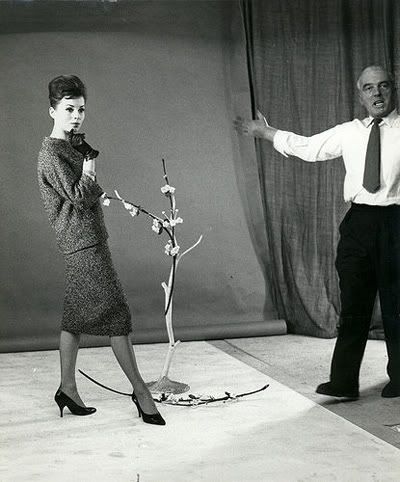
1950s fashion shoot, originally uploaded by Trevira.

What is going on here? Its impossible to know for sure, but I like to speculate that its the fashion designer emerging from the shadows to express his robust opinion about the photoshoot (and perhaps the merits or otherwise of the photographer), just as the shutter clicks.

Although this is a generalisation, for the most part fashion designers weren't always the recognisable public figures they are today. Most people - even those with little interest in fashion - will be able to summon up a mental image of designers such as Karl Lagerfeld, Donatella Versace, John Galliano and Vivienne Westwood, partly because each has a very distinctive style and self-presentation that is instantly recognisable. But also because there is simply much more media out there now, and designers are expected to take part in the publicity machine in a way that just wasn't the case in previous decades.

However, the famous Parisian couturier Paul Poiret was decades ahead of his time, being a hugely accomplished self-publicist. His lavishly decadent costume parties were widely covered in the press, and his larger-than-life persona informed, and fed back into, the perception of his couture house. Poiret was about ostentation, exoticism, a romantic and picturesque kind of modernity and a challenge to conventions (let's not forget that he was credited with freeing women from the corset, which might or might not be true, but anyway).

This precious short film supposedly shows Poiret arriving from Paris at Hounslow airport with two of his mannequins (models), probably another stunt to attract the press since this would have been an appealing novelty item. In fact, it is Poiret himself who runs to greet the plane (look closely at that first figure to appear as it taxis to a halt), and help his models out of it, so perhaps he had arrived earlier:

PARIS FASHIONS BY AIR


There's no date given for this film, so I'm guessing early 1920s, by which time his house was already in terminal decline and, sadly, would close in 1929.


Leaping forward at least a decade, this delightful film from 1938 features the Greek-born Parisian couturier Jean Dessès, who had opened his couture house only the year before. We are invited into his busy workroom, and the salon where a fashion show is being presented. M. Dessès is shown creating a gown on a live model, and there's a painful pun by the perky narrator ("gauze and effect"!):

FASHION COMES TO PARIS!


Jean Dessès is little known these days, and the name Olive O'Neill will probably mean even less to most people. She was, in fact, a very important figure in the development of ready-to-wear clothing in Britain.

Born in Southport, she came to work for the fledgling brand Dorville in London in the 1920s, where she began designing classic and elegant clothes to supplement their primary knitwear line. Having set up her own factory, she studied and adopted American methods of manufacture, grading and sizing, and visited America every year to keep up with new developments. O'Neill was an innovator in textiles too, co-operating with fabric manufacturers to produce exclusive materials and designs. (This information was gathered from Elizabeth Ewing's History of 20th Century Fashion).

This great short film shows the creation of a new dress, from Olive O'Neill's rapid sketch to the final product. Although far less glamorous than the previous film - it was shot in the last months of the Second World War, mind you - it is a fascinating glimpse of a forgotten designer:

INEXPENSIVE DRESS


Returning to glamour and glitz, Christian Dior was perhaps the most famous designer of the 1950s. Find yourself a seat in the Savoy Hotel, London and join the well-heeled guests (including British designer Norman Hartnell) for a very exclusive fashion show from 1950:

DIOR 'CIRCUS' COMES TO TOWN


I'm charmed by M. Dior's expression - he looks captivated, like he's seeing his creations for the first time. Incidentally, that £500 gown would cost you about £12,835 in today's money (thanks to Measuring Worth for that calculation).


Another Paris luminary, and a personal favourite of mine, is Elsa Schiaparelli. This is the only film I could find of her on the British Pathé website. She is seen at a Dublin fashion show in 1953, admiring the Irish fashions on display. Sadly her own business was in trouble at this time, and was closed the following year:

AN TOSTAL FASHIONS PARADE


Last up is this clip from 1958 of a young Yves Saint Laurent presenting his collection for Dior at Blenheim Palace. Princess Margaret presides, and looks completely in her element!:

'DIOR' COMES TO BLENHEIM

Thursday, 7 January 2010

Snow fatigue


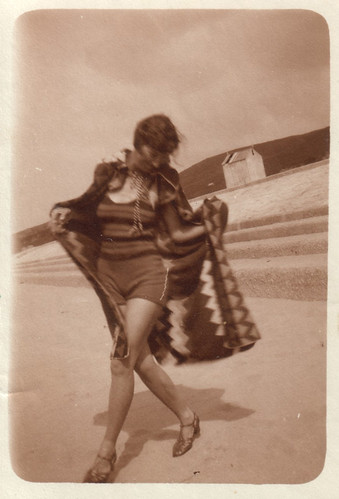
20s beach girl, originally uploaded by Trevira.

We've had some extraordinarily wintery weather this winter in the UK. The media is full of 'snow chaos' stories, and our local supermarket has empty shelves where the milk should be.

Snow is a fun novelty in this country for a day or two, but after that it gets a little tiresome. Unusually, instead of a rapid thaw within a few days, the temperatures have stayed around or below freezing (-16º C in Manchester last night!) and its become dangerous to even venture to the Post Office around the corner. I'd make better progress with skates rather than my wellies - the only footwear I have with any kind of tread on them.

My room overlooks our suburban street, where the snow has been compacted and polished by traffic into solid ice with a treacherous, glassy sheen, and I've lost count of the cars I've seen losing traction and veering sideways as they struggle to ascend the (very low) incline of the road. The eery whine of wheel-spinning has punctuated my day.

So as a respite from the continuing freeze, I'd like to seek refuge in contemplating the picture above, which is one of my favourites from my collection of old photographs and dates from the 1920s.

Its a reminder of better days - and weather - and a cheery evocation of that carefree summer holiday feeling. To me, every element of this picture is perfect, including the dizzily skewed horizon. Looking at it makes me feel happy and warm, and I hope it works its magic for you too.