
That clip is at the very end of this British Pathé dance instruction film (incidentally, fashion history buffs will be delighted by Miss Jose Lennard's lower back skirt hem - a major trend in the last years of the 1920s):
THE FLAT CHARLESTON MADE EASY
The stunt was intended to demonstrate that the new 'flat' Charleston required very little space, in contrast to its original, wild form, which was a veritable whirlwind of flying heels and arms, presenting considerable danger to nearby dancers. Indeed the Charleston was banned from many dancehalls at the time.
It is ironic that this clip is now employed to symbolise the reckless, risk-taking, devil-may-care nature of the times when its original intention was actually quite the opposite.
While I could easily (and quite happily) go on about the Charleston, this post concerns the man who appeared in that film, the famous dance master - and energetic self-publicist - Santos Casani.
Mr Casani was the proprietor of "the largest school of dancing in England," wrote a column for the Daily Mail, and made numerous short dance instruction films for British Pathé's cinemagazine for women, Eve's Film Review. The film company supplied free instruction leaflets based on the dance steps Casani featured, which viewers could send off for, and as a demonstration of how popular these films were, on one occasion they had to print 20,000 leaflets to satisfy the demand (most of this information is derived from Jenny Hammerton's fascinating book For Ladies Only? Eve's Film Review Pathé Cinemagazine 1921-1933).
As an aside, its lovely to imagine a cinema audience practising dance steps under their seats as they watch the films!
Here Casani makes an appearance in Popular Music and Dancing Weekly magazine, demonstrating the first three steps of the 'Five-Step' - steps four and five were published the following week, but unfortunately I don't have a copy of that issue (again, fashion buffs please note how remarkably long Miss Lennard's skirt was in 1924!):
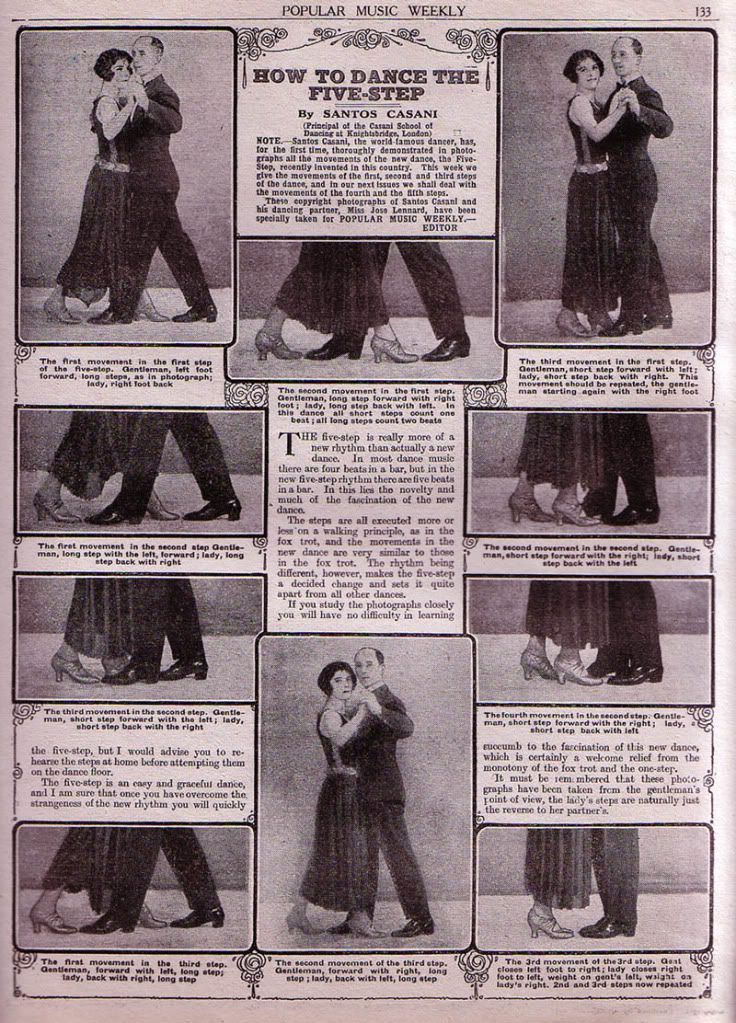 "How to dance the Five-Step by Santos Casani" in Popular Music and Dancing Weekly, 7th June 1924, page 133 (click picture for a larger view).
 In 1933 Casani opened his own nightclub in Imperial House, Regent Street, London and British Pathé was there to record it.
If you were to try to imagine a high-tone 1930s nightclub in the West End of London his establishment lives up to your Art Deco dreams, and this film includes footage of the renowned house band lead by pianist Charlie Kunz, a swimsuit fashion parade, an elegant rendering of the waltz by Mr Casani himself, not to mention a novelty song and a curious female contortionist. Pour yourself into a backless satin dress, shake up a cocktail and join in the fun:
LONDON'S FAMOUS CLUBS AND CABARETS NO. 10 - CASANI'S CLUB
Unlike his near contemporary Victor Silvester, Santos Casani failed to secure himself a place in dance posterity and his name is probably unknown to most people nowadays. But he was clearly a significant figure in his time - a suave, elegant man who knew how to work the media for maximum attention. In his prime, he was Mr Dance, and I'd like to salute his memory.
If you would like to see more of Santos Casani in action, there's plenty more films for you to enjoy.








13 comments:
Great post! I hadn't come across Mr Casani before. I wonder why he failed to secure himself a place in dance posterity with all his connections in the media?
It's also interesting you mention the length of the dress from the photos taken in 1924. You'd expect a knee-length frock, not lest because she's supposed to be demonstrating a dance routine. Strange!
Thanks for sharing. Loved the film reels too.
Thanks Louise! I'd love to find out more about Casani, and he's on my list of 'future research projects.'
Victor Silvester, his rival, worked his way up the dance establishment, and he was also a hugely successful band leader, released records with his famous 'strict tempo.' He ended up with an OBE - who knows what happened to Casani?!
Skirt lengths are fascinating aren't they? Knee length skirts (for evening) didn't appear until 1925, and it is surprising how long some of the early 20s ones are. For the kind of demure and restrained dancing Miss Lennard was demonstrating, I'm sure it wasn't too long.
I've always wondered about that top of the auto scene. I love how it is just a small part of a dance instruction clip!
People do have a bit of a misconception about 1920s skirt lengths. The hemline went up and down from 1918 until it did finally reach the knee in '25. And as you said, the dress in the film shows how just 2 years later, the hem was starting to drop, if only in the back!
I wish I could think of a better description than 'lower back skirt hem' - that's so clunky!
Yes, it was a major trend and I have a 1930s article somewhere written by a dancer who said she loved that style for dancing in, but apparently men weren't so keen on it!
Wonderful to discover this gem. My uncle, who died in 2003 and his wife before that, competed and taught ballroom dancing last century. I was bequeathed his trophies and medals, one of which is a silver medal, the Santos Casani Medal of Merit for Ballroom Dancing. What a tresure!
Janet
Santos Casani, lived out his life in
Montagu Mansions Baker Street , London
HE WAS ABOUT 90 years old.
He liced with Josie. who lost a leg
in later life. They danced the charleston on top of a taxi over waterloo bridge London in 1922.
Its so nice to see all this about Santos. He was one of my great great uncles. An incredible and lovely man so i've been told by members of my family who knew him well. He did so much other than dance, he was in the Royal Flying Corps in the first world war he was also close friends with Billy Butlin, founder of Butlins holiday camps (they were both born in South Africa) I've seen photos of him at London zoo as i believe he donated money to them and helped build some enclosures? There's one photo of him holding a leopard anyway, still quite impressive. He was also an actor.
I'm not sure about Josie but i believe she either lost her leg in the blitz or it got infected i will have to find out more. He was extremely professional but had a heart of gold apparently but i think he lost most of his fortune just before he died in the 60's or 70's. Shame really as he would have been quite an interesting character to talk to!
I was a child when I first met mr casino we lived near montage mansions his wife used to give myself and my friend maths lessons in school holidays and they both used to take us to th pictures in Baker Street ,they did not have any children and used to make such a fuss of us they were such nice people at the time being so young we did not know how famous he was ,she used to make lovely cakes and lemonade I have just seen this site .i used to live in spring mews opposite montage mansions ,also lived there names from the past .peggy mount Pete Murray Laurence Naismith and a lady called Beecham she had a party for the Beatles and my mother helped out at the party and I have a photo of her and George harrison
Sorry that should have been mr Casani have to excuse me ( 71 years old )
I have a signed photograph of Santos Casani which was given to my mother who was a pupil at his dance school.It is signed 1927 or could be 1922, his writing is a little difficult to understand. Is anyone interested ? Rosa Playford
Santos Casani went bankrupt at the end of the 1930s when he overstretched himself - the Casani Club and a club at Firbeck Hall in Yorkshire. He married to Joan Tinley and sadly she lost a leg in the blitz. He served in India during the latter part of WW2 focusing his work on soldiers welfare. By 1945 he was an executive of Butlins and wrote a report advising on leave camps for soldiers in the Indian theatre. Casani was badly injured when a pile of sandbags fell on him. After the war in the UK he lived in a sort of quiet obscurity, but even so often he appears in the newspapers. He was mugged in 1948, but fought off his attackers. He had a role with the Rank Organisation advising on dance halls. He was occasionally remembered in newspaper columns and even featured in a 1955 Pathe documentary film that recalled the 1920s. He was often recorded as a bit of an eccentric in the later years - known for walking his budgie in the park for instance. He died in 1983, Joan died in 1989. They had no children. His effects - medals, etc - were sold off.
And now the weird bit. I believe Santos Casani was the original person who appeared in the photo used at the end of the 1980 movie The Shining. The original photo was altered and Jack Nicholson's face was pasted on by a photo retoucher, but the original photo shows Casani - or that's what I think. Now trying to prove it.
You are correct. It was Santos (born John Golman...) Interesting, eh?
I wish his relative would get in touch.
Post a Comment