Saturday, 17 April 2010

That Tinling feeling

Advertisement for Teddy Tinling's salon from Vogue, 14th April 1937, page 120.  From the Gallery of Costume, Manchester. 

What a singular character Teddy Tinling was!  The opening line of the Wikipedia entry I just linked to does a great job of indicating as much, in its customary dry and succinct manner: "[Teddy Tinling] was an English tennis player, fashion designer, spy and author."  As a career resumé, that one is pretty hard to beat. Plus he was "openly gay" in the days when that was hardly a safe option.

These days people might recall the frilly knickers he created for the American tennis player Gertrude 'Gorgeous Gussie' Moran in 1949, and the kerfuffle those provocative undergarments caused in the media. 

Tinling made his name creating expertly tailored and glamorous tennis wear for many of the star players of his day, but his career in the rag trade began much earlier in 1931 when he opened a salon in South Kensington, London, specialising in wedding and evening gowns for the "carriage trade."  This was evidently successful because by 1937, when his nicely surreal advertisement (above) appeared in Vogue, he was plying his trade in the much posher environs of Mayfair. 

The Second World War interrupted his fashion career and prompted his drastic career switch to spying for the British Intelligence Corps.  I'm sure there's lots of interesting material about his wartime adventures, but sadly they don't appear to be online so I shall press on regardless. 

Shortages of luxury fabrics after the war saw the ever-pragmatic Tinling turning to the growing market of sportswear . . . actually this is all very well documented in the links I've added so I'm going to cut straight to my point and spare you the painful paraphrasing. 

Teddy's tennis wear suggests a fondness for flamboyance, which is certainly borne out in the British Pathé film archive.  The swelle life blog has a fabulous post about one of those films so I won't repeat it here (please visit that link to enjoy it, and don't miss this post about his tennis gear too). 

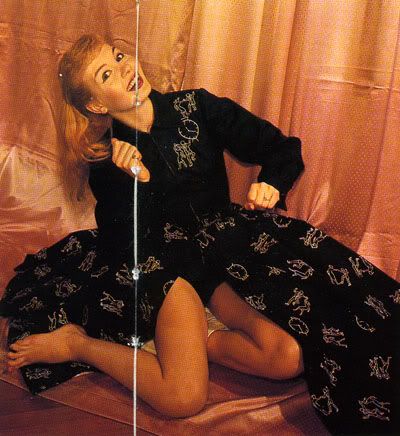
Here's more evidence.  He embraced rock'n'roll with some delightful garments for teenage fans:

"Clothes specially designed for Rock'n'Roll enthusiasts by Teddy Tinling, 1957."  From Frances Kennett (1983) The Collector's Book of Twentieth Century Fashion, London: Book Club Associates, pp. 88-89.  (Apologies for the book binding cutting through the picture - I'm not skilled, or indeed patient, enough to erase that). 

I'm really enjoying that print of clocks and jiving couples (no doubt a reference to Bill Haley's "Rock Around the Clock")

The elfin model Elizabeth Duke can also be seen modelling some "Jive Fashions" possibly from the same collection (Tinling trousers with a heart-shaped pocket printed with the immortal British rocker Tommy Steele) right here. 

Its clear that Teddy Tinling's gift for tailoring glamorous but practical tennis wear was readily transferable to the demands of energetically jiving rock'n'rollers.  Sadly there appears to be no film footage of his teen-rock'n'roll clothing available. 

But there's plenty more camp fashion delights to be found, especially at my favourite resort for vintage footage, British Pathé.  And this is one of the best, a 1958 film of Tinling's leisure fashions inspired by souvenirs from his holidays:   

TEDDY TINLING HOLIDAY FASHIONS


And this short film from 1955 features both his tennis and leisure wear:

BEACH AND TENNIS WEAR


And I'm going to have to include Tinling's spectacular South Pacific fashion show, as featured in the swelle life blog, just so you don't miss it:

TEDDY TINLING FASHIONS


Teddy Tinling's exuberant style has quite won me over.  I only wish that there was more information available about his fashion adventures, rather than just his tennis wear (as admirable as it was).  If anyone can offer any further information about this I would be overjoyed.  All I can say is that I've never come across a single garment with his label on it, and live in hope that I might - someday.

Thursday, 1 April 2010

My April Fool

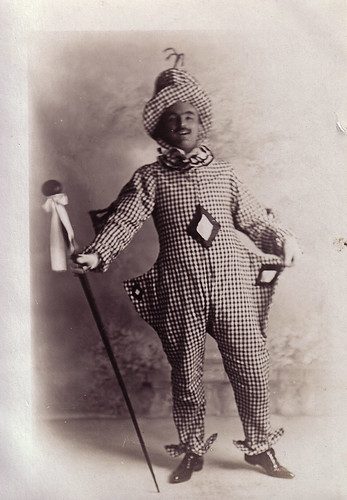
gingham man, originally uploaded by Trevira.

In celebration of today's tradition of ruining someone else's morning with a prank* here's an authentic April Fool for you.** 

He certainly looks as if he's up to no good, and the criminal use of one of my favourite fabrics - gingham - only adds to the offence. 

Let this serve as a warning to you.  Be on your guard for strange men in crazy gingham outfits today because its likely they will be planning some very unfunny practical joke to inflict on you.  They have until 12 pm, so you should be able to relax after that time (everyone knows that April Fool 'jokes' committed after midday mean that the joke's on them, although that's no consolation).

* Can you tell that I'm not a fan of practical jokes?

** This is a complete lie.  I've no idea if this man is an April Fool - its an old photograph, possibly dating from the 1910s, which seemed appropriate for the day.  My sincere apologies for any distress or trauma it may have caused you.

Wednesday, 31 March 2010

Daffodils and memories

1940s lady - hand tinted photograph, originally uploaded by Trevira.  

This beautiful photograph is a hand tinted 8x10 dating from the 1940s, possibly during the Second World War.  A very stylish and attractive woman sits in a picturesque country setting, surrounded by daffodils.  She looks so happy. 

Its only when you turn it over that this photograph zaps you with something quite unexpected and moving.  On the back is written: "Looking at this now - I realise I was carrying my daughter - how I wish those times could have given me the courage to ignore the moral issues and let nature take its course." 

Suddenly its hard to look at that picture in quite the same way.  I imagine this woman was going through her photographs some years later and felt the need to record her regret at the loss of her daughter, perhaps for herself or for her family.  Or just to memorialise her child.  Her daughter was there in that photograph, only we couldn't know that by just looking at the picture, and neither did she at the time. 

I found this photograph among a whole boxful from the same family, and bought as many as I could afford.  Its clear that they later had a son whom they doted on, and enjoyed many happy times and holidays together as a family.  I would like to add some more pictures of the family here, or at least links to them, but trying to do both things resulted in me losing all the text I had written in a mass of tangled HTML.  So I daren't! 

Shuffling through the pictures you would assume this was a very happy family living a very uncomplicated and picture perfect life, but that little note is a sharp reminder that things aren't always that straightforward. 

Monday, 22 March 2010

Ossie Clark in motion

Ossie's sketch of ruffled chiffon dress with tie neck, c. 1968-9, from Judith Watt, Ossie Clark 1965-74, page 79.

Ossie Clark's fashion shows have become the stuff of legend. According to Ossie's long-term friend from his student days, Norman Bain:
These were the first fashion shows that were like happenings, pop concerts and theatre. The feeling was that of a Parisian salon: everybody was there together, writers, artists, actors, dancers. (Quoted in Ossie Clark 1965-74 by Judith Watt).
Excitingly, British Pathé has three films of Ossie Clark and Alice Pollock's early fashion shows from 1968 and 1969. Alice Pollock was a fellow designer and owner of the Quorum boutique where Ossie became her business partner, and she should not be overlooked!

The earliest film has an issue date of 25 January 1968 so its quite possible it was shot in late 1967.

It starts with a fashion show at Maxim's in Paris 'by' Elizabeth Taylor, who, the narrator declares, was planning to open her own boutique there with Richard Burton. The narrator notes that this was "Mia Vicki's collection with several numbers dreamed up by Elizabeth Taylor." (I've found a couple of brief references online to 'Mia & Vicki' with no useful information).

The rather gauche sexiness of the designs is underlined by Richard Burton's approving comment "at last girls look like girls." This was fashion explicitly intended to appeal to men.

This show presents an interesting contrast with the Ossie Clark and Alice Pollock fashion show that follows it, as the commentary notes: "It seems that minis are in for a knock from maxis, from the bare truth to keeping the guys guessing." The glib narration has hit on a crucial point - Ossie Clark and Alice Pollock designed for women, not simply to make women more appealing to men.

Of course there's sexiness - sheer chiffons worn without underwear and the odd flash of a breast (sorry, maybe that's the next film, stay tuned!), - but these were garments that didn't beg for male attention and approval but kept the power and sexual autonomy with the wearer. I'm sure that only a small minority of their customers opted to wear those more revealing numbers as they were shown on the catwalk, but it was up to the customer how much they bared, which was hardly possible with the cutaway swimsuits in Liz Taylor's show.

See what you think:

FASHION SHOWS


Judith Watt notes that:
The show at the Revolution Club, just behind Berkeley Square in Mayfair, in 1968, saw Jimi Hendrix and the Rolling Stones in the audience. Patti Boyd, who only did runway shows for Quorum, wore a cream chiffon dress with a print of blue birds and irritated her husband, George Harrison, in the audience with the rest of the Beatles, by going bra-less. Cynthia Lennon was there too. (Ossie Clark 1965-74, page 84).
Well Cynthia certainly wasn't at the next Revolution fashion show - the following film is dated 11 August 1968 - because John Lennon is shown with his "friend" Yoko Ono, both looking equally bored. This might possibly be because Ossie's shows tended to run at least an hour or two later than billed, and I'm sure they were captivated once it actually started - as I hope you will be too:

'REVOLUTION' FASHION SHOW


Ossie Clark's own notes on this fashion show, written as a 'stream of consciousness' exercise in recall in 1988, are as follows:
'Revolution Number 9.' Pattie Boyd models show at the Revolution and in the press.
'Come on, mother! We're late,' - John Lennon with Yoko looking like a porcelain doll. Kay, Carol tells, a light fell over the stage, like fell over, and he steadied the chair she stepped on, JL. (The Ossie Clark Diaries, page lxiv).
Sadly, John Lennon's moment of gallantry wasn't captured by the newsreel cameras.

This last film is dated 15 May 1969 and consists of unused footage of a fashion show at the Chelsea Town Hall. Well actually, after several viewings I've worked out that there must be footage from another fashion show at another venue spliced in - watch out for the disappearing catwalk and change of decor.

I'll have to warn you that this has no soundtrack and lasts for about four minutes, but I find it mesmerising nonetheless:

( MODERN FASHION ON SHOW )


What is striking about all these fashion shows, among other things, is the charismatic personalities of the models. They all seem to be 'doing their own thing' as the now quaint 60s phrase has it. Some are live-wires, some are demure and some are theatrically vampish (indeed, some seem to be more than a bit stoned!)

You get a strong sense of a variety of distinct personalities rather than a sequence of clones stomping along like well-drilled soldiers in heels, as we're now accustomed to seeing these days.

And they were personalities, especially selected for their individual qualities and encouraged to express themselves as they saw fit - many became part of Ossie's intimate circle of friends and were valued for their character as much as their beauty.

I'll let Lady Henrietta Rous explain this more fully (she does it so well):
Ossie stated that he wanted 'to make a woman aware of her body', and in pursuit of this ideal he brought in a new style of model. They were no longer 'tall things that swayed at you as they walked down the cat walk,' but characters in their own right. Gala Mitchell, with her sculptural bone structure, big eyes and theatrical style, looked particularly good in leather jackets. Others who modelled were KariAnne Jagger (Mick's sister-in-law, whose captivating dances on the stage inspired the Hollies' song which begins "Hey Carrie-Anne, what's your name now, can anybody play?"); Amanda Lear (Salvador Dali's muse and as good a performer as KariAnne); and Lady Carina Fitzalan-Howard, daughter of the Duke of Norfolk, whom Alice had discovered walking down the street.
But perhaps what thrilled me most about seeing these films was the chance to see Ossie Clark's (and Alice Pollock's) clothes in motion.

As you can see most vividly from his sketch at the top of this post, he always thought in terms of how his clothes would work on the female body, and also in motion. Its a privilege to see them how they were intended to be seen.


A note on prices

The first film mentions a few ensembles and prices so I've used measuringworth.com to establish what they might cost (nearly) today:

The white leather suit named 'Daz,' priced at 25 guineas, would be approximately £341 at 2008 prices.

Patti Boyd's outfit called 'African Queen' at 9½ guineas, would be approximately £130 at 2008 prices.


References

Lady Henrietta Rous (ed.) (1998) The Ossie Clark Diaries: In Doze Days. London: Bloomsbury.

Judith Watt (2003) Ossie Clark 1965-1974. London: V&A Publications.

I'd also recommend:

Peter Schlesinger (2003) A Chequered Past: The 60's and 70's. London: Thames & Hudson. This book has some wonderfully candid photographs of many of Ossie's friends and favourite models, and is a visual and gossip-rich treat!

Wednesday, 17 March 2010

Spring is nearly sprung


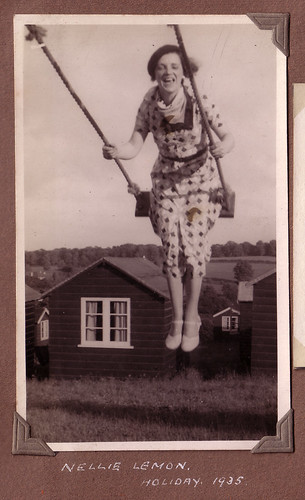
'Nellie Lemon holiday 1935', originally uploaded by Trevira.

There's been a spell of bright sunny weather recently, and the days suddenly seem to have grown that bit longer. Like most British people, I am obsessed with the weather and we tend to get unreasonably excited at any breaks in the cloud.

This sunshine immediately made me think of the picture above, which is easily one of my absolute favourites from my collection.

Meet Nellie Lemon enjoying her holiday at the South Devon Holiday Camp in Paignton, South Devon, sometime in 1935. Not only is she blessed with the most delightful name, but she is captured at the perfect point mid-swing, her face reflecting the simple bliss of simple pleasures. In the sunshine. On holiday.

Nellie's outfit - of a geometric diamond print dress worn with a scarf at the neck and a beret artfully angled to one side, and what might be white leather shoes punched with cooling holes on the vamp - is equally perfect.

I'd challenge any photographer to sum up the best of an English summertime any better than this, an amateur snapshot from 75 years ago. Even the backdrop, of neat little chalets backed by gently rolling hills and trees, is perfect.

Nellie's photograph is my image of what an ideal summer should be (I've overused 'perfect' so I can't possibly use it again!)

This picture comes from an album chock full of entertaining and arresting photographs. The star (and possibly the original owner/author) of it is a very handsome young man called Maurice, who definitely deserves a post of his own sometime.

I'm not sure that Nellie appears in any other photos apart from this one, but as far as I'm concerned she is the star today.

Sunday, 14 March 2010

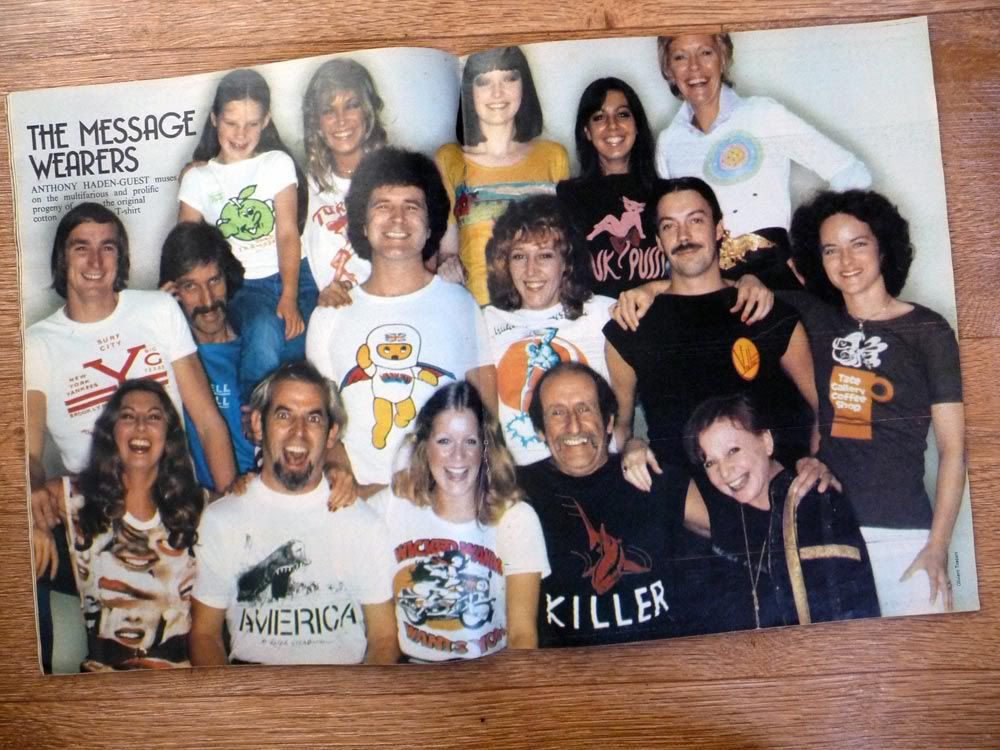
The Message Wearers


Photograph by Oliviero Toscani from the Sunday Telegraph Magazine, 5 December 1975. Original caption: "Got the message? Back row, from left: Helena Axbey wears a Scratch 'n' Sniff "smelly, £1.80; actress Prunella Gee plumps for Turners on the Strip; model Marianne Desnaux wears an embroidered shirt, £3 from Ace, Kings Road; model Nicki Debuse in Anthony Price's Pink Pussies shirt, £3.25 at Jean Machine; Princess Elizabeth Galitzine sports an Apicella design. Centre row, from left: Alan Pascoe in an original Mods shirt, £1.50 from Scott Lester; art director Geoff Axbey in a Bell telephone shirt, Don Grant in the Hesketh Racing shirt, £2.30; Diana Hyslop in a Marvel Comics number, £1.25; actor Tim Curry wears a Voltar T-shirt, £3.25; Sarah Fox-Pitt of the Tate Gallery in their Coffee Shop shirt, £1.50. Front: Marilyn Cole in a Lips shirt, £9 from Howie, Fulham Road; Ralph Steadman promoting his book; Penthouse Pet Val Mitchell; Enzo Apicella turns Killer for £3.25; Thea Porter wears a rare Yugoslav T-shirt."

This is terribly bad form for someone aspiring to write a blog, but this will be another post I haven't actually written myself.

When I lived in Brighton a few years ago, I came across a load of old 1970s Sunday supplement magazines scattered over the pavement near a paper recycling bin. Of course I had to take a look, and among them was a Sunday Telegraph Magazine from 1975 containing the following piece.

Its a wonderful report on the history and language of the t-shirt written by Anthony Haden-Guest with some great quotes from people involved in their design and production (such as Anthony Price) and some observations about t-shirts spotted out and about at the time that ring lots of bells for me.

I would have been nine in 1975, so I certainly wasn't in the market for the £9 Howies 'lips' t-shirt (about £56 in today's money, according to measuringworth.com) but I did have a scratch 'n' sniff t-shirt with a large strawberry on it - see little Helena in the picture above wearing an apple version - and I'm ridiculously pleased to see it featured in this article. That t-shirt, worn with some very wide C&A jeans with three buttons on each back pocket and two-inch deep turn-ups, and some no-brand canvas basketball boots, was my summer holiday uniform that year.

Enough of my memories, let's get to that article. This is a faithful transcription (I hope), and any emphasis/italicisation was in the original piece.


Anthony Haden-Guest, "The Message Wearers," Sunday Telegraph Magazine, 5 December 1975, pp. 36-40

Coco Chanel said it, and cannot be topped. "It doesn't matter how much it costs," observed Mademoiselle, "as long as it looks cheap." Quite so, and here, stepping through late sunlight down Sloane Street, come three girls. They are, all three of them, wearing T-shirts. The dark one, whom I know slightly, is wearing a ravelled item with the device of a Los Angeles radio station, and the shortish blonde is wearing something pink and frilly with shoulder straps (which does not iron out into that basic cotton T, but is one of the numerous descendants of the T-shirt nonetheless). And the tall girl, also blonde, is wearing a puce number with the following written on it, in italic script: This is not a T-shirt.

T-shirts. Words and images, swirling and swanning by. The banal and the opaque. The repetitive images - Marilyn, Mickey Mouse, Mao - merging with political slogans, holiday souvenirs, erotica, and the names of obscure American colleges. Household products jostle with rock groups. T-shirts urge love, make dreadful jokes, and communicate Christian names. The ordinary old stretch-cotton T-shirt has spawned a progeny of sequins, glitter, and - in at least one esoteric case - rubber. What started as just low-budget stuff has, unbeknown to itself, burgeoned into a . . . language.

It has, like all languages, its complexities. When Melody Bugner wears the I'm backing Joe Bugner T-shirt, executed to her own design, her message comes through loud and clear. So, too, when idolatrous garments are worn by the hirelings or fans of the Tate Gallery, Elton John, Marvel Comics, the BBC Proms, the Wombles or The Economist. Maria Schneider, the French actress, likewise demonstrates her respect for guitarist Eric Clapton by sporting his likeness, just as Charo, current wife of musician Xavier Cugat, sensibly wears her own. Elizabeth Taylor's message - I am not Elizabeth Taylor so please stop following me - was more complex. And what is one to make of the legend masochistically flaunted by fast bowler Dennis Lillee, Hit me for six?

Things are even less simple out in the streets. A Coca-Cola T-shirt seldom indicates that the wearer works for that corporation, but there are corporate T-shirts. A travel T-shirt - Bournemouth, say, or Bermuda - may mean, like a book of matches, that you have been there: or that you would like people to think you have been there, or that the idea of going there is a hilarious joke, or just that you like the image on the shirt.

Some people wear T-shirts because they have bad taste, and some to show what good taste they have by wearing bad taste, like rhinestone-studded images of Elvis Presley. That young man wearing an Ohio State University number is usually a Frenchman who would be hard put to it to locate Ohio on a map; but there is a chance he may actually have been at Ohio State. I assume that the T-shirts lettered Hermès, Vogue and Pierre Cardin are a street-satire, though I am not entirely certain; but I am certain that the shirts that have, at the bottom, a trompe l'oeil rendition of a Gucci belt is a joke, and quite a good one at that.

But what of that plumpish lady I once met who bore emblazoned across her frontage a line from a recent hit: Voulez-vous coucher avec moi ce soir? Ted Polhemus, the American author of a book on fashion-as-language, who was working until recently at London's Institute of Contemporary Arts, notes that "the interesting, and important thing about wearing T-shirts is how much unification of image there is in semiological terms. I saw a girl walking down London's King's Road wearing a T-shirt with people making love all over it. You know, one of those Tantric paintings. What can you say to a girl whose T-shirt shows that? You can't say anything, right? It's an anti-sexual gesture."

Semiology is, of course, the science of sign language, and Polhemus goes on to note that, vis-a-vis T-shirts, the signalling extends beyond the image. "Some people just can't wear T-shirts. They iron them. They always look new. T-shirts should have holes ripped in them. In fact, I used to run a service ripping holes in friends' T-shirts . . . "

It is, in a way, surprising that the language of T-shirts has been massively ignored by fashion historians. Oh yes, the fashion mags (especially the tabloids) do their stuff. But in the hard-cover tomes the T-shirt seldom rates a mention. One recent such I scanned runs from Tabard through every manner of Tricorne and Tunic to a Byzantine something called a Tzitsakson. But T-shirts? Never. The late, and usually commendable, James Laver noted with asperity that jeans and the T-shirt lead us to a world in which, as in Red China, all distinctions of class or sex would be abolished. Even Coco Chanel was, as they say, parlant d'autres choses.

Which is regrettable, because it is self-evident what T-shirts have become . . . Mass Couture.

There was nothing stylish about the T-shirt's origins, as the upper half of "combinations", but it was charged with a certain frisson. A bit, one imagines, like a blonde in undies; but also a bit like her shopping in curlers. It was this dual brutish aspect that was exploited by the inarticulate Marlon Brando, who, according to Cleveland Amory's International Celebrity Register, "made a torn T-shirt a symbol of virility". The film was A Streetcar Named Desire, the date was 1947, and it did not take long for the image to register; the undershirt to encroach on the shirt. It happened, inevitably, in California.

"It was an outgrowth of the Hot Rod culture," says Malcolm MacPherson, a London correspondent for Newsweek. "It was in the early Fifties. They stopped drag racing on the freeways, and guys were going to the Santa Ana airstrip. You'd see them wearing T-shirts with the names of, you know, automobiles."

The thing burgeoned. Britain was in one of its phases of acute Americanophilia, and the transatlantic passage of the T-shirt happened so. Marshall Lester, son-and-heir of Scott Lester, who manufactured flags and badges for retail stores, was doodling on a white vest. English, and in his early twenties, he was doodling things American, cities, cars and such, and getting some of them wrong ("Boneville" for Bonneville). But he had them printed and sent them for sale. Just to see.

A couple of days thereafter was the first of the Brighton Mods-and-Rockers riots. Marshall Lester watched it on television. The Mods were wearing his T-shirt. He saw.

Alan Conway, incidentally, a Lester associate, claims that the blood which was soon to be shed on such T-shirts inspired tie-dyeing. Arguable, though tie-dyeing was certainly the next Big Thing. Chester Martin, a doyen of the field, had managed to acquire a stockpile of the original three-button combination tops, and had them dyed in hip colours. They were to become a basic element in the uniform of another Sixties movement: The Hippies.

The advertisements-for-myself potential of the T-shirt was not overlooked by the Underground. T-shirts proclaiming love, peace, revolution and dope. Coca-Cola and Walt Disney were unamused to find their iconography metamorphosed into, say, Cocaine and Mickey Rat.

Visual inventiveness manifested itself here and there. Already in 1963 painter Allen Jones had produced what may have been the first colour-printed T-shirt. Mr Freedom was creating the first real up-market T-shirts; stylishly brassy pieces exploiting a largely American pop iconography of junk foods and comic strips. "We appreciated American stuff," notes designer Anthony Price, "and they didn't, until we had done it."

The mass merchandisers began to move in. Record companies tried to transform the uncommitted into fans with free T-shirts, and fans into mobile hoardings. "T-shirts really boomed in 1966," Alan Conway says. World Cup Willie: Carnaby Street: Swinging London souvenirs. "When the mass market got involved everything became very tatty," says T-shirt designer Peter Golding, "The quality was terrible". Alongside Swinging London, the British T-shirt waned.

But it never died. In spite of fashion journalists, like jeans, it was simply too useful to die. There has been growth, and diversification. At one end of the scale are Marshall Lester, the biggest, and bigger than most American firms, selling projected millions this year. At the other is a small group of designers, and they are bullish. "There's a rebirth," proclaims Peter Golding, "because it used to be you'd have to do millions, but now it's your custom tailoring. And you can do the very best, and it still shouldn't cost more than £10."

Or there is Malcolm McLaren of the shop formerly entitled Let It Rock, but now called Sex. McLaren has organised a small exhibition of his own T-shirts, including the aforementioned rubber one, and one covered with names of which the designer approves disapproves (your correspondent found himself in the latter category, sandwiched between Alan Brien and Playboy's London boss, Victor Lownes). Oh yes, and they come carefully pre-torn, or with weakened seams for tearing.

Contrariwise, Anthony Price, who has attracted attention for his Fifties T-shirt look, remarks, "My friends and I were into that James Dean stuff years ago. It's just that now it's commercial. I won't try and sell anything until two years after we're finished with it. It's just a matter of waiting until Mr Average is ready for it."

What is Mr, or Miss, Average ready for right now? "I think the days of being extreme are gone. People don't want to be looked at any more," says Price. And certainly the street look is now a less ornate one; a hearkening back to basic Americana. College shirts and football numerals. "After all that glitter," muses Andrew Bailey, former London Editor of Rolling Stone, now with Bell Records, "It's quite nice to look like a clean-cut college boy. Even if it's not a college you went to . . ."

And things to come? "Los Angeles is always first, and Paris," says John Dove of Wonder Workshop firmly (Dove has designed some splendidly garish pin-uppy designs). "London's bad-taste level is about one year behind. And Germany's bad-taste level is two years behind us. We sell a lot to them. Rock-n-roll stuff, and they're really into glitter. Next I think Pop is going to be coming back. I foresee a big revival."

Or, to be accurate, a revival of a revival. The T-shirt has accumulated a history. "I still wear my 1973 Rolling Stones Tour T-shirt," says Andrew Bailey. "It's like a - campaign ribbon." The T-shirt as memoir, but there's more to it than this. There are T-shirt collectors who have amassed hundreds, and not merely the rare expensive item, like the early Beatles number recently sold for £85. But T-shirts collected for their associations, their sheer power of image. The classics.

Like the T-shirt with the image of the slung Nikon camera, and the one from Biba's which had the bust-size in sparkly numbers. Or, for that matter, the one with two fried eggs positioned over the boobs; or a close focus photograph of the torso (the T-shirt, that most physically revealing of upper garments, is still oddly obsessed with physicality). Or the Mona Lisa T-shirt, or the defunct line of Private Eye T-shirts, or the T-shirt across the front of which breaks one of Hokusai's woodcut waves. Or the T-shirt which carries a trompe l'oeil rendition of a dinner-jacket and black tie. Or the one which said I'm backing Britain, or that more recent political classic which bore the legend Gather Strength and was to have been worn by four young women from the Amalgamated Textile Workers' Union lined up in a comradely way alongside leading Labour politicos, until they noticed the labels said Made in Portugal.

Innovation, meanwhile, continues. Consider the "smellies", as developed by the 3M Corporation of Minnesota. In our picture (back left) Helena Axbey is wearing a Scratch 'n' Sniff apple, as marketed by Scott Lester. Scratch, and, yes you do sniff apple, and Conway assures me that the shirt will last many hard washes.

Nor does it stop with apples. There's oranges and strawberries. "We're hoping to do something for Coca-Cola. Do you want to smell it? Amazing, isn't it? We've got chocolate, petrol, gas. The gas is revolting. We wouldn't use it on a T-shirt. They can make the smell of anything. Except beer and coffee . . . "

Now upon us also is the iron-on. Images are published in U.S. newspapers which can be ironed on to the T-shirt directly. Just so. Coco Chanel was right. Mass couture. And it is only occasionally that my mind drifts to this cartoon published in last June's The New Yorker.

[I neglected to photograph this. The cartoon shows a young man walking along a beach crowded with people wearing slogan t-shirts. His t-shirt is blank and his girl companion says: "Nonsense! I think it's refreshing to see a T-shirt that doesn't say anything."]

Friday, 12 March 2010

Dr Cunnington knows best

The Gallery of Costume in Manchester reopens tomorrow after an extensive renovation lasting two years and costing over £1 million.

Full disclosure: I have worked as a volunteer at this museum for several years, so its hard to be impartial about it (although I will try!)

The Gallery of Costume is housed in a beautiful 18th century mansion set in the north eastern corner of Platt Fields park, and the improvements have scrupulously respected its architectural integrity and features whilst introducing a welcome sense of space and light.

I'm not going to go on about the building and estate itself (although those that are interested can find a fascinating history of it in the newly republished Fabric of Society, details below) but the couple whose collecting passion and pioneering research formed the basis of what is now one of the most important collections of dress in Britain.

Dr C. Willett Cunnington and his wife Phillis (also a physician) began collecting Victorian dress in the 1930s, and discovered, after making enquiries about it, that there was little or no academic interest in the subject. However, they persisted in their acquisitions and soon accumulated a sizeable collection - not just of garments but books, catalogues and periodicals, fashion plates and photographs - and their research efforts culminated in a series of co-authored books on costume history and theory that helped legitimise the study of dress as a subject of serious enquiry.

The Cunningtons felt strongly that there should be a national museum in Britain entirely devoted to costume and, as they approached retirement from their practice in medicine in 1945, they put their collection up for sale. Their offer was taken up by the City of Manchester Art Galleries, which decided that the now empty Platt Hall would be a suitable venue for it. The Gallery of Costume was launched.

Dr C. W. was quite the media star already - he had "built up a reputation as a lecturer and broadcaster with a flair for racy anecdote, and a gift for summing up the spirit of an age" (Fabric of Society, p.16). And guess what? He can be found in TinTrunk's favourite film resource, the British Pathé archive!

This 1931 film is narrated by Dr C. W. Cunnington himself, as he gives you a potted history of 19th century fashions, worn by real live models (something that no modern curator would permit!) in an elegant garden setting. You can hear evidence of his humour and practised delivery, no doubt honed over numerous lecture appearances, in this delightful short:

A CENTURY OF DRESS. FROM THE FAMOUS COLLECTION OF DR C.W. CUNNINGTON


In 1938 Dr C. W. appears before the camera brandishing a "kind of felt" corset of 1780, and relishing the arrival of a print dress "worn over a hundred years ago" that comes bundled up in brown paper.

I wonder if his wife Phillis was one of the women present in that shot. It does seem that she didn't have quite the media exposure that her husband seemed to enjoy, although perhaps it suited her to stay in the background. There's more non-conservation-standard modelling of antique garments too:

OLD FROCKS


This last film, from 1947, must have been shot during the early days of the Gallery of Costume and begins with a fashion show by designer Rosalind Gilbert. The narrator draws parallels with elements of her designs and historical fashions, and the film then cuts to shots of the Cunnington collection, again being modelled by real live human beings. I won't comment on the curious scene of the woman undressing while being spied on by two little girls (don't worry, its perfectly SFW), except to note that those were obviously much more innocent times:

FASHIONS (issue title is PATHE PICTORIAL LOOKS AT THE PASSING YEARS)


The newly refurbished Gallery of Costume has a fabulous new exhibition on the ground floor covering 20th century fashions - Suffragettes to Supermodels - but if you are visiting, you must venture upstairs to the first floor where Eleanor Thompson has curated an intriguing show of 19th century dress which unpicks Dr C. W.'s theories on women and fashion with a 21st century perspective. Whilst respecting his legacy, it has some illuminating insights into his approach and attitudes to women.


The Gallery of Costume will be open from Wednesday to Saturday every week, 1.30 pm to 4.30 pm.

Address:
Gallery of Costume
Platt Hall
Rusholme
Manchester
M14 5LL

Tel: 44 (0) 161 245 7245


Further reading and exploration

A selection of the museum's photographic collection of over 25,ooo images, can be seen here on flickr.

Jane Tozer and Sarah Levitt, Fabric of Society: A Century of People and Their Clothes 1770-1870, recently republished, I will add details as soon as I know them! [This is an excellent book which features numerous items from the Gallery of Costume's collections in a varied selection of essays about all aspects of dress history, from high fashion to workwear].

The reopening of Manchester's Gallery of Costume. BBC Radio 4 interview by Jenni Murray with Moira Stevenson, head of Manchester City Galleries.

Manchester's Gallery of Costume to reopen after two-year, £1.3million revamp.

Preview of Manchester's Gallery of Costume.

Clothes show returns after £1.3m revamp. [The first, and currently only, comment made me laugh, by the way].

Hats off as revamped clothes show opens.