Wednesday, 10 March 2010

Clothes make the film


Corinne Griffiths in Outcast, 1928, originally uploaded by Trevira.

This post is a bit of a cheat because I haven't written it. It is an article transcribed from an issue of Picturegoer magazine from August 1926 (found while researching at the excellent Bill Douglas Centre for the History of Cinema and Popular Culture), which explores the growing influence of Hollywood on women's fashions.

There's little mention of costume designers, apart from Cora McGeachy and "the well-known New York costumier" Madame Frances.

Cora McGeachy suffers the indignity of being called "Cora MacCreachy" on IMDB, and is credited with only one film, Irene, which is discussed in the article below (incidentally, Irene is available on DVD at Grapevine Video). BroadwayWorld.com supplies another credit: she was the costume designer of the Ziegfeld Follies of 1923 (Summer edition) on Broadway.

Madame Frances apparently employed the young Travis Banton who went on to great things at Paramount.

Hollywood costume designers really hit their stride in the 1930s, with designers such as the aforementioned Travis Banton, Howard Greer and Adrian not just following Paris' lead but creating and launching their own trends.

Indeed, it was necessary for costume designers to create their own fashions, in a sense, since the amount of time involved in film production meant that if they tried to conform too closely to current styles there was the ever-present danger that by the time of release the costumes would be hopelessly out of date. Not to mention the extended period that films might be shown on the circuit - according to this article this was "roughly three years."

So this article is an interesting snapshot of a time when Hollywood still deferred to Parisian authority with regard to fashions - there's mention of the director Frank Tuttle having costumes sent from Paris - but was growing in confidence in its ability to create glamorous costumes of its own. Please enjoy Josie P. Lederer's entertaining report on film fashions in 1926. (I've added links to more information whenever possible, and my comments are in square brackets).


Josie P. Lederer, "Clothes make the film"

For the very latest modes see the movies; they’re nearer than Paris – and cheaper.

As long as there are women in the world, and in the picture theatres, just so long will the title of this article hold good.

For women form the majority of film patrons, and for them and because of them the fashion film was invented. Ever since The Dressmaker from Paris featured a mannequin parade, and registered a great success, every producing company in the U.S.A. has seen fit to make similar specimens.

There is no reason why they shouldn’t. These fashion films fill a very definite want on the part of Mrs. And Miss Suburbia, who go to the movies instead of to Paris to see the latest thing in gowns.

There are over a dozen of these films due for release within the next three months and they are all sure to delight film fans.

The stars, however, are not wildly enthusiastic over them.

Naturally they like the idea of wearing pretty and sumptuous clothes. But, even when they know they are capable of wearing them well, they feel a tiny bit aggrieved at the thought of the success or failure of the film depending, not upon themselves, their director, or their acting, but upon that hitherto unknown quantity, the dress designer.

It is not a question of dollars alone. Battles wage between the great companies, and the bone of contention is the cleverest and most original sartorial specialist. The object is to secure his or her exclusive services.

That is what occurred in Irene, a film famous for presenting the first fashion parade photographed in natural colours – a charming idea beautifully carried out.

In
Cora McGeachy, Colleen Moore vows she has found somebody to whom the commonplace is anathema, and who designs clothes which fit the personality of the wearers as well as the spirit of the story.

The
Irene creations are certainly lovely, from Dame Fashion herself, who introduces the parade, to the various fancy costumes depicting “The Seasons,” and the girls dressed as water lilies, who inhabit the ornamental lake which forms part of the setting.

Colleen Moore’s prettiest is a palest green confection trimmed with row upon row of ostrich feathers, and topped by a large gauze hat with a crown composed entirely of tiny pink roses.

She also wears a striking cigar-brown walking costume; from one of the huge fur-edged sleeves of which peeps the head of a live puppy. The rest of him reposes in a pocket in the cuff specially made for that purpose.

Paramount’s Mannequin, despite its title, has no wonderful fashion parade, but features Dolores Costello and one of the prettiest garden party frocks extant. Picturegoers with imitative minds and clever fingers will doubtless rush home to make one exactly like it.

It is composed of very fine, hand-painted lawn, and its most striking feature is a huge flat bow of black velvet ribbon at the left side of the low waist, held in place by the diamond arrow which plays so dramatic a part in the story.

Though
Mannequin belies the promise of its title, The American Venus, presented by the same company, is little else but a beauty and fashion show. Frank Tuttle, its director, sent to Paris for the costumes, and all the newest and smartest ideas in street and ballroom attire are seen, as well as the snappiest of bathing beauties and bathing dresses.

Louise Brooks, in particular, wears some styles well worth noting, and Dorothy Matthews and Ruth Baren are easily first in the fashion show itself.

Every Gloria Swanson picture is a fashion picture, for the star’s clothes made her reputation and many look to them to support it.

Gloria’s gowns, however, are not for the million. She spends more upon them than any other star; her bills aggregate over 125,000 dollars per annum for film clothes alone.

Then there are her film jewels, which are usually hired at about ten per cent of their actual cost. She wears some 25 pairs of shoes in a picture, and her off screen wardrobe contains nearly fifty walking dresses alone, and over two hundred hats.

The second-best-dressed star is probably Corinne Griffith [featured in the photo above], and she has tried to beat her own record in Mlle. Modiste. After personally combing New York for clothes for this film, she and Madame Frances (the well-known New York costumier), put their heads together and evolved a dazzling wardrobe.

Mlle. Modiste’s hats were made especially for her by Peggy Hoyt, and Corinne spent three days matching up shoes, sandals and evening slippers to her gowns.

The forty gowns Constance Talmadge is to wear for her new crook comedy [this might be Venus of Venice] will prove a potent incentive to fashion fiends to go and see the picture.

And although the dresses in Natacha Rambova’s When Love Grows Cold are outlandish in the extreme, they contain some striking and easily modified ideas, and are worth the admission money. They are very different from Natacha’s ordinary attire, which is striking but severe, and for which Poiret is usually responsible.

Jetta Goudal goes down in movie history as the girl to introduce bouffant gowns into Cecil De Mille productions. That worthy’s heroines had, until the advent of Jetta, been slinky of outline, but “la Goudal” is nothing if not individualistic in her attire.

Interesting facts concerning film favourites can be learned from the studio costumiers who design, fit, and make the film frocks and frills that magnetise so many feminine fans into kinemas.

Most studio designers are agreed that Anna Q. Nilsson, though she is one of the tall stars of filmland, is also so perfectly proportioned that any and every style becomes her.

She can wear hoops or hobble-skirts equally well. The long, flowing gowns and picture hats she affects in the opening reels of
The Greater Glory are a complete contrast to the skin-tight clothes she dons later on in the story.

She looks as well in sporting attire as she does in period garb, and made an excellent boy in
Ponjola and Miss Nobody.

Norma Shearer, Constance Bennett and Dorothy Mackaill would seem to be the young girl’s ideal fashion models.

Constance Bennett has a natural flair for costumes, and the simplest frock, worn as she wears it looks wonderful.

Norma Shearer concentrates very seriously upon her clothes, because her mail tells her how many girls look to her to show them Dame Fashion’s latest whim.

Dorothy Mackaill is a feminine Lon Chaney in that she loses her own personality directly she dons the clothes of the film character she is creating.

She has a slender, graceful figure, and many of her
Chickie and Joanna gowns were eagerly copied by youngsters of her type all over the world.

Fashions come and go so rapidly that it takes an expert to decide what is and what is not a filmable gown.

The life of a big screenplay is, roughly, three years, so that anything that might “date” too definitely must be ruthlessly discarded.

The Fashion picture’s life must, necessarily, be shorter than this, but even then, it justifies its existence, as well as the thousands of dollars spent upon its costumes.

For in the eyes of four-fifths of those who sit in kinemas, clothes, without a doubt do make the film.

-----------------------

I must end with a link to a great article from one of TinTrunk's favourite blogs, The Bioscope, which addresses the subject of fashion on film in the silent era: Catwalks and pavements.

Thursday, 25 February 2010

Constructing the Teddy Boy

One of the most conspicuous aspects of the British Teddy Boy was his hair; that towering quiff carefully and regularly primped with a comb - perhaps a flick knife comb for extra posing points! - and secured with copious fistfuls of pomade.

At least since the nineteenth century, men's hair was simply cut short and combed flat, sometimes slicked with the macassar oil that gave Victorian and Edwardian housewives such headaches worrying about their stained upholstery they were forced to invent the antimacassar. The only possible variations seemed to be in the parting of the hair, and tonsorial exuberance was confined to the moustache.

Given all those long decades of modesty and simplicity in men's hair, it must have been quite a shock in the early 1950s to see young men constructing glossy (and greasy) edifices of hair and quite shamelessly preening in what was seen as an effeminate manner. There can't have been many young men who went quite to this, er, length though:

MEN'S HAIR STYLES


This 1956 film was shot at Cyril Parker's hairdressers shop in Tottenham Court Road, London. The hair 'sausage' or 'elephant trunk' seems very similar to the postiches used by Victorian and Edwardian women to pad out their hairdos - think of those voluminous bouffant styles as sported by the "Gibson Girls" which often needed substantial postiches to achieve.

There's very little footage of Teddy Boys in the British Pathé archive, although interestingly the two clips I've found focus on their hair. So here's the second film, shot at a hairdressing show in Belle Vue, Manchester, in 1955.

There's some bizarre ladies' hairdos, and a varied selection of men's haircuts including the 'Petronius' (Roman style), the 'Curled Semi-Crew Cut,' the 'Brush Cut' and the 'Tony Curtis.' You can catch a brief glimpse of Lew Starr (finessing the Brush Cut), who was the Teddy Boy hairdresser in Manchester, and - I'm told by one who remembers - always had intimidating queues of scowling, smoking ruffians outside his salon in Charles Street:

PAGEANT OF HAIR STYLES


And we all know what 'D.A.' really stands for, don't we?!

Friday, 19 February 2010

Knit your own "fur" coat

A knitted "fur" coat pattern from Woman's Friend magazine, May 7th 1932, page 5.

This charming little pattern was found in a very cheap 1930s women's magazine, printed on (by now) crumbly newsprint.

The idea of knitting a humble little jacket to imitate fur must have had considerable appeal in the hard years of the Depression. And since the instructions look rather brief, I'm assuming its a very simple jacket to make - I can't knit unfortunately so I'm no expert on this.

Click on the picture for a larger version, please print it off with my pleasure, and if you do try to make it I'd love to see the result! You might not be able to source Patons and Baldwins' "Beehive" "Feather Wool" these days, but I'm sure there's a nicely furry modern equivalent yarn that will do.

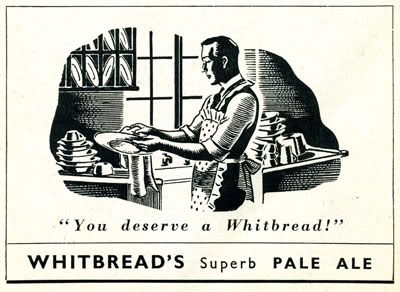
You deserve a Whitbread!

Whitbread Pale Ale advertisement in Lilliput, June 1947, page xv.

This startling advertisement appeared in Lilliput magazine's June 1947 issue. A man is pictured in a frilly apron doing the washing up, presented with no comment or indication that this is the least bit remarkable.

Taken in the context of the immediate post-war years, it did surprise me. Men were returning from fighting six long years of war and the usual story we are told is that women who had ably coped with 'men's' jobs - working in munitions and aeroplane factories during the war - were immediately pushed out of their jobs and ordered back into the home and kitchen where they belonged. It was back to 'business as usual' - the reassuring gendered division of labour with women as housekeepers and mothers, men as breadwinners, and pampered kings of the castle at home.

This ad complicates those assumptions. There's no suggestion that this man is emasculated by helping out at home, even with a frilly apron on, and the scenario is not exploited for comic effect (as it inevitably would be today). In fact he looks rather noble in his woodcut-style vignette. Perhaps gender roles in the post-war years were a little more complicated and nuanced than we have been led to believe by most popular histories.

Of course, I'm sure most women wouldn't have expected to be rewarded with a bottle of pale ale for doing household chores, so there's an indication that the man's efforts are a little bit special, although obviously not unusual.

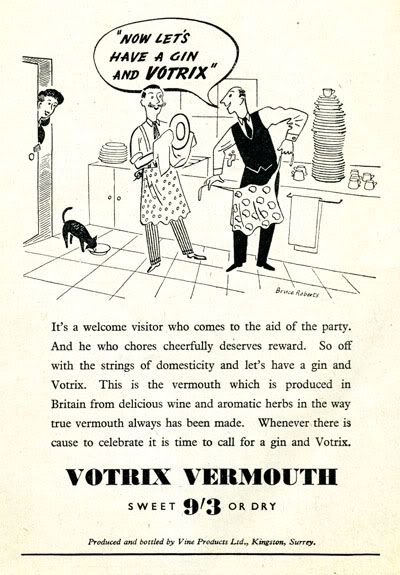
In fact, within a few pages of the same magazine is another very similar advertisement:

Votrix Vermouth advertisement in Lilliput, June 1947, page iii.

The occasion this time is the aftermath of a party, with two gentlemen gamely tackling the piles of dishes. They both wear feminine, patterned aprons and are again deserving of a reward in the form of an alcoholic drink. A delighted-looking wife peers through the door (and then perhaps runs off to fetch their drinks?!)

Did men do anything else around the home except the dishes, now and then? Perhaps . . .

Vactric vacuum cleaner advertisement, from Housewife, November 1947, inside back cover.

This vacuum cleaner advertisement from the same year is rather less credible ("Give him a Vactric"? Hmm) and there is a lightly ironic tone to the copy: "When the household god descends to lend a hand" is a clear indication of the 'normal' domestic power relationship, however humorously expressed.

So the idea of a man helping out with onerous domestic chores is framed in all these advertisements as a sort of special treat for their wives, who are still expected to do them most of the time. But at least its not portrayed as ridiculous or unmanly, as you might expect even to this day, and its considered unremarkable enough to be featured in mainstream advertising.

It makes me wonder how far we've progressed since then (as I contemplate the stairs that need vacuuming . . .)

Monday, 8 February 2010

The magnificent Tilly Losch


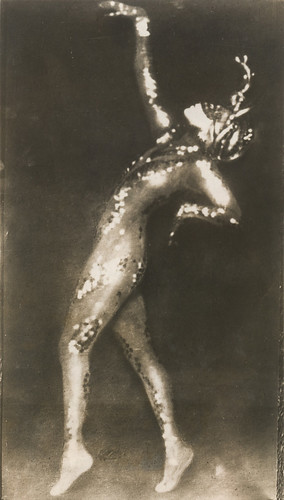
Tilly Losch, 1923, originally uploaded by Trevira.

This beautiful photograph in my collection came from the archive of the newspaper The San Francisco Examiner. There's a damaged relic of a pasted-on label on the reverse giving the title "Serpent of Hell" (the production title? Her character's name?) and a date of April 14th, 1923, which might be the publication date.

Ottilie Ethel Losch was born in Vienna on November 15th 1907, which would make her 15 years of age in this photograph. You can read a summary of her extraordinary life and career in that link over her full name, which details her first stage appearance as a dancer at the age of six with the Vienna Imperial Opera ballet school, her promotion to prima ballerina at the unusually young age of 15, and her subsequent work with Max Reinhardt as both dancer and choreographer (and much more, of course, but we'll come to that soon).

What is puzzling is that according to the Binghamton University Library, which holds Losch's papers, she didn't arrive in the United States until 1927.

Why, then, is she appearing in a popular American newspaper (owned by William Randolph Hearst, by the way) in 1923? In a costume that looks much more Max Reinhardt than something you might expect from the Vienna Imperial Opera, and a full four years before she was reported to have first been invited to perform for Reinhardt in 1927?

The remains of that label note that she was wearing "phosphorous tights" - and I sincerely hope they mean phosphorescent, by the way, or her health might have been seriously endangered.

I'm speculating wildly here - its a bad habit of mine - but perhaps either the photograph date is wrong, or there's something missing or incorrect in that summary of her life?

No matter, Tilly Losch's life was extraordinary anyway, and she is one of those 20th century figures who seems to have orbited around many of the most significant cultural figures of her times, like a female Zelig, only much more beautiful!

She married Edward James, the wealthy English art connoisseur who was a patron of Salvador Dali (he was the proud owner of the first iteration of the iconic Mae West lips sofa, which was installed in his surrealist country pile Monkton House, and was captured by Magritte in this famously baffling portrait). But their marriage ended in a scandalous divorce in 1934 - Tilly accused him of homosexuality, he in return cited just one of her numerous affairs.

Other names that crop up in her life that might still ring a bell to the modern ear include Noel Coward, Fred and Adele Astaire, Kurt Weill, Lotte Lenya, George Balanchine, Berthold Brecht, Jean Cocteau (an ardent fan), the Sitwells and Cecil Beaton.

Her career in Hollywood has left us with some appearances in films such as The Garden of Allah (1936) with Marlene Dietrich, The Good Earth (1937) and Duel in the Sun (1946). All of which I'm pretty sure are readily available on DVD.

Later she retired from dancing and acting and turned to painting, which apparently suited her reportedly shy nature, and was enobled by her 1939 marriage to the Earl of Carnavon to the status of countess. Despite their divorce after the Second World War, they remained on friendly terms and the Earl was one of the few mourners at her 1975 funeral.

But let's go back to the top of this post and contemplate that amazing vision of her as an accomplished teenage dancer making news across the Atlantic - wasn't she magnificent?

Sunday, 7 February 2010

Santos Casani - the forgotten dance master

If you've ever seen one of those archive film montages of the 'roaring twenties' in a TV documentary, there's one clip that always features. Its the one featuring a couple dancing the Charleston on top of a taxi cab driving through a London street.

That clip is at the very end of this British Pathé dance instruction film (incidentally, fashion history buffs will be delighted by Miss Jose Lennard's lower back skirt hem - a major trend in the last years of the 1920s):

THE FLAT CHARLESTON MADE EASY


The stunt was intended to demonstrate that the new 'flat' Charleston required very little space, in contrast to its original, wild form, which was a veritable whirlwind of flying heels and arms, presenting considerable danger to nearby dancers. Indeed the Charleston was banned from many dancehalls at the time.

It is ironic that this clip is now employed to symbolise the reckless, risk-taking, devil-may-care nature of the times when its original intention was actually quite the opposite.

While I could easily (and quite happily) go on about the Charleston, this post concerns the man who appeared in that film, the famous dance master - and energetic self-publicist - Santos Casani.

Mr Casani was the proprietor of "the largest school of dancing in England," wrote a column for the Daily Mail, and made numerous short dance instruction films for British Pathé's cinemagazine for women, Eve's Film Review. The film company supplied free instruction leaflets based on the dance steps Casani featured, which viewers could send off for, and as a demonstration of how popular these films were, on one occasion they had to print 20,000 leaflets to satisfy the demand (most of this information is derived from Jenny Hammerton's fascinating book For Ladies Only? Eve's Film Review Pathé Cinemagazine 1921-1933).

As an aside, its lovely to imagine a cinema audience practising dance steps under their seats as they watch the films!

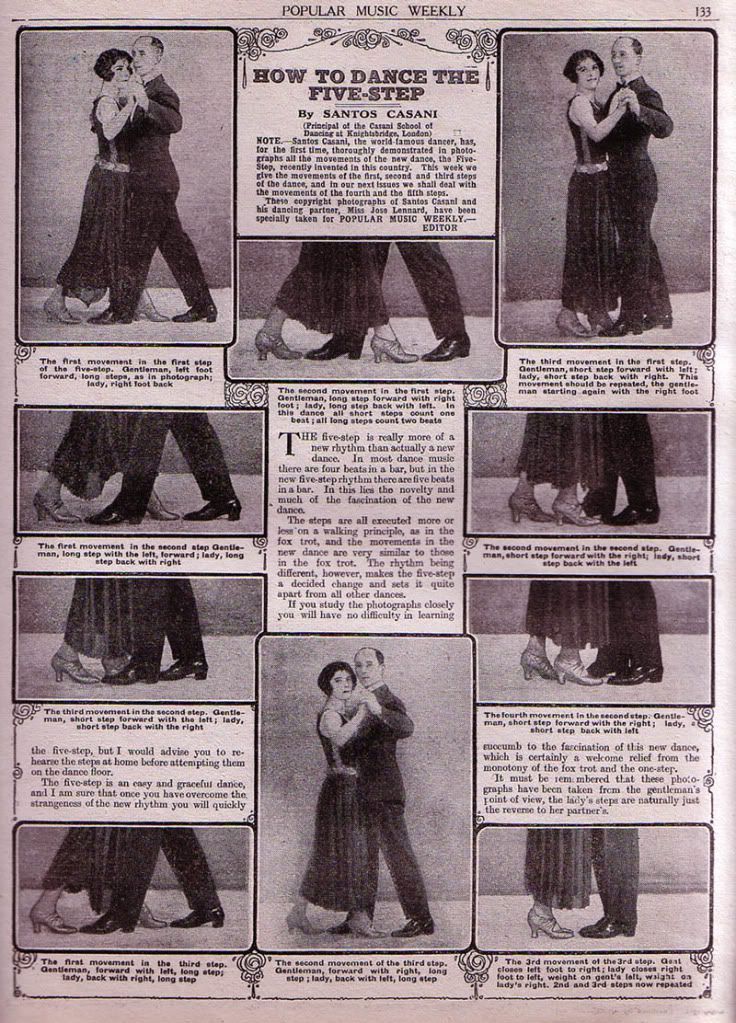
Here Casani makes an appearance in Popular Music and Dancing Weekly magazine, demonstrating the first three steps of the 'Five-Step' - steps four and five were published the following week, but unfortunately I don't have a copy of that issue (again, fashion buffs please note how remarkably long Miss Lennard's skirt was in 1924!):

"How to dance the Five-Step by Santos Casani" in Popular Music and Dancing Weekly, 7th June 1924, page 133 (click picture for a larger view).

In 1933 Casani opened his own nightclub in Imperial House, Regent Street, London and British Pathé was there to record it.

If you were to try to imagine a high-tone 1930s nightclub in the West End of London his establishment lives up to your Art Deco dreams, and this film includes footage of the renowned house band lead by pianist Charlie Kunz, a swimsuit fashion parade, an elegant rendering of the waltz by Mr Casani himself, not to mention a novelty song and a curious female contortionist. Pour yourself into a backless satin dress, shake up a cocktail and join in the fun:

LONDON'S FAMOUS CLUBS AND CABARETS NO. 10 - CASANI'S CLUB


Unlike his near contemporary Victor Silvester, Santos Casani failed to secure himself a place in dance posterity and his name is probably unknown to most people nowadays. But he was clearly a significant figure in his time - a suave, elegant man who knew how to work the media for maximum attention. In his prime, he was Mr Dance, and I'd like to salute his memory.

If you would like to see more of Santos Casani in action, there's plenty more films for you to enjoy.

Thursday, 4 February 2010

Fashion rations

Even during the dark years of the Second World War, and the long years of clothing rationing that followed it, women were expected to keep up appearances. "England's number one glamour girl" Joan Richards, a professional model, doesn't disappoint in this 1944 film where we follow Joan through a "routine day's work." From getting up in the morning with full slap (apologies to US readers - slap = makeup) and immaculate hair, through her long and busy day, she is the epitome of 1940s chic. By the way, these film links have come up as black boxes, but they will work if you click on them.

ANNE EDWARDS (aka GLAMOUR GIRL)


However, not every woman met the grade. This amusing short from September 1946 features the "Pathé Pictorial Fashion Expert" Mr Richard Buzzvine (at least, that what his name sounds like) lurking self-consciously with a newspaper on Regent Street as he casts a waspishly critical eye over young women's outfits. Although his voice isn't heard, the narrator reports his merciless judgements.

Mr Buzzvine is very hard to please, and only one girl meets with his approval, although its hard to see how she is much different from the other 'failures.' Its a useful reminder of how fraught getting dressed used to be, with all kinds of complicated rules and conventions governing what was - and was not - appropriate wear.

RIGHT AND WRONG IN FASHION