Sunday, 1 August 2010

The Story of a Dress

 "The Story of a Dress" by Lorraine Timewell, The Saturday Book 7, 1947, pp. 71-80.

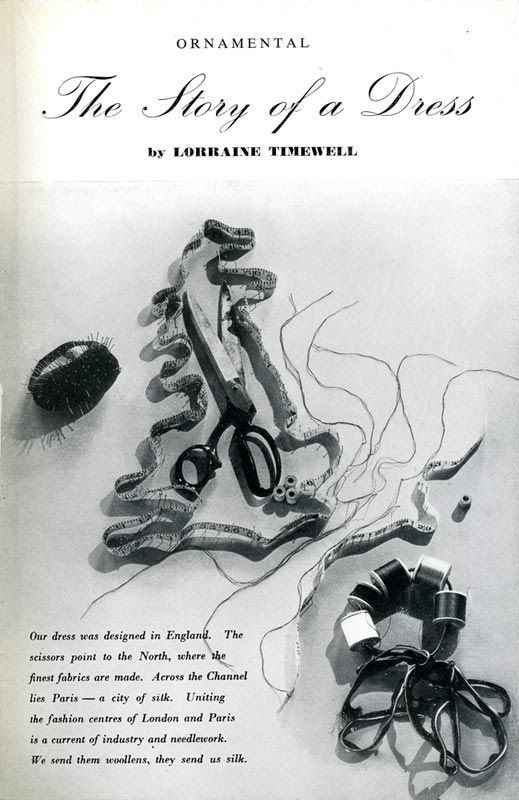
Our dress was designed in England.  The scissors point to the North, where the finest fabrics are made.  Across the Channel lies Paris - a city of silk.  Uniting the fashion centres of London and Paris is a current of industry and needlework.  We send them woollens, they send us silk.
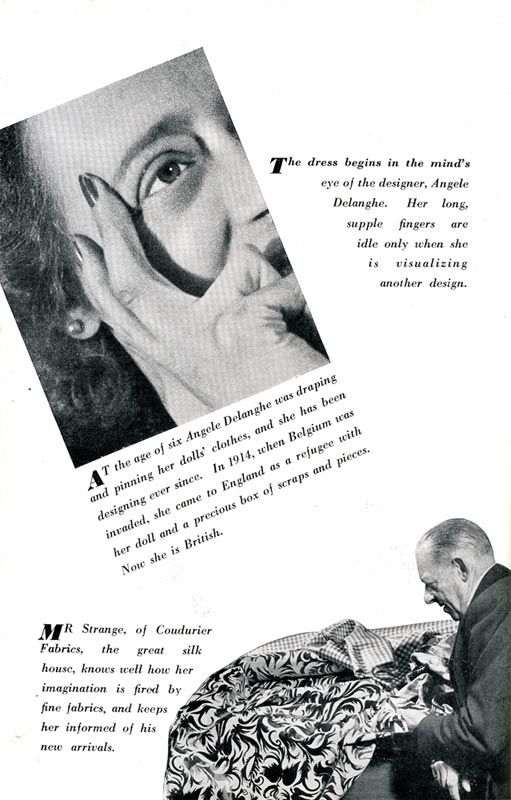


The dress begins in the mind's eye of the designer, Angele Delanghe.  Her long, supple fingers are idle only when she is visualizing another design.

At the age of six Angele Delanghe was draping and pinning her doll's clothes, and she has been designing ever since.  In 1914, when Belgium was invaded, she came to England as a refugee with her doll and a precious box of scraps and pieces.  Now she is British.

Mr Strange, of Coudurier Fabrics, the great silk house, knows well how her imagination is fired by fine fabrics, and keeps her informed of his new arrivals.


In a tiny room she works with the selected fabric straight onto the dummy, its shoulder scarred with pin-marks.  In picture one, she is concentrating her mind not on the checked silk, but on the floral printed silk lying on the table by Smuts the cat.  She knows exactly what she wants to do with it, and in picture two begins to drape and pin.  It is a fine silk in a pale oyster white, with burnt rose and grey outlined flowers scattered over it.
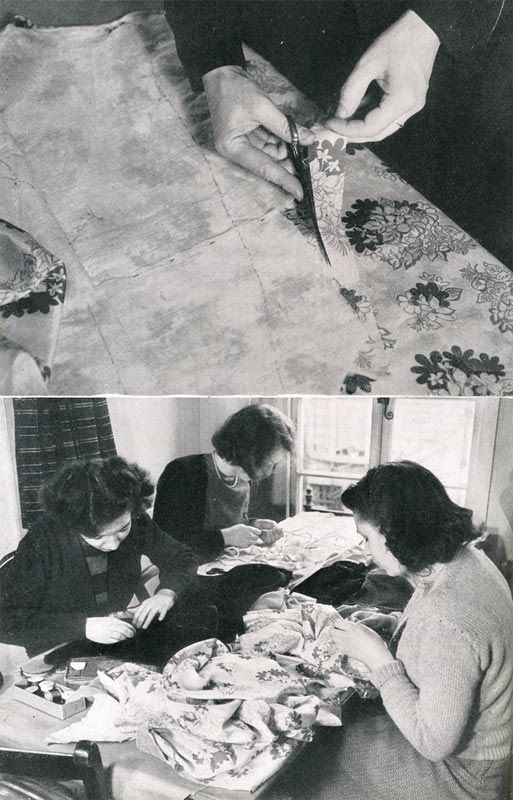
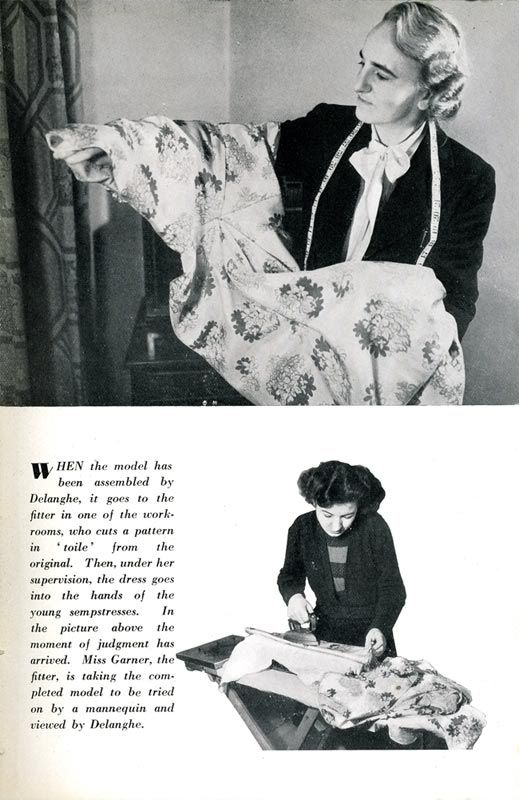


When the model has been assembled by Delanghe, it goes to the fitter in one of the workrooms, who cuts a pattern in 'toile' from the original.  Then, under her supervision, the dress goes into the hands of the young sempstresses.  In the picture above the moment of judgment has arrived.  Miss Garner, the fitter, is taking the completed model to be tried on by a mannequin and viewed by Delanghe.
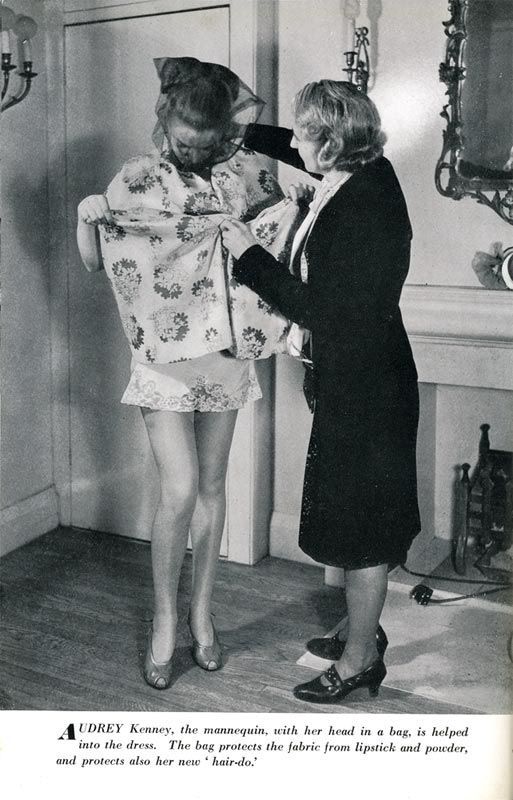


Audrey Kenney, the mannequin, with her head in a bag, is helped into the dress.  The bag protects the fabric from lipstick and powder, and protects also her new 'hair-do.'
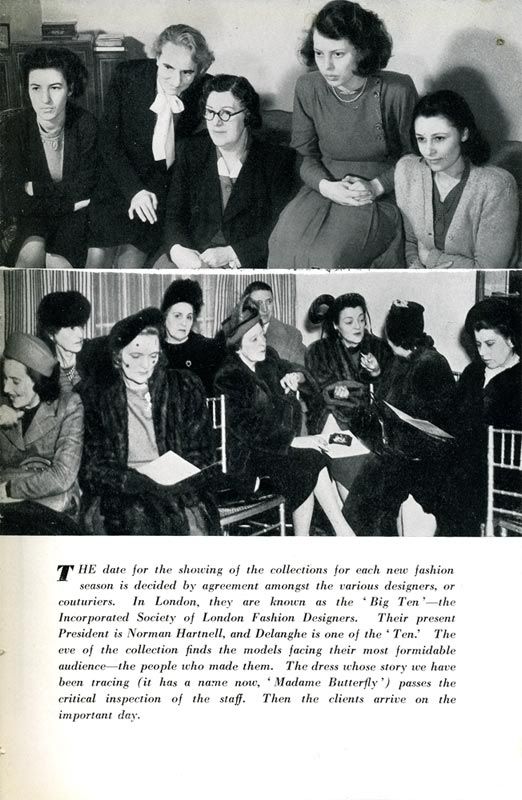


The date for the showing of the collections for each new fashion season is decided by agreement amongst the various designers, or couturiers.  In London, they are known as the 'Big Ten' - the Incorporated Society of London Fashion Designers.  Their present president is Norman Hartnell, and Delanghe is one of the 'Ten.'  The eve of the collection finds the models facing their most formidable audience - the people who made them.  The dress whose story we have been tracing (it has a name now, 'Madame Butterfly') passes the critical inspection of the staff.  Then the clients arrive on the important day.
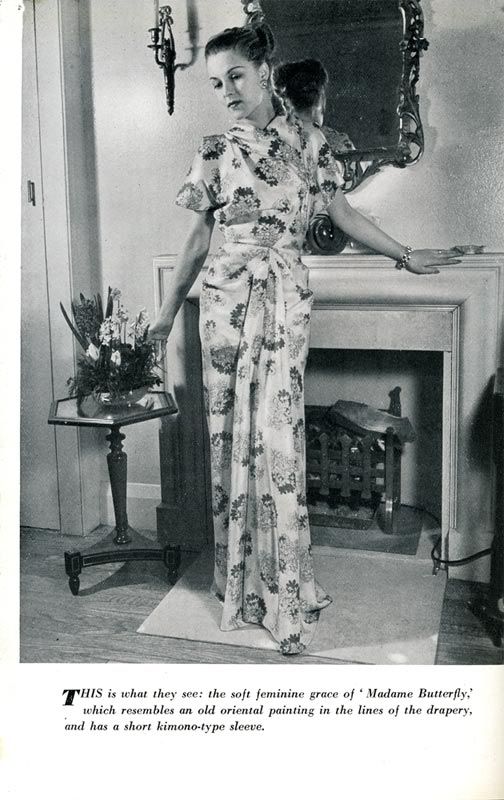


This is what they see: the soft feminine grace of 'Madame Butterfly,' which resembles an old oriental painting in the lines of the drapery, and has a short kimono-type sleeve.
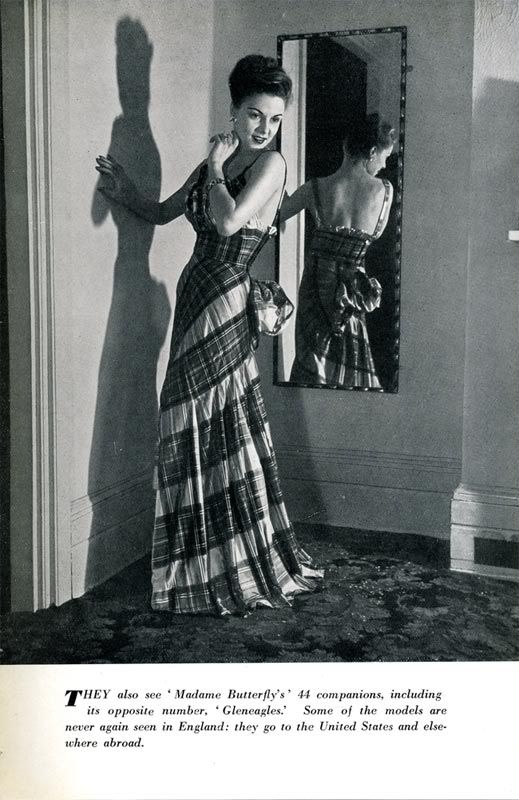


They also see 'Madame Butterfly's' 44 companions, including its opposite number, 'Gleneagles.'  Some of the models are never again seen in England: they go to the United States and elsewhere abroad.
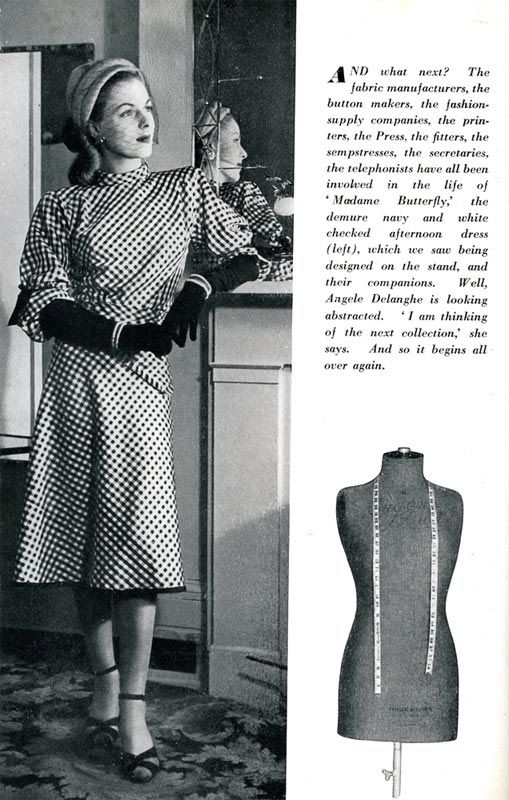


And what next?  The fabric manufacturers, the button makers, the fashion-supply companies, the printers, the Press, the fitters, the sempstresses, the secretaries, the telephonists have all been involved in the life of 'Madame Butterfly,' the demure navy and white checked afternoon dress (left), which we saw being designed on the stand, and their companions.  Well, Angele Delanghe is looking abstracted.  'I am thinking of the next collection,' she says.  And so it begins all over again.

_._._._._._._._._._._._._._._._._._._


This photo story appeared in the seventh edition of The Saturday Book - one of those compendiums of miscellany from the arts to anthropology, history and antiquities, social observation, folklore and all manner of diverting stuff - that were once so popular.

This edition was published in 1947, at pretty much the height of post-wartime austerity and a time when most women could only dream of a new evening gown made of silk, so its interesting to see that Ms Delanghe appeared to have no problem securing such scarce and valuable supplies.  But then, as the piece points out, some (most?) of her output was destined for export.

Its great to see that the author, Lorraine Timewell, chose to feature Angele Delanghe rather than one of the more well known members of the London 'Big Ten' such as Hartnell, Hardy Amies or Digby Morton.

In fact I've found precious little about her, apart from these scraps:

Delanghe was an early member of the Incorporated Society of London Fashion Designers, formed in 1942, which included the Hon. Mrs Reginald Fellowes (its first president), Norman Hartnell, Peter Russell, Worth of London, Digby Morton, Hardy Amies, Bianca Mosca, Creed, Molyneux and Michael Sherard.   (Information from In Vogue: Six Decades of Fashion by Georgina Howell and Exploring 20th Century London).

She was known for creating "soft feminine tailored clothing and beautiful romantic eveningwear and wedding gowns" (from The Cutting Edge: 50 Years of British Fashion, 1947-1997 by Amy de la Haye).

After the war she took over the Ladies' Outfitting and Ready to Wear Departments at Fortnum & Mason and "revitalized" them.

Former women's editor of the Yorkshire Post, Valerie Webster, recalls with palpable frustration that she was required to attend "the couture shows of people like Angele Delanghe and Lachasse who made tweedy suits and hefty jewel-encrusted evening gowns for the grouse moors and hunt ball scene."  To be fair, this was probably in the early 1960s, and young Valerie was more interested in Mary Quant than grouse moors and hunt balls, and perhaps Delanghe was past her prime.

This little 'backstage' story of Angele Delanghe's work at least adds a little more to our knowledge of her.

Saturday, 17 July 2010

TinTrunk dips a toe into the fashion world

I'm a one-man band, a small-time vintage seller trying to establish a business, and my resources and capital amount to pretty much zero.  But sometimes friends can surprise you.

One friend of mine - Elizabeth - is a stylist with some seriously impressive credentials, and we had talked about organising a photo shoot of some TinTrunk prime stock for some time.  Yesterday, thanks to her, it happened.

There was a pretty vague, bullet-pointed brief about Englishness, eccentricity, awkwardness, unlikely combinations, plus a dash of surrealism and straight-faced humour, and some definite ideas about what to avoid - cosy nostalgia and whimsy, straining for 'authentic' replications of period fashions, chintzy floral teacups, and most of all cupcakes!  I'm not a hater by any means, and I'm happy if those aspects of the current vintage trend work for other people, but they just don't work for me. 


Elizabeth suggested I prepare a mood board of ideas and inspirations, which ended up being dominated by some of my collection of old photographs.  I love the weird tension of self-consciousness and self-display seen in old snapshots and cheap studio portraits, but I was keen to avoid any kind of sepia-toned, slavish recreations.  It was more about taking the mood and atmosphere of these anonymous shots and mixing it up with some David Hockney dandyism/Nancy Cunard decadent glamour/gender mix-up playfulness.

We had lots of ideas, but only one short day to shoot as much as we could.

A dear family friend, Helen, agreed to let us use her house and garden as our location.  This house was a derelict 18th century farm building that she has, over a period of about 40 years, turned into an exquisite little cottage packed full of fascinating treasures, and surrounded by a lush garden with some surprising features.

Personally, I was happy to outline the brief and inspirations/influences and let Elizabeth and her talented young recruits run with it, and wait to see what happened.  But bless their hearts, I was consulted at every step along the way.


Here's Rosa, one of the two intimidatingly lovely models, working my 1960s Pucci skirt with a black and white striped 70s blouse that Elizabeth pulled together (something that would never have occurred to me!), being photographed by the newly graduated Sally Davies.  Incidentally, Sally has earned herself a first, and having seen her in action I can understand why.


Sally here is photographing Rosa with Hugh, our male model, who had a deliciously louche appearance - somewhat like a bored, seen-it-all aristrocrat - although he was in fact a very quiet and sweet young man.

I didn't take many photos myself, because I was a little bit preoccupied about looking after all my precious stock.  Some of the items we used are very collectable (meaning they have some value) and I personally treat them with the care and scrupulousness of a museum curator since any damage, stains or flaws will reduce their value considerably.  I tried to switch off that 'conservationist' voice in my head because it was such a privilege to see them worn and styled so imaginatively.  This seemed to work for the duration of the shoot, and I'm so glad I stopped myself from intervening too much!


Helen's rotating summer house, provided a splendid backdrop for Rosa in a 1980s olive green plaid jumpsuit with vintage 1970s Terry de Havilland snakeskin platform shoes, and some bright green gloves that my sister gave me (not for sale, sorry!)  Hugh sports some bright yellow trousers that Elizabeth had daringly combined with a 60s tweed women's cape and a bold polka dot tie.

You can also see Elizabeth poised and ready to pounce with a green suede 60s hood, but its anyone's guess as to whether Hugh or Rosa will end up wearing it.  Which was one of the best aspects of the shoot - the garments were treated neither reverentially nor conventionally and Elizabeth just went with what seemed to work, based on her highly attuned fashiony instincts.

So here's a sneak preview of some of Sally's shots, and I'll leave it to you to decide if they fulfilled that brief detailed earlier.

Not that it matters anyway.  I'm cock-a-hoop about them regardless, and I'm looking forward to exploiting them to the full for the forthcoming TinTrunk website, not to mention flyers, business cards, signs, badges, banners, fridge magnets, coffee mugs, t-shirts, mousemats - blimey, there's so much potential!


My sincere thanks to:

Elizabeth Cardwell/Moss - super duper stylist and all-round organisational talent.
Sally Davies - photographer (she can also style and create garments and is a very accomplished all-rounder in all kinds of fashiony stuff).
Kaye - our makeup artist who worked magic on Rosa for this shoot.  Once I find out her full name and any website/online details these will be added here.
Rosa - the beautiful female model - ditto for details.
Hugh - the handsome male model - ditto for details.
Helen - for allowing us all to run amok in her fabulous house and garden.

Wednesday, 7 July 2010

Get dressed in the NME, 1981-5

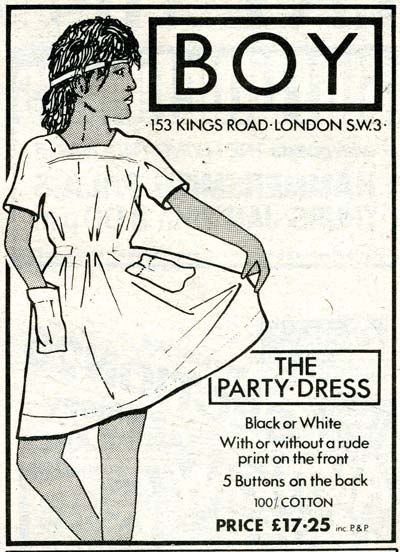
Boy advertisement, NME, 19th December 1981, page 83. 

Here's the last of the clothing ads from the small pile of NMEs remaining in my possession, and these date from 1981 to 1985.  You might notice that most of them come from the bumper Christmas issues, which were the ones I was most likely to keep for their end-of-year summaries, not to mention the hugely enjoyable collections of fatuous quotes from pop stars cherry-picked from the year's interviews.

So Boy's advertisement (above) for a party dress is rather confusing.  It looks like a summer dress to me, especially accessorised with the headband/sweatband.  Mind you, "rude print[s]" are appropriate for all seasons - and wouldn't you love to know what that "rude print" they so primly didn't show was?


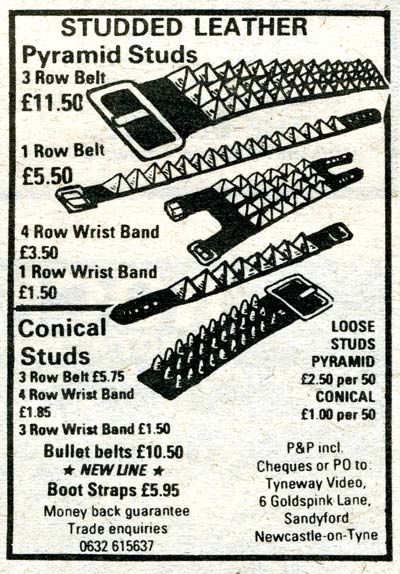
Another all season item is the studded leather belt and Tyneway Video (?) has a very nice pyramid stud example on offer, along with wrist bands and boot straps:

Studded leather advertisement from Tyneway Video, NME, 19th December 1981, page 83.


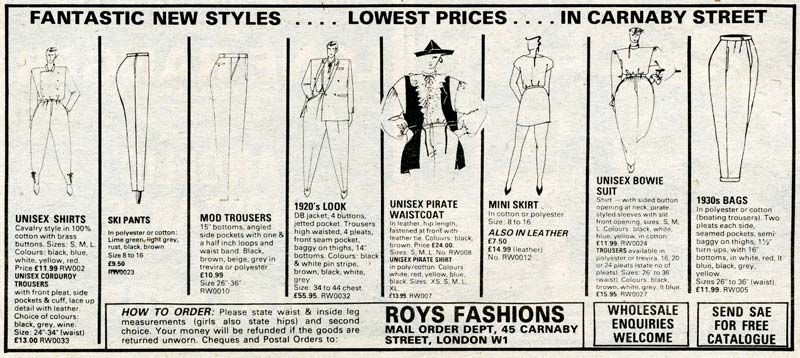
You might remember Roy's Fashions from the previous post, and his December 1981 ad doesn't disappoint:

Roy's Fashions advertisement, NME, 19th December 1981, page 83.  Click on the picture for a larger view.

Roy's range has definitely gone more New Romantic, with a dashing unisex pirate waistcoat and matching pirate shirt, a balloon-legged unisex Bowie suit and what is billed as a "1920s look" suit, although from that sketch it couldn't look more 1980s to me.


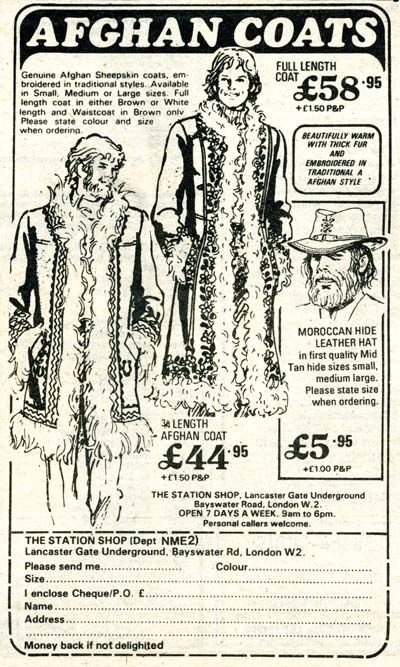
Afghan coats from The Station Shop, NME, 3rd January 1981, page 33.

Are those hippies still here?  Well clearly they are, and the Station Shop is still flogging these wretched Afghan coats to them.  Just stay out of the rain if you're wearing one - if you've ever smelt a wet Afghan coat you won't want to repeat the experience.

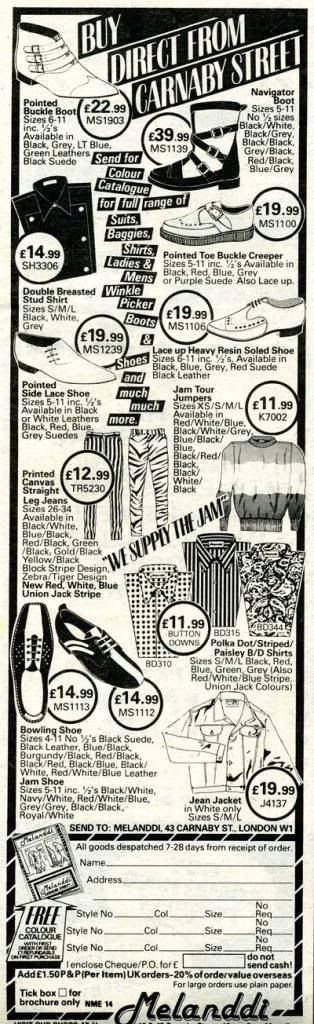
And now a scanner-stretching long ad from Melanddi, proud suppliers to the Jam, from December 1982:

Melanddi advertisement, NME, 25th December 1982, page 75.

The printed canvas jeans remind me that I thought I'd find an ad for Modzart, who were the prime purveyors of printed canvas strides at the time - and I was sure their ads were regularly featured - but I didn't find one.

Moving swiftly on from that deeply uninteresting observation . . .


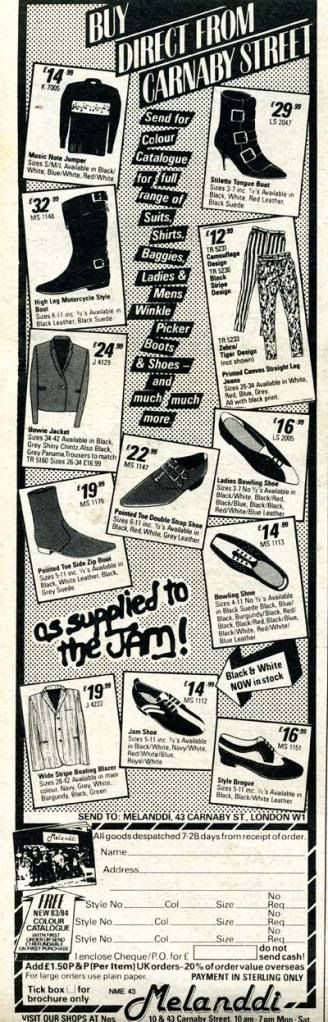
Melanddi advertisement, NME, 24th December 1983, page 75.

Here's Melanddi's Christmas 1983 ad, with a rather curious "Stiletto Tongue Boot" among its newer offerings. 


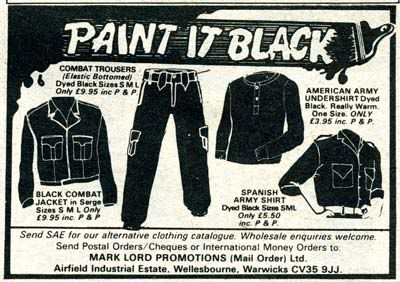
Mark Lord Promotions advertisement, NME, 24th December 1983, page 75.

Mark Lord Promotions have a novel line in black-dyed military surplus which I'm struggling to associate with any particular youth culture grouping of the time.  Its a bit too butch for the goths (hang on, when did New Model Army appear?), maybe a bit too austere for the punks . . . any help here would be much appreciated.


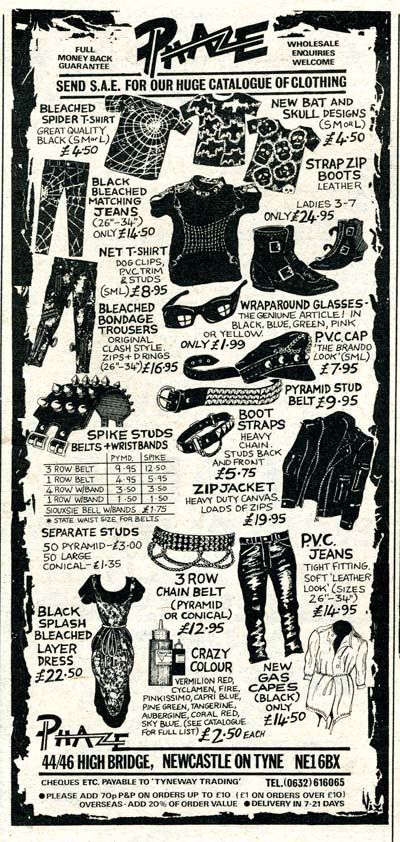
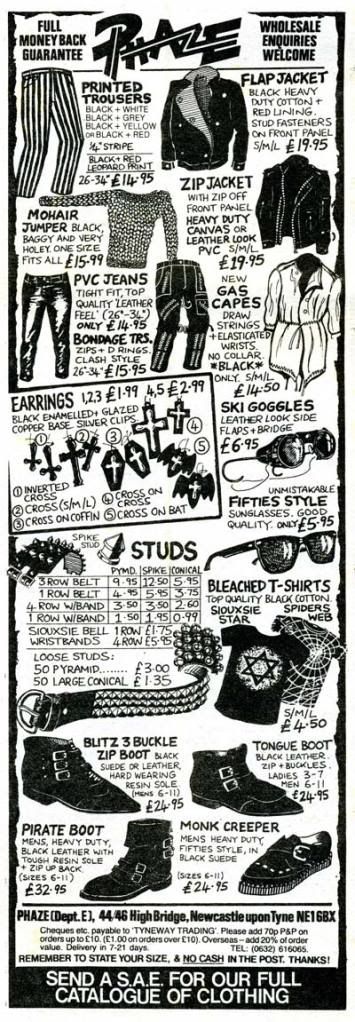
Phaze advertisement, NME, 24th December 1983, page 75.

Phaze of Newcastle has some proper cartoon goth gear, including some splendid bleached spider (web) jeans.  The note at the bottom that cheques should be made out to "Tyneway Trading" might suggest a link with the Tyneway Video studded leather ad earlier.

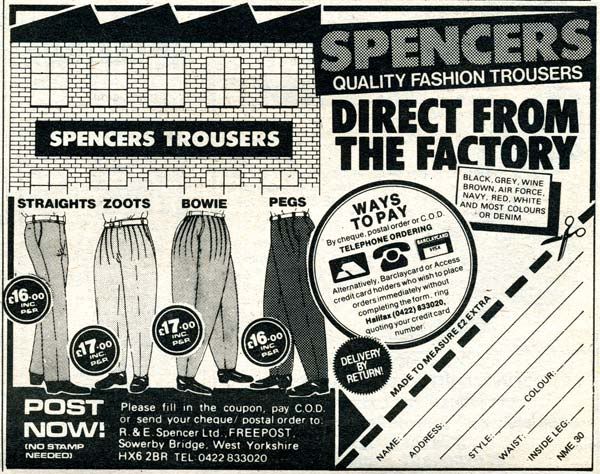
Spencers Trousers advertisement, NME, 24th December 1983, page 75.
I love the specialist suppliers' ads, and Spencers Trousers' one is a goodie.  In case you didn't believe they were "direct from the factory" there's a picture of it right there.  Despite the rather conventional graphic design, this ad inspires confidence in their trousers, and will you look at those Bowies - magnificent!


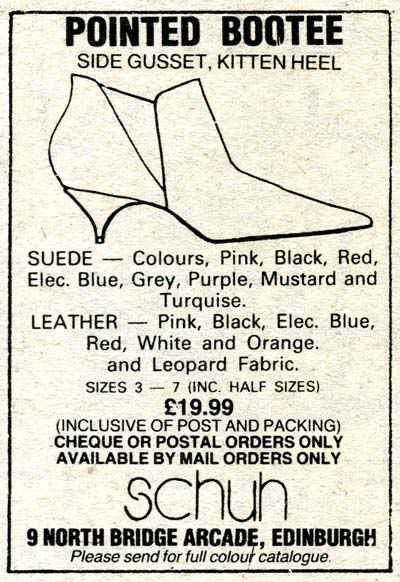
Schuh pointed bootee advertisement, NME, 24th December 1983, page 75.

A modest start for one of the familiar names on the British high street these days.  Schuh's pointed bootee is rather lovely, and comes in an extensive range of colours, plus leopard skin fabric.  I'm picturing Fay Fife of Edinburgh's finest, the Rezillos, in these. 

And here's another familiar shoe retailer, although possibly past its prime now:

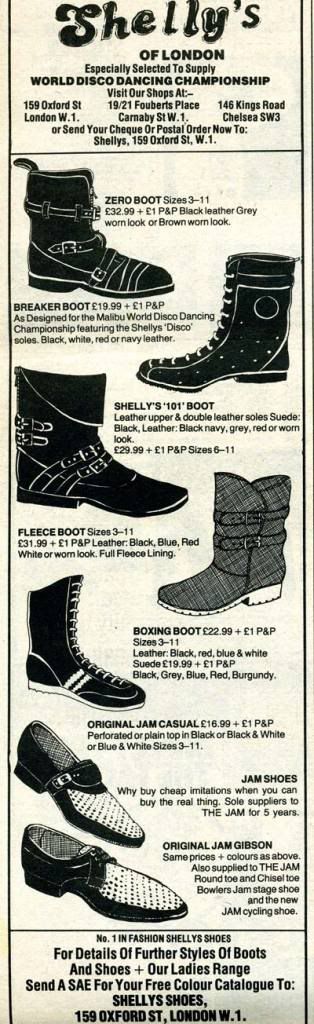
Shelly's of London shoe advertisement, NME, 24th December 1983, page 76.

I had no idea they supplied footwear to the World Disco Dancing Championship, which is quite some endorsement for the quality of their shoes.  The WDDC provided some golden tv moments in the late 70s and early 80s, and there's plenty of clips to enjoy on Youtube.  I've just spent far too long watching a few of them, but I failed to spot Shelly's breaker boot with the "disco" sole. 


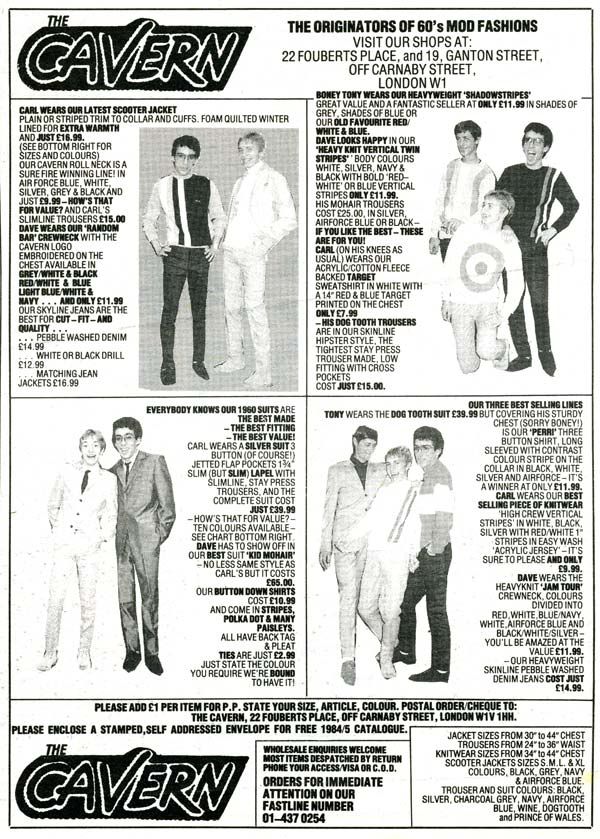
The Cavern advertisement, NME, 22/29th December 1984, page 75.  Click on picture for a larger view.

The Cavern is strictly mod, and I think its rather nice that they name their models.  So please meet Carl, Dave and "Boney" Tony.


Phaze advertisement, NME, 23rd February 1985, page 37.

Phaze return in 1985 with their goth range, and a smattering of punk.

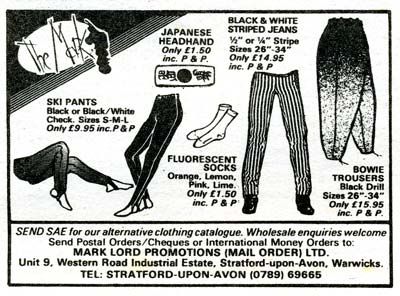
And finally, Mark Lord Promotions' 1985 ad (now trading as 'The Mark') has dropped the black dyed combat jackets and gone a bit New Wavey.  And the Bowie trousers endure:

The Mark advertisement, NME, 23rd February 1985, page 37.

If anyone has any surviving items from these advertisers, or remembers wearing any of this stuff, your comments would be most welcome.

The only things that I recall having are the Sid-Vicious-on-tv t-shirt I mentioned in the previous post, plus a Boy punk shirt that was a copy of the Sex/Seditionaries ones with a woven patch of Karl Marx and a bleach written message "Only Anarchists are pretty."  This I bought from the Boy shop rather than mail order, and, incidentally, was filmed doing so by a Japanese breakfast tv show!


Oh yes, and some Shelly's extra-thick crepe soled brothel creepers.  Ah, memories . . .


Directory of advertisers

The Alien, 20 Corporation Street, Bolton, Lancs (skinhead coats)

Baxby Fashion House, 227 Portobello Road, London W11 (punk and mod)

Boy, 153 King's Road, London SW3 (punk)

The Cavern, 22 Fourberts Place, Carnaby Street, London W1; 19 Ganton Street, Carnaby Street, London W1 (mod)

Fab-Gear, 42 Call Lane, Leeds (also X Clothes shop premises) (punk/new wave)

Furs and Jeans, 48 Manor View, London N3 (Afghan coats)

The General Franchise Co. Limited
, 22 Park Grove, Edgware, Middlesex HA8 7SJ (Ted/rock'n'roll)

J. Holdsworth, 95 Lots Road, Chelsea, London SW10 (punk and mod)

P. Leach, 50d Redcliffe Gardens, Chelsea, London SW10 (punk)

Mainline, 51 Two Mile Hill Road, Kingswood, Bristol, BS15 1BS (punk)

Mark Lord Promotions
(mail order) Ltd, Airfield Industrial Estate, Wellesbourne, Warwickshire CV35 9JJ (black dyed army surplus)
By 1985 advertising as 'The Mark' at Unit 9, Western Road Industrial Estate, Stratford-upon-Avon, Warwickshire (new wave)

Melanddi, 43 Carnaby Street, London W1 (mod, new wave)

Phaze, 44/46 High Bridge, Newcastle-on-Tyne NE1 6BX (punk, goth)

Printout Promotions
, 28A Abington Square, Northampton (punk, mod, metal)

Punters Choice by Cadiss, 117 Hammersmith Road, London W14 (slim ties)

Radar
, 1st Floor, Virgin Records, Union Street, Glasgow and 3 Dundas Street, Edinburgh (retail stockist of P. Leach, punk)

Retro, 26 Union Street, Broadmead, Bristol 1 (mod leather)

Roy's Fashions, 1st Floor, 45 Carnaby Street, London W1 (new wave, mod, new romantic)

Schuh, 9 North Bridge Arcade, Edinburgh (new wave shoes)

Shapes, 252 High Street, Waltham Cross, Hertfordshire, EN8 N78 (hippy/ethnic)

Shelly's of London
, 159 Oxford Street, London W1; 19/21 Fouberts Place, Carnaby Street, London W1; 146 Kings Road, Chelsea SW3 (mod, punk, new wave shoes)

R & E Spencer Ltd, Sowerby Bridge, West Yorkshire, HX6 2BR (trousers)

The Station Shop, Lancaster Gate Underground, Bayswater Road, London W2 (Afghan coats)

Tyneway Video, 6 Goldspink Lane, Sandyford, Newcastle-on-Tyne (studded leather)

Sunday, 13 June 2010

NME fashions, 1980

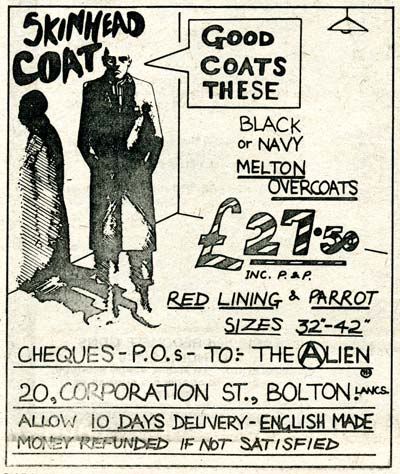
'The Alien' advertisement, NME, 20th December 1980, page 72. 

A brisk canter now through the NME clothing advertisements from my three surviving copies dating from 1980.  Starting with an authentically menacing hand-drawn ad for skinhead coats (presumably Crombie style) with a nicely no-nonsense tag line: "Good Coats These."


Fab-Gear advertisement, NME, 20th December 1980, page 72. Click image for a bigger view.

Fab-Gear of Leeds have the new wave angle covered, and their ad indicates that their retail outlet was X Clothes, an alternative clothing business that started in Manchester.  Music trivia fans will be delighted to learn that Johnny Marr worked in that Manchester branch just prior to forming the Smiths.


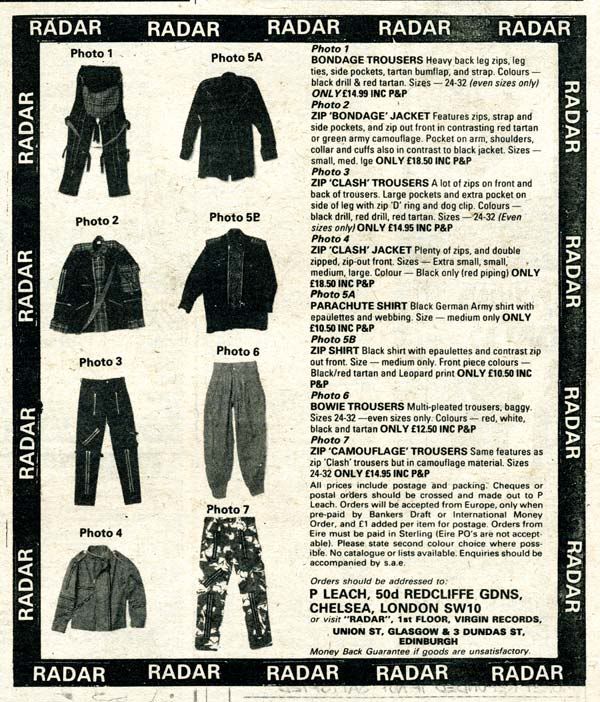
'Radar' advertisement, NME, 20th December 1980, page 73.  Click image for a bigger view.

Radar appears to be a Scottish retailer with shops in Glasgow and Edinburgh, but mail orders are referred to 'P. Leach' of Chelsea, which must be the same company as (possibly misprinted) 'B. Leach' whose bondage trouser ad from 1979 featured in the previous post.

You'll notice that multi-pleated 'Bowie Trousers' were a firm favourite around this time and several  advertisers (in this and the subsequent blog post coming soon) provide their own version of them. 


'Baxby Fashion House' advertisement, NME, 20th December 1980, page 72.  Click image for a bigger view.

Baxby's lamentable line drawings inspire little confidence, especially that Crombie in the bottom right corner.  Oh dear.

These days we routinely expect online retailers to provide full colour photographs from every angle, eye-popping zooms and even rotating 360º views, and it makes you realise what a considerable leap of faith it must have been to have sent off your cross-signed postal order based on a tiny, mis-shapen sketch that gives only the vaguest idea of what the garment might actually look like.


'J. Holdsworth' advertisement, NME, 29th March 1980, page 48.  Click image for a bigger view.

J. Holdsworth's drawings aren't much better, but at least there's a bit more detail. 


'Printout Promotions' advertisement for punk gear, NME, 29th March 1980, page 47.  Click image for a bigger view.

With some of these advertisers you get a sense that there might be some enthusiasm or at least interest in the culture they are exploiting catering for, but Printout Promotions isn't one of them.  They are just happy to produce whatever seems to be in demand.  And there's nothing wrong with that at all, in fact I admire their versatility.

So above, you'll see the punk range, and coming up below is the rock selection:


'Printout Promotions' Giant Rock Sew Ons advertisement, NME, 29th March 1980, page 48.  Click image for a bigger view.

Heavy Metal wasn't really the NME's turf (that was more Sounds territory) and this is the only specifically rock-related merchandise ad I found in my small and highly unrepresentative survey.

Mind you, I can't help warming to that slogan: "Rock on your Chest!"


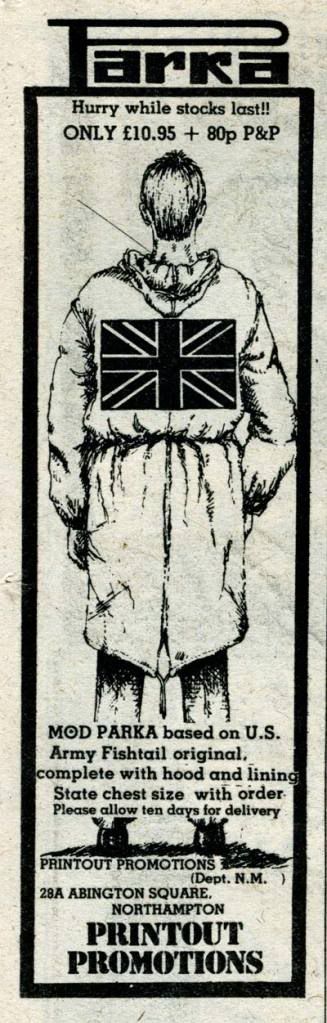
'Printout Promotions' parka advertisement, NME, 29th March 1980, page 48.  Click image for a bigger view.

And here Printout turns its hand to mod styles with Union Jack emblazoned parka.  In fact, I'm sure there were plenty of other subcultural fields that Printout Promotions trained their sights on.  An online search turned up a scanned copy of CB World magazine from April/May 1981 featuring a full page ad of theirs with the proud message: "Leaders in the field of personalised CB wear," which presents merchandise including everything from bodywarmers to car sunstrips.

From versatility to extreme specialisation, let's welcome the self-styled "most exciting Company in the Universe":


'Punters Choice by Cadiss' slim ties advertisement, NME, 27th September 1980, page 53.  Click image for a bigger view.

Punters Choice by Cadiss want to help those of you with overly wide ties, and their Asteroids tie certainly sounds tempting.  Interestingly, they accept Access credit cards - the only NME clothing advertiser I've found that does so - but without a telephone number it looks like those ties will remain "Hard To Find."


'Boy' mail order punk advertisement, NME, 27th September 1980, page 53.

Boy were one of the, er, big boys of punk clothing and I dearly wish I'd sent off for one of those full colour catalogues.

This ad has proved useful to me, though, by way of the mention of Kitsch 22.  I have an old sleeveless t-shirt with a picture of Sid Vicious on tv (printed sideways) that has a perversely black on black woven label.  After much squinting and angling to catch the light on this mystifying label I've discovered that it reads "Kitsch London" and probably came from Boy.

The t-shirt had been featured in a fashion magazine piece showcasing new t-shirt designs and I must have sent off for it, although I have no memory of doing so.  But I kept that clipped picture of the t-shirt (indeed it may still be around, somewhere . . .) and the garment remains in my wardrobe nearly 30 years later.

Steering back to the business in hand, the blog Planet Mondo has some pictures from the 1981 Boy Blackmail catalogue that are definitely worth a look.


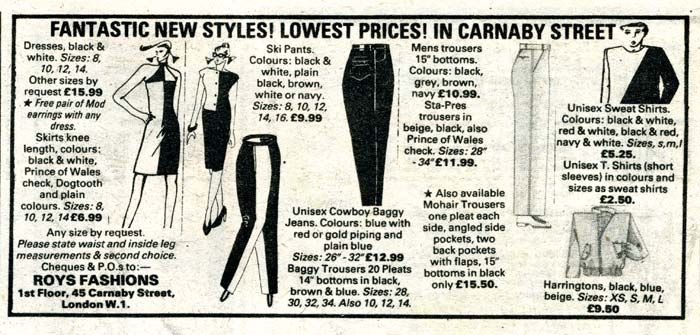
'Roy's Fashions' advertisement, NME, 29th March 1980, page 48.  Click image for a bigger view.

I have a soft spot for Roy's ad, which has a lot to do with that black and white block panel mod dress.


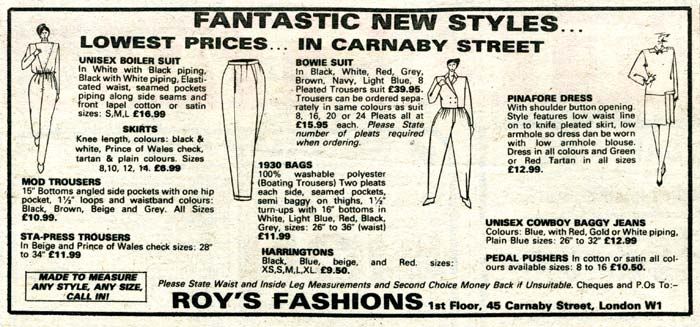
'Roy's Fashions' advertisement, NME, 20th December 1980, page 73.  Click image for a bigger view.

And here's Roy in December 1980 offering not just Bowie trousers but a full Bowie suit for £39.95.


Finally, its heartening to see that the Teds, Britain's oldest and most venerable youth subculture, were not forgotten in 1980.  The General Franchise Company was there to dress them in Polyester Viscose Gaberdine:

'The General Franchise' Drapes and Drainpipes advertisement, NME, 29th March 1980, page 47.  Click image for a bigger view.

The next post will gather up the remaining NME clothing ads scanned from issues dating from 1981 to 1985, and I'll include a handy directory of all the advertisers just to keep up the nerd quotient.  Stay tuned . . .

Friday, 11 June 2010

What could you buy for £6.90 in 1979?

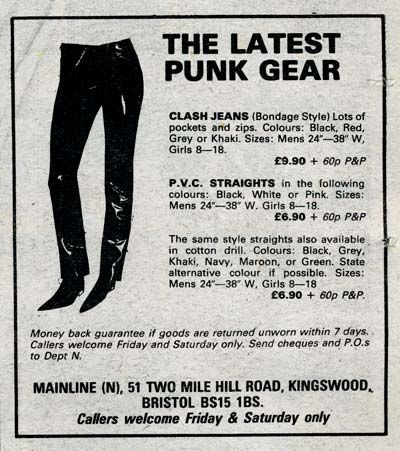
'Mainline' advertisement from the New Musical Express, 29th September 1979, page 63.  

You could treat yourself to some P.V.C. straights - in black, white or *gasp!* pink - as illustrated here in an advertisement by Mainline of Bristol.

I know punks were supposed to be skinny, but the smallest men's size offered here is an extraordinary 24" waist. This might suggest the target market included some very young punks indeed. 

On my recent browse through what little remains of my NME collection, I was drawn to the clothing ads that featured regularly in its back pages and seemed to cater for nearly every youth culture tribe active at the time.

Personally, I wouldn't have dreamed of ordering anything from them because I instinctively mistrusted those monochrome line art drawings and assumed that the garments would be shoddy and disappointing.  I'm sure this was most unfair in some cases, but when you're school-age and pocket money is tight, you tend to be ultra-cautious about where you spend your money. 

That said, I'd like to hope they would have provided a valuable service to provincial (and especially rural) teenagers, keen to express their tribal preferences in sartorial form, who lived more than a tube ride away from Camden Market or the King's Road. 

So, back in 1979, punks were pretty well catered for as you might expect:

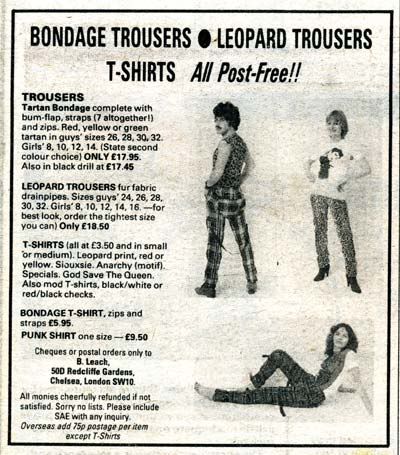
'B. Leach' advertisement, NME, 22nd December 1979, page 73.  

B. Leach of Chelsea offers tartan bondage trousers at £17.95 (bum flap and 7 straps included), and suggests that you order your fur fabric leopard drainpipes in "the tightest size you can."  Those models might have the requisite skinny figures, but they're just not trying hard enough with their hair.  Bondage-trouser-man looks like one of Harry Enfield's scousers, and the two women could be Nolan sisters.

However, it is still the 1970s and the hippies haven't yet been scared away by all those young punks in super tight trousers.

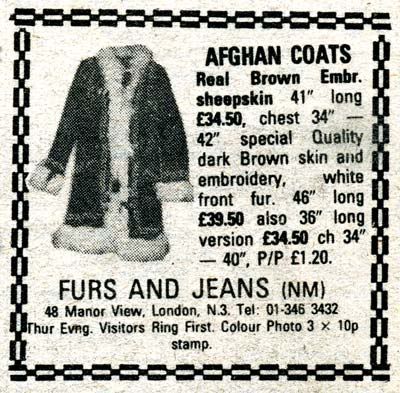
'Furs and Jeans' advertisement, NME, 22nd December 1979, page 73.  

It looks like its much more expensive to be a hippy than a punk.  £34.50 could get you nearly two pairs of B. Leach's bondage strides, or exactly five pairs of Mainline's P.V.C straights, not including p&p of course. 

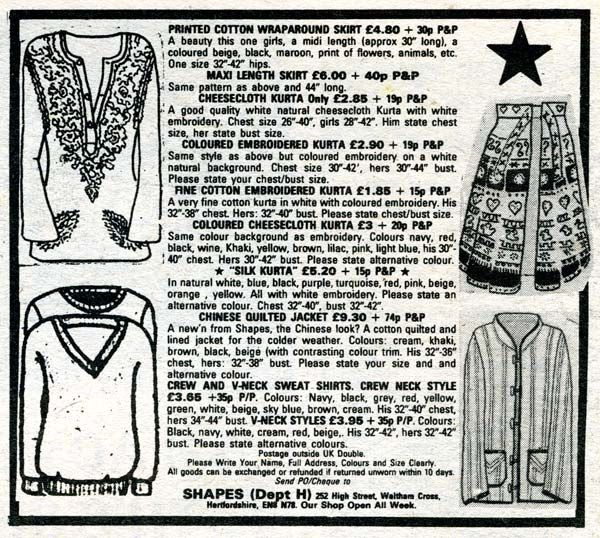
'Shapes' advertisement, NME, 29th September 1979, page 64.  

Maybe its not that expensive being a hippy after all, since Shapes of Waltham Cross, Hertfordshire, is providing printed cotton wraparound skirts for £4.80 and white cheesecloth Kurtas for £2.85. 

But if anyone's known for excessive spending on their wardrobe, its the mods.

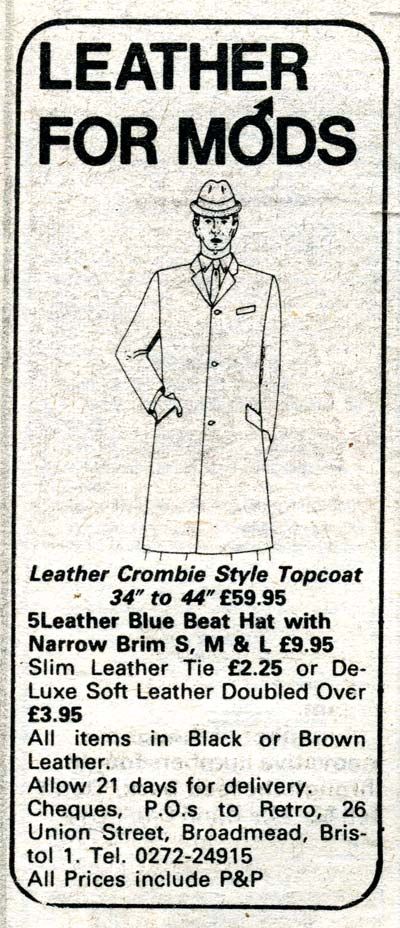
'Retro' advertisement, NME, 22nd December 1979, page 73.  

This leather "Crombie Style Topcoat," from Retro of Bristol, costs an impressive £59.95, and I'm sure I don't remember seeing any late-70s-mod-revival mods wearing one.  Leather ties, certainly, and possibly the odd leather "Blue Beat" hat, but the coat was probably not a big seller given that price. Plus, maybe I'm a bit conservative, but the idea of a Crombie in leather sounds pretty naff to me. 

That's about it from my two surviving copies of the NME from 1979.  There's plenty more ads coming as we plough on through into the 1980s and I'm determined to share them all! 

Authentic punk clothing - with the 'right' labels such as Seditionaries/Sex, Boy and so on - is now fetching big money from enthusiastic collectors.  I would argue that the other contemporary youth culture styles are interesting too, not least because very little of it seems to survive.

People grow out of their teenage enthusiasms and are often quick to bin those embarrassing reminders of their youth as they grow up, start thinking of their careers and/or their new young families, and decide that Pink Floyd were actually amazing despite what Johnny Rotten scrawled on his famous t-shirt.  

The mail-order retailers featured above weren't exactly authentic, but they provided cheaper copies for the majority of people who couldn't afford the originals.  I won't get into the arguments about whether this was piracy or not, or about quality issues - it was inevitable.

You might come across some of this old gear, and some of it might have labels sewn in (this isn't a given - many don't).  With my collector/vintage dealer head on, I reckon these ads might be a useful resource for finding out about those garments.

If you've still got something from one of these companies, or you remember ordering furry leopard print drainpipes from the NME, I'd genuinely love to hear about it.

Tuesday, 11 May 2010

Better Badges

I've been thinking about badges recently, and about how important they were to me in my early teenage years.

As a pupil at a school that required a uniform, badges were one of the few ways to broadcast your sophisticated taste and esoteric musical enthusiasms, and political/ethical concerns if you had any.  Of course, there were also the exuberantly biro'ed pencil cases and army surplus canvas bags but that's another story.

Crucially, they were also very cheap and made ideal pocket money purchases.

There were important distinctions in the style of badges dependent on your musical preferences.  I remember pop music badges in the 70s tended to be large and full colour - a photograph of a beaming David Essex as big as a coaster, for example.  Heavy metal fans favoured enamelled metal badges, or the later cheaper versions which were basically a metal square with a shiny plastic sticker, and the obligatory sew-on patches for their frayed denim waistcoats.

Punk and New Wave fans were more austere in their badge preferences (this was probably a result of limitations in budget and manufacturing capabilities as much as aesthetics).  Monochrome tended to be the rule, or maybe two colours at a push, and they were always small.  Bold graphic band logos tended to work best at this scale, PiL's being a particularly successful example which worked at every size from button badge to shoulder-spanning back-of-the-leather-jacket artwork. 

I filled up my school blazer lapels from a small record retailer in Lincoln called Sanctuary records, which had a black felt-covered board covered in tiny, ¾" badges from which I made my careful selections.

Around the same time, I began reading the NME which had a regular advertiser - Better Badges.  They placed their tiny box ad on the inside last page, always in the bottom right corner.  Happily, I've just found the remains of my NME collection (now reduced to about a dozen copies in total) dating from 1979 to 1985.  And the early ones do indeed have Better Badges ads.

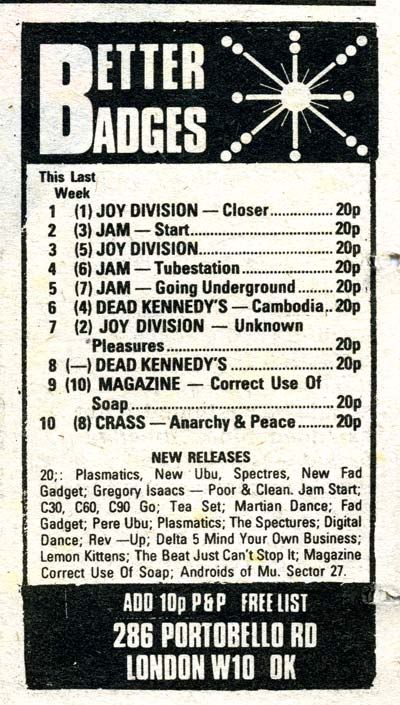
Better Badges ad, NME 27th September 1980.

As you can see, they presented their top sellers in a weekly chart and it gives a wonderfully concise snapshot of the popular underground (if that's not a clumsy oxymoron) music scene of the time.  Apart from the Jam, who weren't underground at all really (despite that song title, yes I see it!)

I can imagine little teen mods satisfying their fan worship by stocking up on badges whilst they save up to buy some black and white bowling shoes, just like Paul Weller's.

Schoolkids usually don't have much money to spend.  You might buy a badge of a record before you bought the record itself.  Or you might buy the badge instead of the record, and satisfy yourself with a fuzzy tape recording of the track off John Peel.  At least you knew about it, and you could let everyone else know you knew about it too.

Better Badges was great because it was right on the money, producing little mascots of nerdy fandom exactly when you needed them.  Before 'everyone else' had heard of them.


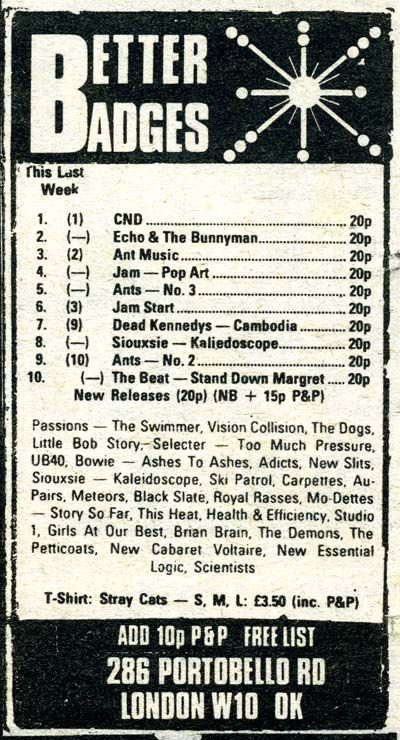
Better Badges, NME 3rd January 1981.  

This ad from January 1981 indicates a rising political awareness with the CND badge (Campaign for Nuclear Disarmament) topping the chart.  I'm sure it was around this time that I sent off for my copy of the CND booklet Protest and Survive, which scared me witless.

I honestly can't remember if I ordered badges directly from Better Badges.  Being isolated in a village in rural Lincolnshire, I regularly sent off postal orders for records and fanzines, and then raced to beat the dog to the post before she tore the packages to shreds (I still have a few records with teeth marks).  The company was also an important producer and distributor of fanzines and its very likely that some of my postal orders went to them, but I'm hazy on this.  At any rate, its certain that I wore their badges.


Better Badges ad, NME 19th December 1981.

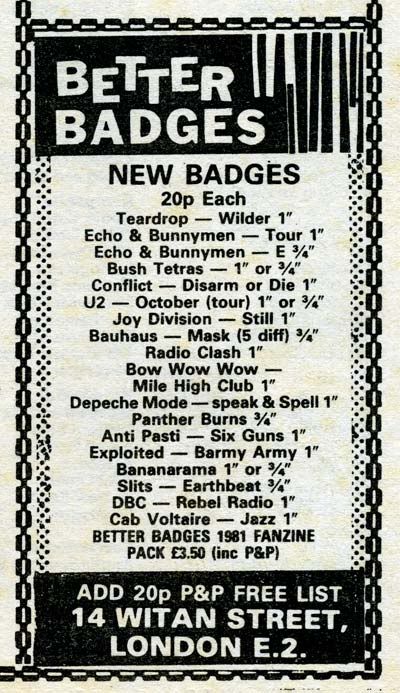
By December 1981, Better Badges had dropped the chart and just listed their new productions, and the P&P had doubled to 20p.

The next year - 1982 - I left school and went to art college, and I think my badge-wearing years ended at around the same time.  Perhaps I considered them a little gauche and immature now I was a grown-up student (oh dear).  It looks like Better Badges stopped advertising in the NME shortly after this too, since my few later copies don't have their ads.

This enjoyable trawl through old NMEs has lead to a day-long scanning session because I was drawn to the clothing ads in the back pages.  So my next few posts will explore the delights of the mail order clothing companies that sold through my (then) favourite music weekly.  


Further reading

I've been very slack about doing research for this post, in fact I haven't done any in my rush to post something after quite a lull.

If you would like to learn more about Better Badges, check these links:

A short history of Better Badges and its role in badge and fanzine production and distribution.

An article by Joly MacFie, founder of Better Badges, which explores how the emergence of cheaper reproduction technologies enabled the DIY/anyone-can-do-it ethos of punk. 

A Village Voice article about Joly MacFie and punkcast.com.

Saturday, 17 April 2010

That Tinling feeling

Advertisement for Teddy Tinling's salon from Vogue, 14th April 1937, page 120.  From the Gallery of Costume, Manchester. 

What a singular character Teddy Tinling was!  The opening line of the Wikipedia entry I just linked to does a great job of indicating as much, in its customary dry and succinct manner: "[Teddy Tinling] was an English tennis player, fashion designer, spy and author."  As a career resumé, that one is pretty hard to beat. Plus he was "openly gay" in the days when that was hardly a safe option.

These days people might recall the frilly knickers he created for the American tennis player Gertrude 'Gorgeous Gussie' Moran in 1949, and the kerfuffle those provocative undergarments caused in the media. 

Tinling made his name creating expertly tailored and glamorous tennis wear for many of the star players of his day, but his career in the rag trade began much earlier in 1931 when he opened a salon in South Kensington, London, specialising in wedding and evening gowns for the "carriage trade."  This was evidently successful because by 1937, when his nicely surreal advertisement (above) appeared in Vogue, he was plying his trade in the much posher environs of Mayfair. 

The Second World War interrupted his fashion career and prompted his drastic career switch to spying for the British Intelligence Corps.  I'm sure there's lots of interesting material about his wartime adventures, but sadly they don't appear to be online so I shall press on regardless. 

Shortages of luxury fabrics after the war saw the ever-pragmatic Tinling turning to the growing market of sportswear . . . actually this is all very well documented in the links I've added so I'm going to cut straight to my point and spare you the painful paraphrasing. 

Teddy's tennis wear suggests a fondness for flamboyance, which is certainly borne out in the British Pathé film archive.  The swelle life blog has a fabulous post about one of those films so I won't repeat it here (please visit that link to enjoy it, and don't miss this post about his tennis gear too). 

Here's more evidence.  He embraced rock'n'roll with some delightful garments for teenage fans:

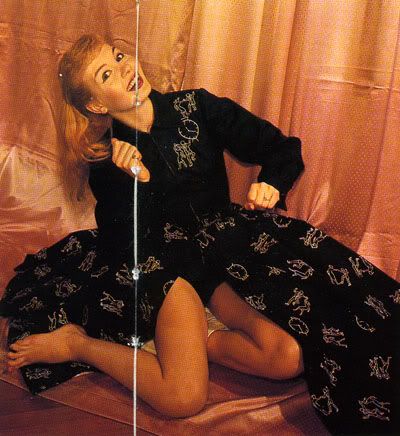
"Clothes specially designed for Rock'n'Roll enthusiasts by Teddy Tinling, 1957."  From Frances Kennett (1983) The Collector's Book of Twentieth Century Fashion, London: Book Club Associates, pp. 88-89.  (Apologies for the book binding cutting through the picture - I'm not skilled, or indeed patient, enough to erase that). 

I'm really enjoying that print of clocks and jiving couples (no doubt a reference to Bill Haley's "Rock Around the Clock")

The elfin model Elizabeth Duke can also be seen modelling some "Jive Fashions" possibly from the same collection (Tinling trousers with a heart-shaped pocket printed with the immortal British rocker Tommy Steele) right here. 

Its clear that Teddy Tinling's gift for tailoring glamorous but practical tennis wear was readily transferable to the demands of energetically jiving rock'n'rollers.  Sadly there appears to be no film footage of his teen-rock'n'roll clothing available. 

But there's plenty more camp fashion delights to be found, especially at my favourite resort for vintage footage, British Pathé.  And this is one of the best, a 1958 film of Tinling's leisure fashions inspired by souvenirs from his holidays:   

TEDDY TINLING HOLIDAY FASHIONS


And this short film from 1955 features both his tennis and leisure wear:

BEACH AND TENNIS WEAR


And I'm going to have to include Tinling's spectacular South Pacific fashion show, as featured in the swelle life blog, just so you don't miss it:

TEDDY TINLING FASHIONS


Teddy Tinling's exuberant style has quite won me over.  I only wish that there was more information available about his fashion adventures, rather than just his tennis wear (as admirable as it was).  If anyone can offer any further information about this I would be overjoyed.  All I can say is that I've never come across a single garment with his label on it, and live in hope that I might - someday.