Showing posts with label 1920s. Show all posts

Wednesday, 10 March 2010

Clothes make the film


Corinne Griffiths in Outcast, 1928, originally uploaded by Trevira.

This post is a bit of a cheat because I haven't written it. It is an article transcribed from an issue of Picturegoer magazine from August 1926 (found while researching at the excellent Bill Douglas Centre for the History of Cinema and Popular Culture), which explores the growing influence of Hollywood on women's fashions.

There's little mention of costume designers, apart from Cora McGeachy and "the well-known New York costumier" Madame Frances.

Cora McGeachy suffers the indignity of being called "Cora MacCreachy" on IMDB, and is credited with only one film, Irene, which is discussed in the article below (incidentally, Irene is available on DVD at Grapevine Video). BroadwayWorld.com supplies another credit: she was the costume designer of the Ziegfeld Follies of 1923 (Summer edition) on Broadway.

Madame Frances apparently employed the young Travis Banton who went on to great things at Paramount.

Hollywood costume designers really hit their stride in the 1930s, with designers such as the aforementioned Travis Banton, Howard Greer and Adrian not just following Paris' lead but creating and launching their own trends.

Indeed, it was necessary for costume designers to create their own fashions, in a sense, since the amount of time involved in film production meant that if they tried to conform too closely to current styles there was the ever-present danger that by the time of release the costumes would be hopelessly out of date. Not to mention the extended period that films might be shown on the circuit - according to this article this was "roughly three years."

So this article is an interesting snapshot of a time when Hollywood still deferred to Parisian authority with regard to fashions - there's mention of the director Frank Tuttle having costumes sent from Paris - but was growing in confidence in its ability to create glamorous costumes of its own. Please enjoy Josie P. Lederer's entertaining report on film fashions in 1926. (I've added links to more information whenever possible, and my comments are in square brackets).


Josie P. Lederer, "Clothes make the film"

For the very latest modes see the movies; they’re nearer than Paris – and cheaper.

As long as there are women in the world, and in the picture theatres, just so long will the title of this article hold good.

For women form the majority of film patrons, and for them and because of them the fashion film was invented. Ever since The Dressmaker from Paris featured a mannequin parade, and registered a great success, every producing company in the U.S.A. has seen fit to make similar specimens.

There is no reason why they shouldn’t. These fashion films fill a very definite want on the part of Mrs. And Miss Suburbia, who go to the movies instead of to Paris to see the latest thing in gowns.

There are over a dozen of these films due for release within the next three months and they are all sure to delight film fans.

The stars, however, are not wildly enthusiastic over them.

Naturally they like the idea of wearing pretty and sumptuous clothes. But, even when they know they are capable of wearing them well, they feel a tiny bit aggrieved at the thought of the success or failure of the film depending, not upon themselves, their director, or their acting, but upon that hitherto unknown quantity, the dress designer.

It is not a question of dollars alone. Battles wage between the great companies, and the bone of contention is the cleverest and most original sartorial specialist. The object is to secure his or her exclusive services.

That is what occurred in Irene, a film famous for presenting the first fashion parade photographed in natural colours – a charming idea beautifully carried out.

In
Cora McGeachy, Colleen Moore vows she has found somebody to whom the commonplace is anathema, and who designs clothes which fit the personality of the wearers as well as the spirit of the story.

The
Irene creations are certainly lovely, from Dame Fashion herself, who introduces the parade, to the various fancy costumes depicting “The Seasons,” and the girls dressed as water lilies, who inhabit the ornamental lake which forms part of the setting.

Colleen Moore’s prettiest is a palest green confection trimmed with row upon row of ostrich feathers, and topped by a large gauze hat with a crown composed entirely of tiny pink roses.

She also wears a striking cigar-brown walking costume; from one of the huge fur-edged sleeves of which peeps the head of a live puppy. The rest of him reposes in a pocket in the cuff specially made for that purpose.

Paramount’s Mannequin, despite its title, has no wonderful fashion parade, but features Dolores Costello and one of the prettiest garden party frocks extant. Picturegoers with imitative minds and clever fingers will doubtless rush home to make one exactly like it.

It is composed of very fine, hand-painted lawn, and its most striking feature is a huge flat bow of black velvet ribbon at the left side of the low waist, held in place by the diamond arrow which plays so dramatic a part in the story.

Though
Mannequin belies the promise of its title, The American Venus, presented by the same company, is little else but a beauty and fashion show. Frank Tuttle, its director, sent to Paris for the costumes, and all the newest and smartest ideas in street and ballroom attire are seen, as well as the snappiest of bathing beauties and bathing dresses.

Louise Brooks, in particular, wears some styles well worth noting, and Dorothy Matthews and Ruth Baren are easily first in the fashion show itself.

Every Gloria Swanson picture is a fashion picture, for the star’s clothes made her reputation and many look to them to support it.

Gloria’s gowns, however, are not for the million. She spends more upon them than any other star; her bills aggregate over 125,000 dollars per annum for film clothes alone.

Then there are her film jewels, which are usually hired at about ten per cent of their actual cost. She wears some 25 pairs of shoes in a picture, and her off screen wardrobe contains nearly fifty walking dresses alone, and over two hundred hats.

The second-best-dressed star is probably Corinne Griffith [featured in the photo above], and she has tried to beat her own record in Mlle. Modiste. After personally combing New York for clothes for this film, she and Madame Frances (the well-known New York costumier), put their heads together and evolved a dazzling wardrobe.

Mlle. Modiste’s hats were made especially for her by Peggy Hoyt, and Corinne spent three days matching up shoes, sandals and evening slippers to her gowns.

The forty gowns Constance Talmadge is to wear for her new crook comedy [this might be Venus of Venice] will prove a potent incentive to fashion fiends to go and see the picture.

And although the dresses in Natacha Rambova’s When Love Grows Cold are outlandish in the extreme, they contain some striking and easily modified ideas, and are worth the admission money. They are very different from Natacha’s ordinary attire, which is striking but severe, and for which Poiret is usually responsible.

Jetta Goudal goes down in movie history as the girl to introduce bouffant gowns into Cecil De Mille productions. That worthy’s heroines had, until the advent of Jetta, been slinky of outline, but “la Goudal” is nothing if not individualistic in her attire.

Interesting facts concerning film favourites can be learned from the studio costumiers who design, fit, and make the film frocks and frills that magnetise so many feminine fans into kinemas.

Most studio designers are agreed that Anna Q. Nilsson, though she is one of the tall stars of filmland, is also so perfectly proportioned that any and every style becomes her.

She can wear hoops or hobble-skirts equally well. The long, flowing gowns and picture hats she affects in the opening reels of
The Greater Glory are a complete contrast to the skin-tight clothes she dons later on in the story.

She looks as well in sporting attire as she does in period garb, and made an excellent boy in
Ponjola and Miss Nobody.

Norma Shearer, Constance Bennett and Dorothy Mackaill would seem to be the young girl’s ideal fashion models.

Constance Bennett has a natural flair for costumes, and the simplest frock, worn as she wears it looks wonderful.

Norma Shearer concentrates very seriously upon her clothes, because her mail tells her how many girls look to her to show them Dame Fashion’s latest whim.

Dorothy Mackaill is a feminine Lon Chaney in that she loses her own personality directly she dons the clothes of the film character she is creating.

She has a slender, graceful figure, and many of her
Chickie and Joanna gowns were eagerly copied by youngsters of her type all over the world.

Fashions come and go so rapidly that it takes an expert to decide what is and what is not a filmable gown.

The life of a big screenplay is, roughly, three years, so that anything that might “date” too definitely must be ruthlessly discarded.

The Fashion picture’s life must, necessarily, be shorter than this, but even then, it justifies its existence, as well as the thousands of dollars spent upon its costumes.

For in the eyes of four-fifths of those who sit in kinemas, clothes, without a doubt do make the film.

-----------------------

I must end with a link to a great article from one of TinTrunk's favourite blogs, The Bioscope, which addresses the subject of fashion on film in the silent era: Catwalks and pavements.

Sunday, 7 February 2010

Santos Casani - the forgotten dance master

If you've ever seen one of those archive film montages of the 'roaring twenties' in a TV documentary, there's one clip that always features. Its the one featuring a couple dancing the Charleston on top of a taxi cab driving through a London street.

That clip is at the very end of this British Pathé dance instruction film (incidentally, fashion history buffs will be delighted by Miss Jose Lennard's lower back skirt hem - a major trend in the last years of the 1920s):

THE FLAT CHARLESTON MADE EASY


The stunt was intended to demonstrate that the new 'flat' Charleston required very little space, in contrast to its original, wild form, which was a veritable whirlwind of flying heels and arms, presenting considerable danger to nearby dancers. Indeed the Charleston was banned from many dancehalls at the time.

It is ironic that this clip is now employed to symbolise the reckless, risk-taking, devil-may-care nature of the times when its original intention was actually quite the opposite.

While I could easily (and quite happily) go on about the Charleston, this post concerns the man who appeared in that film, the famous dance master - and energetic self-publicist - Santos Casani.

Mr Casani was the proprietor of "the largest school of dancing in England," wrote a column for the Daily Mail, and made numerous short dance instruction films for British Pathé's cinemagazine for women, Eve's Film Review. The film company supplied free instruction leaflets based on the dance steps Casani featured, which viewers could send off for, and as a demonstration of how popular these films were, on one occasion they had to print 20,000 leaflets to satisfy the demand (most of this information is derived from Jenny Hammerton's fascinating book For Ladies Only? Eve's Film Review Pathé Cinemagazine 1921-1933).

As an aside, its lovely to imagine a cinema audience practising dance steps under their seats as they watch the films!

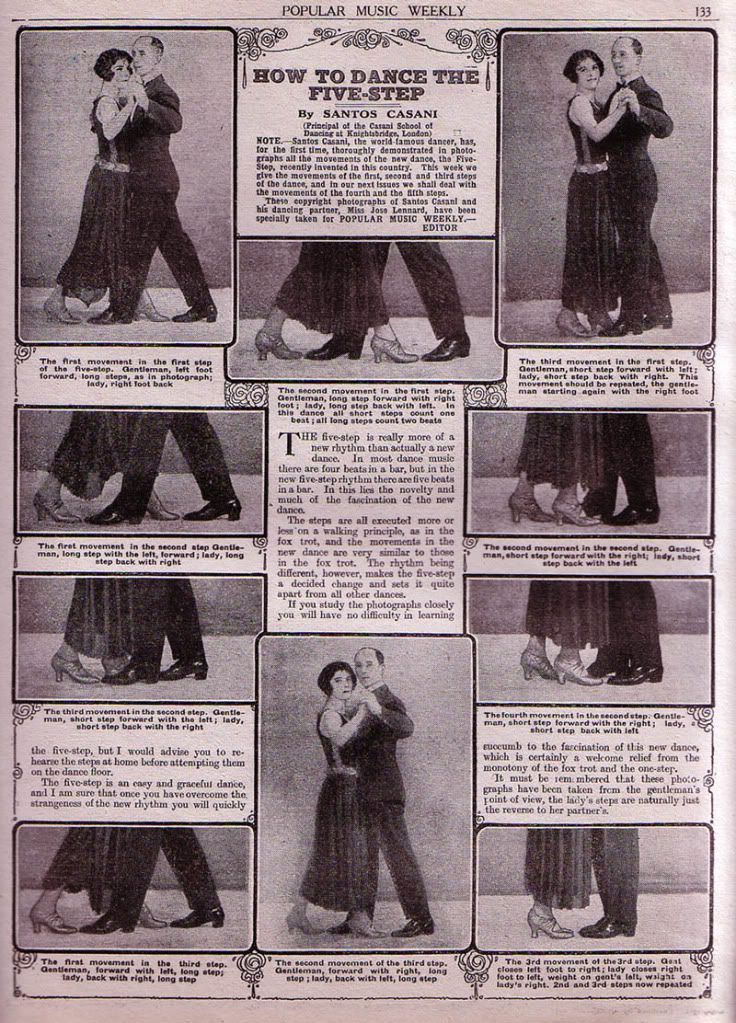
Here Casani makes an appearance in Popular Music and Dancing Weekly magazine, demonstrating the first three steps of the 'Five-Step' - steps four and five were published the following week, but unfortunately I don't have a copy of that issue (again, fashion buffs please note how remarkably long Miss Lennard's skirt was in 1924!):

"How to dance the Five-Step by Santos Casani" in Popular Music and Dancing Weekly, 7th June 1924, page 133 (click picture for a larger view).

In 1933 Casani opened his own nightclub in Imperial House, Regent Street, London and British Pathé was there to record it.

If you were to try to imagine a high-tone 1930s nightclub in the West End of London his establishment lives up to your Art Deco dreams, and this film includes footage of the renowned house band lead by pianist Charlie Kunz, a swimsuit fashion parade, an elegant rendering of the waltz by Mr Casani himself, not to mention a novelty song and a curious female contortionist. Pour yourself into a backless satin dress, shake up a cocktail and join in the fun:

LONDON'S FAMOUS CLUBS AND CABARETS NO. 10 - CASANI'S CLUB


Unlike his near contemporary Victor Silvester, Santos Casani failed to secure himself a place in dance posterity and his name is probably unknown to most people nowadays. But he was clearly a significant figure in his time - a suave, elegant man who knew how to work the media for maximum attention. In his prime, he was Mr Dance, and I'd like to salute his memory.

If you would like to see more of Santos Casani in action, there's plenty more films for you to enjoy.

Thursday, 7 January 2010

Snow fatigue


20s beach girl, originally uploaded by Trevira.

We've had some extraordinarily wintery weather this winter in the UK. The media is full of 'snow chaos' stories, and our local supermarket has empty shelves where the milk should be.

Snow is a fun novelty in this country for a day or two, but after that it gets a little tiresome. Unusually, instead of a rapid thaw within a few days, the temperatures have stayed around or below freezing (-16º C in Manchester last night!) and its become dangerous to even venture to the Post Office around the corner. I'd make better progress with skates rather than my wellies - the only footwear I have with any kind of tread on them.

My room overlooks our suburban street, where the snow has been compacted and polished by traffic into solid ice with a treacherous, glassy sheen, and I've lost count of the cars I've seen losing traction and veering sideways as they struggle to ascend the (very low) incline of the road. The eery whine of wheel-spinning has punctuated my day.

So as a respite from the continuing freeze, I'd like to seek refuge in contemplating the picture above, which is one of my favourites from my collection of old photographs and dates from the 1920s.

Its a reminder of better days - and weather - and a cheery evocation of that carefree summer holiday feeling. To me, every element of this picture is perfect, including the dizzily skewed horizon. Looking at it makes me feel happy and warm, and I hope it works its magic for you too.

Monday, 28 December 2009

A souvenir of Blackpool


I did unexpectedly well for presents this Christmas, and among them was this tiny porcelain shoe sporting the town crest of Blackpool. Judging by its style it possibly dates from the 1900s, and is clearly an imitation of the famous Goss armorial china that was developed in the 19th century and was produced in an almost endless variety of forms.

The Goss range wasn't just extensive in its inventive array of novelty shapes. According to Larch S. Garrad in A Present From . . . Holiday Souvenirs of the British Isles: "Allegedly, Goss souvenirs were produced for every town in the United Kingdom that had a coat of arms."

This example was perhaps made in Germany - the generic red 'foreign' stamp underneath being no help at all in narrowing down its origin. But this doesn't really matter since I have a fascination for British seaside resorts, and Blackpool holds a special place among them.

Blackpool has a good claim to being the world's first working-class seaside resort - a title contested primarily by New York's Coney Island - and both towns developed more or less in parallel. John K. Walton explores the development and decline of both places in his excellent article "Popular Playgrounds: Blackpool and Coney Island, c. 1880-1970" (available to download as a pdf here - scroll down to Volume 17, Number 1).

The millions of visitors who descended on Blackpool every summer holiday season were determined to have fun and spend their money, and perhaps take home a small memento or gift with their last few pennies, and this porcelain shoe was probably very cheap in its day. All the better to attract the eye of the working-class holidaymaker with limited cash.

But a shoe doesn't really say Blackpool to me, even with a fancy town crest on it. The iconic Blackpool Tower however, Lancashire's homage to Paris' Eiffel Tower which opened in 1894, does the job nicely.

This vintage Stratton tieclip features the tower rendered in vivid blue enamel - and is currently available at the time of writing in my Etsy shop, dear reader. As a seaside souvenir, I would argue that its actually pretty tasteful:


Stratton was established in 1860, and is most famous for its men's accessories such as cufflinks and tieclips, not to mention its women's powder compacts. Vintage examples attract avid collectors, but having cast an eye on their current range (Stratton is still going) I have to say I am sadly underwhelmed.

Of course we've got to return to Blackpool in its prime, with three marvellous films from the BFI (British Film Institute) showing the town in three different eras.

First is this 1904 Mitchell and Kenyon film of hordes of visitors promenading on Blackpool's Victoria Pier. This was shot around the time that I reckon my shoe souvenir dates from:


This 1926 film clip, shot by Claude Friese-Green in what looks like a two-colour green/red process, shows the 'Reel' ride at Blackpool's Pleasure Beach. There's also a very pleased "lassie from Lancashire" proudly showing off her feathered kewpie doll prize, from the 'Shalwyn' stall, at the end:


Finally, this fabulous excerpt from the 1957 film Holiday, which reveals some obvious American influence on the town (hotdogs with or without fried onions), the 'Reel' again, and some lovely 50s fashions:

Saturday, 21 November 2009

What could you buy for one shilling in 1928?


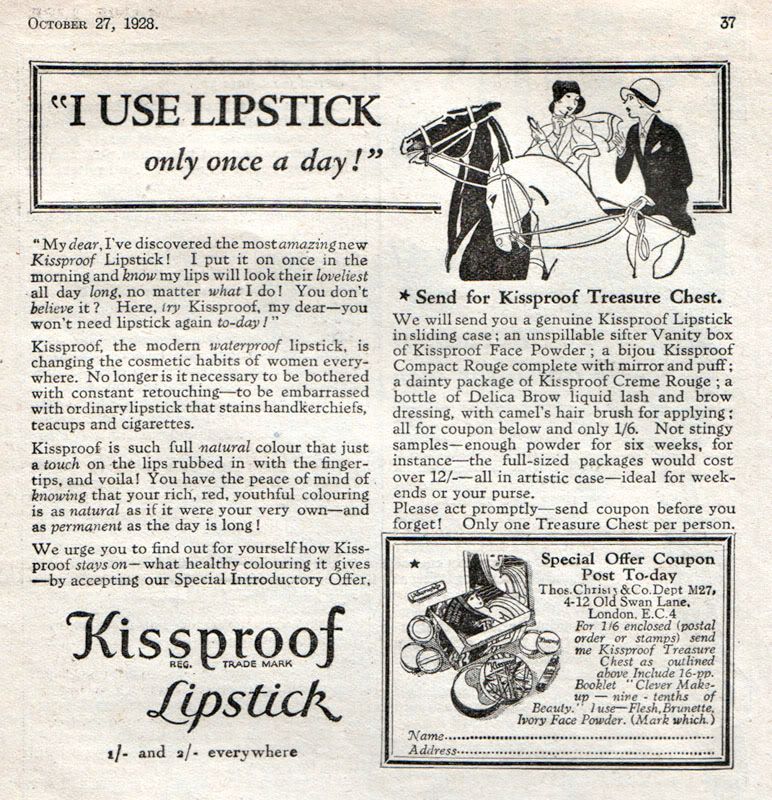
Kissproof lipstick advertisement from Woman's Life magazine, October 27th 1928.


You could buy a Kissproof lipstick in a "rich, red, youthful colouring" that is not only waterproof but requires only one application in the morning because it is "as permanent as the day is long."

Now that is quite some claim to make, because I'm sure that right at this moment there are boffins in the labs of L'Oreal still busily trying to formulate a lasting lip colour to live up to that kind of claim. Perhaps the Kissproof formula included a pigment that actually stained the lips?

According to Wikipedia that was indeed the case: "long-lasting, indelible stains were the most popular" in the 1920s.

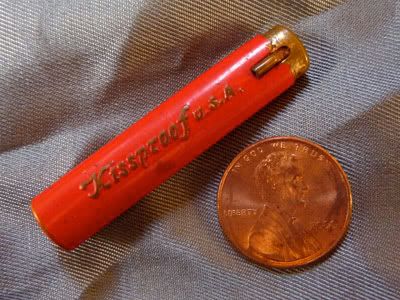
So if this lipstick (lip dye?) required only one application a day, presumably you wouldn't need much of it. In fact, the lipsticks were tiny:

Kissproof lipstick, with a cent for scale (apologies to UK viewers, the cent appears to be the universal indicator of scale - it is slightly smaller than a penny).

This example measures just under 1¾ inches (4.2 cm) long and just over ¼ inch (9 mm) wide. I can't remember how I acquired this lipstick, but I suspect it was from the days when my mother ran a vintage clothes shop and would sometimes find things (shopping lists, hair grips, handkerchiefs, no diamond rings unfortunately) in the old handbags she sold.

Its not cylindrical as you might expect, but a kind of flattened, oval shape, and it has been used right up to the nub (it was a matte, dark red colour, incidentally).

Another popular lipstick brand was Tattoo:

This has the typical cylindrical shape, but is only 1 inch (2.5 cm) in length. It is etched with dancing maidens dressed only in skimpy grass skirts.

Compared to modern lipsticks, these are absolutely tiny, and must have been a boon in the days when handbags were correspondingly petite.

Just to return to the Kissproof ad at the top for a moment: it strikes me as a rather strange advertisement for a cosmetic product. Its very brisk and English, with two posh, outdoorsy women ("My dear") conversing on horseback. This is not the kind of scenario you might associate with a lipstick - I'd imagine a night club, or fancy restaurant, or one of those newfangled cocktail bars that came over from America during the 1920s. Where's the glamour, or the sex appeal?

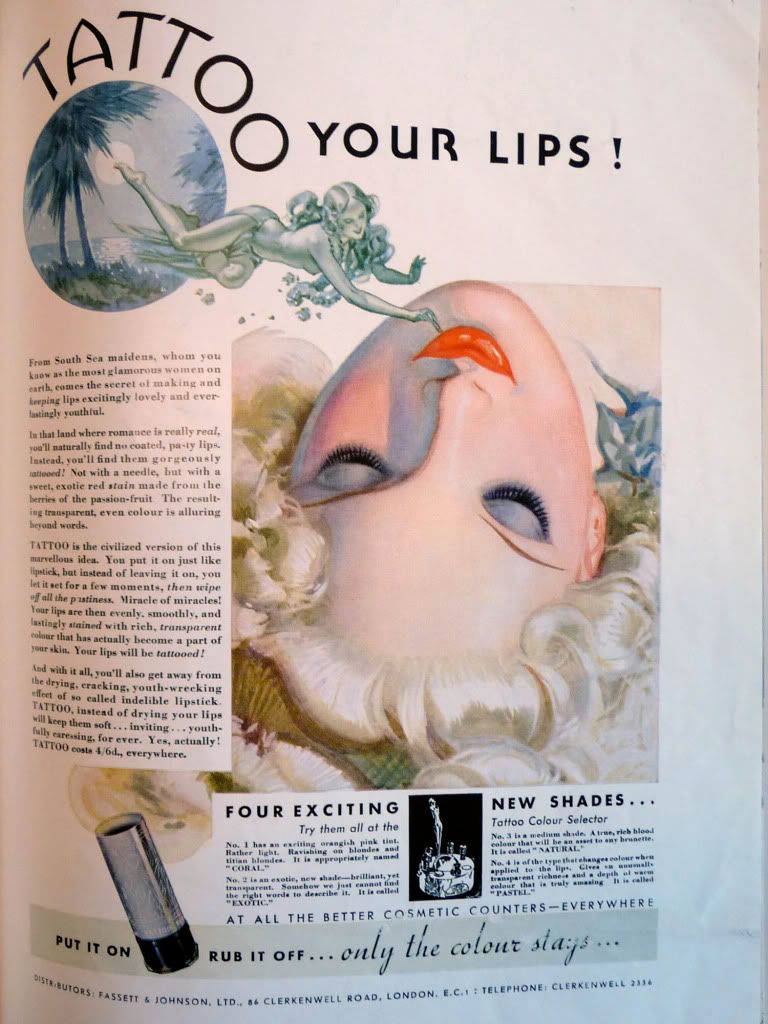
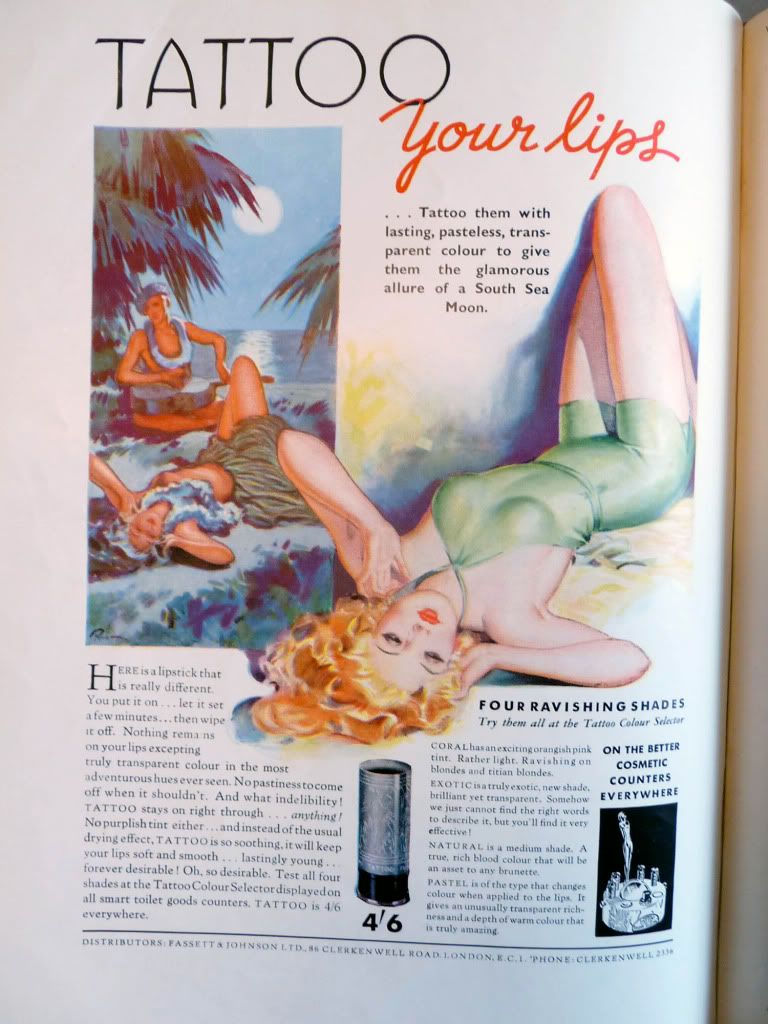
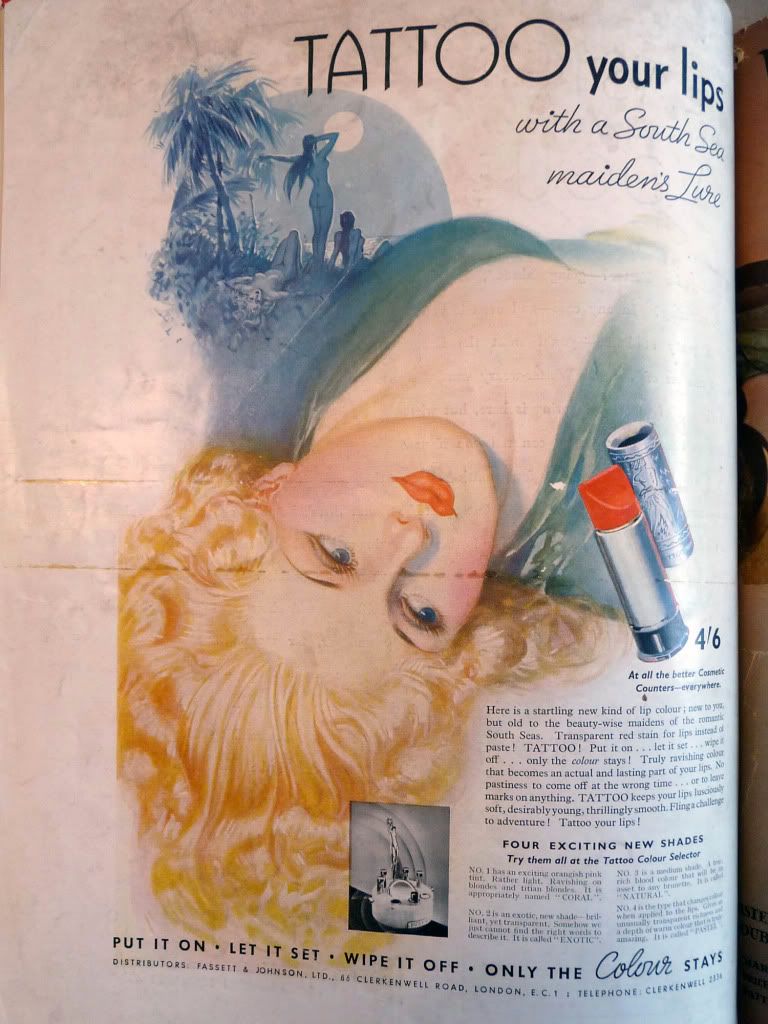
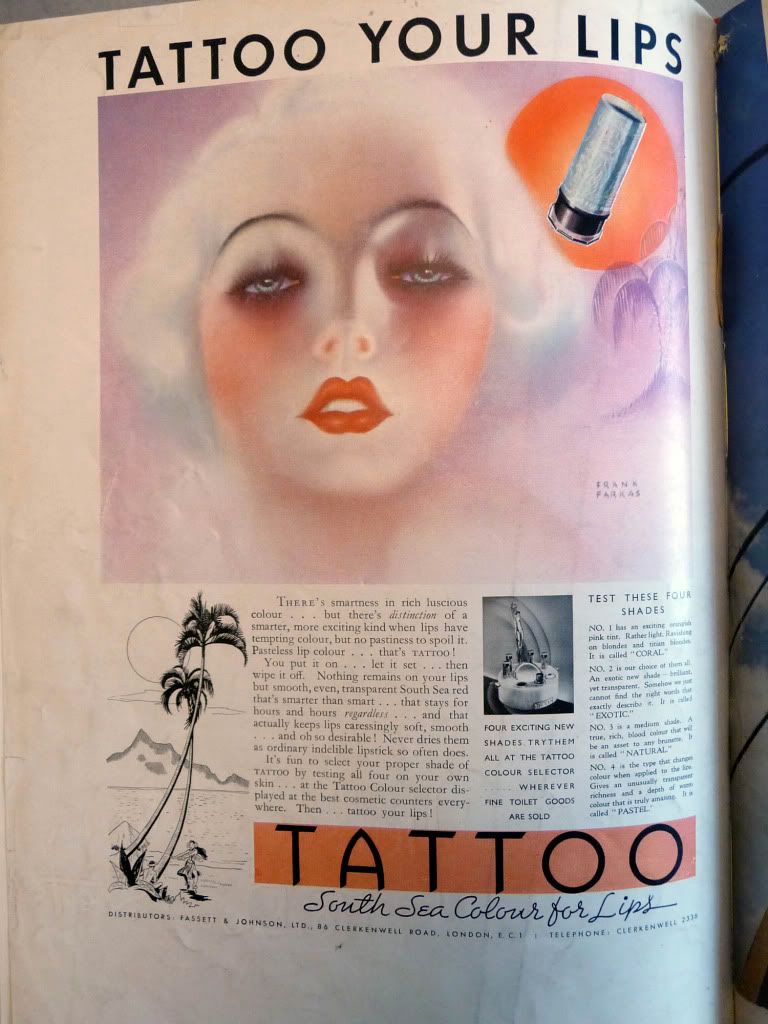
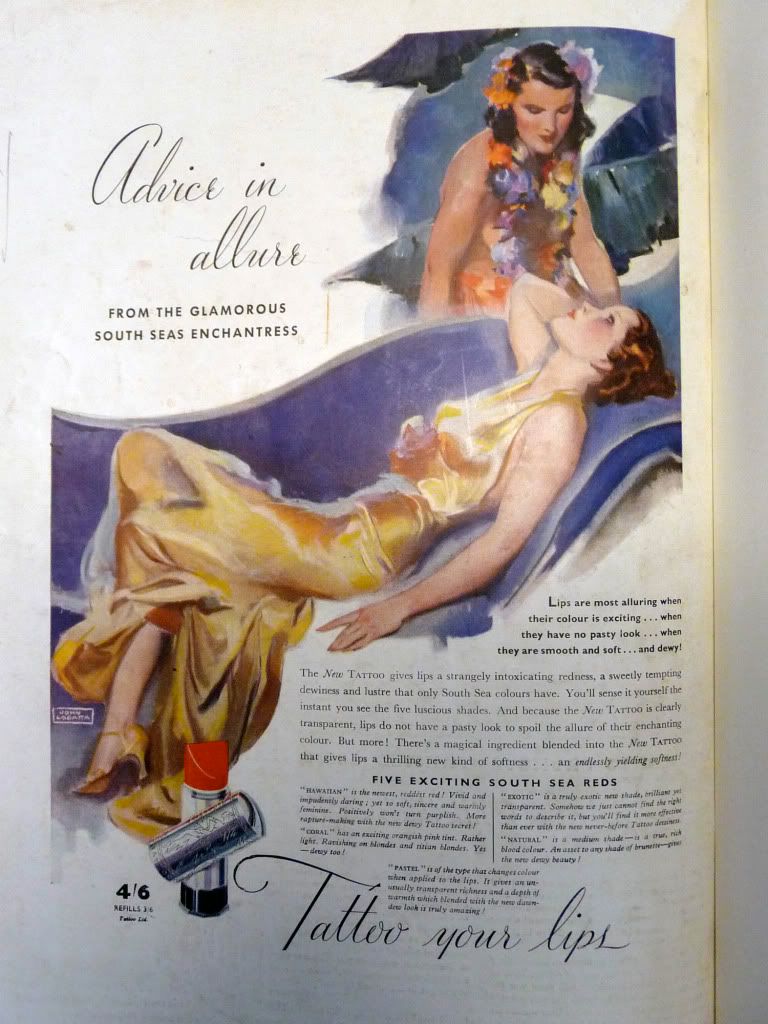
Well, the Tattoo lipstick company knew all about sex appeal, and in a series of advertisements from the 1930s they laid on the glamour and exotic sex appeal with a trowel:


Vogue, 7th August 1935, full page ad on the back cover.

"From South Sea maidens, whom you know as the most glamorous women on earth, comes the secret of making and keeping lips excitingly lovely and everlastingly youthful.

In that land where romance is really real, you'll naturally find no coated, pasty lips. Instead, you'll find them gorgeously tattooed! Not with a needle, but with a sweet, exotic red stain made from the berries of the passion-fruit. The resulting transparent, even colour is alluring beyond words."

Now that's more like it! "Really real" romance! And there's even a glimpse of bosom!

The recumbent female figure with the dewy lips was a signature feature of many of these Tattoo ads:


Vogue, 21st August 1935, full page ad inside the back cover.

Here, a modern, swimsuit-clad young lady precisely echoes the posture of her South Sea island sister, who is so transported by the dreamy guitar melodies that she's writhing on the ground!

"TATTOO is so soothing, it will keep your lips soft and smooth . . . lastingly young . . . forever desirable! Oh, so desirable."

Phew! I think we're getting the message. I'll bet these overheated, sensual ads found a receptive audience beyond their intended market.

Incidentally, they've also dropped the claim that these lipsticks are made "from the berries of the passion-fruit" which I'm sure was completely untrue, not to mention faintly ridiculous, and was probably only added because it had the word 'passion' in it. EDIT: I've re-read the copy and its clear I misunderstood it - those South Sea maidens were supposedly 'tattooing' their lips with passion-fruit - it was not claimed to be an ingredient of the lipstick. I'm not convinced that you would get much colour from a passion-fruit so the idea is still preposterous!


Vogue, 4th March 1936, full page ad on the back cover.


They must have liked that swooning posture, because you can see one of the women at the top of this ad in more or less the same position, not to mention being naked and with two other naked women.

"Fling a challenge to adventure! Tattoo yours lips!"

And what kind of adventure might that be, hmmm?


Vogue, 15th April 1936, full page ad on the back cover.

South Sea exoticism is relegated to the bottom left corner in this 1936 ad, which features an ethereal Jean Harlow type, the right way up for a change. (This illustration is signed by Frank Farkas, about whom I've failed to find out much except that he trained in Europe and worked in an ad agency called Farkas-Jensen-Farkas in Chicago).


Vogue, 7th July 1937, full page ad on the back cover.

This last Tattoo ad, illustrated by John LaGatta has a "South Seas Enchantress" whispering secrets to a languid chestnut brunette in a gloriously liquid satin gown. Its perhaps a little more restrained (if you ignore the hint of lesbian eroticism, that is), although the copy is anything but:

"There's a magical ingredient blended into the New TATTOO that gives lips a thrilling new kind of softness . . . an endlessly yielding softness!"

Well, really. I can feel my inner brisk Englishwoman losing patience now. That's quite enough of that!

[Note: the Tattoo advertisements were found in bound copies of British Vogue, held at the Gallery of Costume, Manchester].

Tuesday, 10 November 2009

Connie bobs her hair

Connie
Connie, originally uploaded by Trevira.

Meet the lovely Connie, captured some time in the 1910s (quite possibly during the First World War), with her tumbling tresses, huge bows and pretty pale silk dress with pearl beading.

Hollywood buffs might be reminded of "America's Sweetheart" Mary Pickford, at that time the most famous woman in the world.

But then the 1920s arrived:

the new modern Connie
the new modern Connie, originally uploaded by Trevira.

And Connie was transformed! She's bobbed her hair, and wears a simple day dress with a Peter Pan collar.

Not only that, but her inscribed greeting on the photographs has changed from the rather formal and restrained 'with love Connie' to the brash and informal 'tons of love Con.' Its not just her hair that has changed!

After I uploaded these two pictures on Flickr I got some interesting responses, including one from anniebee drawing parallels with F.Scott Fitzgerald's 1920 short story Bernice Bobs Her Hair (there's a link to the full text of the story on that page too).

And magpie-moon claimed to prefer the pre-bob Connie, which led me to wonder about the modern appeal of these two different aspects of femininity. Both play on the 'girlish' - the older style a flowery, frilly and wistful look of an adolescent who can't wait to grow up, put her hair 'up' and become a proper lady; the 'newer' style, although it looks more modern to our eyes, actually references the kind of haircut and dress that pre-pubertal girls wore at that time, and suggests a wish never to grow up!

As a rough indication of the relative popularity of these looks, the 1910s Connie photograph has been 'favourited' 23 times and the 1920s Connie has 21 'favourites' - 1910s Connie is ahead by a narrow margin.

I can't let this one pass without the now obligatory British Pathé gem, so here's a young lady getting her hair shingled (a later variant of the bob) in 1924 by the eminent hairdresser Emile Long:

"SHINGLED" - A CUTTING LITTLE EPISODE IN ONE ACT

Monday, 9 November 2009

Everyone was so much smaller in the old days

"With love to dear Gwenn
With love to dear Gwenn, originally uploaded by Trevira.

Of course they weren't all much smaller in the old days, but its surprising how often I'll hear that repeated. Madame, above, photographed in 1909, is a particularly good answer to that lazy generalisation.

And here's another:

now identified: Mercedes Gleitze, champion swimmer

When I first uploaded this picture on Flickr I had no idea who this woman was, and hadn't a hope of deciphering the pencilled autograph across it. She wears a 1920s knitted swimming costume, which turned out to be a bit of clue.

A Flickr contact, alan.98, succeeded in identifying her as Mercedes Gleitze - a well-known endurance swimmer in the 1920s and 1930s who was the first English woman to swim the English Channel in 1927. This incredible feat, completed in just over 15 hours on a bitterly cold day in October, was, within days, beaten by Dr. Dorothy Cochrane Logan. Unfortunately Dr. Logan's 13 hour crossing was soon revealed as a hoax, which led people to doubt Mercedes' own achievement.

Determined to prove her case, Mercedes insisted she would swim the Channel again. Meanwhile, the prestigious watch company Rolex saw this new attempt - and the guaranteed attendant glare of publicity - as a golden opportunity to promote their recently patented waterproof watch, the Rolex Oyster. Miss Gleitze agreed, and wore the watch hung round her neck with a ribbon for her 'Vindication Swim.'

Unfortunately, her attempt at the crossing failed in waters that were even colder than her previous successful swim and she was pulled from the sea almost unconscious after enduring it for nearly 10½ hours. However, she had proved her stamina and endurance, the Rolex Oyster survived and kept perfect time, and Miss Gleitze supplied a glowing testimonial and was featured in subsequent advertisements for the watch. You can read a much more comprehensive account of this story here.

Mercedes Gleitze had the kind of sturdy figure that must have been perfectly suited for this kind of swimming. Although she looks 'big' she was obviously incredibly fit, not to mention incredibly brave and resolute. A thoroughly modern woman in the 1920s, and a name to admire to this day.

I can't help but notice that although she was 'modern' in her pioneering activities, her personal style was actually quite old-fashioned. Her long hair proves that not every woman in the 1920s chopped their hair into a short bob - even though it would have been even more practical for her as a long-distance swimmer. Footage shows that she wore her hair in two plaits which were then coiled round over her ears - Princess Leia style! - which was a popular strategy to avoid actually cutting your hair whilst still approximating the neat, short, fashionable look of a bob.

Miss Gleitze went on to complete marathon swims across the world - including being the first person (not woman, person) to swim across the Straits of Gibraltar in 1928. As if there aren't enough reasons to admire her, she used the money earned from her swims to open the Mercedes Gleitze Home for the Homeless in Leicester in 1933.

The fantastic British Pathé has come up with the goods again! This film supposedly shows Mercedes Gleitze shortly after her failed Channel crossing, although she looks rather too perky to have just been pulled from the waves to me:

A SPLENDID FAILURE

And here she is in action, setting off from Folkestone in 1926 on one of her failed attempts to cross the Channel:

THE CHANNEL WINS AGAIN

Monday, 2 November 2009

Oxford Bags at their widest


"Oxford Bags" at their widest, originally uploaded by Trevira.

Sometimes stories get a bit distorted over time, as evidence is repeated second, third and fourth hand until little essential parts of it go missing.

This picture was found in the book These Tremendous Years 1919-1938 published by the Daily Express. Its a marvellous run through of all the major events, personalities, fashions and crazes of that period, and here - in the 1927 section - is a photograph of a man wearing extraordinary trousers.

The text explains things quite clearly:

'"Oxford bags" at their widest were seen in the West End of London when a man, wanting to win a wager, walked out in trousers measuring forty-eight inches across each leg. The fashion of extra-wide trousers, begun in 1923, though still popular among undergraduates was now dying out generally, but trousers have never got back to the narrow widths of pre-war days.'

So this isn't a fashionable young man pushing the stylistic envelope. In fact he looks like rather a grumpy middle aged man who wants to prove a point. Oxford bags were widely mocked, and even, according to Beverley Nichols, 'somehow connected with atheism, [and] effeminacy.'

This man is ridiculing Oxford bags, and the godless, sissy undergraduates that sported them at the time! You can almost hear him harumphing as he submits to the newspaper photographer's attention while he marches down the road.

But the interesting thing is I've seen this exact photograph reproduced in a popular men's fashion history book to demonstrate the extremes that Oxford bags went to, with no mention of the wager at all.

So a humorous wager and publicity stunt gradually becomes recorded fact and the context is lost to history.

UPDATE: Having given this some thought, the original caption to the picture is misleading. It claims that the trousers measure "forty eight inches across each leg," but I would suggest that that was the circumference, and not the width. A 24 inch width (two feet) is still pretty vast. This confusion between circumference and width might account for the ludicrous misreporting (and its repetition over the years) of the Oxford bags phenomenon.

And further - I've found another picture of this same man in a rather more jovial mood. Perhaps he'd just collected his winnings?

Sunday, 1 November 2009

What could you do for 2/6 in 1924?

Where to dance, originally uploaded by Trevira.

You could go dancing in one of the palatial new dance halls that were appearing all over the country, the first of which was the (recently demolished) Hammersmith Palais de Danse, built in 1919.

The murky newsprint photographs don't give much idea of their scale and splendour, but you can make out the huge, 'oriental' style lanterns that became a signature feature of many of these Palais.

H.V. Morton made a visit to 'A Suburban Dance' recounted in his book Nights of London, published in 1926. His account helps fill those murky little photos with the people and life that is absent from them:

You give eighteenpence to a young woman who is imprisoned behind a brass grille, and you enter the dance hall.

The floor is covered with young men and girls fox-trotting to the music of an excellent band. The hall is large. Big yellow lanterns hang from the roof. Your first impression is that the girls are extraordinarily pretty and the men surprisingly ordinary. The girls have dressed for the dance; the men do not possess evening clothes. Here and there a star dancer has changed into a special kind of trousers, grey or black Oxford trousers as a rule, which billow over very pointed brown shoes. With these trousers he wears the coat and waistcoat of his lounge suit. Young men who do not dance linger in vague, drifting groups on the outskirts of the floor, smoking cigarettes and making comment. Pretty little wallflowers sit out by the dozen. Now and again two girls rise and dance together.

The music ends, the lights go up. Then a surprising thing occurs. In an instant men and girls have parted! The girls go over to one end of the room to sit on chairs ranged against the wall; the men group themselves in bands and coteries around the floor and light up the cigarettes which they had left parked on the radiator!

You look at the girls with interest. Most of them work in the big shops in the district. Each one wears a knee-short, tasteful evening frock and light stockings. You look along the rows of chairs and realise that here are seen the prettiest, neatest legs in London. In the Ritz, the Savoy, Claridge's, the pretty woman is easily picked out from the crowd; in this eighteenpenny suburban dance 'hop' a new beauty dawns on the sight of each minute; the girls are all between the ages of sixteen and twenty-five. Perhaps that is the secret; they have abundant vitality and youth. They also have abundant lip-stick and powder, and one or two have Eton-cropped their heads.

It strikes you again and again that they are too vital and brilliant for the dull youths who lean against the wall and smoke cigarettes and whisper.


And if you'd like to see a glimpse of possibly 'the prettiest, neatest legs in London' the British Pathé film archive has a short clip of the Wimbledon Palais (the dance hall at the top of the advert) filmed in 1926:


DANCE TIME