Showing posts with label youth culture. Show all posts

Monday, 22 November 2010

Cathy McGow-ow-ow-owan

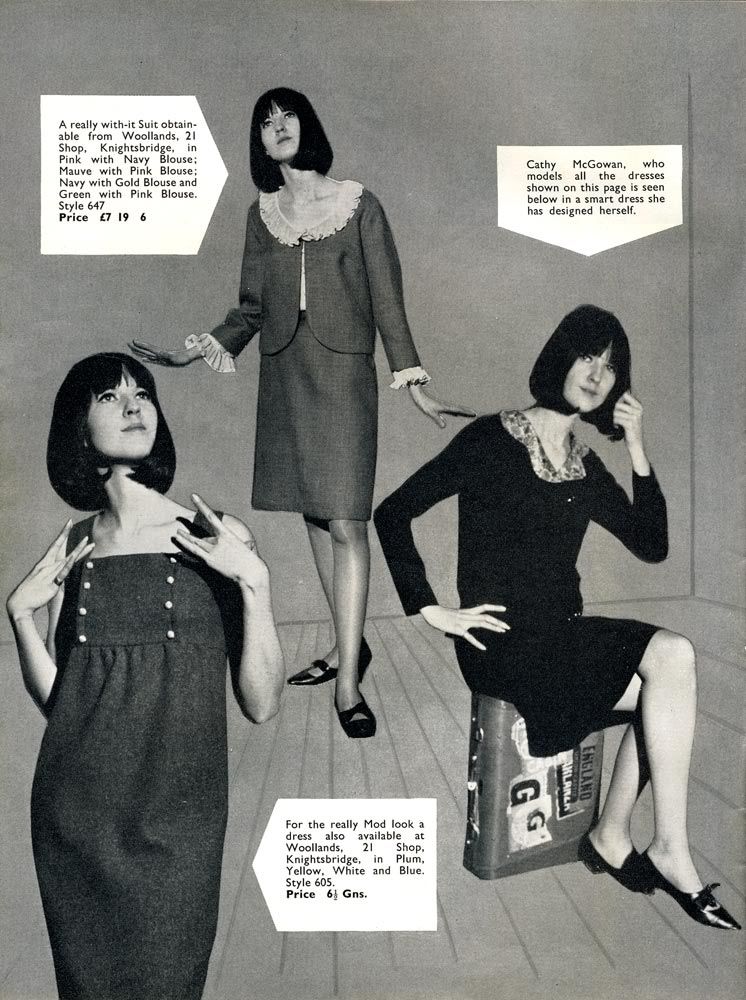
Cathy McGowan models dresses, including one of her own design on the right, in Mod's Monthly, March 1964.

Two things have prompted this post.  The first was finally deciding to sell a treasured mid-60s Cathy McGowan's Boutique mini mac that's been in my personal collection for years.  You can take a peek at it right here.

The second was the ever wonderful Miss Peelpants, who, as well as kindly offering her opinion on my mac, posted some scans from the first ever Cathy McGowan's Boutique catalogue on her blog.

Its hard to gauge precisely how well known Cathy McGowan is these days - are teenagers aware of her in the same way that they might know something about Twiggy? - but she was, in her time, just as much of a style icon as La Moss is today (whatever you might think about her).

As presenter of Ready, Steady, Go! from 1964-66 she demonstrated an unerring sense of style that proved hugely influential to the hordes of young teenage girls who were avid viewers of the TV show, tuning in not just to see the latest pop sensations and dance steps, but Cathy's new outfit of the week.

I have four copies of The Mod's Monthly magazine from 1964, which I've covered before and no doubt will plunder again at some point, and Cathy features largely in all of them.  Quite naturally since she was famously known as the "Queen of the Mods."

Wednesday, 7 July 2010

Get dressed in the NME, 1981-5

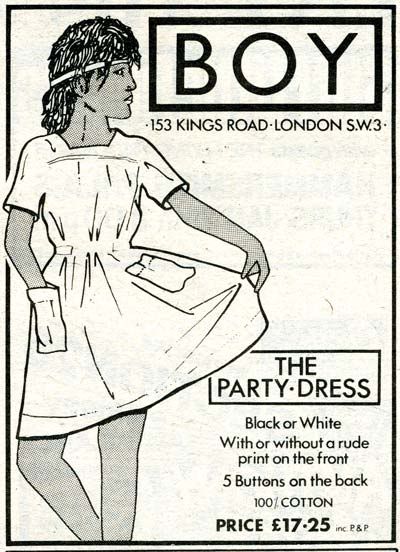
Boy advertisement, NME, 19th December 1981, page 83. 

Here's the last of the clothing ads from the small pile of NMEs remaining in my possession, and these date from 1981 to 1985.  You might notice that most of them come from the bumper Christmas issues, which were the ones I was most likely to keep for their end-of-year summaries, not to mention the hugely enjoyable collections of fatuous quotes from pop stars cherry-picked from the year's interviews.

So Boy's advertisement (above) for a party dress is rather confusing.  It looks like a summer dress to me, especially accessorised with the headband/sweatband.  Mind you, "rude print[s]" are appropriate for all seasons - and wouldn't you love to know what that "rude print" they so primly didn't show was?


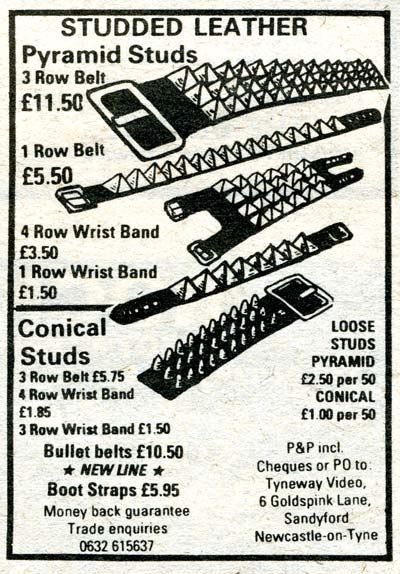
Another all season item is the studded leather belt and Tyneway Video (?) has a very nice pyramid stud example on offer, along with wrist bands and boot straps:

Studded leather advertisement from Tyneway Video, NME, 19th December 1981, page 83.


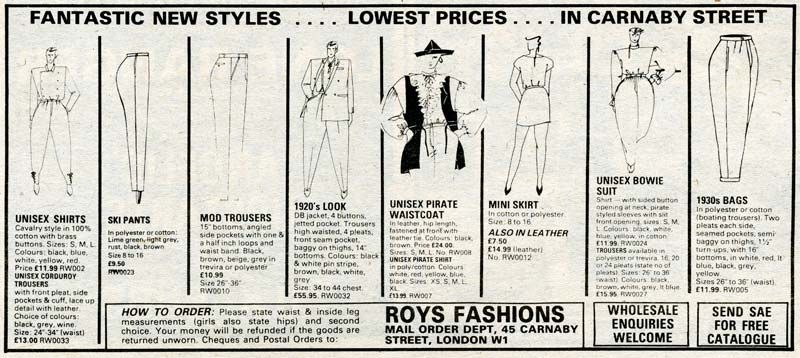
You might remember Roy's Fashions from the previous post, and his December 1981 ad doesn't disappoint:

Roy's Fashions advertisement, NME, 19th December 1981, page 83.  Click on the picture for a larger view.

Roy's range has definitely gone more New Romantic, with a dashing unisex pirate waistcoat and matching pirate shirt, a balloon-legged unisex Bowie suit and what is billed as a "1920s look" suit, although from that sketch it couldn't look more 1980s to me.


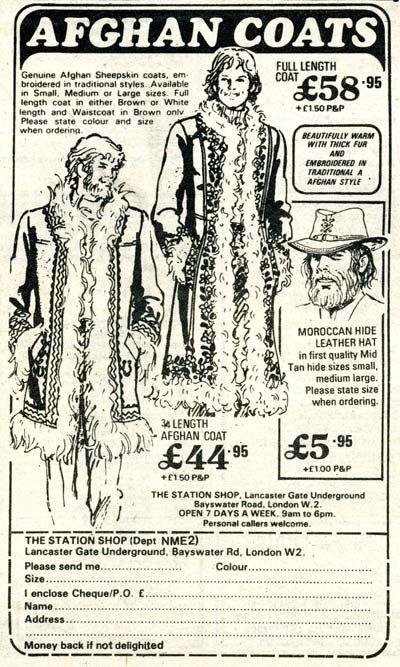
Afghan coats from The Station Shop, NME, 3rd January 1981, page 33.

Are those hippies still here?  Well clearly they are, and the Station Shop is still flogging these wretched Afghan coats to them.  Just stay out of the rain if you're wearing one - if you've ever smelt a wet Afghan coat you won't want to repeat the experience.

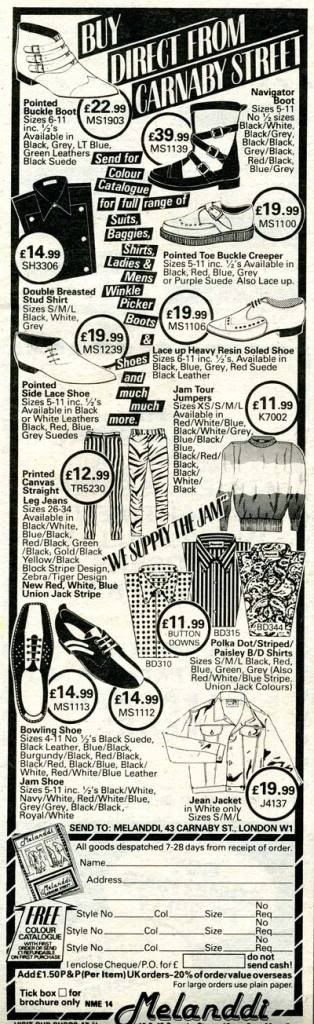
And now a scanner-stretching long ad from Melanddi, proud suppliers to the Jam, from December 1982:

Melanddi advertisement, NME, 25th December 1982, page 75.

The printed canvas jeans remind me that I thought I'd find an ad for Modzart, who were the prime purveyors of printed canvas strides at the time - and I was sure their ads were regularly featured - but I didn't find one.

Moving swiftly on from that deeply uninteresting observation . . .


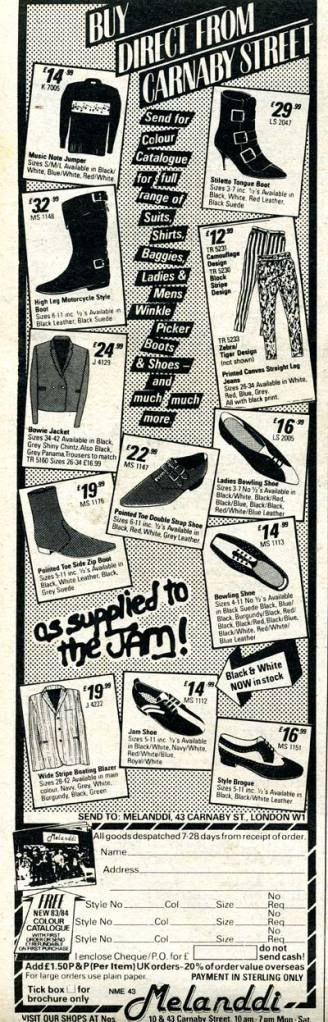
Melanddi advertisement, NME, 24th December 1983, page 75.

Here's Melanddi's Christmas 1983 ad, with a rather curious "Stiletto Tongue Boot" among its newer offerings. 


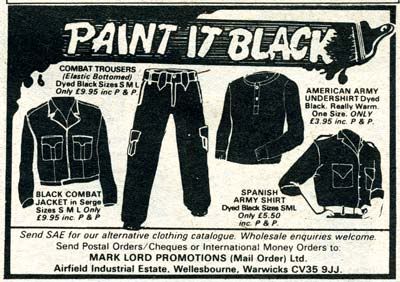
Mark Lord Promotions advertisement, NME, 24th December 1983, page 75.

Mark Lord Promotions have a novel line in black-dyed military surplus which I'm struggling to associate with any particular youth culture grouping of the time.  Its a bit too butch for the goths (hang on, when did New Model Army appear?), maybe a bit too austere for the punks . . . any help here would be much appreciated.


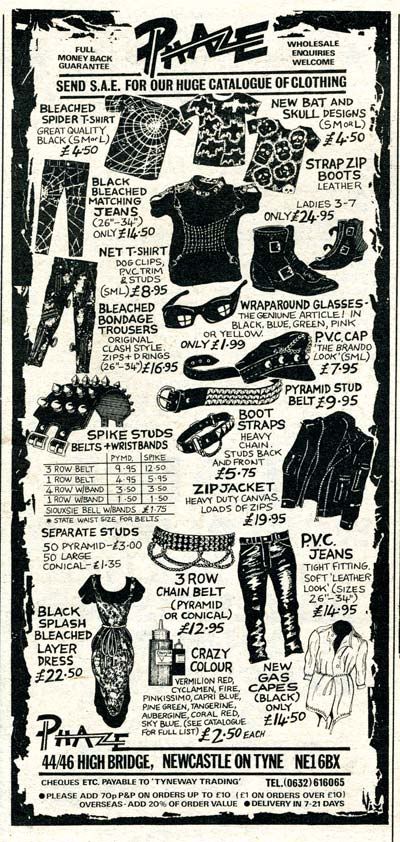
Phaze advertisement, NME, 24th December 1983, page 75.

Phaze of Newcastle has some proper cartoon goth gear, including some splendid bleached spider (web) jeans.  The note at the bottom that cheques should be made out to "Tyneway Trading" might suggest a link with the Tyneway Video studded leather ad earlier.


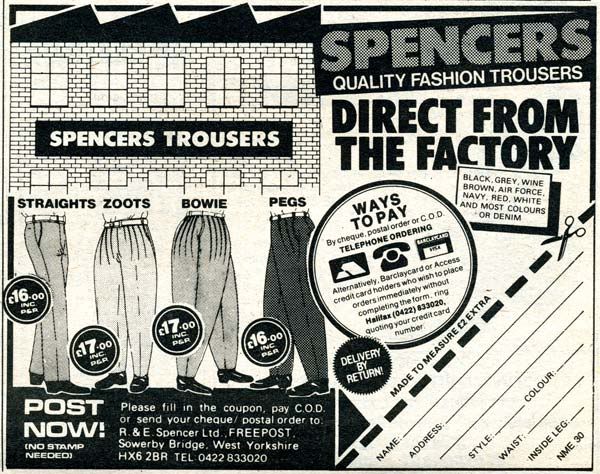
Spencers Trousers advertisement, NME, 24th December 1983, page 75.

I love the specialist suppliers' ads, and Spencers Trousers' one is a goodie.  In case you didn't believe they were "direct from the factory" there's a picture of it right there.  Despite the rather conventional graphic design, this ad inspires confidence in their trousers, and will you look at those Bowies - magnificent!


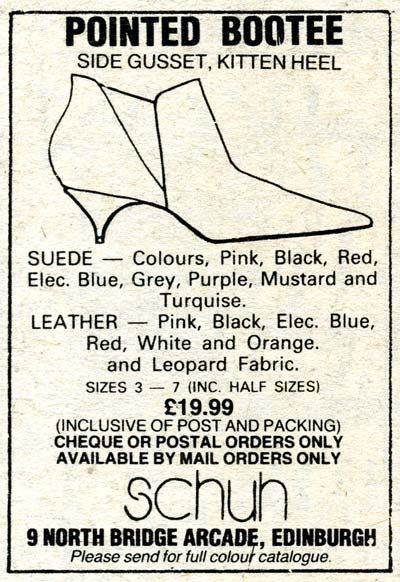
Schuh pointed bootee advertisement, NME, 24th December 1983, page 75.

A modest start for one of the familiar names on the British high street these days.  Schuh's pointed bootee is rather lovely, and comes in an extensive range of colours, plus leopard skin fabric.  I'm picturing Fay Fife of Edinburgh's finest, the Rezillos, in these. 

And here's another familiar shoe retailer, although possibly past its prime now:

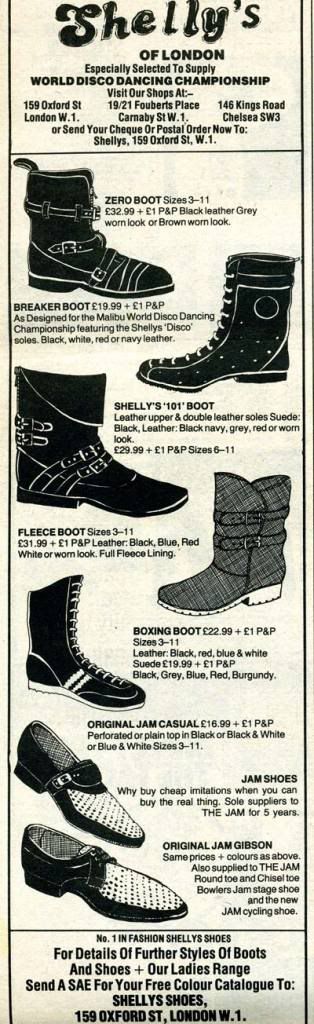
Shelly's of London shoe advertisement, NME, 24th December 1983, page 76.

I had no idea they supplied footwear to the World Disco Dancing Championship, which is quite some endorsement for the quality of their shoes.  The WDDC provided some golden tv moments in the late 70s and early 80s, and there's plenty of clips to enjoy on Youtube.  I've just spent far too long watching a few of them, but I failed to spot Shelly's breaker boot with the "disco" sole. 


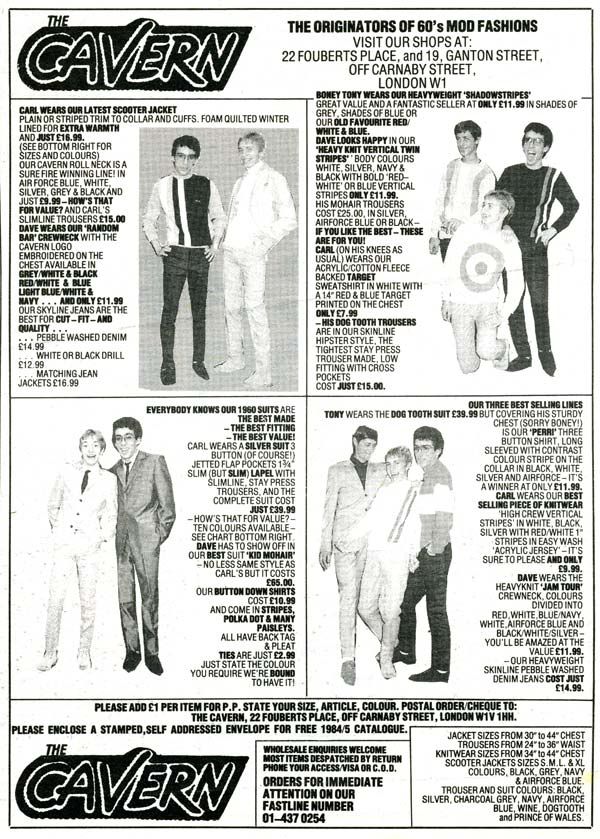
The Cavern advertisement, NME, 22/29th December 1984, page 75.  Click on picture for a larger view.

The Cavern is strictly mod, and I think its rather nice that they name their models.  So please meet Carl, Dave and "Boney" Tony.


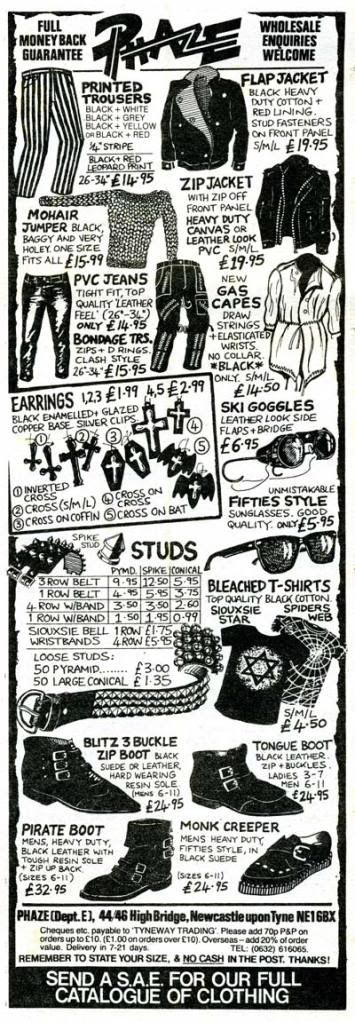
Phaze advertisement, NME, 23rd February 1985, page 37.

Phaze return in 1985 with their goth range, and a smattering of punk.

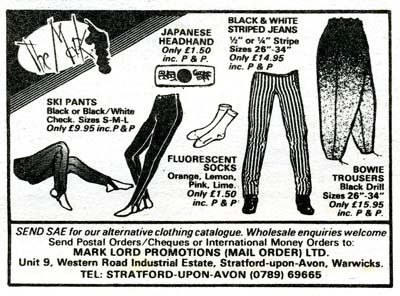
And finally, Mark Lord Promotions' 1985 ad (now trading as 'The Mark') has dropped the black dyed combat jackets and gone a bit New Wavey.  And the Bowie trousers endure:

The Mark advertisement, NME, 23rd February 1985, page 37.

If anyone has any surviving items from these advertisers, or remembers wearing any of this stuff, your comments would be most welcome.

The only things that I recall having are the Sid-Vicious-on-tv t-shirt I mentioned in the previous post, plus a Boy punk shirt that was a copy of the Sex/Seditionaries ones with a woven patch of Karl Marx and a bleach written message "Only Anarchists are pretty."  This I bought from the Boy shop rather than mail order, and, incidentally, was filmed doing so by a Japanese breakfast tv show!


Oh yes, and some Shelly's extra-thick crepe soled brothel creepers.  Ah, memories . . .


Directory of advertisers

The Alien, 20 Corporation Street, Bolton, Lancs (skinhead coats)

Baxby Fashion House, 227 Portobello Road, London W11 (punk and mod)

Boy, 153 King's Road, London SW3 (punk)

The Cavern, 22 Fourberts Place, Carnaby Street, London W1; 19 Ganton Street, Carnaby Street, London W1 (mod)

Fab-Gear, 42 Call Lane, Leeds (also X Clothes shop premises) (punk/new wave)

Furs and Jeans, 48 Manor View, London N3 (Afghan coats)

The General Franchise Co. Limited
, 22 Park Grove, Edgware, Middlesex HA8 7SJ (Ted/rock'n'roll)

J. Holdsworth, 95 Lots Road, Chelsea, London SW10 (punk and mod)

P. Leach, 50d Redcliffe Gardens, Chelsea, London SW10 (punk)

Mainline, 51 Two Mile Hill Road, Kingswood, Bristol, BS15 1BS (punk)

Mark Lord Promotions
(mail order) Ltd, Airfield Industrial Estate, Wellesbourne, Warwickshire CV35 9JJ (black dyed army surplus)
By 1985 advertising as 'The Mark' at Unit 9, Western Road Industrial Estate, Stratford-upon-Avon, Warwickshire (new wave)

Melanddi, 43 Carnaby Street, London W1 (mod, new wave)

Phaze, 44/46 High Bridge, Newcastle-on-Tyne NE1 6BX (punk, goth)

Printout Promotions
, 28A Abington Square, Northampton (punk, mod, metal)

Punters Choice by Cadiss, 117 Hammersmith Road, London W14 (slim ties)

Radar
, 1st Floor, Virgin Records, Union Street, Glasgow and 3 Dundas Street, Edinburgh (retail stockist of P. Leach, punk)

Retro, 26 Union Street, Broadmead, Bristol 1 (mod leather)

Roy's Fashions, 1st Floor, 45 Carnaby Street, London W1 (new wave, mod, new romantic)

Schuh, 9 North Bridge Arcade, Edinburgh (new wave shoes)

Shapes, 252 High Street, Waltham Cross, Hertfordshire, EN8 N78 (hippy/ethnic)

Shelly's of London
, 159 Oxford Street, London W1; 19/21 Fouberts Place, Carnaby Street, London W1; 146 Kings Road, Chelsea SW3 (mod, punk, new wave shoes)

R & E Spencer Ltd, Sowerby Bridge, West Yorkshire, HX6 2BR (trousers)

The Station Shop, Lancaster Gate Underground, Bayswater Road, London W2 (Afghan coats)

Tyneway Video, 6 Goldspink Lane, Sandyford, Newcastle-on-Tyne (studded leather)

Sunday, 13 June 2010

NME fashions, 1980

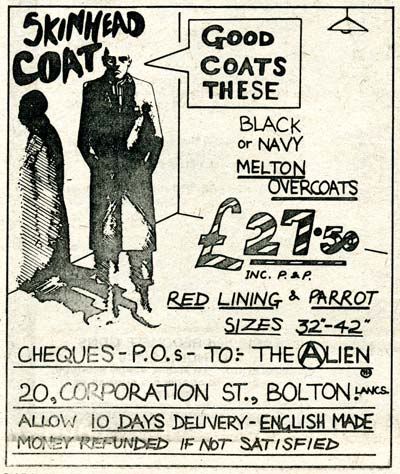
'The Alien' advertisement, NME, 20th December 1980, page 72. 

A brisk canter now through the NME clothing advertisements from my three surviving copies dating from 1980.  Starting with an authentically menacing hand-drawn ad for skinhead coats (presumably Crombie style) with a nicely no-nonsense tag line: "Good Coats These."

Fab-Gear advertisement, NME, 20th December 1980, page 72. Click image for a bigger view.

Fab-Gear of Leeds have the new wave angle covered, and their ad indicates that their retail outlet was X Clothes, an alternative clothing business that started in Manchester.  Music trivia fans will be delighted to learn that Johnny Marr worked in that Manchester branch just prior to forming the Smiths.


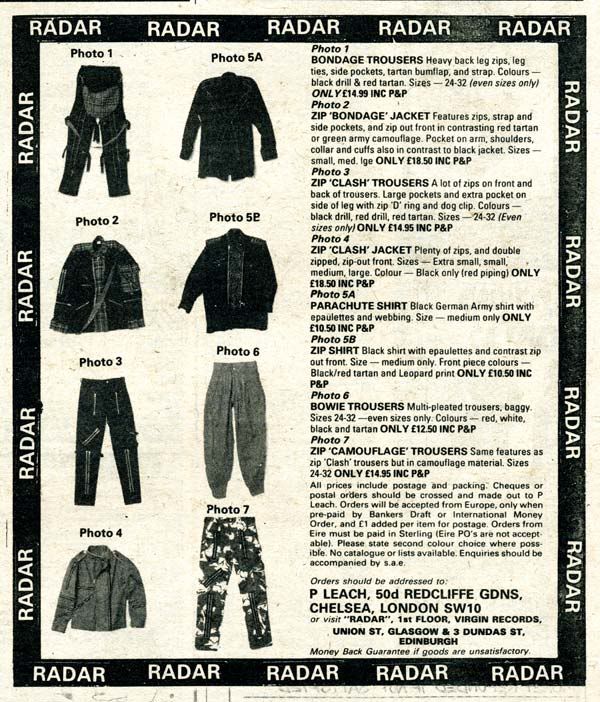
'Radar' advertisement, NME, 20th December 1980, page 73.  Click image for a bigger view.

Radar appears to be a Scottish retailer with shops in Glasgow and Edinburgh, but mail orders are referred to 'P. Leach' of Chelsea, which must be the same company as (possibly misprinted) 'B. Leach' whose bondage trouser ad from 1979 featured in the previous post.

You'll notice that multi-pleated 'Bowie Trousers' were a firm favourite around this time and several  advertisers (in this and the subsequent blog post coming soon) provide their own version of them. 


'Baxby Fashion House' advertisement, NME, 20th December 1980, page 72.  Click image for a bigger view.

Baxby's lamentable line drawings inspire little confidence, especially that Crombie in the bottom right corner.  Oh dear.

These days we routinely expect online retailers to provide full colour photographs from every angle, eye-popping zooms and even rotating 360º views, and it makes you realise what a considerable leap of faith it must have been to have sent off your cross-signed postal order based on a tiny, mis-shapen sketch that gives only the vaguest idea of what the garment might actually look like.


'J. Holdsworth' advertisement, NME, 29th March 1980, page 48.  Click image for a bigger view.

J. Holdsworth's drawings aren't much better, but at least there's a bit more detail. 


'Printout Promotions' advertisement for punk gear, NME, 29th March 1980, page 47.  Click image for a bigger view.

With some of these advertisers you get a sense that there might be some enthusiasm or at least interest in the culture they are exploiting catering for, but Printout Promotions isn't one of them.  They are just happy to produce whatever seems to be in demand.  And there's nothing wrong with that at all, in fact I admire their versatility.

So above, you'll see the punk range, and coming up below is the rock selection:


'Printout Promotions' Giant Rock Sew Ons advertisement, NME, 29th March 1980, page 48.  Click image for a bigger view.

Heavy Metal wasn't really the NME's turf (that was more Sounds territory) and this is the only specifically rock-related merchandise ad I found in my small and highly unrepresentative survey.

Mind you, I can't help warming to that slogan: "Rock on your Chest!"


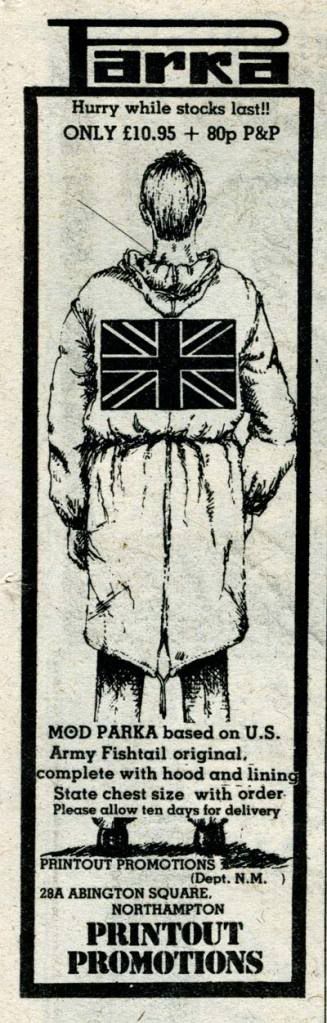
'Printout Promotions' parka advertisement, NME, 29th March 1980, page 48.  Click image for a bigger view.

And here Printout turns its hand to mod styles with Union Jack emblazoned parka.  In fact, I'm sure there were plenty of other subcultural fields that Printout Promotions trained their sights on.  An online search turned up a scanned copy of CB World magazine from April/May 1981 featuring a full page ad of theirs with the proud message: "Leaders in the field of personalised CB wear," which presents merchandise including everything from bodywarmers to car sunstrips.

From versatility to extreme specialisation, let's welcome the self-styled "most exciting Company in the Universe":


'Punters Choice by Cadiss' slim ties advertisement, NME, 27th September 1980, page 53.  Click image for a bigger view.

Punters Choice by Cadiss want to help those of you with overly wide ties, and their Asteroids tie certainly sounds tempting.  Interestingly, they accept Access credit cards - the only NME clothing advertiser I've found that does so - but without a telephone number it looks like those ties will remain "Hard To Find."


'Boy' mail order punk advertisement, NME, 27th September 1980, page 53.

Boy were one of the, er, big boys of punk clothing and I dearly wish I'd sent off for one of those full colour catalogues.

This ad has proved useful to me, though, by way of the mention of Kitsch 22.  I have an old sleeveless t-shirt with a picture of Sid Vicious on tv (printed sideways) that has a perversely black on black woven label.  After much squinting and angling to catch the light on this mystifying label I've discovered that it reads "Kitsch London" and probably came from Boy.

The t-shirt had been featured in a fashion magazine piece showcasing new t-shirt designs and I must have sent off for it, although I have no memory of doing so.  But I kept that clipped picture of the t-shirt (indeed it may still be around, somewhere . . .) and the garment remains in my wardrobe nearly 30 years later.

Steering back to the business in hand, the blog Planet Mondo has some pictures from the 1981 Boy Blackmail catalogue that are definitely worth a look.


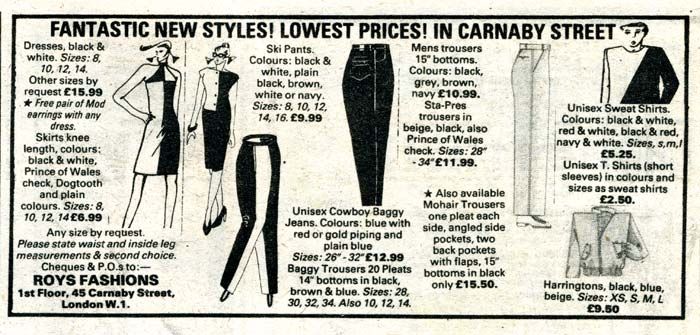
'Roy's Fashions' advertisement, NME, 29th March 1980, page 48.  Click image for a bigger view.

I have a soft spot for Roy's ad, which has a lot to do with that black and white block panel mod dress.


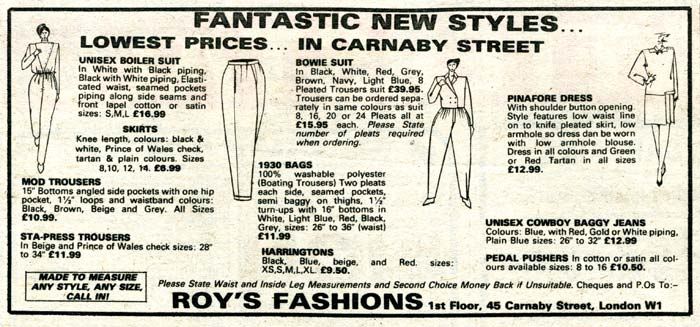
'Roy's Fashions' advertisement, NME, 20th December 1980, page 73.  Click image for a bigger view.

And here's Roy in December 1980 offering not just Bowie trousers but a full Bowie suit for £39.95.


Finally, its heartening to see that the Teds, Britain's oldest and most venerable youth subculture, were not forgotten in 1980.  The General Franchise Company was there to dress them in Polyester Viscose Gaberdine:

'The General Franchise' Drapes and Drainpipes advertisement, NME, 29th March 1980, page 47.  Click image for a bigger view.

The next post will gather up the remaining NME clothing ads scanned from issues dating from 1981 to 1985, and I'll include a handy directory of all the advertisers just to keep up the nerd quotient.  Stay tuned . . .

Friday, 11 June 2010

What could you buy for £6.90 in 1979?

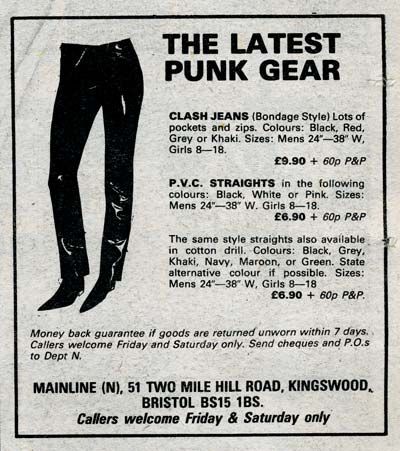
'Mainline' advertisement from the New Musical Express, 29th September 1979, page 63.  

You could treat yourself to some P.V.C. straights - in black, white or *gasp!* pink - as illustrated here in an advertisement by Mainline of Bristol.

I know punks were supposed to be skinny, but the smallest men's size offered here is an extraordinary 24" waist. This might suggest the target market included some very young punks indeed. 

On my recent browse through what little remains of my NME collection, I was drawn to the clothing ads that featured regularly in its back pages and seemed to cater for nearly every youth culture tribe active at the time.

Personally, I wouldn't have dreamed of ordering anything from them because I instinctively mistrusted those monochrome line art drawings and assumed that the garments would be shoddy and disappointing.  I'm sure this was most unfair in some cases, but when you're school-age and pocket money is tight, you tend to be ultra-cautious about where you spend your money. 

That said, I'd like to hope they would have provided a valuable service to provincial (and especially rural) teenagers, keen to express their tribal preferences in sartorial form, who lived more than a tube ride away from Camden Market or the King's Road. 

So, back in 1979, punks were pretty well catered for as you might expect:

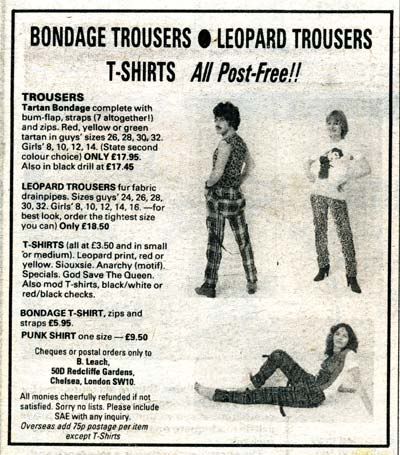
'B. Leach' advertisement, NME, 22nd December 1979, page 73.  

B. Leach of Chelsea offers tartan bondage trousers at £17.95 (bum flap and 7 straps included), and suggests that you order your fur fabric leopard drainpipes in "the tightest size you can."  Those models might have the requisite skinny figures, but they're just not trying hard enough with their hair.  Bondage-trouser-man looks like one of Harry Enfield's scousers, and the two women could be Nolan sisters.

However, it is still the 1970s and the hippies haven't yet been scared away by all those young punks in super tight trousers.

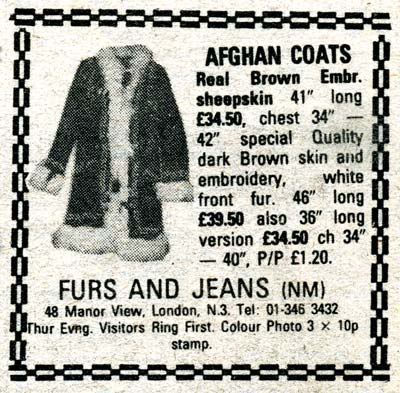
'Furs and Jeans' advertisement, NME, 22nd December 1979, page 73.  

It looks like its much more expensive to be a hippy than a punk.  £34.50 could get you nearly two pairs of B. Leach's bondage strides, or exactly five pairs of Mainline's P.V.C straights, not including p&p of course. 

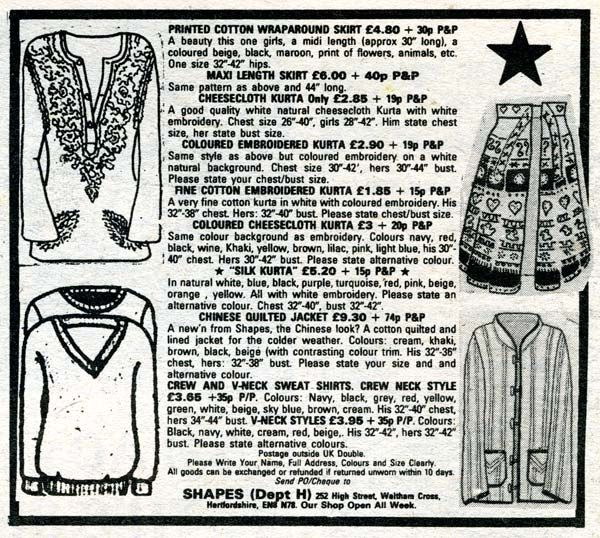
'Shapes' advertisement, NME, 29th September 1979, page 64.  

Maybe its not that expensive being a hippy after all, since Shapes of Waltham Cross, Hertfordshire, is providing printed cotton wraparound skirts for £4.80 and white cheesecloth Kurtas for £2.85. 

But if anyone's known for excessive spending on their wardrobe, its the mods.

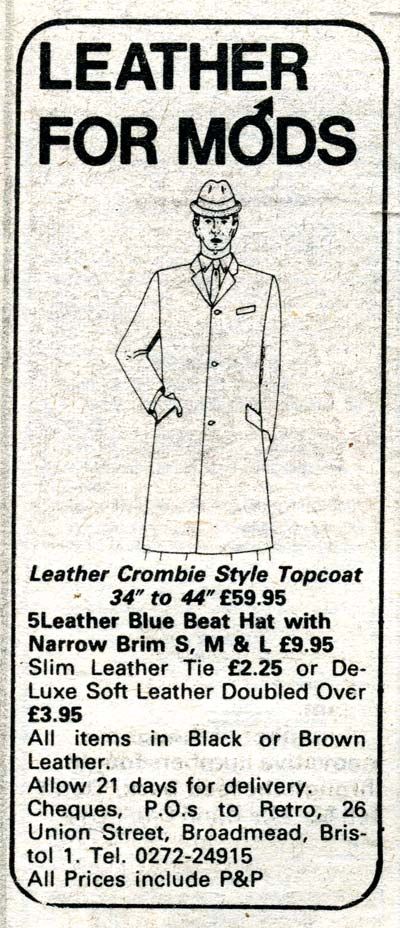
'Retro' advertisement, NME, 22nd December 1979, page 73.  

This leather "Crombie Style Topcoat," from Retro of Bristol, costs an impressive £59.95, and I'm sure I don't remember seeing any late-70s-mod-revival mods wearing one.  Leather ties, certainly, and possibly the odd leather "Blue Beat" hat, but the coat was probably not a big seller given that price. Plus, maybe I'm a bit conservative, but the idea of a Crombie in leather sounds pretty naff to me. 

That's about it from my two surviving copies of the NME from 1979.  There's plenty more ads coming as we plough on through into the 1980s and I'm determined to share them all! 

Authentic punk clothing - with the 'right' labels such as Seditionaries/Sex, Boy and so on - is now fetching big money from enthusiastic collectors.  I would argue that the other contemporary youth culture styles are interesting too, not least because very little of it seems to survive.

People grow out of their teenage enthusiasms and are often quick to bin those embarrassing reminders of their youth as they grow up, start thinking of their careers and/or their new young families, and decide that Pink Floyd were actually amazing despite what Johnny Rotten scrawled on his famous t-shirt.  

The mail-order retailers featured above weren't exactly authentic, but they provided cheaper copies for the majority of people who couldn't afford the originals.  I won't get into the arguments about whether this was piracy or not, or about quality issues - it was inevitable.

You might come across some of this old gear, and some of it might have labels sewn in (this isn't a given - many don't).  With my collector/vintage dealer head on, I reckon these ads might be a useful resource for finding out about those garments.

If you've still got something from one of these companies, or you remember ordering furry leopard print drainpipes from the NME, I'd genuinely love to hear about it.

Tuesday, 11 May 2010

Better Badges

I've been thinking about badges recently, and about how important they were to me in my early teenage years.

As a pupil at a school that required a uniform, badges were one of the few ways to broadcast your sophisticated taste and esoteric musical enthusiasms, and political/ethical concerns if you had any.  Of course, there were also the exuberantly biro'ed pencil cases and army surplus canvas bags but that's another story.

Crucially, they were also very cheap and made ideal pocket money purchases.

There were important distinctions in the style of badges dependent on your musical preferences.  I remember pop music badges in the 70s tended to be large and full colour - a photograph of a beaming David Essex as big as a coaster, for example.  Heavy metal fans favoured enamelled metal badges, or the later cheaper versions which were basically a metal square with a shiny plastic sticker, and the obligatory sew-on patches for their frayed denim waistcoats.

Punk and New Wave fans were more austere in their badge preferences (this was probably a result of limitations in budget and manufacturing capabilities as much as aesthetics).  Monochrome tended to be the rule, or maybe two colours at a push, and they were always small.  Bold graphic band logos tended to work best at this scale, PiL's being a particularly successful example which worked at every size from button badge to shoulder-spanning back-of-the-leather-jacket artwork. 

I filled up my school blazer lapels from a small record retailer in Lincoln called Sanctuary records, which had a black felt-covered board covered in tiny, ¾" badges from which I made my careful selections.

Around the same time, I began reading the NME which had a regular advertiser - Better Badges.  They placed their tiny box ad on the inside last page, always in the bottom right corner.  Happily, I've just found the remains of my NME collection (now reduced to about a dozen copies in total) dating from 1979 to 1985.  And the early ones do indeed have Better Badges ads.

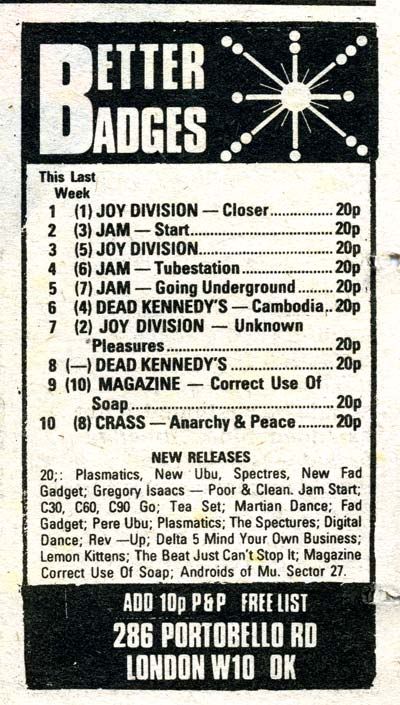
Better Badges ad, NME 27th September 1980.

As you can see, they presented their top sellers in a weekly chart and it gives a wonderfully concise snapshot of the popular underground (if that's not a clumsy oxymoron) music scene of the time.  Apart from the Jam, who weren't underground at all really (despite that song title, yes I see it!)

I can imagine little teen mods satisfying their fan worship by stocking up on badges whilst they save up to buy some black and white bowling shoes, just like Paul Weller's.

Schoolkids usually don't have much money to spend.  You might buy a badge of a record before you bought the record itself.  Or you might buy the badge instead of the record, and satisfy yourself with a fuzzy tape recording of the track off John Peel.  At least you knew about it, and you could let everyone else know you knew about it too.

Better Badges was great because it was right on the money, producing little mascots of nerdy fandom exactly when you needed them.  Before 'everyone else' had heard of them.


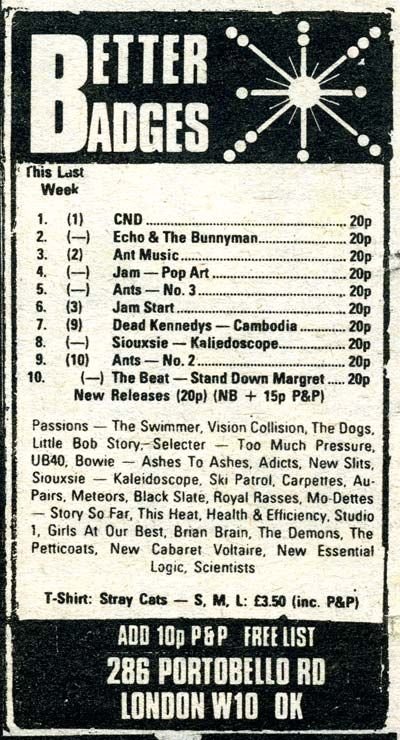
Better Badges, NME 3rd January 1981.  

This ad from January 1981 indicates a rising political awareness with the CND badge (Campaign for Nuclear Disarmament) topping the chart.  I'm sure it was around this time that I sent off for my copy of the CND booklet Protest and Survive, which scared me witless.

I honestly can't remember if I ordered badges directly from Better Badges.  Being isolated in a village in rural Lincolnshire, I regularly sent off postal orders for records and fanzines, and then raced to beat the dog to the post before she tore the packages to shreds (I still have a few records with teeth marks).  The company was also an important producer and distributor of fanzines and its very likely that some of my postal orders went to them, but I'm hazy on this.  At any rate, its certain that I wore their badges.


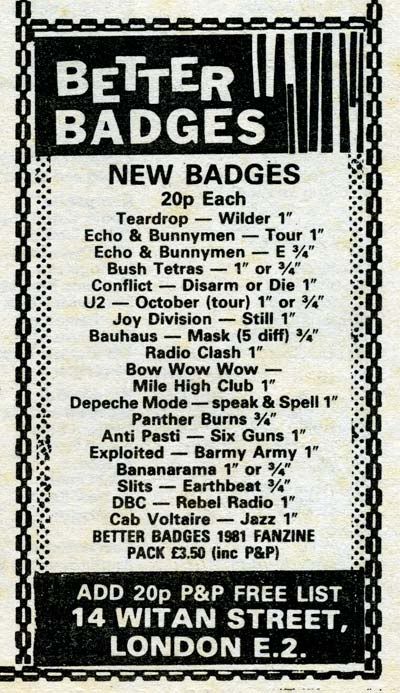
Better Badges ad, NME 19th December 1981.

By December 1981, Better Badges had dropped the chart and just listed their new productions, and the P&P had doubled to 20p.

The next year - 1982 - I left school and went to art college, and I think my badge-wearing years ended at around the same time.  Perhaps I considered them a little gauche and immature now I was a grown-up student (oh dear).  It looks like Better Badges stopped advertising in the NME shortly after this too, since my few later copies don't have their ads.

This enjoyable trawl through old NMEs has lead to a day-long scanning session because I was drawn to the clothing ads in the back pages.  So my next few posts will explore the delights of the mail order clothing companies that sold through my (then) favourite music weekly.  


Further reading

I've been very slack about doing research for this post, in fact I haven't done any in my rush to post something after quite a lull.

If you would like to learn more about Better Badges, check these links:

A short history of Better Badges and its role in badge and fanzine production and distribution.

An article by Joly MacFie, founder of Better Badges, which explores how the emergence of cheaper reproduction technologies enabled the DIY/anyone-can-do-it ethos of punk. 

A Village Voice article about Joly MacFie and punkcast.com.

Thursday, 25 February 2010

Constructing the Teddy Boy

One of the most conspicuous aspects of the British Teddy Boy was his hair; that towering quiff carefully and regularly primped with a comb - perhaps a flick knife comb for extra posing points! - and secured with copious fistfuls of pomade.

At least since the nineteenth century, men's hair was simply cut short and combed flat, sometimes slicked with the macassar oil that gave Victorian and Edwardian housewives such headaches worrying about their stained upholstery they were forced to invent the antimacassar. The only possible variations seemed to be in the parting of the hair, and tonsorial exuberance was confined to the moustache.

Given all those long decades of modesty and simplicity in men's hair, it must have been quite a shock in the early 1950s to see young men constructing glossy (and greasy) edifices of hair and quite shamelessly preening in what was seen as an effeminate manner. There can't have been many young men who went quite to this, er, length though:

MEN'S HAIR STYLES


This 1956 film was shot at Cyril Parker's hairdressers shop in Tottenham Court Road, London. The hair 'sausage' or 'elephant trunk' seems very similar to the postiches used by Victorian and Edwardian women to pad out their hairdos - think of those voluminous bouffant styles as sported by the "Gibson Girls" which often needed substantial postiches to achieve.

There's very little footage of Teddy Boys in the British Pathé archive, although interestingly the two clips I've found focus on their hair. So here's the second film, shot at a hairdressing show in Belle Vue, Manchester, in 1955.

There's some bizarre ladies' hairdos, and a varied selection of men's haircuts including the 'Petronius' (Roman style), the 'Curled Semi-Crew Cut,' the 'Brush Cut' and the 'Tony Curtis.' You can catch a brief glimpse of Lew Starr (finessing the Brush Cut), who was the Teddy Boy hairdresser in Manchester, and - I'm told by one who remembers - always had intimidating queues of scowling, smoking ruffians outside his salon in Charles Street:

PAGEANT OF HAIR STYLES


And we all know what 'D.A.' really stands for, don't we?!

Sunday, 1 November 2009

What could you do for 2/6 in 1924?

Where to dance, originally uploaded by Trevira.

You could go dancing in one of the palatial new dance halls that were appearing all over the country, the first of which was the (recently demolished) Hammersmith Palais de Danse, built in 1919.

The murky newsprint photographs don't give much idea of their scale and splendour, but you can make out the huge, 'oriental' style lanterns that became a signature feature of many of these Palais.

H.V. Morton made a visit to 'A Suburban Dance' recounted in his book Nights of London, published in 1926. His account helps fill those murky little photos with the people and life that is absent from them:

You give eighteenpence to a young woman who is imprisoned behind a brass grille, and you enter the dance hall.

The floor is covered with young men and girls fox-trotting to the music of an excellent band. The hall is large. Big yellow lanterns hang from the roof. Your first impression is that the girls are extraordinarily pretty and the men surprisingly ordinary. The girls have dressed for the dance; the men do not possess evening clothes. Here and there a star dancer has changed into a special kind of trousers, grey or black Oxford trousers as a rule, which billow over very pointed brown shoes. With these trousers he wears the coat and waistcoat of his lounge suit. Young men who do not dance linger in vague, drifting groups on the outskirts of the floor, smoking cigarettes and making comment. Pretty little wallflowers sit out by the dozen. Now and again two girls rise and dance together.

The music ends, the lights go up. Then a surprising thing occurs. In an instant men and girls have parted! The girls go over to one end of the room to sit on chairs ranged against the wall; the men group themselves in bands and coteries around the floor and light up the cigarettes which they had left parked on the radiator!

You look at the girls with interest. Most of them work in the big shops in the district. Each one wears a knee-short, tasteful evening frock and light stockings. You look along the rows of chairs and realise that here are seen the prettiest, neatest legs in London. In the Ritz, the Savoy, Claridge's, the pretty woman is easily picked out from the crowd; in this eighteenpenny suburban dance 'hop' a new beauty dawns on the sight of each minute; the girls are all between the ages of sixteen and twenty-five. Perhaps that is the secret; they have abundant vitality and youth. They also have abundant lip-stick and powder, and one or two have Eton-cropped their heads.

It strikes you again and again that they are too vital and brilliant for the dull youths who lean against the wall and smoke cigarettes and whisper.


And if you'd like to see a glimpse of possibly 'the prettiest, neatest legs in London' the British Pathé film archive has a short clip of the Wimbledon Palais (the dance hall at the top of the advert) filmed in 1926:


DANCE TIME