Showing posts with label magazine. Show all posts

Monday, 22 November 2010

Cathy McGow-ow-ow-owan

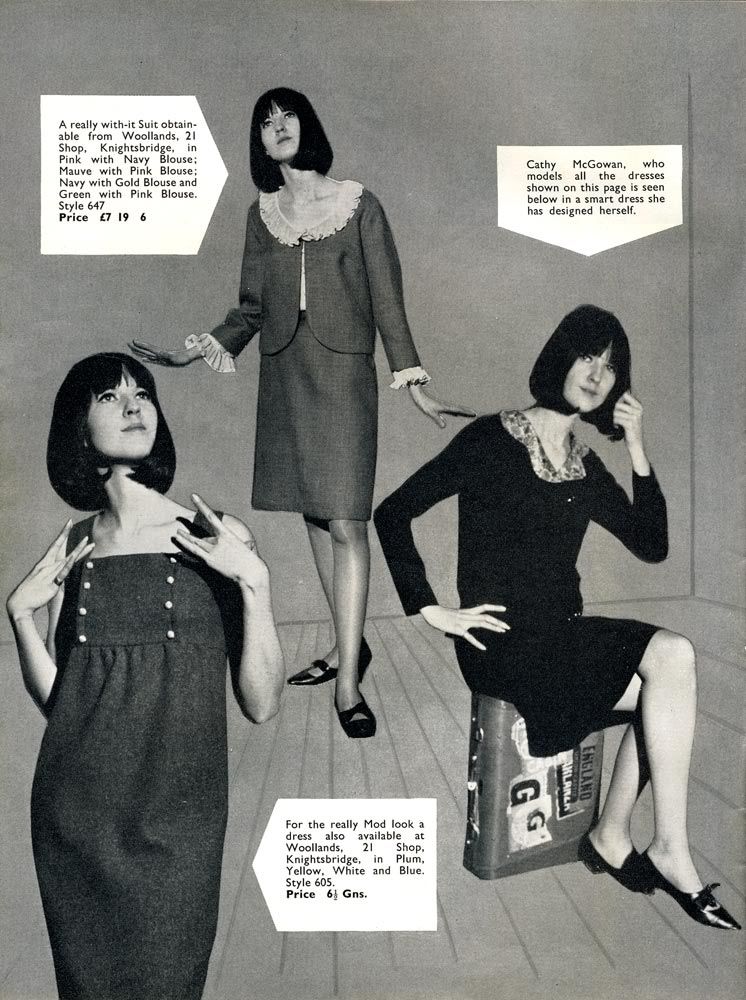
Cathy McGowan models dresses, including one of her own design on the right, in Mod's Monthly, March 1964.

Two things have prompted this post.  The first was finally deciding to sell a treasured mid-60s Cathy McGowan's Boutique mini mac that's been in my personal collection for years.  You can take a peek at it right here.

The second was the ever wonderful Miss Peelpants, who, as well as kindly offering her opinion on my mac, posted some scans from the first ever Cathy McGowan's Boutique catalogue on her blog.

Its hard to gauge precisely how well known Cathy McGowan is these days - are teenagers aware of her in the same way that they might know something about Twiggy? - but she was, in her time, just as much of a style icon as La Moss is today (whatever you might think about her).

As presenter of Ready, Steady, Go! from 1964-66 she demonstrated an unerring sense of style that proved hugely influential to the hordes of young teenage girls who were avid viewers of the TV show, tuning in not just to see the latest pop sensations and dance steps, but Cathy's new outfit of the week.

I have four copies of The Mod's Monthly magazine from 1964, which I've covered before and no doubt will plunder again at some point, and Cathy features largely in all of them.  Quite naturally since she was famously known as the "Queen of the Mods."

Saturday, 17 April 2010

That Tinling feeling

Advertisement for Teddy Tinling's salon from Vogue, 14th April 1937, page 120.  From the Gallery of Costume, Manchester. 

What a singular character Teddy Tinling was!  The opening line of the Wikipedia entry I just linked to does a great job of indicating as much, in its customary dry and succinct manner: "[Teddy Tinling] was an English tennis player, fashion designer, spy and author."  As a career resumé, that one is pretty hard to beat. Plus he was "openly gay" in the days when that was hardly a safe option.

These days people might recall the frilly knickers he created for the American tennis player Gertrude 'Gorgeous Gussie' Moran in 1949, and the kerfuffle those provocative undergarments caused in the media. 

Tinling made his name creating expertly tailored and glamorous tennis wear for many of the star players of his day, but his career in the rag trade began much earlier in 1931 when he opened a salon in South Kensington, London, specialising in wedding and evening gowns for the "carriage trade."  This was evidently successful because by 1937, when his nicely surreal advertisement (above) appeared in Vogue, he was plying his trade in the much posher environs of Mayfair. 

The Second World War interrupted his fashion career and prompted his drastic career switch to spying for the British Intelligence Corps.  I'm sure there's lots of interesting material about his wartime adventures, but sadly they don't appear to be online so I shall press on regardless. 

Shortages of luxury fabrics after the war saw the ever-pragmatic Tinling turning to the growing market of sportswear . . . actually this is all very well documented in the links I've added so I'm going to cut straight to my point and spare you the painful paraphrasing. 

Teddy's tennis wear suggests a fondness for flamboyance, which is certainly borne out in the British Pathé film archive.  The swelle life blog has a fabulous post about one of those films so I won't repeat it here (please visit that link to enjoy it, and don't miss this post about his tennis gear too). 

Here's more evidence.  He embraced rock'n'roll with some delightful garments for teenage fans:

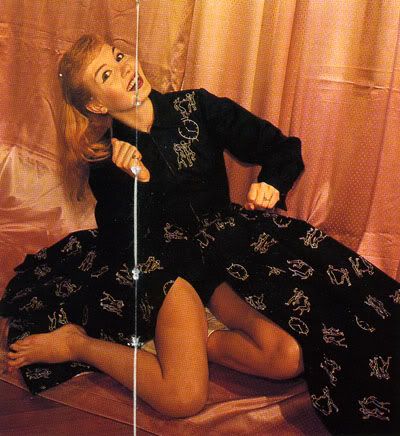
"Clothes specially designed for Rock'n'Roll enthusiasts by Teddy Tinling, 1957."  From Frances Kennett (1983) The Collector's Book of Twentieth Century Fashion, London: Book Club Associates, pp. 88-89.  (Apologies for the book binding cutting through the picture - I'm not skilled, or indeed patient, enough to erase that). 

I'm really enjoying that print of clocks and jiving couples (no doubt a reference to Bill Haley's "Rock Around the Clock")

The elfin model Elizabeth Duke can also be seen modelling some "Jive Fashions" possibly from the same collection (Tinling trousers with a heart-shaped pocket printed with the immortal British rocker Tommy Steele) right here

Its clear that Teddy Tinling's gift for tailoring glamorous but practical tennis wear was readily transferable to the demands of energetically jiving rock'n'rollers.  Sadly there appears to be no film footage of his teen-rock'n'roll clothing available. 

But there's plenty more camp fashion delights to be found, especially at my favourite resort for vintage footage, British Pathé.  And this is one of the best, a 1958 film of Tinling's leisure fashions inspired by souvenirs from his holidays:   

TEDDY TINLING HOLIDAY FASHIONS


And this short film from 1955 features both his tennis and leisure wear:

BEACH AND TENNIS WEAR


And I'm going to have to include Tinling's spectacular South Pacific fashion show, as featured in the swelle life blog, just so you don't miss it:

TEDDY TINLING FASHIONS


Teddy Tinling's exuberant style has quite won me over.  I only wish that there was more information available about his fashion adventures, rather than just his tennis wear (as admirable as it was).  If anyone can offer any further information about this I would be overjoyed.  All I can say is that I've never come across a single garment with his label on it, and live in hope that I might - someday.

Sunday, 14 March 2010

The Message Wearers


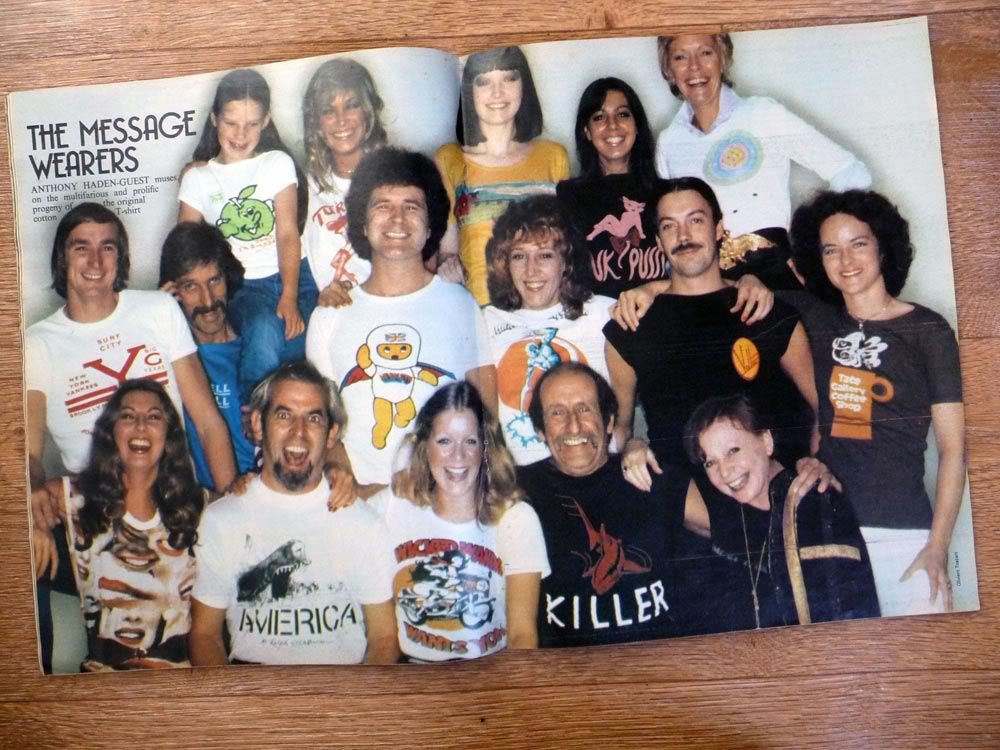
Photograph by Oliviero Toscani from the Sunday Telegraph Magazine, 5 December 1975. Original caption: "Got the message? Back row, from left: Helena Axbey wears a Scratch 'n' Sniff "smelly, £1.80; actress Prunella Gee plumps for Turners on the Strip; model Marianne Desnaux wears an embroidered shirt, £3 from Ace, Kings Road; model Nicki Debuse in Anthony Price's Pink Pussies shirt, £3.25 at Jean Machine; Princess Elizabeth Galitzine sports an Apicella design. Centre row, from left: Alan Pascoe in an original Mods shirt, £1.50 from Scott Lester; art director Geoff Axbey in a Bell telephone shirt, Don Grant in the Hesketh Racing shirt, £2.30; Diana Hyslop in a Marvel Comics number, £1.25; actor Tim Curry wears a Voltar T-shirt, £3.25; Sarah Fox-Pitt of the Tate Gallery in their Coffee Shop shirt, £1.50. Front: Marilyn Cole in a Lips shirt, £9 from Howie, Fulham Road; Ralph Steadman promoting his book; Penthouse Pet Val Mitchell; Enzo Apicella turns Killer for £3.25; Thea Porter wears a rare Yugoslav T-shirt."

This is terribly bad form for someone aspiring to write a blog, but this will be another post I haven't actually written myself.

When I lived in Brighton a few years ago, I came across a load of old 1970s Sunday supplement magazines scattered over the pavement near a paper recycling bin. Of course I had to take a look, and among them was a Sunday Telegraph Magazine from 1975 containing the following piece.

Its a wonderful report on the history and language of the t-shirt written by Anthony Haden-Guest with some great quotes from people involved in their design and production (such as Anthony Price) and some observations about t-shirts spotted out and about at the time that ring lots of bells for me.

I would have been nine in 1975, so I certainly wasn't in the market for the £9 Howies 'lips' t-shirt (about £56 in today's money, according to measuringworth.com) but I did have a scratch 'n' sniff t-shirt with a large strawberry on it - see little Helena in the picture above wearing an apple version - and I'm ridiculously pleased to see it featured in this article. That t-shirt, worn with some very wide C&A jeans with three buttons on each back pocket and two-inch deep turn-ups, and some no-brand canvas basketball boots, was my summer holiday uniform that year.

Enough of my memories, let's get to that article. This is a faithful transcription (I hope), and any emphasis/italicisation was in the original piece.


Anthony Haden-Guest, "The Message Wearers," Sunday Telegraph Magazine, 5 December 1975, pp. 36-40

Coco Chanel said it, and cannot be topped. "It doesn't matter how much it costs," observed Mademoiselle, "as long as it looks cheap." Quite so, and here, stepping through late sunlight down Sloane Street, come three girls. They are, all three of them, wearing T-shirts. The dark one, whom I know slightly, is wearing a ravelled item with the device of a Los Angeles radio station, and the shortish blonde is wearing something pink and frilly with shoulder straps (which does not iron out into that basic cotton T, but is one of the numerous descendants of the T-shirt nonetheless). And the tall girl, also blonde, is wearing a puce number with the following written on it, in italic script: This is not a T-shirt.

T-shirts. Words and images, swirling and swanning by. The banal and the opaque. The repetitive images - Marilyn, Mickey Mouse, Mao - merging with political slogans, holiday souvenirs, erotica, and the names of obscure American colleges. Household products jostle with rock groups. T-shirts urge love, make dreadful jokes, and communicate Christian names. The ordinary old stretch-cotton T-shirt has spawned a progeny of sequins, glitter, and - in at least one esoteric case - rubber. What started as just low-budget stuff has, unbeknown to itself, burgeoned into a . . . language.

It has, like all languages, its complexities. When Melody Bugner wears the I'm backing Joe Bugner T-shirt, executed to her own design, her message comes through loud and clear. So, too, when idolatrous garments are worn by the hirelings or fans of the Tate Gallery, Elton John, Marvel Comics, the BBC Proms, the Wombles or The Economist. Maria Schneider, the French actress, likewise demonstrates her respect for guitarist Eric Clapton by sporting his likeness, just as Charo, current wife of musician Xavier Cugat, sensibly wears her own. Elizabeth Taylor's message - I am not Elizabeth Taylor so please stop following me - was more complex. And what is one to make of the legend masochistically flaunted by fast bowler Dennis Lillee, Hit me for six?

Things are even less simple out in the streets. A Coca-Cola T-shirt seldom indicates that the wearer works for that corporation, but there are corporate T-shirts. A travel T-shirt - Bournemouth, say, or Bermuda - may mean, like a book of matches, that you have been there: or that you would like people to think you have been there, or that the idea of going there is a hilarious joke, or just that you like the image on the shirt.

Some people wear T-shirts because they have bad taste, and some to show what good taste they have by wearing bad taste, like rhinestone-studded images of Elvis Presley. That young man wearing an Ohio State University number is usually a Frenchman who would be hard put to it to locate Ohio on a map; but there is a chance he may actually have been at Ohio State. I assume that the T-shirts lettered Hermès, Vogue and Pierre Cardin are a street-satire, though I am not entirely certain; but I am certain that the shirts that have, at the bottom, a trompe l'oeil rendition of a Gucci belt is a joke, and quite a good one at that.

But what of that plumpish lady I once met who bore emblazoned across her frontage a line from a recent hit: Voulez-vous coucher avec moi ce soir? Ted Polhemus, the American author of a book on fashion-as-language, who was working until recently at London's Institute of Contemporary Arts, notes that "the interesting, and important thing about wearing T-shirts is how much unification of image there is in semiological terms. I saw a girl walking down London's King's Road wearing a T-shirt with people making love all over it. You know, one of those Tantric paintings. What can you say to a girl whose T-shirt shows that? You can't say anything, right? It's an anti-sexual gesture."

Semiology is, of course, the science of sign language, and Polhemus goes on to note that, vis-a-vis T-shirts, the signalling extends beyond the image. "Some people just can't wear T-shirts. They iron them. They always look new. T-shirts should have holes ripped in them. In fact, I used to run a service ripping holes in friends' T-shirts . . . "

It is, in a way, surprising that the language of T-shirts has been massively ignored by fashion historians. Oh yes, the fashion mags (especially the tabloids) do their stuff. But in the hard-cover tomes the T-shirt seldom rates a mention. One recent such I scanned runs from Tabard through every manner of Tricorne and Tunic to a Byzantine something called a Tzitsakson. But T-shirts? Never. The late, and usually commendable, James Laver noted with asperity that jeans and the T-shirt lead us to a world in which, as in Red China, all distinctions of class or sex would be abolished. Even Coco Chanel was, as they say, parlant d'autres choses.

Which is regrettable, because it is self-evident what T-shirts have become . . . Mass Couture.

There was nothing stylish about the T-shirt's origins, as the upper half of "combinations", but it was charged with a certain frisson. A bit, one imagines, like a blonde in undies; but also a bit like her shopping in curlers. It was this dual brutish aspect that was exploited by the inarticulate Marlon Brando, who, according to Cleveland Amory's International Celebrity Register, "made a torn T-shirt a symbol of virility". The film was A Streetcar Named Desire, the date was 1947, and it did not take long for the image to register; the undershirt to encroach on the shirt. It happened, inevitably, in California.

"It was an outgrowth of the Hot Rod culture," says Malcolm MacPherson, a London correspondent for Newsweek. "It was in the early Fifties. They stopped drag racing on the freeways, and guys were going to the Santa Ana airstrip. You'd see them wearing T-shirts with the names of, you know, automobiles."

The thing burgeoned. Britain was in one of its phases of acute Americanophilia, and the transatlantic passage of the T-shirt happened so. Marshall Lester, son-and-heir of Scott Lester, who manufactured flags and badges for retail stores, was doodling on a white vest. English, and in his early twenties, he was doodling things American, cities, cars and such, and getting some of them wrong ("Boneville" for Bonneville). But he had them printed and sent them for sale. Just to see.

A couple of days thereafter was the first of the Brighton Mods-and-Rockers riots. Marshall Lester watched it on television. The Mods were wearing his T-shirt. He saw.

Alan Conway, incidentally, a Lester associate, claims that the blood which was soon to be shed on such T-shirts inspired tie-dyeing. Arguable, though tie-dyeing was certainly the next Big Thing. Chester Martin, a doyen of the field, had managed to acquire a stockpile of the original three-button combination tops, and had them dyed in hip colours. They were to become a basic element in the uniform of another Sixties movement: The Hippies.

The advertisements-for-myself potential of the T-shirt was not overlooked by the Underground. T-shirts proclaiming love, peace, revolution and dope. Coca-Cola and Walt Disney were unamused to find their iconography metamorphosed into, say, Cocaine and Mickey Rat.

Visual inventiveness manifested itself here and there. Already in 1963 painter Allen Jones had produced what may have been the first colour-printed T-shirt. Mr Freedom was creating the first real up-market T-shirts; stylishly brassy pieces exploiting a largely American pop iconography of junk foods and comic strips. "We appreciated American stuff," notes designer Anthony Price, "and they didn't, until we had done it."

The mass merchandisers began to move in. Record companies tried to transform the uncommitted into fans with free T-shirts, and fans into mobile hoardings. "T-shirts really boomed in 1966," Alan Conway says. World Cup Willie: Carnaby Street: Swinging London souvenirs. "When the mass market got involved everything became very tatty," says T-shirt designer Peter Golding, "The quality was terrible". Alongside Swinging London, the British T-shirt waned.

But it never died. In spite of fashion journalists, like jeans, it was simply too useful to die. There has been growth, and diversification. At one end of the scale are Marshall Lester, the biggest, and bigger than most American firms, selling projected millions this year. At the other is a small group of designers, and they are bullish. "There's a rebirth," proclaims Peter Golding, "because it used to be you'd have to do millions, but now it's your custom tailoring. And you can do the very best, and it still shouldn't cost more than £10."

Or there is Malcolm McLaren of the shop formerly entitled Let It Rock, but now called Sex. McLaren has organised a small exhibition of his own T-shirts, including the aforementioned rubber one, and one covered with names of which the designer approves disapproves (your correspondent found himself in the latter category, sandwiched between Alan Brien and Playboy's London boss, Victor Lownes). Oh yes, and they come carefully pre-torn, or with weakened seams for tearing.

Contrariwise, Anthony Price, who has attracted attention for his Fifties T-shirt look, remarks, "My friends and I were into that James Dean stuff years ago. It's just that now it's commercial. I won't try and sell anything until two years after we're finished with it. It's just a matter of waiting until Mr Average is ready for it."

What is Mr, or Miss, Average ready for right now? "I think the days of being extreme are gone. People don't want to be looked at any more," says Price. And certainly the street look is now a less ornate one; a hearkening back to basic Americana. College shirts and football numerals. "After all that glitter," muses Andrew Bailey, former London Editor of Rolling Stone, now with Bell Records, "It's quite nice to look like a clean-cut college boy. Even if it's not a college you went to . . ."

And things to come? "Los Angeles is always first, and Paris," says John Dove of Wonder Workshop firmly (Dove has designed some splendidly garish pin-uppy designs). "London's bad-taste level is about one year behind. And Germany's bad-taste level is two years behind us. We sell a lot to them. Rock-n-roll stuff, and they're really into glitter. Next I think Pop is going to be coming back. I foresee a big revival."

Or, to be accurate, a revival of a revival. The T-shirt has accumulated a history. "I still wear my 1973 Rolling Stones Tour T-shirt," says Andrew Bailey. "It's like a - campaign ribbon." The T-shirt as memoir, but there's more to it than this. There are T-shirt collectors who have amassed hundreds, and not merely the rare expensive item, like the early Beatles number recently sold for £85. But T-shirts collected for their associations, their sheer power of image. The classics.

Like the T-shirt with the image of the slung Nikon camera, and the one from Biba's which had the bust-size in sparkly numbers. Or, for that matter, the one with two fried eggs positioned over the boobs; or a close focus photograph of the torso (the T-shirt, that most physically revealing of upper garments, is still oddly obsessed with physicality). Or the Mona Lisa T-shirt, or the defunct line of Private Eye T-shirts, or the T-shirt across the front of which breaks one of Hokusai's woodcut waves. Or the T-shirt which carries a trompe l'oeil rendition of a dinner-jacket and black tie. Or the one which said I'm backing Britain, or that more recent political classic which bore the legend Gather Strength and was to have been worn by four young women from the Amalgamated Textile Workers' Union lined up in a comradely way alongside leading Labour politicos, until they noticed the labels said Made in Portugal.

Innovation, meanwhile, continues. Consider the "smellies", as developed by the 3M Corporation of Minnesota. In our picture (back left) Helena Axbey is wearing a Scratch 'n' Sniff apple, as marketed by Scott Lester. Scratch, and, yes you do sniff apple, and Conway assures me that the shirt will last many hard washes.

Nor does it stop with apples. There's oranges and strawberries. "We're hoping to do something for Coca-Cola. Do you want to smell it? Amazing, isn't it? We've got chocolate, petrol, gas. The gas is revolting. We wouldn't use it on a T-shirt. They can make the smell of anything. Except beer and coffee . . . "

Now upon us also is the iron-on. Images are published in U.S. newspapers which can be ironed on to the T-shirt directly. Just so. Coco Chanel was right. Mass couture. And it is only occasionally that my mind drifts to this cartoon published in last June's The New Yorker.

[I neglected to photograph this. The cartoon shows a young man walking along a beach crowded with people wearing slogan t-shirts. His t-shirt is blank and his girl companion says: "Nonsense! I think it's refreshing to see a T-shirt that doesn't say anything."]

Wednesday, 10 March 2010

Clothes make the film


Corinne Griffiths in Outcast, 1928, originally uploaded by Trevira.

This post is a bit of a cheat because I haven't written it. It is an article transcribed from an issue of Picturegoer magazine from August 1926 (found while researching at the excellent Bill Douglas Centre for the History of Cinema and Popular Culture), which explores the growing influence of Hollywood on women's fashions.

There's little mention of costume designers, apart from Cora McGeachy and "the well-known New York costumier" Madame Frances.

Cora McGeachy suffers the indignity of being called "Cora MacCreachy" on IMDB, and is credited with only one film, Irene, which is discussed in the article below (incidentally, Irene is available on DVD at Grapevine Video). BroadwayWorld.com supplies another credit: she was the costume designer of the Ziegfeld Follies of 1923 (Summer edition) on Broadway.

Madame Frances apparently employed the young Travis Banton who went on to great things at Paramount.

Hollywood costume designers really hit their stride in the 1930s, with designers such as the aforementioned Travis Banton, Howard Greer and Adrian not just following Paris' lead but creating and launching their own trends.

Indeed, it was necessary for costume designers to create their own fashions, in a sense, since the amount of time involved in film production meant that if they tried to conform too closely to current styles there was the ever-present danger that by the time of release the costumes would be hopelessly out of date. Not to mention the extended period that films might be shown on the circuit - according to this article this was "roughly three years."

So this article is an interesting snapshot of a time when Hollywood still deferred to Parisian authority with regard to fashions - there's mention of the director Frank Tuttle having costumes sent from Paris - but was growing in confidence in its ability to create glamorous costumes of its own. Please enjoy Josie P. Lederer's entertaining report on film fashions in 1926. (I've added links to more information whenever possible, and my comments are in square brackets).


Josie P. Lederer, "Clothes make the film"

For the very latest modes see the movies; they’re nearer than Paris – and cheaper.

As long as there are women in the world, and in the picture theatres, just so long will the title of this article hold good.

For women form the majority of film patrons, and for them and because of them the fashion film was invented. Ever since The Dressmaker from Paris featured a mannequin parade, and registered a great success, every producing company in the U.S.A. has seen fit to make similar specimens.

There is no reason why they shouldn’t. These fashion films fill a very definite want on the part of Mrs. And Miss Suburbia, who go to the movies instead of to Paris to see the latest thing in gowns.

There are over a dozen of these films due for release within the next three months and they are all sure to delight film fans.

The stars, however, are not wildly enthusiastic over them.

Naturally they like the idea of wearing pretty and sumptuous clothes. But, even when they know they are capable of wearing them well, they feel a tiny bit aggrieved at the thought of the success or failure of the film depending, not upon themselves, their director, or their acting, but upon that hitherto unknown quantity, the dress designer.

It is not a question of dollars alone. Battles wage between the great companies, and the bone of contention is the cleverest and most original sartorial specialist. The object is to secure his or her exclusive services.

That is what occurred in Irene, a film famous for presenting the first fashion parade photographed in natural colours – a charming idea beautifully carried out.

In
Cora McGeachy, Colleen Moore vows she has found somebody to whom the commonplace is anathema, and who designs clothes which fit the personality of the wearers as well as the spirit of the story.

The
Irene creations are certainly lovely, from Dame Fashion herself, who introduces the parade, to the various fancy costumes depicting “The Seasons,” and the girls dressed as water lilies, who inhabit the ornamental lake which forms part of the setting.

Colleen Moore’s prettiest is a palest green confection trimmed with row upon row of ostrich feathers, and topped by a large gauze hat with a crown composed entirely of tiny pink roses.

She also wears a striking cigar-brown walking costume; from one of the huge fur-edged sleeves of which peeps the head of a live puppy. The rest of him reposes in a pocket in the cuff specially made for that purpose.

Paramount’s Mannequin, despite its title, has no wonderful fashion parade, but features Dolores Costello and one of the prettiest garden party frocks extant. Picturegoers with imitative minds and clever fingers will doubtless rush home to make one exactly like it.

It is composed of very fine, hand-painted lawn, and its most striking feature is a huge flat bow of black velvet ribbon at the left side of the low waist, held in place by the diamond arrow which plays so dramatic a part in the story.

Though
Mannequin belies the promise of its title, The American Venus, presented by the same company, is little else but a beauty and fashion show. Frank Tuttle, its director, sent to Paris for the costumes, and all the newest and smartest ideas in street and ballroom attire are seen, as well as the snappiest of bathing beauties and bathing dresses.

Louise Brooks, in particular, wears some styles well worth noting, and Dorothy Matthews and Ruth Baren are easily first in the fashion show itself.

Every Gloria Swanson picture is a fashion picture, for the star’s clothes made her reputation and many look to them to support it.

Gloria’s gowns, however, are not for the million. She spends more upon them than any other star; her bills aggregate over 125,000 dollars per annum for film clothes alone.

Then there are her film jewels, which are usually hired at about ten per cent of their actual cost. She wears some 25 pairs of shoes in a picture, and her off screen wardrobe contains nearly fifty walking dresses alone, and over two hundred hats.

The second-best-dressed star is probably Corinne Griffith [featured in the photo above], and she has tried to beat her own record in Mlle. Modiste. After personally combing New York for clothes for this film, she and Madame Frances (the well-known New York costumier), put their heads together and evolved a dazzling wardrobe.

Mlle. Modiste’s hats were made especially for her by Peggy Hoyt, and Corinne spent three days matching up shoes, sandals and evening slippers to her gowns.

The forty gowns Constance Talmadge is to wear for her new crook comedy [this might be Venus of Venice] will prove a potent incentive to fashion fiends to go and see the picture.

And although the dresses in Natacha Rambova’s When Love Grows Cold are outlandish in the extreme, they contain some striking and easily modified ideas, and are worth the admission money. They are very different from Natacha’s ordinary attire, which is striking but severe, and for which Poiret is usually responsible.

Jetta Goudal goes down in movie history as the girl to introduce bouffant gowns into Cecil De Mille productions. That worthy’s heroines had, until the advent of Jetta, been slinky of outline, but “la Goudal” is nothing if not individualistic in her attire.

Interesting facts concerning film favourites can be learned from the studio costumiers who design, fit, and make the film frocks and frills that magnetise so many feminine fans into kinemas.

Most studio designers are agreed that Anna Q. Nilsson, though she is one of the tall stars of filmland, is also so perfectly proportioned that any and every style becomes her.

She can wear hoops or hobble-skirts equally well. The long, flowing gowns and picture hats she affects in the opening reels of
The Greater Glory are a complete contrast to the skin-tight clothes she dons later on in the story.

She looks as well in sporting attire as she does in period garb, and made an excellent boy in
Ponjola and Miss Nobody.

Norma Shearer, Constance Bennett and Dorothy Mackaill would seem to be the young girl’s ideal fashion models.

Constance Bennett has a natural flair for costumes, and the simplest frock, worn as she wears it looks wonderful.

Norma Shearer concentrates very seriously upon her clothes, because her mail tells her how many girls look to her to show them Dame Fashion’s latest whim.

Dorothy Mackaill is a feminine Lon Chaney in that she loses her own personality directly she dons the clothes of the film character she is creating.

She has a slender, graceful figure, and many of her
Chickie and Joanna gowns were eagerly copied by youngsters of her type all over the world.

Fashions come and go so rapidly that it takes an expert to decide what is and what is not a filmable gown.

The life of a big screenplay is, roughly, three years, so that anything that might “date” too definitely must be ruthlessly discarded.

The Fashion picture’s life must, necessarily, be shorter than this, but even then, it justifies its existence, as well as the thousands of dollars spent upon its costumes.

For in the eyes of four-fifths of those who sit in kinemas, clothes, without a doubt do make the film.

-----------------------

I must end with a link to a great article from one of TinTrunk's favourite blogs, The Bioscope, which addresses the subject of fashion on film in the silent era: Catwalks and pavements.

Monday, 16 November 2009

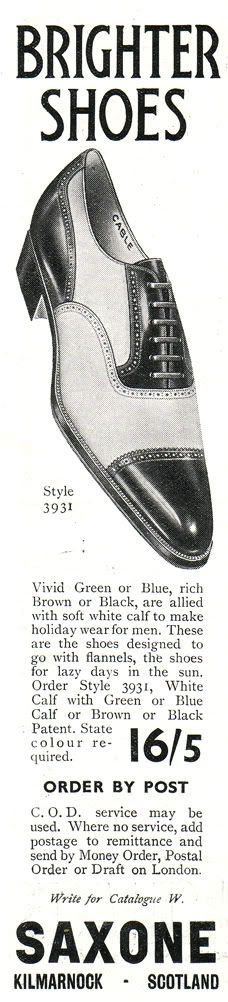
What could you buy for 16/5 in 1933?

You could treat yourself to a smart pair of co-respondent shoes from Saxone, delivered to your door.

But wait! I always picture this type of shoe in cream and brown, or possibly black and white if you're a bit of a flash Harry. These shoes betray their elegant half-tone illustration by being proudly offered in "Vivid green or blue" and white kid, along with those more conventional options. Can you imagine?

This advertisement was found in the July 1933 edition of The Wide World: The Magazine For Men, which is full of manly adventure stories about vicious head-hunting tribes in Ecuador, bank hold-ups in Canada, and shooting rogue elephants in the British Cameroons.

I suspect you'd have to be a particularly adventurous type of man (foolhardy, even) to wear "vivid green" and white co-respondent shoes in 1933. Or at any other time for that matter.

What could you buy for 6d in 1934?

Well perhaps not buy outright, since 6d is your deposit on "a delightful Spring Frock in Fashion's latest style," and you would in fact be obliged to make fortnightly payments of 1/6 (1 shilling and 6 pence) until the balance of 12/11 was reached.

Oh, and there's 6d for postage too.

But you do get a free pair of black patent leather shoes, so its looking more like a bargain. J.A. Davis was one of a number of mail order clothing companies advertising in the issue of Picturegoer magazine (June 2nd, 1934) that this ad appeared in, and it was certainly the cheapest.


Corot, of 33 Old Bond Street, London, was the dearest. It offered two models: "miss innocence," a pure silk crepe de chine frock for 3½ guineas cash or 10/6 monthly (a guinea was one pound and one shilling - 21 shillings - the 'posh' pound!), and "fresh as the morning," a linen sun frock with matching cape for 2½ guineas cash or 7/6 monthly.

Doing some sums - "miss innocence" is effectively 73s 6d and nearly six times the price of J.A. Davis' frock (with its rather less romantic title of "model 12").

This disparity in prices points to the wide readership of Picturegoer magazine, although even Corot would not have been considered a 'high end' clothing retailer at the time. Prestigious department stores were offering couture copy model gowns for up to 25 guineas, which gives some perspective on the market.

There's lots to pick over here - I always enjoy the fortuitous abbreviation of 'artificial' into 'art' when referring to synthetic fabrics, which makes them sound much more prestigious and appealing.

And I am always brought up short by the colour options listed, with the quite customary use of a derogatory racial term for shades of brown. Nobody would have turned a hair at that term in those days, and within my memory I recall seeing coloured pencils being labelled the same way.

If I'm ever lured by the warm appeal of cosy nostalgia - "things were so much better in the old days, you could leave your door unlocked, kids had respect for their elders" and all that nonsense - that's something to bring me right back down to earth with a bump.

Saturday, 31 October 2009

Mr Parkinson

Another article I wrote, for a magazine I forget the title of. That no one read.

This is a story about my encounter with a true eccentric when I was about nine, and is accurate in every respect (at least, accurate to my vivid memories of it, which are so strange it almost feels like I dreamt it):

Mr Parkinson

Confessions of a charity shop worker

This was an article I wrote for the Liverpool magazine Plastic Rhino some time ago. It might be a lazy way to fill out this new blog, but what the heck. I need to get a few posts in, and this piece explains a lot about me and my interest in old things:


Confessions of a charity shop worker

Charity shops saved my life. No really they did. From the ‘thrift shops’ on the various RAF camps where I lived as a child, to my student days and beyond, I would have struggled to clothe myself, equip and furnish my numerous shabby bedsits, read as much esoteric and trashy literature or listen to as much esoteric and trashy music without them. Charity shops fed my obsessions with an unpredictable supply of lucky finds, nurtured me as a collector and provided a smugly satisfying contrary form of elitism. All through the eighties, I sneered at the designer label obsessed masses, and never missed an opportunity to crow about how little my new acquisitions cost me. As unpleasant as this perverse snobbery sounds, I’m reluctant to condemn my younger, smart arse self, since I was making a virtue of a necessity. Like a lot of people at that time, I was permanently skint.