I did unexpectedly well for presents this Christmas, and among them was this tiny porcelain shoe sporting the town crest of Blackpool. Judging by its style it possibly dates from the 1900s, and is clearly an imitation of the famous Goss armorial china that was developed in the 19th century and was produced in an almost endless variety of forms.
The Goss range wasn't just extensive in its inventive array of novelty shapes. According to Larch S. Garrad in A Present From . . . Holiday Souvenirs of the British Isles: "Allegedly, Goss souvenirs were produced for every town in the United Kingdom that had a coat of arms."
This example was perhaps made in Germany - the generic red 'foreign' stamp underneath being no help at all in narrowing down its origin. But this doesn't really matter since I have a fascination for British seaside resorts, and Blackpool holds a special place among them.
Blackpool has a good claim to being the world's first working-class seaside resort - a title contested primarily by New York's Coney Island - and both towns developed more or less in parallel. John K. Walton explores the development and decline of both places in his excellent article "Popular Playgrounds: Blackpool and Coney Island, c. 1880-1970" (available to download as a pdf here - scroll down to Volume 17, Number 1).
The millions of visitors who descended on Blackpool every summer holiday season were determined to have fun and spend their money, and perhaps take home a small memento or gift with their last few pennies, and this porcelain shoe was probably very cheap in its day. All the better to attract the eye of the working-class holidaymaker with limited cash.
But a shoe doesn't really say Blackpool to me, even with a fancy town crest on it. The iconic Blackpool Tower however, Lancashire's homage to Paris' Eiffel Tower which opened in 1894, does the job nicely.
This vintage Stratton tieclip features the tower rendered in vivid blue enamel - and is currently available at the time of writing in my Etsy shop, dear reader. As a seaside souvenir, I would argue that its actually pretty tasteful:
Stratton was established in 1860, and is most famous for its men's accessories such as cufflinks and tieclips, not to mention its women's powder compacts. Vintage examples attract avid collectors, but having cast an eye on their current range (Stratton is still going) I have to say I am sadly underwhelmed.
Of course we've got to return to Blackpool in its prime, with three marvellous films from the BFI (British Film Institute) showing the town in three different eras.
First is this 1904 Mitchell and Kenyon film of hordes of visitors promenading on Blackpool's Victoria Pier. This was shot around the time that I reckon my shoe souvenir dates from:
This 1926 film clip, shot by Claude Friese-Green in what looks like a two-colour green/red process, shows the 'Reel' ride at Blackpool's Pleasure Beach. There's also a very pleased "lassie from Lancashire" proudly showing off her feathered kewpie doll prize, from the 'Shalwyn' stall, at the end:
Finally, this fabulous excerpt from the 1957 film Holiday, which reveals some obvious American influence on the town (hotdogs with or without fried onions), the 'Reel' again, and some lovely 50s fashions:
Tea diffuser from the Headquarters & General Supplies Ltd catalogue, 1950.
You could purchase a "National Service" tea diffuser (now more commonly known as a tea infuser) to help eke out your tea ration.
This ingenious item was found in a 1950 catalogue produced by Headquarters & General Supplies Ltd ("Contractors to War Office, Ministry of Supply, Crown Agents for the Colonies and Education Authorities") based in London.
As you might expect from their business connections, the catalogue has plenty of military surplus clothing and accessories, such as waterproof RAF flying suits - for 45/- or 49/6 with a hood - which are recommended for motorcyclists and motorists. And "Genuine British Army Berets" for 5 shillings ("certainly a smart article for holiday use").
After the war, military surplus flooded onto the market. It was well made and good quality, durable, practical and plentiful. The catalogue makes a fine job of suggesting alternative uses for some often very specialist garments, as has been noted above, but here are some more:
Solid Leather Army Jerkins (12/6): "Ideal for motoring, golf, or hard wear."
Merchant Navy Waterproof Suits (19/6): "For outdoor workers, cyclists, builders."
Interestingly, there are also "Solid Leather Pilots' Jackets Zip Front . . . lined throughout with pure Sheep's Wool" for £5 5s - presumably the sheepskin flying jackets that now fetch extremely high prices in the collectors' market.
Clothes rationing ended in March 1949 but tea rationing continued until 1952, making that 1/9 for a tea diffuser look like a very shrewd investment.
Additional notes
Measuring Worth provides a handy calculator for working out the equivalent prices in today's money (well, 2008 is the nearest they can get), using the Retail Price Index. So let's see:
Tea diffuser 1/9 = £2.25 (you can buy more or less the same thing today for about £3)
RAF flying suit 45/- = £57.76
British Army beret 5/- = £6.42
Ex-Naval Torpedo Hazard Suits 17/6 = £22.46
Solid Leather Army Jerkins 12/6 = £16.04
Merchant Navy Waterproof Suits 19/6 = £25.03
Solid Leather Pilots' Jackets £5 5s = £134.77
And because I seem to have wandered off the subject of tea a bit in this post, here's a stern man in a white coat (a "tea instructor") explaining more than you'll ever need to know about the dos and don'ts of tea making. This is a 1941 film from the BFI's YouTube channel:
If that's worn you out (or you can't face a full ten minutes of tea making instruction) then join Harrod's shopper Elizabeth Allan in 1955 as she introduces the wonder of the teabag. Look out for the brief appearance of a tea diffuser/infuser:
A Victorian handbill found in a book by Renée Huggett called Shops published in 1969.
This marvellous Victorian promotional handbill (flyer) from London addresses the discerning working man in need of new clothing. Written in a presumably authentic slang current at the time, it has an immediacy and humour that defies its age, even though much of it is completely mystifying to the modern reader.
Let's have a go:
Mr H nabs the chance of putting his customers awake, that he has just made his escape from India, not forgetting to clap his mawleys upon some of the right sort of stuff, when on his return home he was stunned to find one of the top Manufacturers of Manchester had cut his lucky, and stepped off to the Swan Stream, leaving behind him a valuable stock of Moleskins, Cords, Velveteens, Box Cloths, Plushes, Doe Skins, Pilots &c., and having some ready in his kick--grabbed the chance--stepped home with the swag--and is now safely landed at his crib. He can turn out Toggery, very slap at the following low prices for
Ready Gilt--Tick being No go.
Upper Benjamins, built on a downy plan, a monarch to half-a-finnuff, Fishing or Shooting Togs, cut slap, 1 pound, 1 quarter, and a peg. A Fancy Sleeve Blue Plush or Pilot ditto, made very saucy, a couter. Pair of Kerseymere or Doeskin Kicksies, built very slap with the artful dodge, a canary. Pair of Bath or Worsted Cords, cut to drop down on the trotters, a quid. Pair of out and out Cords, built very serious, 9 bob and a kick. Pair of stout Broad Cords, built in the Melton Mowbray style, half a sov. Pair of Moleskins, built hanky spanky, with a double fakement down the sides and artful buttons at bottom, half a monarch.
MUD PIPES, KNEE CAPS, AND TROTTER CASES BUILT VERY LOW.
A decent allowance made to Seedy Swells, Tea Kettle Purgers, Head Robbers, and Flunkeys out of Collar Gentlemen finding their own Broady can be accommodated.
(My thanks to flickr contact Bollops for taking the trouble to transcribe this text when I originally posted this picture there).
Many of the terms are obviously types of cloth: moleskin (a heavy, cotton cloth with a short, soft pile on one side), corduroy, velveteen, box cloth (I failed to find a definition of this), plush, doeskin (a fine, soft woollen cloth), pilot (a thick woollen cloth, often dyed blue used for overcoats and sailors' gear), kerseymere (a twilled fine woollen cloth).
Then there's prices: a monarch (a sovereign? That's one pound), half-a-finnuff (? - thanks to alan.98's comment below, I've discovered that a finnuff is Yiddish for a fiver), 1 pound, 1 quarter (a crown or five shillings? One pound was twenty shillings) and a peg (?), a couter (a sovereign, found in an excellent article on costermongers' backslang on the Victorian Web here), a canary (?), 9 bob (9 shillings) and a kick (?)
And of course, there's the garments on offer themselves: many appear to be trousers, such as the kicksies, or the cords "cut to drop down on the trotters (feet?)." Perhaps the "Upper Benjamins" and the "Fancy sleeve Blue Plush or Pilot ditto" are coats or jackets - the mention of a sleeve is a bit of a clue! "Mud pipes" might be some kind of oilskin waders or trousers, but I'm guessing here. "Knee caps" are possibly protective pads worn over the knees for labourers who have to kneel in their work, but again this is pure speculation. "Trotter cases" are likely to be boots if we can assume that trotters are feet.
The final call to "Seedy Swells, Tea Kettle Purgers, Head Robbers, and Flunkeys out of Collar" strongly suggests that Mr Harris is happy to do business with men of dubious reputation, so long as they have the ready cash of course.
This is a piece densely packed with detail and description, and deserves much more research than my desultory efforts.
But as much as its fun to try to translate this text, perhaps the most enjoyable thing about it is the way it reads. I would love to hear Bob Hoskins tackle this in his ripest Cockney growl.
Apparently Mr Harris advertised widely, or he copied a widely used format. More or less the same text, with some minor variations, appears in Mayhew's London Life and the London Poor of the mid 19th century (scroll down to the last quarter of the page or do a search for "slap up" on that page to find the passage), and in the New York Herald in 1888, which suggests that this tailor/outfitter was so familiar with the London criminal underworld that his handbill "appeals to the thieves, burglars and outcasts from society only."
This assertion is unfair I believe. Mr Harris was clearly drawing from the rich source of contemporary slang that would have been readily understood by its intended audience - working class men living in the slums of London. That's not to deny that perhaps Mr Harris was borrowing a bit of underworld cool by using terms that were not entirely respectable or correct, especially in Victorian times, but he was clearly a shrewd businessman who knew how to speak to his market. And he was aware that a more formal approach was a waste of time and expense (handbills cost money to print).
Credits are due. My sincere thanks to flickr friends Bollops and Art Nahpro for doing all the heavy leg-work to unearth most of the links that I have used in this piece.
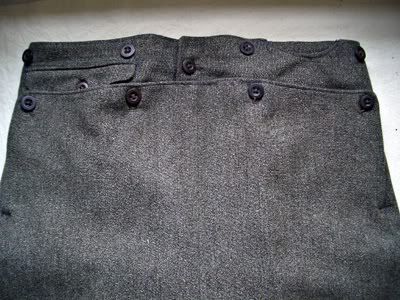
I've not finished yet! At that time (19th century), trousers would not have had the central vertical fly front we are familiar with today, but a fall front. This is a method of fastening the trousers with a flap that spanned the front waist and was fastened with buttons. Take a look at this pair of trousers which will give you the idea:
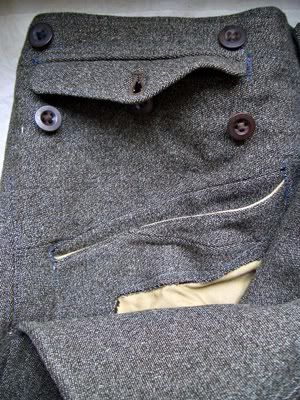
These trousers are from a suit made possibly in the early 1930s, according to the museum record, which is in the collection of the Gallery of Costume, Manchester. You can see that there are four buttons near the waistband which open to reveal:
OK, that might not be what you were expecting. This is under that front panel you saw above, and there's the pocket with a flap at the top which was visible in the first picture, and also a hidden diagonal welted pocket below it.
Sorry, this is getting complicated! So if you were getting dressed you would have to fasten two side panels of the trousers with a central button or two, and then fasten up the four buttons that secure the fall front over that.
I'm pretty sure this style was archaic by the time this suit was made, and it doesn't look like a regular "lounge suit" as it is catalogued in the museum. To be fair, I'm sure there was a note in the museum record about it being a gamekeeper's suit, which would make much more sense. This suit is very old-fashioned for the time, assuming that given date is correct, and is sturdy and warm enough for tramping through the Cheshire countryside in the depths of winter with a shotgun over your shoulder and maybe a brace of pheasants hanging off your belt.
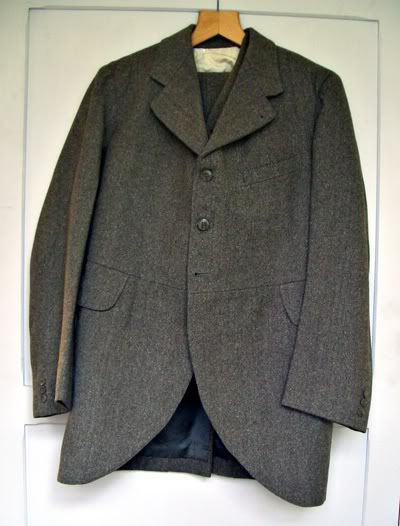
Just to complete the picture, here's the jacket of the suit:
Its beautifully curved cutaway hem, high button front fastening and waist seam speak of earlier days. The days of Mr Harris even.
There's been a dearth of film in recent posts, so this is the nearest I can get to Mr Harris's time and place - a wonderful film from 1903 of Petticoat Lane, London, from the BFI's Youtube channel. Don't you wish it had a soundtrack?: