Showing posts with label dancing. Show all posts

Monday, 8 February 2010

The magnificent Tilly Losch


Tilly Losch, 1923, originally uploaded by Trevira.

This beautiful photograph in my collection came from the archive of the newspaper The San Francisco Examiner. There's a damaged relic of a pasted-on label on the reverse giving the title "Serpent of Hell" (the production title? Her character's name?) and a date of April 14th, 1923, which might be the publication date.

Ottilie Ethel Losch was born in Vienna on November 15th 1907, which would make her 15 years of age in this photograph. You can read a summary of her extraordinary life and career in that link over her full name, which details her first stage appearance as a dancer at the age of six with the Vienna Imperial Opera ballet school, her promotion to prima ballerina at the unusually young age of 15, and her subsequent work with Max Reinhardt as both dancer and choreographer (and much more, of course, but we'll come to that soon).

What is puzzling is that according to the Binghamton University Library, which holds Losch's papers, she didn't arrive in the United States until 1927.

Why, then, is she appearing in a popular American newspaper (owned by William Randolph Hearst, by the way) in 1923? In a costume that looks much more Max Reinhardt than something you might expect from the Vienna Imperial Opera, and a full four years before she was reported to have first been invited to perform for Reinhardt in 1927?

The remains of that label note that she was wearing "phosphorous tights" - and I sincerely hope they mean phosphorescent, by the way, or her health might have been seriously endangered.

I'm speculating wildly here - its a bad habit of mine - but perhaps either the photograph date is wrong, or there's something missing or incorrect in that summary of her life?

No matter, Tilly Losch's life was extraordinary anyway, and she is one of those 20th century figures who seems to have orbited around many of the most significant cultural figures of her times, like a female Zelig, only much more beautiful!

She married Edward James, the wealthy English art connoisseur who was a patron of Salvador Dali (he was the proud owner of the first iteration of the iconic Mae West lips sofa, which was installed in his surrealist country pile Monkton House, and was captured by Magritte in this famously baffling portrait). But their marriage ended in a scandalous divorce in 1934 - Tilly accused him of homosexuality, he in return cited just one of her numerous affairs.

Other names that crop up in her life that might still ring a bell to the modern ear include Noel Coward, Fred and Adele Astaire, Kurt Weill, Lotte Lenya, George Balanchine, Berthold Brecht, Jean Cocteau (an ardent fan), the Sitwells and Cecil Beaton.

Her career in Hollywood has left us with some appearances in films such as The Garden of Allah (1936) with Marlene Dietrich, The Good Earth (1937) and Duel in the Sun (1946). All of which I'm pretty sure are readily available on DVD.

Later she retired from dancing and acting and turned to painting, which apparently suited her reportedly shy nature, and was enobled by her 1939 marriage to the Earl of Carnavon to the status of countess. Despite their divorce after the Second World War, they remained on friendly terms and the Earl was one of the few mourners at her 1975 funeral.

But let's go back to the top of this post and contemplate that amazing vision of her as an accomplished teenage dancer making news across the Atlantic - wasn't she magnificent?

Sunday, 7 February 2010

Santos Casani - the forgotten dance master

If you've ever seen one of those archive film montages of the 'roaring twenties' in a TV documentary, there's one clip that always features. Its the one featuring a couple dancing the Charleston on top of a taxi cab driving through a London street.

That clip is at the very end of this British Pathé dance instruction film (incidentally, fashion history buffs will be delighted by Miss Jose Lennard's lower back skirt hem - a major trend in the last years of the 1920s):

THE FLAT CHARLESTON MADE EASY


The stunt was intended to demonstrate that the new 'flat' Charleston required very little space, in contrast to its original, wild form, which was a veritable whirlwind of flying heels and arms, presenting considerable danger to nearby dancers. Indeed the Charleston was banned from many dancehalls at the time.

It is ironic that this clip is now employed to symbolise the reckless, risk-taking, devil-may-care nature of the times when its original intention was actually quite the opposite.

While I could easily (and quite happily) go on about the Charleston, this post concerns the man who appeared in that film, the famous dance master - and energetic self-publicist - Santos Casani.

Mr Casani was the proprietor of "the largest school of dancing in England," wrote a column for the Daily Mail, and made numerous short dance instruction films for British Pathé's cinemagazine for women, Eve's Film Review. The film company supplied free instruction leaflets based on the dance steps Casani featured, which viewers could send off for, and as a demonstration of how popular these films were, on one occasion they had to print 20,000 leaflets to satisfy the demand (most of this information is derived from Jenny Hammerton's fascinating book For Ladies Only? Eve's Film Review Pathé Cinemagazine 1921-1933).

As an aside, its lovely to imagine a cinema audience practising dance steps under their seats as they watch the films!

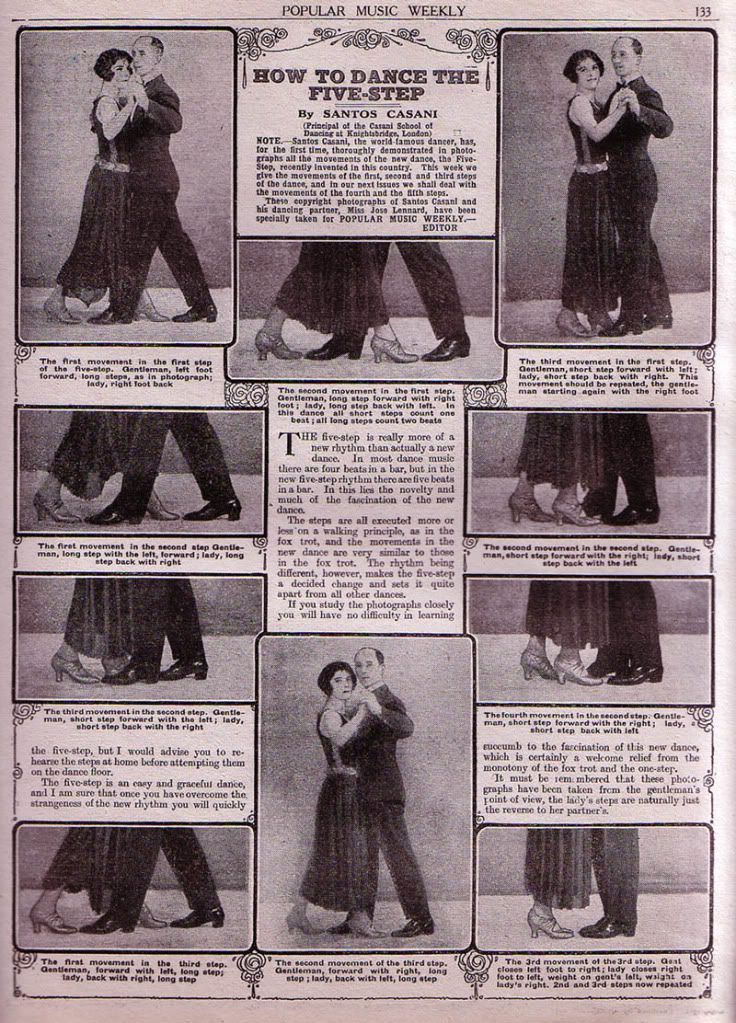
Here Casani makes an appearance in Popular Music and Dancing Weekly magazine, demonstrating the first three steps of the 'Five-Step' - steps four and five were published the following week, but unfortunately I don't have a copy of that issue (again, fashion buffs please note how remarkably long Miss Lennard's skirt was in 1924!):

"How to dance the Five-Step by Santos Casani" in Popular Music and Dancing Weekly, 7th June 1924, page 133 (click picture for a larger view).

In 1933 Casani opened his own nightclub in Imperial House, Regent Street, London and British Pathé was there to record it.

If you were to try to imagine a high-tone 1930s nightclub in the West End of London his establishment lives up to your Art Deco dreams, and this film includes footage of the renowned house band lead by pianist Charlie Kunz, a swimsuit fashion parade, an elegant rendering of the waltz by Mr Casani himself, not to mention a novelty song and a curious female contortionist. Pour yourself into a backless satin dress, shake up a cocktail and join in the fun:

LONDON'S FAMOUS CLUBS AND CABARETS NO. 10 - CASANI'S CLUB


Unlike his near contemporary Victor Silvester, Santos Casani failed to secure himself a place in dance posterity and his name is probably unknown to most people nowadays. But he was clearly a significant figure in his time - a suave, elegant man who knew how to work the media for maximum attention. In his prime, he was Mr Dance, and I'd like to salute his memory.

If you would like to see more of Santos Casani in action, there's plenty more films for you to enjoy.

Tuesday, 22 December 2009

Are you dancing? Are you asking?

Christmas is the prime party season, and parties often involve dancing. Which gives me another opportunity to plunder the vaults of British Pathé for some vintage treasures on that very theme.

Ballroom dancing is fraught with dangers - where do I put my hands? What frock should I wear? Which foot goes first? - so here's a helpful, unnamed dance instructor to put you right in a very prim short filmed at the Empress Room, Kensington, London in 1938.

Watch out for the swing step that's "hot from Harlem" but, the narrator warns, is "rather too hot for English ballrooms":

DANCING


The "English style" mentioned was developed by English dance teachers' organisations to regulate and tame the wild new dances coming from the United States, and was explicitly intended to eliminate any aberrant moves such as kicks or swinging hips, or indeed anything that smacked of self-expression, sexuality or spontaneity.

In the crowded conditions of most English dancehalls at this time, it could be argued that some control was needed to preserve the smooth rotation of dancing couples around the floor without things ending up in fisticuffs over collisions and painfully stomped feet. But the efforts of the dance instructors drained nearly all the personality and unique appeal (not to mention the fun) of these dances to the extent that it was difficult to discern one dance from the other.

We need an antidote to all that prim English reserve. And Earl and Josephine Leach, in this 1937 film demonstrating an hilarious version of the Big Apple, are here to supply it. They gleefully break all the rules:

THE BIG APPLE


This was precisely the time - the late 1930s - when dance hall managers realised that the sterling efforts of those dance instructors had succeeded in making many patrons scared of taking to the floor in case they committed a dreadful faux pas and showed themselves up. Dancing was in danger of becoming a difficult exercise only to be attempted by trained experts.

As a result, dance hall proprietors (including the dominant Mecca Ballroom chain) actively encouraged the development of easy dances that anyone could do after watching a short demonstration.

Watch this short film, shot at the Streatham Locarno (south London) in 1938, and you too will be able to do the Lambeth Walk with confidence:

NEW DANCES FOR EVERYBODY


Of course, what was around the corner was the all-conquering Jitterbug, which ruled British dance floors during the Second World War, and wasn't actually that easy to do well. But we had a useful influx of US servicemen to teach us how to do it properly.

This fun film - from Youtube rather than British Pathé this time - shows MGM's comic take on the dance craze in 1944:


Make sure you clear away all furniture and breakables before you attempt this at home.


Additional notes

This post neglects the original pioneers of most of these dances, the African-American community, which is sorely under-represented in the British Pathé archive. OK, that's probably understandable since it was a UK based operation. This post shows how their dances were interpreted on this uptight little island. But I can't let this pass without some acknowledgement, so here goes.

My all-time favourite dance sequence of all time is this clip from the 1941 film Hellzapoppin' featuring Slim and Slam and the Harlem Congaroos (I'm sure its many other people's favourite too, but it doesn't hurt to repeat it) which is approximately five minutes of pure joy. If you've never seen it before, prepare to be amazed:

Sunday, 1 November 2009

What could you do for 2/6 in 1924?

Where to dance, originally uploaded by Trevira.

You could go dancing in one of the palatial new dance halls that were appearing all over the country, the first of which was the (recently demolished) Hammersmith Palais de Danse, built in 1919.

The murky newsprint photographs don't give much idea of their scale and splendour, but you can make out the huge, 'oriental' style lanterns that became a signature feature of many of these Palais.

H.V. Morton made a visit to 'A Suburban Dance' recounted in his book Nights of London, published in 1926. His account helps fill those murky little photos with the people and life that is absent from them:

You give eighteenpence to a young woman who is imprisoned behind a brass grille, and you enter the dance hall.

The floor is covered with young men and girls fox-trotting to the music of an excellent band. The hall is large. Big yellow lanterns hang from the roof. Your first impression is that the girls are extraordinarily pretty and the men surprisingly ordinary. The girls have dressed for the dance; the men do not possess evening clothes. Here and there a star dancer has changed into a special kind of trousers, grey or black Oxford trousers as a rule, which billow over very pointed brown shoes. With these trousers he wears the coat and waistcoat of his lounge suit. Young men who do not dance linger in vague, drifting groups on the outskirts of the floor, smoking cigarettes and making comment. Pretty little wallflowers sit out by the dozen. Now and again two girls rise and dance together.

The music ends, the lights go up. Then a surprising thing occurs. In an instant men and girls have parted! The girls go over to one end of the room to sit on chairs ranged against the wall; the men group themselves in bands and coteries around the floor and light up the cigarettes which they had left parked on the radiator!

You look at the girls with interest. Most of them work in the big shops in the district. Each one wears a knee-short, tasteful evening frock and light stockings. You look along the rows of chairs and realise that here are seen the prettiest, neatest legs in London. In the Ritz, the Savoy, Claridge's, the pretty woman is easily picked out from the crowd; in this eighteenpenny suburban dance 'hop' a new beauty dawns on the sight of each minute; the girls are all between the ages of sixteen and twenty-five. Perhaps that is the secret; they have abundant vitality and youth. They also have abundant lip-stick and powder, and one or two have Eton-cropped their heads.

It strikes you again and again that they are too vital and brilliant for the dull youths who lean against the wall and smoke cigarettes and whisper.


And if you'd like to see a glimpse of possibly 'the prettiest, neatest legs in London' the British Pathé film archive has a short clip of the Wimbledon Palais (the dance hall at the top of the advert) filmed in 1926:


DANCE TIME