Showing posts with label UK. Show all posts

Monday, 22 November 2010

Cathy McGow-ow-ow-owan

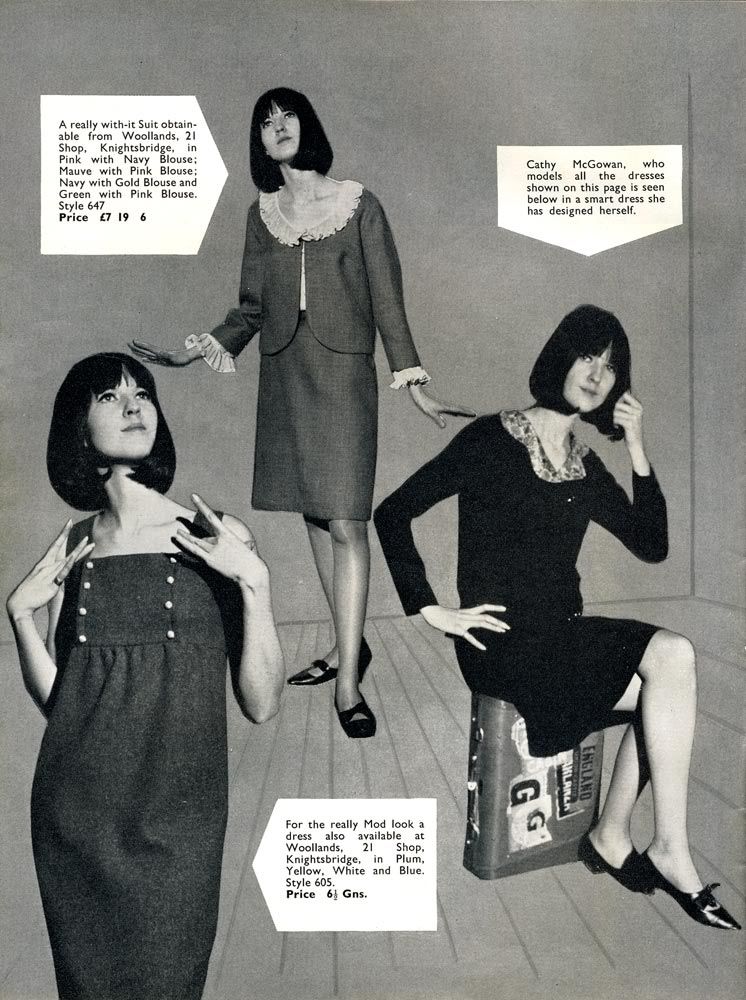
Cathy McGowan models dresses, including one of her own design on the right, in Mod's Monthly, March 1964.

Two things have prompted this post.  The first was finally deciding to sell a treasured mid-60s Cathy McGowan's Boutique mini mac that's been in my personal collection for years.  You can take a peek at it right here.

The second was the ever wonderful Miss Peelpants, who, as well as kindly offering her opinion on my mac, posted some scans from the first ever Cathy McGowan's Boutique catalogue on her blog.

Its hard to gauge precisely how well known Cathy McGowan is these days - are teenagers aware of her in the same way that they might know something about Twiggy? - but she was, in her time, just as much of a style icon as La Moss is today (whatever you might think about her).

As presenter of Ready, Steady, Go! from 1964-66 she demonstrated an unerring sense of style that proved hugely influential to the hordes of young teenage girls who were avid viewers of the TV show, tuning in not just to see the latest pop sensations and dance steps, but Cathy's new outfit of the week.

I have four copies of The Mod's Monthly magazine from 1964, which I've covered before and no doubt will plunder again at some point, and Cathy features largely in all of them.  Quite naturally since she was famously known as the "Queen of the Mods."

Sunday, 7 February 2010

Santos Casani - the forgotten dance master

If you've ever seen one of those archive film montages of the 'roaring twenties' in a TV documentary, there's one clip that always features. Its the one featuring a couple dancing the Charleston on top of a taxi cab driving through a London street.

That clip is at the very end of this British Pathé dance instruction film (incidentally, fashion history buffs will be delighted by Miss Jose Lennard's lower back skirt hem - a major trend in the last years of the 1920s):

THE FLAT CHARLESTON MADE EASY


The stunt was intended to demonstrate that the new 'flat' Charleston required very little space, in contrast to its original, wild form, which was a veritable whirlwind of flying heels and arms, presenting considerable danger to nearby dancers. Indeed the Charleston was banned from many dancehalls at the time.

It is ironic that this clip is now employed to symbolise the reckless, risk-taking, devil-may-care nature of the times when its original intention was actually quite the opposite.

While I could easily (and quite happily) go on about the Charleston, this post concerns the man who appeared in that film, the famous dance master - and energetic self-publicist - Santos Casani.

Mr Casani was the proprietor of "the largest school of dancing in England," wrote a column for the Daily Mail, and made numerous short dance instruction films for British Pathé's cinemagazine for women, Eve's Film Review. The film company supplied free instruction leaflets based on the dance steps Casani featured, which viewers could send off for, and as a demonstration of how popular these films were, on one occasion they had to print 20,000 leaflets to satisfy the demand (most of this information is derived from Jenny Hammerton's fascinating book For Ladies Only? Eve's Film Review Pathé Cinemagazine 1921-1933).

As an aside, its lovely to imagine a cinema audience practising dance steps under their seats as they watch the films!

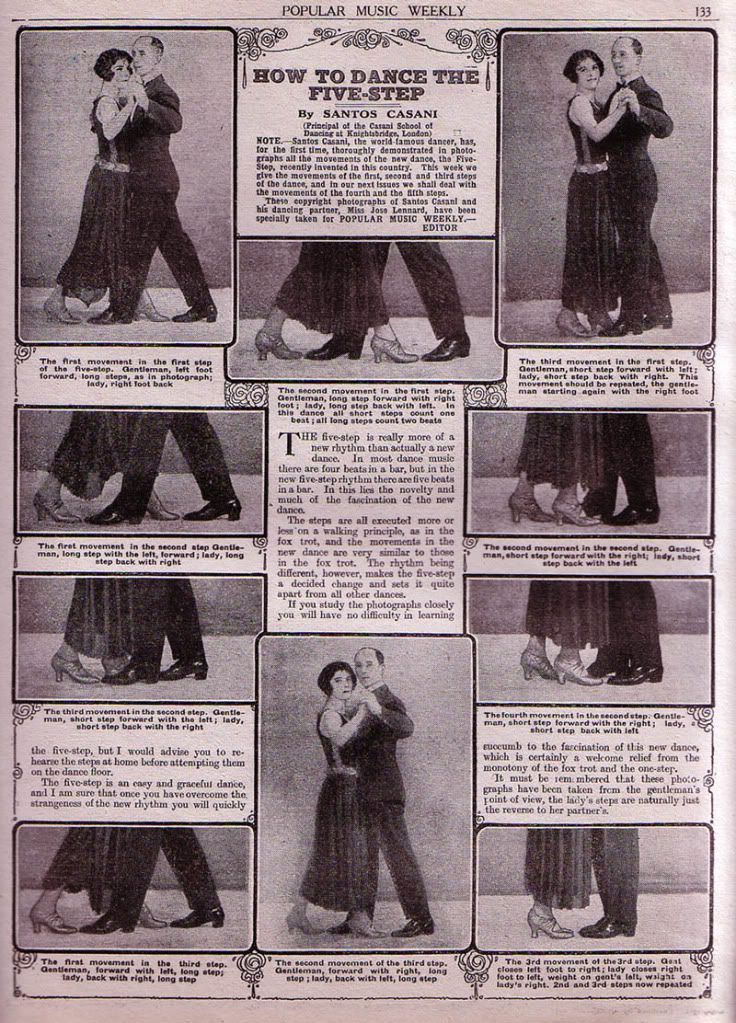
Here Casani makes an appearance in Popular Music and Dancing Weekly magazine, demonstrating the first three steps of the 'Five-Step' - steps four and five were published the following week, but unfortunately I don't have a copy of that issue (again, fashion buffs please note how remarkably long Miss Lennard's skirt was in 1924!):

"How to dance the Five-Step by Santos Casani" in Popular Music and Dancing Weekly, 7th June 1924, page 133 (click picture for a larger view).

In 1933 Casani opened his own nightclub in Imperial House, Regent Street, London and British Pathé was there to record it.

If you were to try to imagine a high-tone 1930s nightclub in the West End of London his establishment lives up to your Art Deco dreams, and this film includes footage of the renowned house band lead by pianist Charlie Kunz, a swimsuit fashion parade, an elegant rendering of the waltz by Mr Casani himself, not to mention a novelty song and a curious female contortionist. Pour yourself into a backless satin dress, shake up a cocktail and join in the fun:

LONDON'S FAMOUS CLUBS AND CABARETS NO. 10 - CASANI'S CLUB


Unlike his near contemporary Victor Silvester, Santos Casani failed to secure himself a place in dance posterity and his name is probably unknown to most people nowadays. But he was clearly a significant figure in his time - a suave, elegant man who knew how to work the media for maximum attention. In his prime, he was Mr Dance, and I'd like to salute his memory.

If you would like to see more of Santos Casani in action, there's plenty more films for you to enjoy.

Thursday, 7 January 2010

Snow fatigue


20s beach girl, originally uploaded by Trevira.

We've had some extraordinarily wintery weather this winter in the UK. The media is full of 'snow chaos' stories, and our local supermarket has empty shelves where the milk should be.

Snow is a fun novelty in this country for a day or two, but after that it gets a little tiresome. Unusually, instead of a rapid thaw within a few days, the temperatures have stayed around or below freezing (-16º C in Manchester last night!) and its become dangerous to even venture to the Post Office around the corner. I'd make better progress with skates rather than my wellies - the only footwear I have with any kind of tread on them.

My room overlooks our suburban street, where the snow has been compacted and polished by traffic into solid ice with a treacherous, glassy sheen, and I've lost count of the cars I've seen losing traction and veering sideways as they struggle to ascend the (very low) incline of the road. The eery whine of wheel-spinning has punctuated my day.

So as a respite from the continuing freeze, I'd like to seek refuge in contemplating the picture above, which is one of my favourites from my collection of old photographs and dates from the 1920s.

Its a reminder of better days - and weather - and a cheery evocation of that carefree summer holiday feeling. To me, every element of this picture is perfect, including the dizzily skewed horizon. Looking at it makes me feel happy and warm, and I hope it works its magic for you too.

Saturday, 14 November 2009

How do you advertise when you don't have anything to sell?


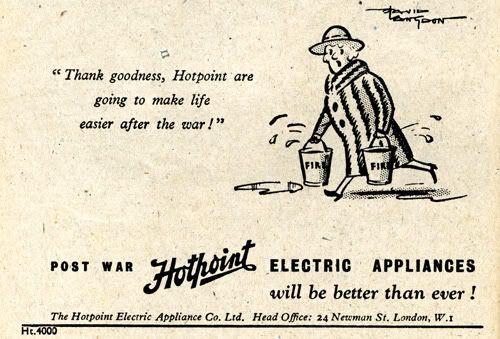
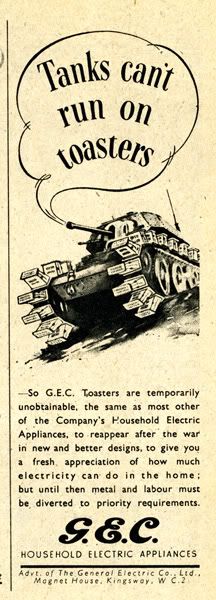
Leafing through a copy of Modern Woman magazine from January 1944, I noticed that a number of the advertisements weren't promoting actual goods, but the promise of them after the war.

The frazzled lady above with the fire buckets is presumably doing the weekly wash, and couldn't wait until she was able to buy a new Hotpoint washing machine, something that I'm sure a lot of women at the time could relate to.

G.E.C. (below) used an arresting illustration to make the point that their production lines were diverted to munitions work for the duration:


Clothing manufacturers, such as Healthguard knitwear, were busy supplying the troops with uniforms and (presumably in this case) cosy and durable knitted sweaters and undergarments, although in this industry, unlike that of the electrical manufacturers, a small proportion of their output was devoted to the domestic market:


The tone is sympathetic but encouraging - acknowledging that their products will be scarce and probably require a concerted effort to hunt around numerous retailers to source - "annoying, perhaps, but well worth the bother." (I can't see that phrase catching on in the same way as "Keep calm and carry on," somehow).

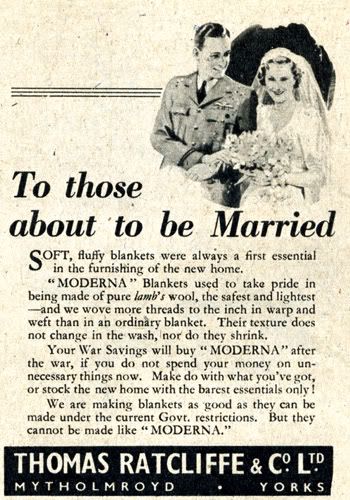
Thomas Ratcliffe & Co. Ltd., makers of Moderna wool blankets, appear concerned to preserve their image as producers of high quality goods:


After explaining what makes their blankets so special - "pure lamb's wool . . . more threads to the inch in warp and weft than in an ordinary blanket" - they are obliged to confess that their wartime blankets, produced "under the current Govt. restrictions," aren't quite so special. In fact, its clear they really don't want to sell you their current, substandard blankets at all and instead urge wartime brides who are setting up their new homes to save their money for the (better) post-war Moderna blankets and in the meantime "make do with what you've got"!

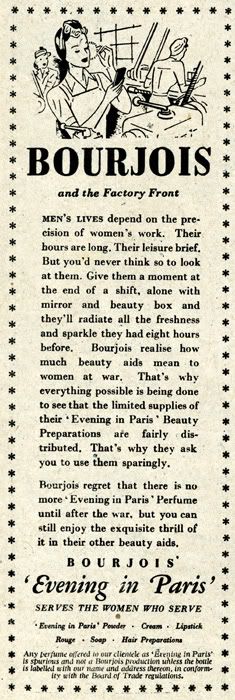
Bourjois, the cosmetics manufacturer, congratulates women on maintaining their feminine allure whilst engaged in arduous war work, but urges them to use their scarce products sparingly:


In small print at the bottom, after expressing regret that their Evening in Paris perfume will not be available during the war, is this warning: "Any perfume offered to our clientele as 'Evening in Paris' is spurious and not a Bourjois production unless the bottle is labelled with our name and address thereon, in conformity with the Board of Trade regulations."

It seems that shoddy, counterfeit goods were another hazard of wartime life.

All these adverts appeared in a single magazine in 1944, five years into the Second World War, and their message must have been repeated throughout countless publications during the conflict. Although manufacturers engaged in essential war production were probably not suffering unduly, with their lucrative Government contracts, they were evidently anxious to maintain public goodwill and the future customer base that would ensure their post war prosperity.

For consumers, it must have been constantly frustrating to be repeatedly reminded about what they didn't have and couldn't get. Everything had to wait until after the war.

But what nobody seemed to realise (or perhaps didn't dare admit) was that all these enticing goods wouldn't suddenly appear in the shops once victory was declared in 1945. In fact, shortages and rationing got much worse! The government had huge wartime debts and just about anything worth selling was exported to help pay it off.

After six long years of deprivation, not to mention the stress and heartbreak of living through a long and bitter world war, the patient and enduring British consumers were faced with a further nine years wait before all rationing finally ended in 1954.

Of course, they weren't necessarily that patient and enduring (who would be?) If you want to learn more about the 'ordinary' British person's experience of the immediate post war years, you can't do better than Simon Garfield's book Our Hidden Lives. Garfield skilfully and sensitively edits the Mass Observation diaries of five people to illustrate how this largely overlooked era affected those five individuals, and it makes surprisingly vivid and compelling reading.

An aspect of wartime advertising I haven't mentioned yet, is the manufacturers' awareness of the limits of that assumed patience. An Atkinsons Eau de Cologne ad pleads: "Supplies are scarce though, so please don't be cross if the shopkeeper is out of stock." A Parozone bleach ad urges: "Don't blame your suppliers if you can't get all the Parazone you want. Bear with us please - we are doing everything possible to maintain supplies."

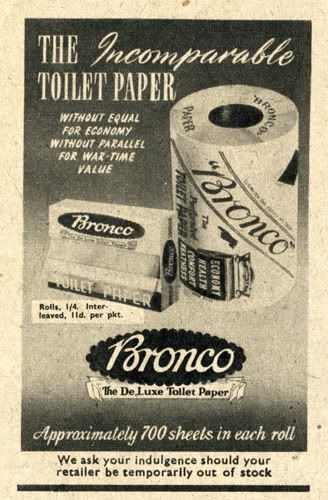
There's a clear hint of the daily, small-scale conflicts that poor, hard-pressed shop staff had to face from frustrated and enraged shoppers. But, I ask you, could you tolerate this?:


At the bottom of this advertisement it says: "We ask your indulgence should your retailer be temporarily out of stock." My memories of Bronco are of the waxy, stiff and resolutely non-absorbent toilet paper that no-one would buy or use out of choice. To have only Bronco toilet paper available is torture enough. To have no toilet paper at all is beyond comprehension!

As my grandmother (and probably yours too) always said - we don't know we're born!