
Finding historic accounts of men's fashions can be a challenge. For the most part, women's fashions dominate surviving records for obvious reasons: fashion has long been assumed to be a largely feminine preoccupation, women's fashions have a faster turnover of trends so there's always some new novelty to observe, and they tend to be more dramatic and eye-catching. Equally, while a woman's appearance was (and frequently still is, sadly) considered to be the most pertinent and interesting aspect of her being, a man's appearance was taken to be the least important thing about him, unless it was particularly remarkable or curious. Men were judged, and recorded, on different criteria - skills, talents, character, achievements - with their wardrobe coming very low on the list, if at all.
As a result, there's a real lack of detailed descriptions of everyday men's wear since it was usually considered of no importance or relevance. Which is why this short piece, 'Frenchmen's Fashions,' published in the seventh Saturday Book in 1947, is such a treasure. Written by Honor Tracy, it provides a precious snapshot of men's fashions in Paris in the immediate post-war period.
Showing posts with label Second World War. Show all posts
Showing posts with label Second World War. Show all posts
Monday, 24 January 2011


Thursday, 4 February 2010
Fashion rations
Even during the dark years of the Second World War, and the long years of clothing rationing that followed it, women were expected to keep up appearances. "England's number one glamour girl" Joan Richards, a professional model, doesn't disappoint in this 1944 film where we follow Joan through a "routine day's work." From getting up in the morning with full slap (apologies to US readers - slap = makeup) and immaculate hair, through her long and busy day, she is the epitome of 1940s chic. By the way, these film links have come up as black boxes, but they will work if you click on them.
However, not every woman met the grade. This amusing short from September 1946 features the "Pathé Pictorial Fashion Expert" Mr Richard Buzzvine (at least, that what his name sounds like) lurking self-consciously with a newspaper on Regent Street as he casts a waspishly critical eye over young women's outfits. Although his voice isn't heard, the narrator reports his merciless judgements.
Mr Buzzvine is very hard to please, and only one girl meets with his approval, although its hard to see how she is much different from the other 'failures.' Its a useful reminder of how fraught getting dressed used to be, with all kinds of complicated rules and conventions governing what was - and was not - appropriate wear.
ANNE EDWARDS (aka GLAMOUR GIRL)
However, not every woman met the grade. This amusing short from September 1946 features the "Pathé Pictorial Fashion Expert" Mr Richard Buzzvine (at least, that what his name sounds like) lurking self-consciously with a newspaper on Regent Street as he casts a waspishly critical eye over young women's outfits. Although his voice isn't heard, the narrator reports his merciless judgements.
Mr Buzzvine is very hard to please, and only one girl meets with his approval, although its hard to see how she is much different from the other 'failures.' Its a useful reminder of how fraught getting dressed used to be, with all kinds of complicated rules and conventions governing what was - and was not - appropriate wear.
RIGHT AND WRONG IN FASHION
Tuesday, 15 December 2009
What could you buy for 1/9 in 1950?
 Tea diffuser from the Headquarters & General Supplies Ltd catalogue, 1950.
 You could purchase a "National Service" tea diffuser (now more commonly known as a tea infuser) to help eke out your tea ration.
This ingenious item was found in a 1950 catalogue produced by Headquarters & General Supplies Ltd ("Contractors to War Office, Ministry of Supply, Crown Agents for the Colonies and Education Authorities") based in London.
As you might expect from their business connections, the catalogue has plenty of military surplus clothing and accessories, such as waterproof RAF flying suits - for 45/- or 49/6 with a hood - which are recommended for motorcyclists and motorists. And "Genuine British Army Berets" for 5 shillings ("certainly a smart article for holiday use").
After the war, military surplus flooded onto the market. It was well made and good quality, durable, practical and plentiful. The catalogue makes a fine job of suggesting alternative uses for some often very specialist garments, as has been noted above, but here are some more:
Ex-Naval Torpedo Hazard Suits (17/6): "Ideal for motoring, cycling, boating, etc."
Solid Leather Army Jerkins (12/6): "Ideal for motoring, golf, or hard wear."
Merchant Navy Waterproof Suits (19/6): "For outdoor workers, cyclists, builders."
Interestingly, there are also "Solid Leather Pilots' Jackets Zip Front . . . lined throughout with pure Sheep's Wool" for £5 5s - presumably the sheepskin flying jackets that now fetch extremely high prices in the collectors' market.
Clothes rationing ended in March 1949 but tea rationing continued until 1952, making that 1/9 for a tea diffuser look like a very shrewd investment.
Additional notes
Measuring Worth provides a handy calculator for working out the equivalent prices in today's money (well, 2008 is the nearest they can get), using the Retail Price Index. So let's see:
Tea diffuser 1/9 = £2.25 (you can buy more or less the same thing today for about £3)
RAF flying suit 45/- = £57.76
British Army beret 5/- = £6.42
Ex-Naval Torpedo Hazard Suits 17/6 = £22.46
Solid Leather Army Jerkins 12/6 = £16.04
Merchant Navy Waterproof Suits 19/6 = £25.03
Solid Leather Pilots' Jackets £5 5s = £134.77
And because I seem to have wandered off the subject of tea a bit in this post, here's a stern man in a white coat (a "tea instructor") explaining more than you'll ever need to know about the dos and don'ts of tea making. This is a 1941 film from the BFI's YouTube channel:
If that's worn you out (or you can't face a full ten minutes of tea making instruction) then join Harrod's shopper Elizabeth Allan in 1955 as she introduces the wonder of the teabag. Look out for the brief appearance of a tea diffuser/infuser:
Sunday, 15 November 2009
Upcycling, recycling, remaking, reusing

hand made antique dolly peg, originally uploaded by Trevira. This is made of a strip cut from an old tin, wound round a split stick.
In principal its ALL good, but having recently joined Etsy I've had reason to give it some more thought.
There's a lot of people busily remaking new garments out of vintage ones, and some of them are remarkably inventive and stylish. But I do have qualms about using, and drastically altering, vintage items that are perfectly wearable and undamaged as they are.
In their original state, they are authentic survivors of their era, and often have some value as collector's items or potential museum pieces. Once they have undergone such alterations, they are no longer authentic, and have lost that intrinsic value accrued by age, rarity and desirability - but on the other hand, they may have gained in appeal for the modern buyer who isn't the least bit interested in history or authenticity.
Of course, reusing and remaking clothing is nothing new. For centuries, people have plundered old, secondhand garments - unpicked silk dresses to remake the valuable fabric into something new; removed lace collars and trimmings to adorn another blouse or dress; snipped off buttons and saved them for the next suitable sewing project.
As fashions changed, garments might be altered to conform to the newest styles. When paisley cashmere shawls fell out of favour in the nineteenth century, for example, some of them ended up as neat little jackets or mantles. Here's a late example from the 1920s, held at the Gallery of Costume, Manchester.
In the days before 'vintage' became the lucrative marketing term it is today (something I've discussed rather pompously here), nobody was sentimental about secondhand clothing, regarding it as raw material to be used as they saw fit.
So perhaps I shouldn't be bothered. But the historian in me can't help but mourn the loss of items that have survived the years intact, only to be destroyed at the hands of some unsympathetic maker who is perhaps blind to its merits. (There is a case to be made, I suppose, that the 'new' items made from old ones become authentic artefacts of the current era).
That said, I find it hard to care about mass produced 1980s garments - they're not that old, they're plentiful and most of them are pretty dreadful (I'm being unforgivably subjective here!). Perhaps in twenty years I might feel differently.
My parameters for justified reuse are: badly damaged and/or worn out garments - or ones less than twenty years old - that have no particular qualities, uniqueness or style to them are fair game.
Admittedly, this is probably still ridiculously irrational and sentimental of me. Especially since I have quite a number of vintage clothes in my wardrobe that I wear on a regular basis and will eventually wear out and (effectively) destroy myself!
The era most associated with reusing and remaking garments is that of the Second World War - when 'make do and mend' was an imperative that no-one could afford to ignore. Goodness knows how many potentially valuable 'vintage' items ended up chopped up or altered (like my first ever vintage dress, which got off relatively lightly) during that time.
Anne Edwards, fashion editor of Woman magazine, provides some ingenious tips on how to decimate your poor husband's wardrobe while he is off fighting the war, in this 1942 British Pathé clip (this film might account for the relative scarcity of 1930s menswear!):
HATS (aka MAKE AND MEND HATS)
Even women's wardrobes weren't safe from the scissors! An evening dress is transformed into a becoming day dress (and turban):
EVENING AND DAY FROCK (issue title is HI-DE-HI)
And finally, "great grandma's priceless old lace" is turned into some attractive household decor items:
LACE (issue title is GIVE AND TAKE)
Saturday, 14 November 2009
How do you advertise when you don't have anything to sell?
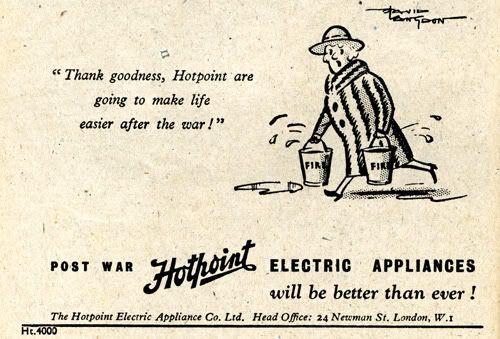
Leafing through a copy of Modern Woman magazine from January 1944, I noticed that a number of the advertisements weren't promoting actual goods, but the promise of them after the war.
The frazzled lady above with the fire buckets is presumably doing the weekly wash, and couldn't wait until she was able to buy a new Hotpoint washing machine, something that I'm sure a lot of women at the time could relate to.
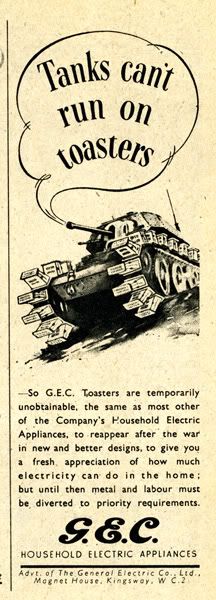
G.E.C. (below) used an arresting illustration to make the point that their production lines were diverted to munitions work for the duration:

Clothing manufacturers, such as Healthguard knitwear, were busy supplying the troops with uniforms and (presumably in this case) cosy and durable knitted sweaters and undergarments, although in this industry, unlike that of the electrical manufacturers, a small proportion of their output was devoted to the domestic market:


The tone is sympathetic but encouraging - acknowledging that their products will be scarce and probably require a concerted effort to hunt around numerous retailers to source - "annoying, perhaps, but well worth the bother." (I can't see that phrase catching on in the same way as "Keep calm and carry on," somehow).
Thomas Ratcliffe & Co. Ltd., makers of Moderna wool blankets, appear concerned to preserve their image as producers of high quality goods:

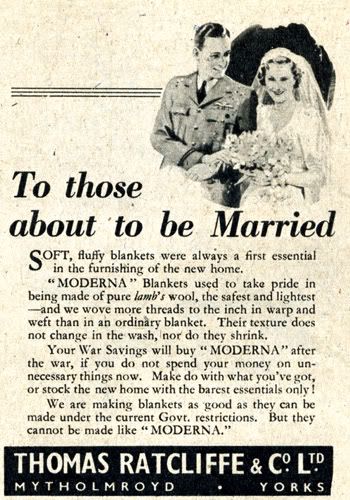
After explaining what makes their blankets so special - "pure lamb's wool . . . more threads to the inch in warp and weft than in an ordinary blanket" - they are obliged to confess that their wartime blankets, produced "under the current Govt. restrictions," aren't quite so special. In fact, its clear they really don't want to sell you their current, substandard blankets at all and instead urge wartime brides who are setting up their new homes to save their money for the (better) post-war Moderna blankets and in the meantime "make do with what you've got"!
Bourjois, the cosmetics manufacturer, congratulates women on maintaining their feminine allure whilst engaged in arduous war work, but urges them to use their scarce products sparingly:
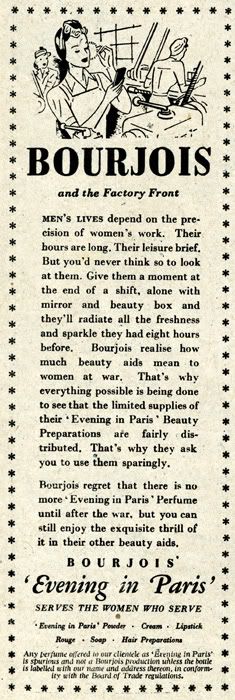
In small print at the bottom, after expressing regret that their Evening in Paris perfume will not be available during the war, is this warning: "Any perfume offered to our clientele as 'Evening in Paris' is spurious and not a Bourjois production unless the bottle is labelled with our name and address thereon, in conformity with the Board of Trade regulations."
It seems that shoddy, counterfeit goods were another hazard of wartime life.
All these adverts appeared in a single magazine in 1944, five years into the Second World War, and their message must have been repeated throughout countless publications during the conflict. Although manufacturers engaged in essential war production were probably not suffering unduly, with their lucrative Government contracts, they were evidently anxious to maintain public goodwill and the future customer base that would ensure their post war prosperity.
For consumers, it must have been constantly frustrating to be repeatedly reminded about what they didn't have and couldn't get. Everything had to wait until after the war.
But what nobody seemed to realise (or perhaps didn't dare admit) was that all these enticing goods wouldn't suddenly appear in the shops once victory was declared in 1945. In fact, shortages and rationing got much worse! The government had huge wartime debts and just about anything worth selling was exported to help pay it off.
After six long years of deprivation, not to mention the stress and heartbreak of living through a long and bitter world war, the patient and enduring British consumers were faced with a further nine years wait before all rationing finally ended in 1954.
Of course, they weren't necessarily that patient and enduring (who would be?) If you want to learn more about the 'ordinary' British person's experience of the immediate post war years, you can't do better than Simon Garfield's book Our Hidden Lives. Garfield skilfully and sensitively edits the Mass Observation diaries of five people to illustrate how this largely overlooked era affected those five individuals, and it makes surprisingly vivid and compelling reading.
An aspect of wartime advertising I haven't mentioned yet, is the manufacturers' awareness of the limits of that assumed patience. An Atkinsons Eau de Cologne ad pleads: "Supplies are scarce though, so please don't be cross if the shopkeeper is out of stock." A Parozone bleach ad urges: "Don't blame your suppliers if you can't get all the Parazone you want. Bear with us please - we are doing everything possible to maintain supplies."
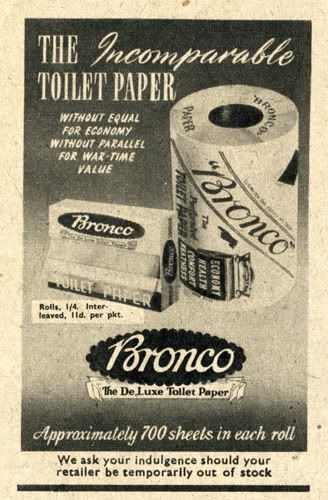
There's a clear hint of the daily, small-scale conflicts that poor, hard-pressed shop staff had to face from frustrated and enraged shoppers. But, I ask you, could you tolerate this?:

At the bottom of this advertisement it says: "We ask your indulgence should your retailer be temporarily out of stock." My memories of Bronco are of the waxy, stiff and resolutely non-absorbent toilet paper that no-one would buy or use out of choice. To have only Bronco toilet paper available is torture enough. To have no toilet paper at all is beyond comprehension!
At the bottom of this advertisement it says: "We ask your indulgence should your retailer be temporarily out of stock." My memories of Bronco are of the waxy, stiff and resolutely non-absorbent toilet paper that no-one would buy or use out of choice. To have only Bronco toilet paper available is torture enough. To have no toilet paper at all is beyond comprehension!
As my grandmother (and probably yours too) always said - we don't know we're born!
Subscribe to:
Posts (Atom)


