Showing posts with label 1950s. Show all posts

Saturday, 17 April 2010

That Tinling feeling

Advertisement for Teddy Tinling's salon from Vogue, 14th April 1937, page 120.  From the Gallery of Costume, Manchester. 

What a singular character Teddy Tinling was!  The opening line of the Wikipedia entry I just linked to does a great job of indicating as much, in its customary dry and succinct manner: "[Teddy Tinling] was an English tennis player, fashion designer, spy and author."  As a career resumé, that one is pretty hard to beat. Plus he was "openly gay" in the days when that was hardly a safe option.

These days people might recall the frilly knickers he created for the American tennis player Gertrude 'Gorgeous Gussie' Moran in 1949, and the kerfuffle those provocative undergarments caused in the media. 

Tinling made his name creating expertly tailored and glamorous tennis wear for many of the star players of his day, but his career in the rag trade began much earlier in 1931 when he opened a salon in South Kensington, London, specialising in wedding and evening gowns for the "carriage trade."  This was evidently successful because by 1937, when his nicely surreal advertisement (above) appeared in Vogue, he was plying his trade in the much posher environs of Mayfair. 

The Second World War interrupted his fashion career and prompted his drastic career switch to spying for the British Intelligence Corps.  I'm sure there's lots of interesting material about his wartime adventures, but sadly they don't appear to be online so I shall press on regardless. 

Shortages of luxury fabrics after the war saw the ever-pragmatic Tinling turning to the growing market of sportswear . . . actually this is all very well documented in the links I've added so I'm going to cut straight to my point and spare you the painful paraphrasing. 

Teddy's tennis wear suggests a fondness for flamboyance, which is certainly borne out in the British Pathé film archive.  The swelle life blog has a fabulous post about one of those films so I won't repeat it here (please visit that link to enjoy it, and don't miss this post about his tennis gear too). 

Here's more evidence.  He embraced rock'n'roll with some delightful garments for teenage fans:
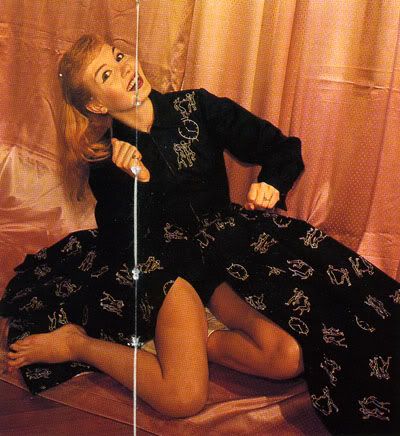
"Clothes specially designed for Rock'n'Roll enthusiasts by Teddy Tinling, 1957."  From Frances Kennett (1983) The Collector's Book of Twentieth Century Fashion, London: Book Club Associates, pp. 88-89.  (Apologies for the book binding cutting through the picture - I'm not skilled, or indeed patient, enough to erase that). 

I'm really enjoying that print of clocks and jiving couples (no doubt a reference to Bill Haley's "Rock Around the Clock")

The elfin model Elizabeth Duke can also be seen modelling some "Jive Fashions" possibly from the same collection (Tinling trousers with a heart-shaped pocket printed with the immortal British rocker Tommy Steele) right here. 

Its clear that Teddy Tinling's gift for tailoring glamorous but practical tennis wear was readily transferable to the demands of energetically jiving rock'n'rollers.  Sadly there appears to be no film footage of his teen-rock'n'roll clothing available. 

But there's plenty more camp fashion delights to be found, especially at my favourite resort for vintage footage, British Pathé.  And this is one of the best, a 1958 film of Tinling's leisure fashions inspired by souvenirs from his holidays:   

TEDDY TINLING HOLIDAY FASHIONS


And this short film from 1955 features both his tennis and leisure wear:

BEACH AND TENNIS WEAR


And I'm going to have to include Tinling's spectacular South Pacific fashion show, as featured in the swelle life blog, just so you don't miss it:

TEDDY TINLING FASHIONS


Teddy Tinling's exuberant style has quite won me over.  I only wish that there was more information available about his fashion adventures, rather than just his tennis wear (as admirable as it was).  If anyone can offer any further information about this I would be overjoyed.  All I can say is that I've never come across a single garment with his label on it, and live in hope that I might - someday.

Thursday, 25 February 2010

Constructing the Teddy Boy

One of the most conspicuous aspects of the British Teddy Boy was his hair; that towering quiff carefully and regularly primped with a comb - perhaps a flick knife comb for extra posing points! - and secured with copious fistfuls of pomade.

At least since the nineteenth century, men's hair was simply cut short and combed flat, sometimes slicked with the macassar oil that gave Victorian and Edwardian housewives such headaches worrying about their stained upholstery they were forced to invent the antimacassar. The only possible variations seemed to be in the parting of the hair, and tonsorial exuberance was confined to the moustache.

Given all those long decades of modesty and simplicity in men's hair, it must have been quite a shock in the early 1950s to see young men constructing glossy (and greasy) edifices of hair and quite shamelessly preening in what was seen as an effeminate manner. There can't have been many young men who went quite to this, er, length though:

MEN'S HAIR STYLES


This 1956 film was shot at Cyril Parker's hairdressers shop in Tottenham Court Road, London. The hair 'sausage' or 'elephant trunk' seems very similar to the postiches used by Victorian and Edwardian women to pad out their hairdos - think of those voluminous bouffant styles as sported by the "Gibson Girls" which often needed substantial postiches to achieve.

There's very little footage of Teddy Boys in the British Pathé archive, although interestingly the two clips I've found focus on their hair. So here's the second film, shot at a hairdressing show in Belle Vue, Manchester, in 1955.

There's some bizarre ladies' hairdos, and a varied selection of men's haircuts including the 'Petronius' (Roman style), the 'Curled Semi-Crew Cut,' the 'Brush Cut' and the 'Tony Curtis.' You can catch a brief glimpse of Lew Starr (finessing the Brush Cut), who was the Teddy Boy hairdresser in Manchester, and - I'm told by one who remembers - always had intimidating queues of scowling, smoking ruffians outside his salon in Charles Street:

PAGEANT OF HAIR STYLES


And we all know what 'D.A.' really stands for, don't we?!

Monday, 28 December 2009

A souvenir of Blackpool


I did unexpectedly well for presents this Christmas, and among them was this tiny porcelain shoe sporting the town crest of Blackpool. Judging by its style it possibly dates from the 1900s, and is clearly an imitation of the famous Goss armorial china that was developed in the 19th century and was produced in an almost endless variety of forms.

The Goss range wasn't just extensive in its inventive array of novelty shapes. According to Larch S. Garrad in A Present From . . . Holiday Souvenirs of the British Isles: "Allegedly, Goss souvenirs were produced for every town in the United Kingdom that had a coat of arms."

This example was perhaps made in Germany - the generic red 'foreign' stamp underneath being no help at all in narrowing down its origin. But this doesn't really matter since I have a fascination for British seaside resorts, and Blackpool holds a special place among them.

Blackpool has a good claim to being the world's first working-class seaside resort - a title contested primarily by New York's Coney Island - and both towns developed more or less in parallel. John K. Walton explores the development and decline of both places in his excellent article "Popular Playgrounds: Blackpool and Coney Island, c. 1880-1970" (available to download as a pdf here - scroll down to Volume 17, Number 1).

The millions of visitors who descended on Blackpool every summer holiday season were determined to have fun and spend their money, and perhaps take home a small memento or gift with their last few pennies, and this porcelain shoe was probably very cheap in its day. All the better to attract the eye of the working-class holidaymaker with limited cash.

But a shoe doesn't really say Blackpool to me, even with a fancy town crest on it. The iconic Blackpool Tower however, Lancashire's homage to Paris' Eiffel Tower which opened in 1894, does the job nicely.

This vintage Stratton tieclip features the tower rendered in vivid blue enamel - and is currently available at the time of writing in my Etsy shop, dear reader. As a seaside souvenir, I would argue that its actually pretty tasteful:


Stratton was established in 1860, and is most famous for its men's accessories such as cufflinks and tieclips, not to mention its women's powder compacts. Vintage examples attract avid collectors, but having cast an eye on their current range (Stratton is still going) I have to say I am sadly underwhelmed.

Of course we've got to return to Blackpool in its prime, with three marvellous films from the BFI (British Film Institute) showing the town in three different eras.

First is this 1904 Mitchell and Kenyon film of hordes of visitors promenading on Blackpool's Victoria Pier. This was shot around the time that I reckon my shoe souvenir dates from:


This 1926 film clip, shot by Claude Friese-Green in what looks like a two-colour green/red process, shows the 'Reel' ride at Blackpool's Pleasure Beach. There's also a very pleased "lassie from Lancashire" proudly showing off her feathered kewpie doll prize, from the 'Shalwyn' stall, at the end:


Finally, this fabulous excerpt from the 1957 film Holiday, which reveals some obvious American influence on the town (hotdogs with or without fried onions), the 'Reel' again, and some lovely 50s fashions:

Thursday, 17 December 2009

Lend me your elephant's ear - and I'll make a bag out of it

My last post was a complete failure as a viable Christmas gift idea for all kinds of reasons - let alone the fact that the fishtank was from a catalogue that was about 50 years old - so I've decided to make amends with some more promising prospects for the lady in your life.

Sadly most of these are from more or less the same date or even earlier so you've the same chance (exactly none, unless you are a very accomplished vintage buyer) of finding them.

If you've read any of the previous posts you will know that I am an ardent fan of the British Pathé film archive, so I'm happy to present a few more gems that I have gathered from their amazingly extensive collection.

First up is a delightful film from 1946 about what the narrator cheerfully refers to as "junk" jewellery, which would probably be classed as "costume" jewellery these days.

Apologies for not being able to embed these films but, trust me, they are all worth the bother of opening a new tab or window to view (you can complain in the comments if they're not!):

EAR-RINGS [sic] (aka JUNK JEWELLERY)


And continuing on the earrings theme is this film from 1955 (in glorious Technicolour!) which showcases the stock of a Soho shop called "Going Gay" and is essential viewing for anyone who appreciates 50s kitsch jewellery:

PARTY EARRINGS


There's some very dubious parallels drawn with ancient civilisations and ethnic cultures by the narrator, but they're easy to ignore with all those marvellous baubles to enjoy.

Another potential gift idea is a handbag, an item that most women can't have too many of.

In the following 1955 film you are first presented with a pink handbag made out of elephants' ears. Control your nausea - and please don't worry, there's nothing distressing shown - because this is a terrific film with some prize examples that really shouldn't be missed, including something for the dipsomaniac gentleman:

LEATHER FAIR


Spectacles might not be your first thought for a gift, but bear with me here because this is a fantastic 1955 film with some extraordinary examples of eye-wear.

Its hard not to be distracted by the flying hands of the optician who seems to swoop over every woman featured with dramatic and energetic gestures - I'm sure he's making some interesting and informative points, only we can't hear them:

SPECTACLES


Finally, if you've ever wondered what spectacles might be suitable for motoring and the beach you have your answer in the last few seconds of this film:

MODELS LEARN SPEC BEAUTY (aka SPECTACLE FASHION)


Lucie Clayton's was a finishing/modelling school in London for very posh 'gels' (Joanna Lumley among them) which has recently been amalgamated with two secretarial colleges to form Quest Business Training. I'm pretty sure classes in "Spec Beauty" aren't part of the current curriculum.

Wednesday, 16 December 2009

Stuck for Christmas gift ideas?


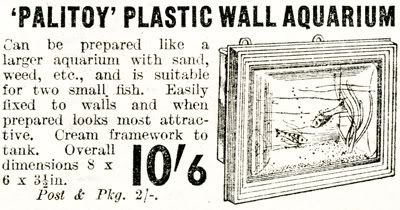
How about this mesmerising plastic wall aquarium, found in an undated Gamages catalogue? It probably dates from the late 1950s judging by the women's fashions featured in the middle pages. The men's fashions are no help at all, indeed some of the garment illustrations look like they've been used for at least 15 years.

Although I like the idea in principal, I'm troubled by the small dimensions of the tank and the evident lack of space and oxygen. Not to mention the lack of structures for the fish to hide and shelter from the glare of human scrutiny. I dread to think that it might have had lights built in too.

Granted I know little or nothing about keeping fish, but I'm sure this Plastic Wall Aquarium is guaranteed to traumatise them before it gently simmers then suffocates them, and they end up doing that listless backstroke on the surface (hopefully screened from view by the generously proportioned frame).

All in all, it suggests a high turnover of guppies, and possibly some equally traumatised children.

Perhaps its not the best suggestion for a Christmas gift. Apologies.


Additional notes

Using Measuring Worth's marvellous calculator, 10/6 would be equivalent to about £9.47 today. (I've taken a complete guess and used 1957 as the original year).

Tuesday, 15 December 2009

What could you buy for 1/9 in 1950?

Tea diffuser from the Headquarters & General Supplies Ltd catalogue, 1950.

You could purchase a "National Service" tea diffuser (now more commonly known as a tea infuser) to help eke out your tea ration.

This ingenious item was found in a 1950 catalogue produced by Headquarters & General Supplies Ltd ("Contractors to War Office, Ministry of Supply, Crown Agents for the Colonies and Education Authorities") based in London.

As you might expect from their business connections, the catalogue has plenty of military surplus clothing and accessories, such as waterproof RAF flying suits - for 45/- or 49/6 with a hood - which are recommended for motorcyclists and motorists. And "Genuine British Army Berets" for 5 shillings ("certainly a smart article for holiday use").

After the war, military surplus flooded onto the market. It was well made and good quality, durable, practical and plentiful. The catalogue makes a fine job of suggesting alternative uses for some often very specialist garments, as has been noted above, but here are some more:

Ex-Naval Torpedo Hazard Suits (17/6): "Ideal for motoring, cycling, boating, etc."

Solid Leather Army Jerkins (12/6): "Ideal for motoring, golf, or hard wear."

Merchant Navy Waterproof Suits (19/6): "For outdoor workers, cyclists, builders."


Interestingly, there are also "Solid Leather Pilots' Jackets Zip Front . . . lined throughout with pure Sheep's Wool" for £5 5s - presumably the sheepskin flying jackets that now fetch extremely high prices in the collectors' market.

Clothes rationing ended in March 1949 but tea rationing continued until 1952, making that 1/9 for a tea diffuser look like a very shrewd investment.


Additional notes

Measuring Worth provides a handy calculator for working out the equivalent prices in today's money (well, 2008 is the nearest they can get), using the Retail Price Index. So let's see:

Tea diffuser 1/9 = £2.25 (you can buy more or less the same thing today for about £3)

RAF flying suit 45/- = £57.76

British Army beret 5/- = £6.42

Ex-Naval Torpedo Hazard Suits 17/6 = £22.46

Solid Leather Army Jerkins 12/6 = £16.04

Merchant Navy Waterproof Suits 19/6 = £25.03

Solid Leather Pilots' Jackets £5 5s = £134.77

And because I seem to have wandered off the subject of tea a bit in this post, here's a stern man in a white coat (a "tea instructor") explaining more than you'll ever need to know about the dos and don'ts of tea making. This is a 1941 film from the BFI's YouTube channel:


If that's worn you out (or you can't face a full ten minutes of tea making instruction) then join Harrod's shopper Elizabeth Allan in 1955 as she introduces the wonder of the teabag. Look out for the brief appearance of a tea diffuser/infuser: