
Finding historic accounts of men's fashions can be a challenge. For the most part, women's fashions dominate surviving records for obvious reasons: fashion has long been assumed to be a largely feminine preoccupation, women's fashions have a faster turnover of trends so there's always some new novelty to observe, and they tend to be more dramatic and eye-catching. Equally, while a woman's appearance was (and frequently still is, sadly) considered to be the most pertinent and interesting aspect of her being, a man's appearance was taken to be the least important thing about him, unless it was particularly remarkable or curious. Men were judged, and recorded, on different criteria - skills, talents, character, achievements - with their wardrobe coming very low on the list, if at all.
As a result, there's a real lack of detailed descriptions of everyday men's wear since it was usually considered of no importance or relevance. Which is why this short piece, 'Frenchmen's Fashions,' published in the seventh Saturday Book in 1947, is such a treasure. Written by Honor Tracy, it provides a precious snapshot of men's fashions in Paris in the immediate post-war period.
Showing posts with label dress history. Show all posts
Showing posts with label dress history. Show all posts
Monday, 24 January 2011


Sunday, 1 August 2010
The Story of a Dress
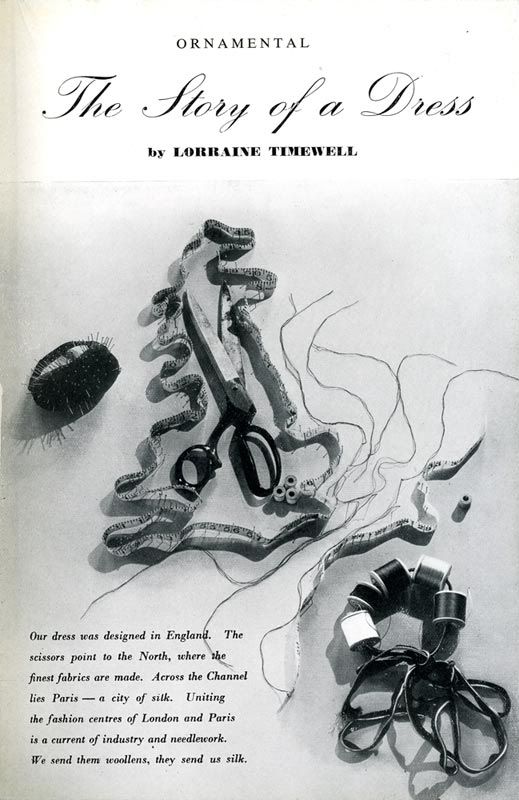
"The Story of a Dress" by Lorraine Timewell, The Saturday Book 7, 1947, pp. 71-80.
Our dress was designed in England. The scissors point to the North, where the finest fabrics are made. Across the Channel lies Paris - a city of silk. Uniting the fashion centres of London and Paris is a current of industry and needlework. We send them woollens, they send us silk.
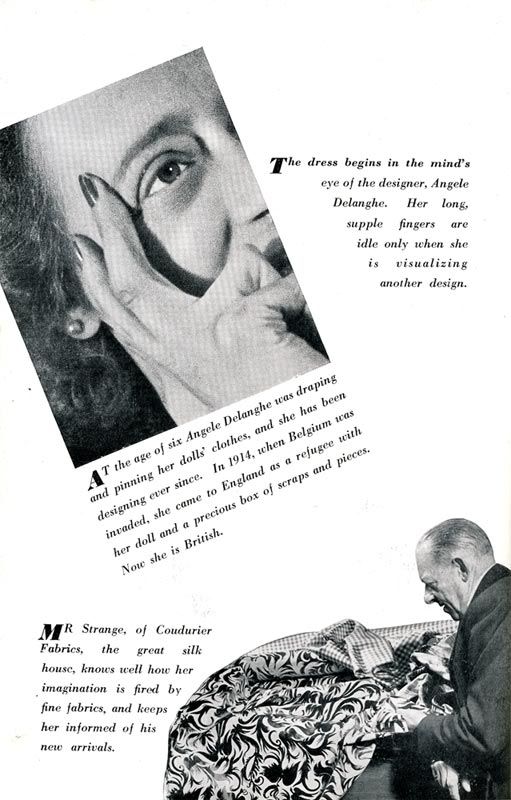
The dress begins in the mind's eye of the designer, Angele Delanghe. Her long, supple fingers are idle only when she is visualizing another design.
At the age of six Angele Delanghe was draping and pinning her doll's clothes, and she has been designing ever since. In 1914, when Belgium was invaded, she came to England as a refugee with her doll and a precious box of scraps and pieces. Now she is British.
Mr Strange, of Coudurier Fabrics, the great silk house, knows well how her imagination is fired by fine fabrics, and keeps her informed of his new arrivals.

In a tiny room she works with the selected fabric straight onto the dummy, its shoulder scarred with pin-marks. In picture one, she is concentrating her mind not on the checked silk, but on the floral printed silk lying on the table by Smuts the cat. She knows exactly what she wants to do with it, and in picture two begins to drape and pin. It is a fine silk in a pale oyster white, with burnt rose and grey outlined flowers scattered over it.
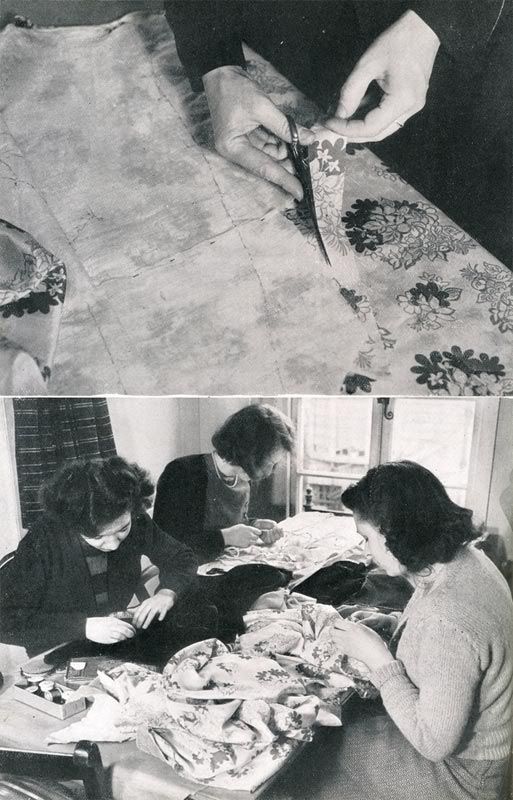
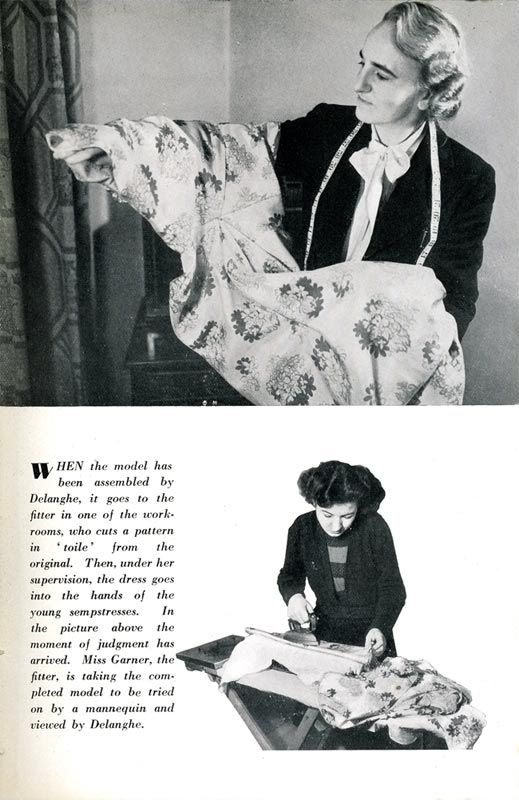
When the model has been assembled by Delanghe, it goes to the fitter in one of the workrooms, who cuts a pattern in 'toile' from the original. Then, under her supervision, the dress goes into the hands of the young sempstresses. In the picture above the moment of judgment has arrived. Miss Garner, the fitter, is taking the completed model to be tried on by a mannequin and viewed by Delanghe.
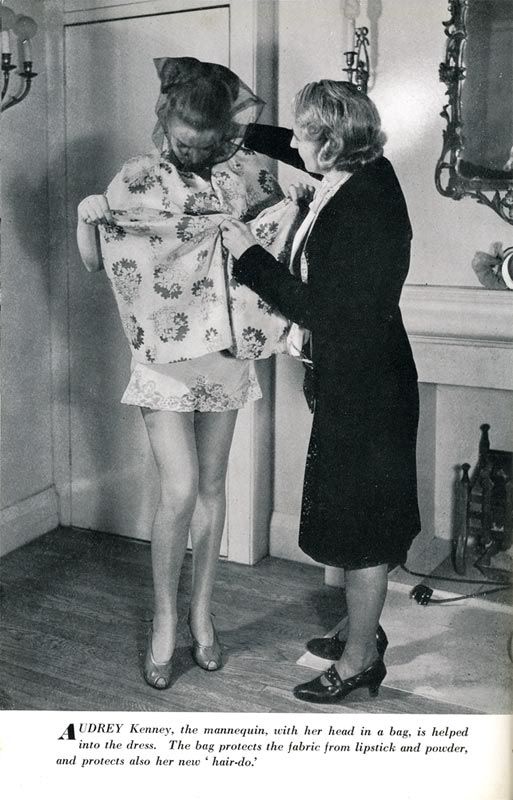
Audrey Kenney, the mannequin, with her head in a bag, is helped into the dress. The bag protects the fabric from lipstick and powder, and protects also her new 'hair-do.'
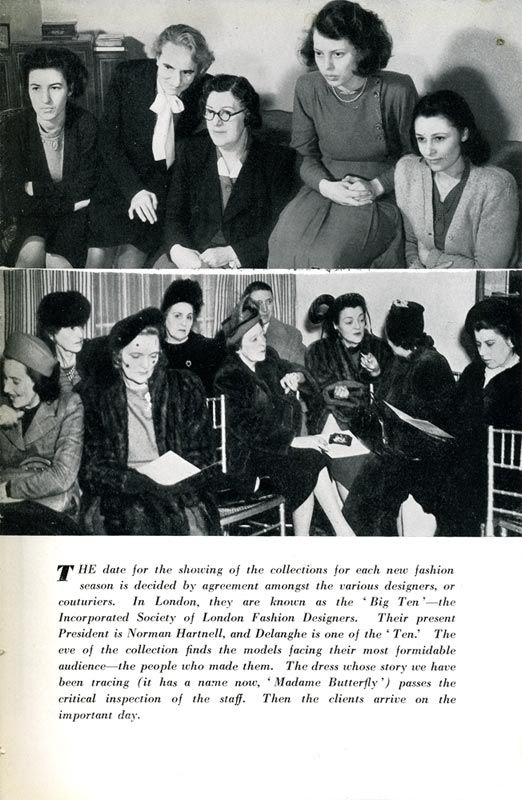
The date for the showing of the collections for each new fashion season is decided by agreement amongst the various designers, or couturiers. In London, they are known as the 'Big Ten' - the Incorporated Society of London Fashion Designers. Their present president is Norman Hartnell, and Delanghe is one of the 'Ten.' The eve of the collection finds the models facing their most formidable audience - the people who made them. The dress whose story we have been tracing (it has a name now, 'Madame Butterfly') passes the critical inspection of the staff. Then the clients arrive on the important day.
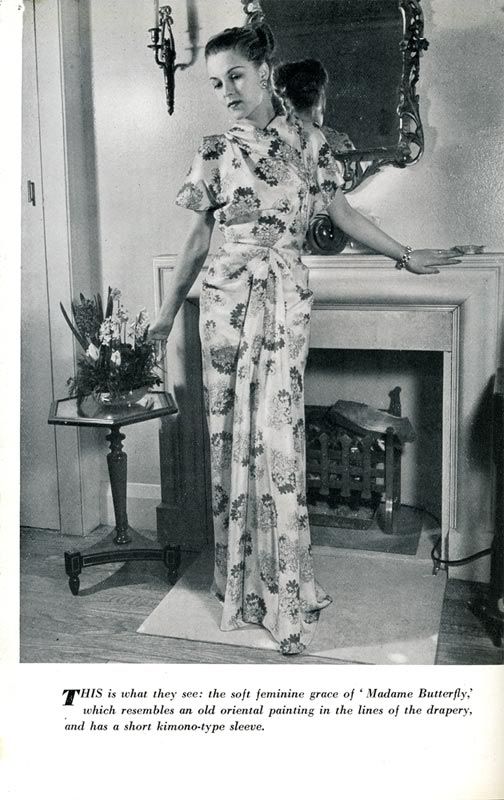
This is what they see: the soft feminine grace of 'Madame Butterfly,' which resembles an old oriental painting in the lines of the drapery, and has a short kimono-type sleeve.
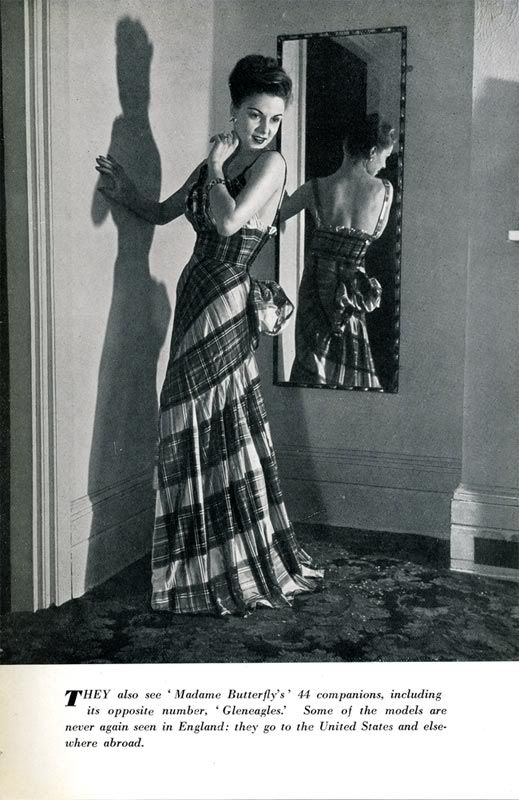
They also see 'Madame Butterfly's' 44 companions, including its opposite number, 'Gleneagles.' Some of the models are never again seen in England: they go to the United States and elsewhere abroad.
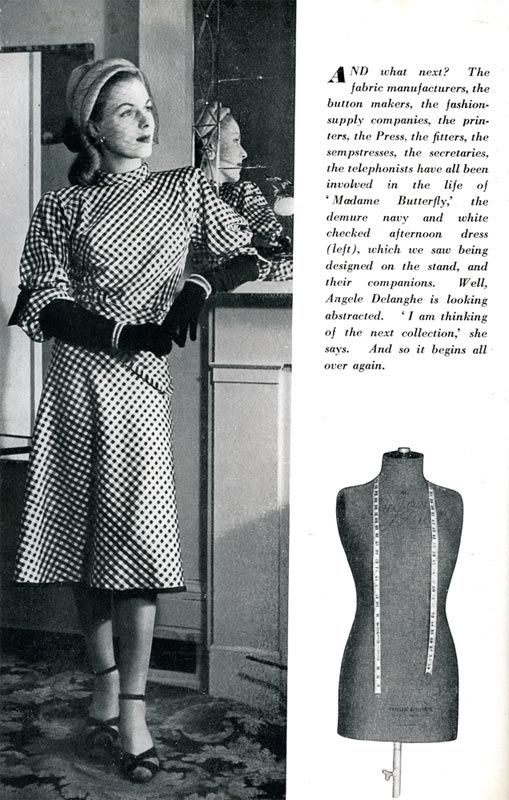
And what next? The fabric manufacturers, the button makers, the fashion-supply companies, the printers, the Press, the fitters, the sempstresses, the secretaries, the telephonists have all been involved in the life of 'Madame Butterfly,' the demure navy and white checked afternoon dress (left), which we saw being designed on the stand, and their companions. Well, Angele Delanghe is looking abstracted. 'I am thinking of the next collection,' she says. And so it begins all over again.
_._._._._._._._._._._._._._._._._._._
This photo story appeared in the seventh edition of The Saturday Book - one of those compendiums of miscellany from the arts to anthropology, history and antiquities, social observation, folklore and all manner of diverting stuff - that were once so popular.
This edition was published in 1947, at pretty much the height of post-wartime austerity and a time when most women could only dream of a new evening gown made of silk, so its interesting to see that Ms Delanghe appeared to have no problem securing such scarce and valuable supplies. But then, as the piece points out, some (most?) of her output was destined for export.
Its great to see that the author, Lorraine Timewell, chose to feature Angele Delanghe rather than one of the more well known members of the London 'Big Ten' such as Hartnell, Hardy Amies or Digby Morton.
In fact I've found precious little about her, apart from these scraps:
Delanghe was an early member of the Incorporated Society of London Fashion Designers, formed in 1942, which included the Hon. Mrs Reginald Fellowes (its first president), Norman Hartnell, Peter Russell, Worth of London, Digby Morton, Hardy Amies, Bianca Mosca, Creed, Molyneux and Michael Sherard. (Information from In Vogue: Six Decades of Fashion by Georgina Howell and Exploring 20th Century London).
She was known for creating "soft feminine tailored clothing and beautiful romantic eveningwear and wedding gowns" (from The Cutting Edge: 50 Years of British Fashion, 1947-1997 by Amy de la Haye).
After the war she took over the Ladies' Outfitting and Ready to Wear Departments at Fortnum & Mason and "revitalized" them.
Former women's editor of the Yorkshire Post, Valerie Webster, recalls with palpable frustration that she was required to attend "the couture shows of people like Angele Delanghe and Lachasse who made tweedy suits and hefty jewel-encrusted evening gowns for the grouse moors and hunt ball scene." To be fair, this was probably in the early 1960s, and young Valerie was more interested in Mary Quant than grouse moors and hunt balls, and perhaps Delanghe was past her prime.
This little 'backstage' story of Angele Delanghe's work at least adds a little more to our knowledge of her.
Sunday, 14 March 2010
The Message Wearers
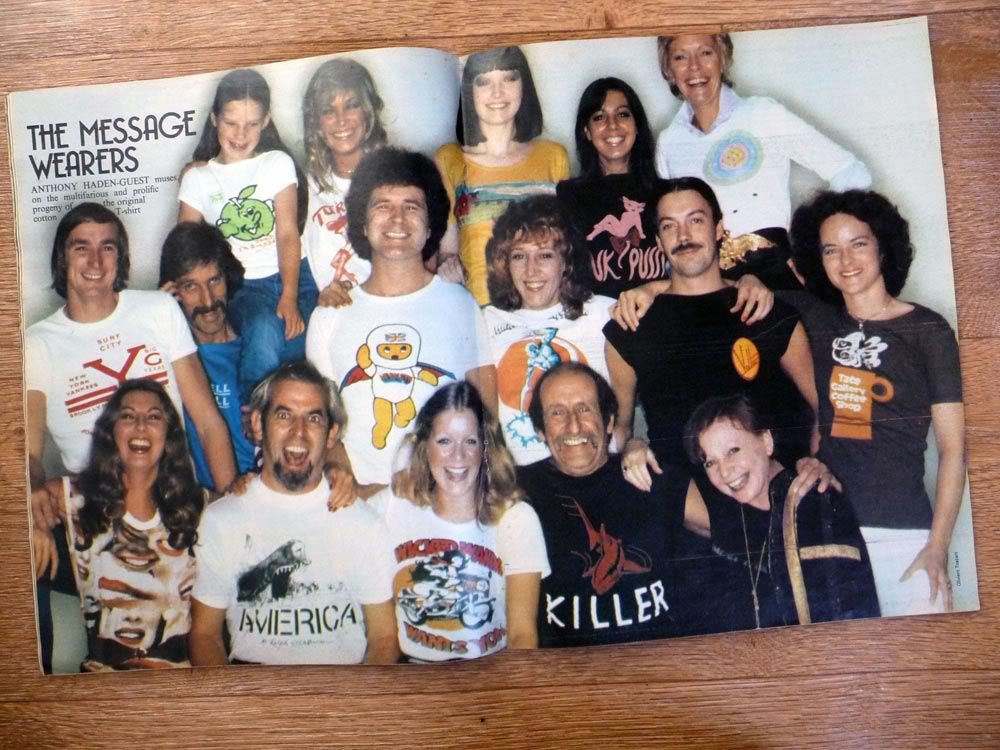
Photograph by Oliviero Toscani from the Sunday Telegraph Magazine, 5 December 1975. Original caption: "Got the message? Back row, from left: Helena Axbey wears a Scratch 'n' Sniff "smelly, £1.80; actress Prunella Gee plumps for Turners on the Strip; model Marianne Desnaux wears an embroidered shirt, £3 from Ace, Kings Road; model Nicki Debuse in Anthony Price's Pink Pussies shirt, £3.25 at Jean Machine; Princess Elizabeth Galitzine sports an Apicella design. Centre row, from left: Alan Pascoe in an original Mods shirt, £1.50 from Scott Lester; art director Geoff Axbey in a Bell telephone shirt, Don Grant in the Hesketh Racing shirt, £2.30; Diana Hyslop in a Marvel Comics number, £1.25; actor Tim Curry wears a Voltar T-shirt, £3.25; Sarah Fox-Pitt of the Tate Gallery in their Coffee Shop shirt, £1.50. Front: Marilyn Cole in a Lips shirt, £9 from Howie, Fulham Road; Ralph Steadman promoting his book; Penthouse Pet Val Mitchell; Enzo Apicella turns Killer for £3.25; Thea Porter wears a rare Yugoslav T-shirt."
This is terribly bad form for someone aspiring to write a blog, but this will be another post I haven't actually written myself.
When I lived in Brighton a few years ago, I came across a load of old 1970s Sunday supplement magazines scattered over the pavement near a paper recycling bin. Of course I had to take a look, and among them was a Sunday Telegraph Magazine from 1975 containing the following piece.
Its a wonderful report on the history and language of the t-shirt written by Anthony Haden-Guest with some great quotes from people involved in their design and production (such as Anthony Price) and some observations about t-shirts spotted out and about at the time that ring lots of bells for me.
I would have been nine in 1975, so I certainly wasn't in the market for the £9 Howies 'lips' t-shirt (about £56 in today's money, according to measuringworth.com) but I did have a scratch 'n' sniff t-shirt with a large strawberry on it - see little Helena in the picture above wearing an apple version - and I'm ridiculously pleased to see it featured in this article. That t-shirt, worn with some very wide C&A jeans with three buttons on each back pocket and two-inch deep turn-ups, and some no-brand canvas basketball boots, was my summer holiday uniform that year.
Enough of my memories, let's get to that article. This is a faithful transcription (I hope), and any emphasis/italicisation was in the original piece.
Anthony Haden-Guest, "The Message Wearers," Sunday Telegraph Magazine, 5 December 1975, pp. 36-40
Coco Chanel said it, and cannot be topped. "It doesn't matter how much it costs," observed Mademoiselle, "as long as it looks cheap." Quite so, and here, stepping through late sunlight down Sloane Street, come three girls. They are, all three of them, wearing T-shirts. The dark one, whom I know slightly, is wearing a ravelled item with the device of a Los Angeles radio station, and the shortish blonde is wearing something pink and frilly with shoulder straps (which does not iron out into that basic cotton T, but is one of the numerous descendants of the T-shirt nonetheless). And the tall girl, also blonde, is wearing a puce number with the following written on it, in italic script: This is not a T-shirt.
T-shirts. Words and images, swirling and swanning by. The banal and the opaque. The repetitive images - Marilyn, Mickey Mouse, Mao - merging with political slogans, holiday souvenirs, erotica, and the names of obscure American colleges. Household products jostle with rock groups. T-shirts urge love, make dreadful jokes, and communicate Christian names. The ordinary old stretch-cotton T-shirt has spawned a progeny of sequins, glitter, and - in at least one esoteric case - rubber. What started as just low-budget stuff has, unbeknown to itself, burgeoned into a . . . language.
It has, like all languages, its complexities. When Melody Bugner wears the I'm backing Joe Bugner T-shirt, executed to her own design, her message comes through loud and clear. So, too, when idolatrous garments are worn by the hirelings or fans of the Tate Gallery, Elton John, Marvel Comics, the BBC Proms, the Wombles or The Economist. Maria Schneider, the French actress, likewise demonstrates her respect for guitarist Eric Clapton by sporting his likeness, just as Charo, current wife of musician Xavier Cugat, sensibly wears her own. Elizabeth Taylor's message - I am not Elizabeth Taylor so please stop following me - was more complex. And what is one to make of the legend masochistically flaunted by fast bowler Dennis Lillee, Hit me for six?
Things are even less simple out in the streets. A Coca-Cola T-shirt seldom indicates that the wearer works for that corporation, but there are corporate T-shirts. A travel T-shirt - Bournemouth, say, or Bermuda - may mean, like a book of matches, that you have been there: or that you would like people to think you have been there, or that the idea of going there is a hilarious joke, or just that you like the image on the shirt.
Some people wear T-shirts because they have bad taste, and some to show what good taste they have by wearing bad taste, like rhinestone-studded images of Elvis Presley. That young man wearing an Ohio State University number is usually a Frenchman who would be hard put to it to locate Ohio on a map; but there is a chance he may actually have been at Ohio State. I assume that the T-shirts lettered Hermès, Vogue and Pierre Cardin are a street-satire, though I am not entirely certain; but I am certain that the shirts that have, at the bottom, a trompe l'oeil rendition of a Gucci belt is a joke, and quite a good one at that.
But what of that plumpish lady I once met who bore emblazoned across her frontage a line from a recent hit: Voulez-vous coucher avec moi ce soir? Ted Polhemus, the American author of a book on fashion-as-language, who was working until recently at London's Institute of Contemporary Arts, notes that "the interesting, and important thing about wearing T-shirts is how much unification of image there is in semiological terms. I saw a girl walking down London's King's Road wearing a T-shirt with people making love all over it. You know, one of those Tantric paintings. What can you say to a girl whose T-shirt shows that? You can't say anything, right? It's an anti-sexual gesture."
Semiology is, of course, the science of sign language, and Polhemus goes on to note that, vis-a-vis T-shirts, the signalling extends beyond the image. "Some people just can't wear T-shirts. They iron them. They always look new. T-shirts should have holes ripped in them. In fact, I used to run a service ripping holes in friends' T-shirts . . . "
It is, in a way, surprising that the language of T-shirts has been massively ignored by fashion historians. Oh yes, the fashion mags (especially the tabloids) do their stuff. But in the hard-cover tomes the T-shirt seldom rates a mention. One recent such I scanned runs from Tabard through every manner of Tricorne and Tunic to a Byzantine something called a Tzitsakson. But T-shirts? Never. The late, and usually commendable, James Laver noted with asperity that jeans and the T-shirt lead us to a world in which, as in Red China, all distinctions of class or sex would be abolished. Even Coco Chanel was, as they say, parlant d'autres choses.
Which is regrettable, because it is self-evident what T-shirts have become . . . Mass Couture.
There was nothing stylish about the T-shirt's origins, as the upper half of "combinations", but it was charged with a certain frisson. A bit, one imagines, like a blonde in undies; but also a bit like her shopping in curlers. It was this dual brutish aspect that was exploited by the inarticulate Marlon Brando, who, according to Cleveland Amory's International Celebrity Register, "made a torn T-shirt a symbol of virility". The film was A Streetcar Named Desire, the date was 1947, and it did not take long for the image to register; the undershirt to encroach on the shirt. It happened, inevitably, in California.
"It was an outgrowth of the Hot Rod culture," says Malcolm MacPherson, a London correspondent for Newsweek. "It was in the early Fifties. They stopped drag racing on the freeways, and guys were going to the Santa Ana airstrip. You'd see them wearing T-shirts with the names of, you know, automobiles."
The thing burgeoned. Britain was in one of its phases of acute Americanophilia, and the transatlantic passage of the T-shirt happened so. Marshall Lester, son-and-heir of Scott Lester, who manufactured flags and badges for retail stores, was doodling on a white vest. English, and in his early twenties, he was doodling things American, cities, cars and such, and getting some of them wrong ("Boneville" for Bonneville). But he had them printed and sent them for sale. Just to see.
A couple of days thereafter was the first of the Brighton Mods-and-Rockers riots. Marshall Lester watched it on television. The Mods were wearing his T-shirt. He saw.
Alan Conway, incidentally, a Lester associate, claims that the blood which was soon to be shed on such T-shirts inspired tie-dyeing. Arguable, though tie-dyeing was certainly the next Big Thing. Chester Martin, a doyen of the field, had managed to acquire a stockpile of the original three-button combination tops, and had them dyed in hip colours. They were to become a basic element in the uniform of another Sixties movement: The Hippies.
The advertisements-for-myself potential of the T-shirt was not overlooked by the Underground. T-shirts proclaiming love, peace, revolution and dope. Coca-Cola and Walt Disney were unamused to find their iconography metamorphosed into, say, Cocaine and Mickey Rat.
Visual inventiveness manifested itself here and there. Already in 1963 painter Allen Jones had produced what may have been the first colour-printed T-shirt. Mr Freedom was creating the first real up-market T-shirts; stylishly brassy pieces exploiting a largely American pop iconography of junk foods and comic strips. "We appreciated American stuff," notes designer Anthony Price, "and they didn't, until we had done it."
The mass merchandisers began to move in. Record companies tried to transform the uncommitted into fans with free T-shirts, and fans into mobile hoardings. "T-shirts really boomed in 1966," Alan Conway says. World Cup Willie: Carnaby Street: Swinging London souvenirs. "When the mass market got involved everything became very tatty," says T-shirt designer Peter Golding, "The quality was terrible". Alongside Swinging London, the British T-shirt waned.
But it never died. In spite of fashion journalists, like jeans, it was simply too useful to die. There has been growth, and diversification. At one end of the scale are Marshall Lester, the biggest, and bigger than most American firms, selling projected millions this year. At the other is a small group of designers, and they are bullish. "There's a rebirth," proclaims Peter Golding, "because it used to be you'd have to do millions, but now it's your custom tailoring. And you can do the very best, and it still shouldn't cost more than £10."
Or there is Malcolm McLaren of the shop formerly entitled Let It Rock, but now called Sex. McLaren has organised a small exhibition of his own T-shirts, including the aforementioned rubber one, and one covered with names of which the designer approves disapproves (your correspondent found himself in the latter category, sandwiched between Alan Brien and Playboy's London boss, Victor Lownes). Oh yes, and they come carefully pre-torn, or with weakened seams for tearing.
Contrariwise, Anthony Price, who has attracted attention for his Fifties T-shirt look, remarks, "My friends and I were into that James Dean stuff years ago. It's just that now it's commercial. I won't try and sell anything until two years after we're finished with it. It's just a matter of waiting until Mr Average is ready for it."
What is Mr, or Miss, Average ready for right now? "I think the days of being extreme are gone. People don't want to be looked at any more," says Price. And certainly the street look is now a less ornate one; a hearkening back to basic Americana. College shirts and football numerals. "After all that glitter," muses Andrew Bailey, former London Editor of Rolling Stone, now with Bell Records, "It's quite nice to look like a clean-cut college boy. Even if it's not a college you went to . . ."
And things to come? "Los Angeles is always first, and Paris," says John Dove of Wonder Workshop firmly (Dove has designed some splendidly garish pin-uppy designs). "London's bad-taste level is about one year behind. And Germany's bad-taste level is two years behind us. We sell a lot to them. Rock-n-roll stuff, and they're really into glitter. Next I think Pop is going to be coming back. I foresee a big revival."
Or, to be accurate, a revival of a revival. The T-shirt has accumulated a history. "I still wear my 1973 Rolling Stones Tour T-shirt," says Andrew Bailey. "It's like a - campaign ribbon." The T-shirt as memoir, but there's more to it than this. There are T-shirt collectors who have amassed hundreds, and not merely the rare expensive item, like the early Beatles number recently sold for £85. But T-shirts collected for their associations, their sheer power of image. The classics.
Like the T-shirt with the image of the slung Nikon camera, and the one from Biba's which had the bust-size in sparkly numbers. Or, for that matter, the one with two fried eggs positioned over the boobs; or a close focus photograph of the torso (the T-shirt, that most physically revealing of upper garments, is still oddly obsessed with physicality). Or the Mona Lisa T-shirt, or the defunct line of Private Eye T-shirts, or the T-shirt across the front of which breaks one of Hokusai's woodcut waves. Or the T-shirt which carries a trompe l'oeil rendition of a dinner-jacket and black tie. Or the one which said I'm backing Britain, or that more recent political classic which bore the legend Gather Strength and was to have been worn by four young women from the Amalgamated Textile Workers' Union lined up in a comradely way alongside leading Labour politicos, until they noticed the labels said Made in Portugal.
Innovation, meanwhile, continues. Consider the "smellies", as developed by the 3M Corporation of Minnesota. In our picture (back left) Helena Axbey is wearing a Scratch 'n' Sniff apple, as marketed by Scott Lester. Scratch, and, yes you do sniff apple, and Conway assures me that the shirt will last many hard washes.
Nor does it stop with apples. There's oranges and strawberries. "We're hoping to do something for Coca-Cola. Do you want to smell it? Amazing, isn't it? We've got chocolate, petrol, gas. The gas is revolting. We wouldn't use it on a T-shirt. They can make the smell of anything. Except beer and coffee . . . "
Now upon us also is the iron-on. Images are published in U.S. newspapers which can be ironed on to the T-shirt directly. Just so. Coco Chanel was right. Mass couture. And it is only occasionally that my mind drifts to this cartoon published in last June's The New Yorker.
[I neglected to photograph this. The cartoon shows a young man walking along a beach crowded with people wearing slogan t-shirts. His t-shirt is blank and his girl companion says: "Nonsense! I think it's refreshing to see a T-shirt that doesn't say anything."]
Friday, 12 March 2010
Dr Cunnington knows best
The Gallery of Costume in Manchester reopens tomorrow after an extensive renovation lasting two years and costing over £1 million.
Full disclosure: I have worked as a volunteer at this museum for several years, so its hard to be impartial about it (although I will try!)
The Gallery of Costume is housed in a beautiful 18th century mansion set in the north eastern corner of Platt Fields park, and the improvements have scrupulously respected its architectural integrity and features whilst introducing a welcome sense of space and light.
I'm not going to go on about the building and estate itself (although those that are interested can find a fascinating history of it in the newly republished Fabric of Society, details below) but the couple whose collecting passion and pioneering research formed the basis of what is now one of the most important collections of dress in Britain.
Dr C. Willett Cunnington and his wife Phillis (also a physician) began collecting Victorian dress in the 1930s, and discovered, after making enquiries about it, that there was little or no academic interest in the subject. However, they persisted in their acquisitions and soon accumulated a sizeable collection - not just of garments but books, catalogues and periodicals, fashion plates and photographs - and their research efforts culminated in a series of co-authored books on costume history and theory that helped legitimise the study of dress as a subject of serious enquiry.
The Cunningtons felt strongly that there should be a national museum in Britain entirely devoted to costume and, as they approached retirement from their practice in medicine in 1945, they put their collection up for sale. Their offer was taken up by the City of Manchester Art Galleries, which decided that the now empty Platt Hall would be a suitable venue for it. The Gallery of Costume was launched.
Dr C. W. was quite the media star already - he had "built up a reputation as a lecturer and broadcaster with a flair for racy anecdote, and a gift for summing up the spirit of an age" (Fabric of Society, p.16). And guess what? He can be found in TinTrunk's favourite film resource, the British Pathé archive!
This 1931 film is narrated by Dr C. W. Cunnington himself, as he gives you a potted history of 19th century fashions, worn by real live models (something that no modern curator would permit!) in an elegant garden setting. You can hear evidence of his humour and practised delivery, no doubt honed over numerous lecture appearances, in this delightful short:
In 1938 Dr C. W. appears before the camera brandishing a "kind of felt" corset of 1780, and relishing the arrival of a print dress "worn over a hundred years ago" that comes bundled up in brown paper.
I wonder if his wife Phillis was one of the women present in that shot. It does seem that she didn't have quite the media exposure that her husband seemed to enjoy, although perhaps it suited her to stay in the background. There's more non-conservation-standard modelling of antique garments too:
This last film, from 1947, must have been shot during the early days of the Gallery of Costume and begins with a fashion show by designer Rosalind Gilbert. The narrator draws parallels with elements of her designs and historical fashions, and the film then cuts to shots of the Cunnington collection, again being modelled by real live human beings. I won't comment on the curious scene of the woman undressing while being spied on by two little girls (don't worry, its perfectly SFW), except to note that those were obviously much more innocent times:
The newly refurbished Gallery of Costume has a fabulous new exhibition on the ground floor covering 20th century fashions - Suffragettes to Supermodels - but if you are visiting, you must venture upstairs to the first floor where Eleanor Thompson has curated an intriguing show of 19th century dress which unpicks Dr C. W.'s theories on women and fashion with a 21st century perspective. Whilst respecting his legacy, it has some illuminating insights into his approach and attitudes to women.
The Gallery of Costume will be open from Wednesday to Saturday every week, 1.30 pm to 4.30 pm.
Address:
Gallery of Costume
Platt Hall
Rusholme
Manchester
M14 5LL
Tel: 44 (0) 161 245 7245
Further reading and exploration
A selection of the museum's photographic collection of over 25,ooo images, can be seen here on flickr.
Jane Tozer and Sarah Levitt, Fabric of Society: A Century of People and Their Clothes 1770-1870, recently republished, I will add details as soon as I know them! [This is an excellent book which features numerous items from the Gallery of Costume's collections in a varied selection of essays about all aspects of dress history, from high fashion to workwear].
The reopening of Manchester's Gallery of Costume. BBC Radio 4 interview by Jenni Murray with Moira Stevenson, head of Manchester City Galleries.
Manchester's Gallery of Costume to reopen after two-year, £1.3million revamp.
Preview of Manchester's Gallery of Costume.
Clothes show returns after £1.3m revamp. [The first, and currently only, comment made me laugh, by the way].
Hats off as revamped clothes show opens.
Full disclosure: I have worked as a volunteer at this museum for several years, so its hard to be impartial about it (although I will try!)
The Gallery of Costume is housed in a beautiful 18th century mansion set in the north eastern corner of Platt Fields park, and the improvements have scrupulously respected its architectural integrity and features whilst introducing a welcome sense of space and light.
I'm not going to go on about the building and estate itself (although those that are interested can find a fascinating history of it in the newly republished Fabric of Society, details below) but the couple whose collecting passion and pioneering research formed the basis of what is now one of the most important collections of dress in Britain.
Dr C. Willett Cunnington and his wife Phillis (also a physician) began collecting Victorian dress in the 1930s, and discovered, after making enquiries about it, that there was little or no academic interest in the subject. However, they persisted in their acquisitions and soon accumulated a sizeable collection - not just of garments but books, catalogues and periodicals, fashion plates and photographs - and their research efforts culminated in a series of co-authored books on costume history and theory that helped legitimise the study of dress as a subject of serious enquiry.
The Cunningtons felt strongly that there should be a national museum in Britain entirely devoted to costume and, as they approached retirement from their practice in medicine in 1945, they put their collection up for sale. Their offer was taken up by the City of Manchester Art Galleries, which decided that the now empty Platt Hall would be a suitable venue for it. The Gallery of Costume was launched.
Dr C. W. was quite the media star already - he had "built up a reputation as a lecturer and broadcaster with a flair for racy anecdote, and a gift for summing up the spirit of an age" (Fabric of Society, p.16). And guess what? He can be found in TinTrunk's favourite film resource, the British Pathé archive!
This 1931 film is narrated by Dr C. W. Cunnington himself, as he gives you a potted history of 19th century fashions, worn by real live models (something that no modern curator would permit!) in an elegant garden setting. You can hear evidence of his humour and practised delivery, no doubt honed over numerous lecture appearances, in this delightful short:
A CENTURY OF DRESS. FROM THE FAMOUS COLLECTION OF DR C.W. CUNNINGTON
In 1938 Dr C. W. appears before the camera brandishing a "kind of felt" corset of 1780, and relishing the arrival of a print dress "worn over a hundred years ago" that comes bundled up in brown paper.
I wonder if his wife Phillis was one of the women present in that shot. It does seem that she didn't have quite the media exposure that her husband seemed to enjoy, although perhaps it suited her to stay in the background. There's more non-conservation-standard modelling of antique garments too:
OLD FROCKS
This last film, from 1947, must have been shot during the early days of the Gallery of Costume and begins with a fashion show by designer Rosalind Gilbert. The narrator draws parallels with elements of her designs and historical fashions, and the film then cuts to shots of the Cunnington collection, again being modelled by real live human beings. I won't comment on the curious scene of the woman undressing while being spied on by two little girls (don't worry, its perfectly SFW), except to note that those were obviously much more innocent times:
FASHIONS (issue title is PATHE PICTORIAL LOOKS AT THE PASSING YEARS)
The newly refurbished Gallery of Costume has a fabulous new exhibition on the ground floor covering 20th century fashions - Suffragettes to Supermodels - but if you are visiting, you must venture upstairs to the first floor where Eleanor Thompson has curated an intriguing show of 19th century dress which unpicks Dr C. W.'s theories on women and fashion with a 21st century perspective. Whilst respecting his legacy, it has some illuminating insights into his approach and attitudes to women.
The Gallery of Costume will be open from Wednesday to Saturday every week, 1.30 pm to 4.30 pm.
Address:
Gallery of Costume
Platt Hall
Rusholme
Manchester
M14 5LL
Tel: 44 (0) 161 245 7245
Further reading and exploration
A selection of the museum's photographic collection of over 25,ooo images, can be seen here on flickr.
Jane Tozer and Sarah Levitt, Fabric of Society: A Century of People and Their Clothes 1770-1870, recently republished, I will add details as soon as I know them! [This is an excellent book which features numerous items from the Gallery of Costume's collections in a varied selection of essays about all aspects of dress history, from high fashion to workwear].
The reopening of Manchester's Gallery of Costume. BBC Radio 4 interview by Jenni Murray with Moira Stevenson, head of Manchester City Galleries.
Manchester's Gallery of Costume to reopen after two-year, £1.3million revamp.
Preview of Manchester's Gallery of Costume.
Clothes show returns after £1.3m revamp. [The first, and currently only, comment made me laugh, by the way].
Hats off as revamped clothes show opens.
Wednesday, 10 March 2010
Clothes make the film

Corinne Griffiths in Outcast, 1928, originally uploaded by Trevira.
This post is a bit of a cheat because I haven't written it. It is an article transcribed from an issue of Picturegoer magazine from August 1926 (found while researching at the excellent Bill Douglas Centre for the History of Cinema and Popular Culture), which explores the growing influence of Hollywood on women's fashions.
There's little mention of costume designers, apart from Cora McGeachy and "the well-known New York costumier" Madame Frances.
Cora McGeachy suffers the indignity of being called "Cora MacCreachy" on IMDB, and is credited with only one film, Irene, which is discussed in the article below (incidentally, Irene is available on DVD at Grapevine Video). BroadwayWorld.com supplies another credit: she was the costume designer of the Ziegfeld Follies of 1923 (Summer edition) on Broadway.
Madame Frances apparently employed the young Travis Banton who went on to great things at Paramount.
Hollywood costume designers really hit their stride in the 1930s, with designers such as the aforementioned Travis Banton, Howard Greer and Adrian not just following Paris' lead but creating and launching their own trends.
Indeed, it was necessary for costume designers to create their own fashions, in a sense, since the amount of time involved in film production meant that if they tried to conform too closely to current styles there was the ever-present danger that by the time of release the costumes would be hopelessly out of date. Not to mention the extended period that films might be shown on the circuit - according to this article this was "roughly three years."
So this article is an interesting snapshot of a time when Hollywood still deferred to Parisian authority with regard to fashions - there's mention of the director Frank Tuttle having costumes sent from Paris - but was growing in confidence in its ability to create glamorous costumes of its own. Please enjoy Josie P. Lederer's entertaining report on film fashions in 1926. (I've added links to more information whenever possible, and my comments are in square brackets).
Josie P. Lederer, "Clothes make the film"
For the very latest modes see the movies; they’re nearer than Paris – and cheaper.
As long as there are women in the world, and in the picture theatres, just so long will the title of this article hold good.
For women form the majority of film patrons, and for them and because of them the fashion film was invented. Ever since The Dressmaker from Paris featured a mannequin parade, and registered a great success, every producing company in the U.S.A. has seen fit to make similar specimens.
There is no reason why they shouldn’t. These fashion films fill a very definite want on the part of Mrs. And Miss Suburbia, who go to the movies instead of to Paris to see the latest thing in gowns.
There are over a dozen of these films due for release within the next three months and they are all sure to delight film fans.
The stars, however, are not wildly enthusiastic over them.
Naturally they like the idea of wearing pretty and sumptuous clothes. But, even when they know they are capable of wearing them well, they feel a tiny bit aggrieved at the thought of the success or failure of the film depending, not upon themselves, their director, or their acting, but upon that hitherto unknown quantity, the dress designer.
It is not a question of dollars alone. Battles wage between the great companies, and the bone of contention is the cleverest and most original sartorial specialist. The object is to secure his or her exclusive services.
That is what occurred in Irene, a film famous for presenting the first fashion parade photographed in natural colours – a charming idea beautifully carried out.
In Cora McGeachy, Colleen Moore vows she has found somebody to whom the commonplace is anathema, and who designs clothes which fit the personality of the wearers as well as the spirit of the story.
The Irene creations are certainly lovely, from Dame Fashion herself, who introduces the parade, to the various fancy costumes depicting “The Seasons,” and the girls dressed as water lilies, who inhabit the ornamental lake which forms part of the setting.
Colleen Moore’s prettiest is a palest green confection trimmed with row upon row of ostrich feathers, and topped by a large gauze hat with a crown composed entirely of tiny pink roses.
She also wears a striking cigar-brown walking costume; from one of the huge fur-edged sleeves of which peeps the head of a live puppy. The rest of him reposes in a pocket in the cuff specially made for that purpose.
Paramount’s Mannequin, despite its title, has no wonderful fashion parade, but features Dolores Costello and one of the prettiest garden party frocks extant. Picturegoers with imitative minds and clever fingers will doubtless rush home to make one exactly like it.
It is composed of very fine, hand-painted lawn, and its most striking feature is a huge flat bow of black velvet ribbon at the left side of the low waist, held in place by the diamond arrow which plays so dramatic a part in the story.
Though Mannequin belies the promise of its title, The American Venus, presented by the same company, is little else but a beauty and fashion show. Frank Tuttle, its director, sent to Paris for the costumes, and all the newest and smartest ideas in street and ballroom attire are seen, as well as the snappiest of bathing beauties and bathing dresses.
Louise Brooks, in particular, wears some styles well worth noting, and Dorothy Matthews and Ruth Baren are easily first in the fashion show itself.
Every Gloria Swanson picture is a fashion picture, for the star’s clothes made her reputation and many look to them to support it.
Gloria’s gowns, however, are not for the million. She spends more upon them than any other star; her bills aggregate over 125,000 dollars per annum for film clothes alone.
Then there are her film jewels, which are usually hired at about ten per cent of their actual cost. She wears some 25 pairs of shoes in a picture, and her off screen wardrobe contains nearly fifty walking dresses alone, and over two hundred hats.
The second-best-dressed star is probably Corinne Griffith [featured in the photo above], and she has tried to beat her own record in Mlle. Modiste. After personally combing New York for clothes for this film, she and Madame Frances (the well-known New York costumier), put their heads together and evolved a dazzling wardrobe.
Mlle. Modiste’s hats were made especially for her by Peggy Hoyt, and Corinne spent three days matching up shoes, sandals and evening slippers to her gowns.
The forty gowns Constance Talmadge is to wear for her new crook comedy [this might be Venus of Venice] will prove a potent incentive to fashion fiends to go and see the picture.
And although the dresses in Natacha Rambova’s When Love Grows Cold are outlandish in the extreme, they contain some striking and easily modified ideas, and are worth the admission money. They are very different from Natacha’s ordinary attire, which is striking but severe, and for which Poiret is usually responsible.
Jetta Goudal goes down in movie history as the girl to introduce bouffant gowns into Cecil De Mille productions. That worthy’s heroines had, until the advent of Jetta, been slinky of outline, but “la Goudal” is nothing if not individualistic in her attire.
Interesting facts concerning film favourites can be learned from the studio costumiers who design, fit, and make the film frocks and frills that magnetise so many feminine fans into kinemas.
Most studio designers are agreed that Anna Q. Nilsson, though she is one of the tall stars of filmland, is also so perfectly proportioned that any and every style becomes her.
She can wear hoops or hobble-skirts equally well. The long, flowing gowns and picture hats she affects in the opening reels of The Greater Glory are a complete contrast to the skin-tight clothes she dons later on in the story.
She looks as well in sporting attire as she does in period garb, and made an excellent boy in Ponjola and Miss Nobody.
Norma Shearer, Constance Bennett and Dorothy Mackaill would seem to be the young girl’s ideal fashion models.
Constance Bennett has a natural flair for costumes, and the simplest frock, worn as she wears it looks wonderful.
Norma Shearer concentrates very seriously upon her clothes, because her mail tells her how many girls look to her to show them Dame Fashion’s latest whim.
Dorothy Mackaill is a feminine Lon Chaney in that she loses her own personality directly she dons the clothes of the film character she is creating.
She has a slender, graceful figure, and many of her Chickie and Joanna gowns were eagerly copied by youngsters of her type all over the world.
Fashions come and go so rapidly that it takes an expert to decide what is and what is not a filmable gown.
The life of a big screenplay is, roughly, three years, so that anything that might “date” too definitely must be ruthlessly discarded.
The Fashion picture’s life must, necessarily, be shorter than this, but even then, it justifies its existence, as well as the thousands of dollars spent upon its costumes.
For in the eyes of four-fifths of those who sit in kinemas, clothes, without a doubt do make the film.
-----------------------
I must end with a link to a great article from one of TinTrunk's favourite blogs, The Bioscope, which addresses the subject of fashion on film in the silent era: Catwalks and pavements.
Thursday, 25 February 2010
Constructing the Teddy Boy
One of the most conspicuous aspects of the British Teddy Boy was his hair; that towering quiff carefully and regularly primped with a comb - perhaps a flick knife comb for extra posing points! - and secured with copious fistfuls of pomade.
At least since the nineteenth century, men's hair was simply cut short and combed flat, sometimes slicked with the macassar oil that gave Victorian and Edwardian housewives such headaches worrying about their stained upholstery they were forced to invent the antimacassar. The only possible variations seemed to be in the parting of the hair, and tonsorial exuberance was confined to the moustache.
Given all those long decades of modesty and simplicity in men's hair, it must have been quite a shock in the early 1950s to see young men constructing glossy (and greasy) edifices of hair and quite shamelessly preening in what was seen as an effeminate manner. There can't have been many young men who went quite to this, er, length though:
This 1956 film was shot at Cyril Parker's hairdressers shop in Tottenham Court Road, London. The hair 'sausage' or 'elephant trunk' seems very similar to the postiches used by Victorian and Edwardian women to pad out their hairdos - think of those voluminous bouffant styles as sported by the "Gibson Girls" which often needed substantial postiches to achieve.
There's very little footage of Teddy Boys in the British Pathé archive, although interestingly the two clips I've found focus on their hair. So here's the second film, shot at a hairdressing show in Belle Vue, Manchester, in 1955.
There's some bizarre ladies' hairdos, and a varied selection of men's haircuts including the 'Petronius' (Roman style), the 'Curled Semi-Crew Cut,' the 'Brush Cut' and the 'Tony Curtis.' You can catch a brief glimpse of Lew Starr (finessing the Brush Cut), who was the Teddy Boy hairdresser in Manchester, and - I'm told by one who remembers - always had intimidating queues of scowling, smoking ruffians outside his salon in Charles Street:
And we all know what 'D.A.' really stands for, don't we?!
At least since the nineteenth century, men's hair was simply cut short and combed flat, sometimes slicked with the macassar oil that gave Victorian and Edwardian housewives such headaches worrying about their stained upholstery they were forced to invent the antimacassar. The only possible variations seemed to be in the parting of the hair, and tonsorial exuberance was confined to the moustache.
Given all those long decades of modesty and simplicity in men's hair, it must have been quite a shock in the early 1950s to see young men constructing glossy (and greasy) edifices of hair and quite shamelessly preening in what was seen as an effeminate manner. There can't have been many young men who went quite to this, er, length though:
MEN'S HAIR STYLES
This 1956 film was shot at Cyril Parker's hairdressers shop in Tottenham Court Road, London. The hair 'sausage' or 'elephant trunk' seems very similar to the postiches used by Victorian and Edwardian women to pad out their hairdos - think of those voluminous bouffant styles as sported by the "Gibson Girls" which often needed substantial postiches to achieve.
There's very little footage of Teddy Boys in the British Pathé archive, although interestingly the two clips I've found focus on their hair. So here's the second film, shot at a hairdressing show in Belle Vue, Manchester, in 1955.
There's some bizarre ladies' hairdos, and a varied selection of men's haircuts including the 'Petronius' (Roman style), the 'Curled Semi-Crew Cut,' the 'Brush Cut' and the 'Tony Curtis.' You can catch a brief glimpse of Lew Starr (finessing the Brush Cut), who was the Teddy Boy hairdresser in Manchester, and - I'm told by one who remembers - always had intimidating queues of scowling, smoking ruffians outside his salon in Charles Street:
PAGEANT OF HAIR STYLES
And we all know what 'D.A.' really stands for, don't we?!
Friday, 19 February 2010
Knit your own "fur" coat
 A knitted "fur" coat pattern from Woman's Friend magazine, May 7th 1932, page 5.
 This charming little pattern was found in a very cheap 1930s women's magazine, printed on (by now) crumbly newsprint.
The idea of knitting a humble little jacket to imitate fur must have had considerable appeal in the hard years of the Depression. And since the instructions look rather brief, I'm assuming its a very simple jacket to make - I can't knit unfortunately so I'm no expert on this.
Click on the picture for a larger version, please print it off with my pleasure, and if you do try to make it I'd love to see the result! You might not be able to source Patons and Baldwins' "Beehive" "Feather Wool" these days, but I'm sure there's a nicely furry modern equivalent yarn that will do.
Thursday, 4 February 2010
Fashion rations
Even during the dark years of the Second World War, and the long years of clothing rationing that followed it, women were expected to keep up appearances. "England's number one glamour girl" Joan Richards, a professional model, doesn't disappoint in this 1944 film where we follow Joan through a "routine day's work." From getting up in the morning with full slap (apologies to US readers - slap = makeup) and immaculate hair, through her long and busy day, she is the epitome of 1940s chic. By the way, these film links have come up as black boxes, but they will work if you click on them.
However, not every woman met the grade. This amusing short from September 1946 features the "Pathé Pictorial Fashion Expert" Mr Richard Buzzvine (at least, that what his name sounds like) lurking self-consciously with a newspaper on Regent Street as he casts a waspishly critical eye over young women's outfits. Although his voice isn't heard, the narrator reports his merciless judgements.
Mr Buzzvine is very hard to please, and only one girl meets with his approval, although its hard to see how she is much different from the other 'failures.' Its a useful reminder of how fraught getting dressed used to be, with all kinds of complicated rules and conventions governing what was - and was not - appropriate wear.
ANNE EDWARDS (aka GLAMOUR GIRL)
However, not every woman met the grade. This amusing short from September 1946 features the "Pathé Pictorial Fashion Expert" Mr Richard Buzzvine (at least, that what his name sounds like) lurking self-consciously with a newspaper on Regent Street as he casts a waspishly critical eye over young women's outfits. Although his voice isn't heard, the narrator reports his merciless judgements.
Mr Buzzvine is very hard to please, and only one girl meets with his approval, although its hard to see how she is much different from the other 'failures.' Its a useful reminder of how fraught getting dressed used to be, with all kinds of complicated rules and conventions governing what was - and was not - appropriate wear.
RIGHT AND WRONG IN FASHION
Sunday, 24 January 2010
Endorsed by Madame Schiaparelli
The fashion designer Elsa Schiaparelli presents an interesting contrast to Gabrielle 'Coco' Chanel - they were reportedly bitter rivals during the 1930s when Schiaparelli was in her prime.
Chanel, a determined social climber, was desperate to shake off the stigma of her poverty-stricken origins, whereas Schiaparelli was born into privilege as the daughter of aristocratic parents.
Chanel introduced a luxurious simplicity and practicality into high fashion, and was skilled with a needle, having trained and worked as a seamstress in her early years, whereas Schiaparelli had no formal fashion or dressmaking training but was gifted with a talent for adventurous innovation, stimulated and enhanced by her close personal association and collaboration with some of the leading avant-garde artists of her day.
There's plenty of information online (and in good, old-fashioned books!) about the careers of both designers, so there's no need to repeat it here. What interests me right now is some print evidence of Schiaparelli's commercial collaborations with two manufacturers, which perhaps present another interesting contrast with Chanel. I would have to do much more detailed research to discover if Schiap (her nickname - pronounced 'Skap') was unusual in this respect - its too late to venture to the library right now, and I'm keen to post this sooner rather than later so please forgive the lack of comparative evidence from other designers.
This 1936 advertisement for Lightning Coloured Plastic Zipp Fasteners below (manufactured by Imperial Chemical Industries - the still mighty ICI) proudly displays a brown wool dress designed by Schiaparelli with a very prominent zip running down the centre front. Dilys E. Blum, in her book Shocking: The Art and Fashion of Elsa Schiaparelli, notes that Harry Houghton, of the Canadian division of the Lightning Fastener Company had offered Schiaparelli £10,000 to use their recently developed coloured plastic zips in her clothing in 1933.
She obviously needed no further encouragement. According to most sources, Schiaparelli was the first Parisian couturier to utilise zip fasteners - indeed, to make a prominent design feature of them rather than hide them away as most functional clothing fasteners were by convention. (Apart from buttons, of course, which have been a handy way to display wealth and taste for some time).
Anyway, back to the advertisement. This conspicuous zip adds a considerable sexual charge to what is ostensibly a rather modest garment. Remember, zips are very easy and quick to open, and this dress flaunts its ability to be opened from top to bottom in seconds flat.
The juxtoposition of the model with a classical Greek-looking nude sculpture serves to underline this subliminal message, while at the same time adding a shrewdly judged gloss of 'culture' and prestige. This ad, although it doesn't look like it at first glance, was a pretty challenging and provocative proposition for the mid 1930s:
 Lightning Zipp advertisement from (British) Vogue, 14th October 1936, page 19.
In her autobiography, which alternates disconcertingly between the first and third person, Schiap makes no mention of her lucrative promotional deal with Lightning Zipps but does describe the impact her use of zips made when first presented in a collection of hers. This was actually the August launch of her Winter 1935-36 collection, although this is not stated in the text:
Perhaps it was this difficulty that led Schiap, as the V&A explains, to use different zip companies depending on where her garments were to be sold: "In London she used zips from the Lightening Fastener Company of Great Britain, in Paris she used zips made by Éclair and for export to the USA, Hookless Fastener Company zips produced in the USA."
By the following year, the Lightning Zipp campaign featured more conventional illustrations of Schiaparelli's designs in a fashion show setting:
 Lightning Zipp advertisement from (British) Vogue, 14th April 1937, p.65.
The copy reads:
As early as 1929, Schiaparelli had licensed her designs for reproduction by ready-to-wear companies and paper pattern manufacturers in America. Her fascination with textiles, and especially new developments in synthetic fibres, led her to collaborate with a number of manufacturers including Bianchini, Colcombet and Ducharne. She could see interesting textural potential even in test fabrics dismissed as 'mistakes' by their producers and was responsible for popularising a number of innovative new materials, including rayon crêpes.
During the early 1930s she endorsed a number of American-produced fabrics, not to mention hosiery and shoes, seeing these collaborations as a valuable way to develop and enhance her profile in that vast and lucrative market. But she also had strong connections with Great Britain - she regarded the country as her second home - and loved British textiles such as Scottish tweeds.
In November 1936, the British textile manufacturer William Hollins & Co. launched its new range of thirty-six 'Schiaparelli Viyella Fashion Fabrics' made of a blend of cotton and wool. She was credited with making this rather prosaic and workaday fabric fashionable, and in this following sequence of advertisements it is clear that she had some fun with this commission:
 Viyella/Schiaparelli advertisement from (British) Vogue, 22nd April 1937, pp.58-59.
In this ad from April 1937, the layout makes a playful reference to pageantry, with heraldic motifs such as the shield, the crown and the ribbon. And the copy makes this explicit:
Incidentally, a pasted-over addendum reluctantly adds the news of a price increase for these fabrics, from 4/11 to 5/11 per yard (in today's money, from £11.82 to £14.22, thanks Measuring Worth!)
The mannequin's curiously pointed knit hat makes her look like a chess piece, which is a happy coincidence when we consider the next advertisement, from November 1937:
 Viyella/Schiaparelli advertisement in (British) Vogue, 10th November 1937, pp.18-19.
In this case, the theme isn't exactly chess, but Alice in Wonderland:
The next ad, from September 1938, startled me because it looks as if it dates from nearly twenty years later:
 Viyella/Schiaparelli advertisement in (British) Vogue, 7th September 1938, p.9.
I'd love to know if these fabrics were indeed "Unshrinkable. Fadeless" as the copy proudly declares. Are there any Schiaparelli collectors out there with examples of her late 30s sportswear who can verify this claim?
This last ad, from November 1938, looks more of its time, featuring a three-quarter length swagger coat and a wonderful 'up' hairdo of a kind that would remain in favour throughout the 1940s:
 Viyella/Schiaparelli advertisement in (British) Vogue, 2nd November 1938, p.20.
Plus it has scotty dogs, which is always a good thing in my book.
Schiaparelli was obviously a very shrewd businesswoman, as well as an inspired designer, who had no snobbishly bourgeois scruples about entering into business deals with those who might be considered a little too populist - a little too 'mass market' - for an elite Parisian couturier to associate his or her name with.
As I've stated earlier, I really do have no idea to what extent other contemporary couturiers - such as Chanel - dipped their toes into that mass market (and I'm aware of her perfumes - this is a different degree of diffusion), but I will explain that I gathered these advertisements while scouring through the Gallery of Costume's bound collection of British Vogues. I noticed that no other couturier featured in ads of this kind during the 1930s. Perhaps if I had leafed through the American Vogues, I might have discovered a different story . . .
The two couture giants faced very different fates after the Second World War. Schiaparelli found herself out of step with fashion and finally closed her business in 1954 - the same year that Chanel emerged from her exile in Switzerland to relaunch her salon to widespread international acclaim (I understand that it wasn't the French who were cheering - they remembered her cosy intimacy with the Nazis too well).
As a result Chanel secured her place among the fashion immortals and her house endures, its status revived and maintained by Karl Lagerfeld. Schiap is hardly forgotten, but she gradually recedes back in time as a respected and revered figure too closely associated with her prime years in the 1930s to be considered relevant today.
And to finish, a charming short promotional film for cotton knitting yarns from the mid 1930s, which might not seem to have anything to do with Schiaparelli. You'll just have to watch it to the very end to understand why it is here:
Additional notes
Information was gathered from two books which I would recommend as essential if you have any interest in Schiaparelli -
Elsa Schiaparelli (recently republished by the V&A) Shocking Life: The Autobiography of Elsa Schiaparelli.
Dilys E. Blum, Shocking: The Art and Fashion of Elsa Schiaparelli.
Chanel, a determined social climber, was desperate to shake off the stigma of her poverty-stricken origins, whereas Schiaparelli was born into privilege as the daughter of aristocratic parents.
Chanel introduced a luxurious simplicity and practicality into high fashion, and was skilled with a needle, having trained and worked as a seamstress in her early years, whereas Schiaparelli had no formal fashion or dressmaking training but was gifted with a talent for adventurous innovation, stimulated and enhanced by her close personal association and collaboration with some of the leading avant-garde artists of her day.
There's plenty of information online (and in good, old-fashioned books!) about the careers of both designers, so there's no need to repeat it here. What interests me right now is some print evidence of Schiaparelli's commercial collaborations with two manufacturers, which perhaps present another interesting contrast with Chanel. I would have to do much more detailed research to discover if Schiap (her nickname - pronounced 'Skap') was unusual in this respect - its too late to venture to the library right now, and I'm keen to post this sooner rather than later so please forgive the lack of comparative evidence from other designers.
This 1936 advertisement for Lightning Coloured Plastic Zipp Fasteners below (manufactured by Imperial Chemical Industries - the still mighty ICI) proudly displays a brown wool dress designed by Schiaparelli with a very prominent zip running down the centre front. Dilys E. Blum, in her book Shocking: The Art and Fashion of Elsa Schiaparelli, notes that Harry Houghton, of the Canadian division of the Lightning Fastener Company had offered Schiaparelli £10,000 to use their recently developed coloured plastic zips in her clothing in 1933.
She obviously needed no further encouragement. According to most sources, Schiaparelli was the first Parisian couturier to utilise zip fasteners - indeed, to make a prominent design feature of them rather than hide them away as most functional clothing fasteners were by convention. (Apart from buttons, of course, which have been a handy way to display wealth and taste for some time).
Anyway, back to the advertisement. This conspicuous zip adds a considerable sexual charge to what is ostensibly a rather modest garment. Remember, zips are very easy and quick to open, and this dress flaunts its ability to be opened from top to bottom in seconds flat.
The juxtoposition of the model with a classical Greek-looking nude sculpture serves to underline this subliminal message, while at the same time adding a shrewdly judged gloss of 'culture' and prestige. This ad, although it doesn't look like it at first glance, was a pretty challenging and provocative proposition for the mid 1930s:
 Lightning Zipp advertisement from (British) Vogue, 14th October 1936, page 19.
 In her autobiography, which alternates disconcertingly between the first and third person, Schiap makes no mention of her lucrative promotional deal with Lightning Zipps but does describe the impact her use of zips made when first presented in a collection of hers. This was actually the August launch of her Winter 1935-36 collection, although this is not stated in the text:
. . . what upset the poor, breathless reporters most were the zips. Not only did they appear for the first time but in the most unexpected places, even on evening clothes. The whole collection was full of them. Astounded buyers bought and bought. They had come prepared for every kind of strange button. Indeed these had been the signature of the house. But they were not prepared for zips. They grasped the significance of the new trend even more than Schiap, and they bought and bought . . .She must have been delighted with the overflowing order books, but then found herself facing an unanticipated problem:
On delivery day, however, our telephone started to ring viciously, and the desperate voices of all the commissionaires were raised to a pitch of indignation.Blum records that on July 18th 1936, "The U.S. duty on imported zippers increase[d] from 45 per cent to 66 per cent, threatening to delay the export of Schiaparelli's collection."
"The dresses cannot be shipped."
For some peculiar reason, still unknown to me, there was some agreement or contract between France and America whereby zippers could not be imported. Cables and radio-telephone calls were exchanged across the Atlantic and the zipper controversy reached the size of a political issue. After a few days of hair-tearing and supreme exhaustion, the zipper dresses were at last allowed into America, and ever since, like Columbus, they have remained unchallenged.
Perhaps it was this difficulty that led Schiap, as the V&A explains, to use different zip companies depending on where her garments were to be sold: "In London she used zips from the Lightening Fastener Company of Great Britain, in Paris she used zips made by Éclair and for export to the USA, Hookless Fastener Company zips produced in the USA."
By the following year, the Lightning Zipp campaign featured more conventional illustrations of Schiaparelli's designs in a fashion show setting:
 Lightning Zipp advertisement from (British) Vogue, 14th April 1937, p.65.
The copy reads:
Zipps on day suits, on evening gowns, on cocktail trouser suits. Zipps at front, side or back, in every colour of the rainbow, matching, contrasting . . . always decorative, always practical. Schiaparelli has made plastic zipps a feature of her recent collections, and continues - as do other leading couturiers - to use them for fashion fastening.By August 1937, a subsequent Lightning Zipp ad makes no mention of Schiaparelli so perhaps that deal had run its course. However, Schiap had plenty of other irons in the fire.
As early as 1929, Schiaparelli had licensed her designs for reproduction by ready-to-wear companies and paper pattern manufacturers in America. Her fascination with textiles, and especially new developments in synthetic fibres, led her to collaborate with a number of manufacturers including Bianchini, Colcombet and Ducharne. She could see interesting textural potential even in test fabrics dismissed as 'mistakes' by their producers and was responsible for popularising a number of innovative new materials, including rayon crêpes.
During the early 1930s she endorsed a number of American-produced fabrics, not to mention hosiery and shoes, seeing these collaborations as a valuable way to develop and enhance her profile in that vast and lucrative market. But she also had strong connections with Great Britain - she regarded the country as her second home - and loved British textiles such as Scottish tweeds.
In November 1936, the British textile manufacturer William Hollins & Co. launched its new range of thirty-six 'Schiaparelli Viyella Fashion Fabrics' made of a blend of cotton and wool. She was credited with making this rather prosaic and workaday fabric fashionable, and in this following sequence of advertisements it is clear that she had some fun with this commission:
 Viyella/Schiaparelli advertisement from (British) Vogue, 22nd April 1937, pp.58-59.
In this ad from April 1937, the layout makes a playful reference to pageantry, with heraldic motifs such as the shield, the crown and the ribbon. And the copy makes this explicit:
Schiaparelli herself has styled the new 'Viyella' Fashion Fabrics for this smartest, most colourful, most romantic of seasons. Bright challenging colours and subtle elusive shades. Novelty weaves. Checks, spots, stripes, and designs of entirely new character. A special heavier weight 'Viyella' for tailored suits and dresses.This was a coronation year (not Edward, ahem - he preferred a gilded and comfortable exile with his American divorcée - but his quiet brother George) so that explains all the pageantry.
A pageant of fabrics for a season of pageantry.
The Schiaparelli model photographed opposite is one of many 'Viyella' models in her latest collection, and she is featuring the new 'Viyella' Fashion Fabrics in her Paris Sportshop. These very same fabrics are now in all the shops for you to choose from . . . for that extra frock, that extra suit for this exciting season.
Incidentally, a pasted-over addendum reluctantly adds the news of a price increase for these fabrics, from 4/11 to 5/11 per yard (in today's money, from £11.82 to £14.22, thanks Measuring Worth!)
The mannequin's curiously pointed knit hat makes her look like a chess piece, which is a happy coincidence when we consider the next advertisement, from November 1937:
 Viyella/Schiaparelli advertisement in (British) Vogue, 10th November 1937, pp.18-19.
In this case, the theme isn't exactly chess, but Alice in Wonderland:
When I said "Check!" you purred!" said Alice (Through the Looking-glass) to her kitten - and when you see the new Schiaparelli-designed 'Viyellas' you'll react much like the kitten. Here are checks indeed! Unexpected, out-of-the-ordinary checks, the kind that make glorious little tops of two-pieces, spruce tailored frocks, swagger 'cow-boy' shirts, and so on. Crowds of other patterns too, embroidered spots and tricky little stripes - all in original, becoming fashionable colour schemes. The lovely blending plains are also important - Schiaparelli has used two of them for her superbly moulded jacket-blouse and skirt photographed here - Bright Rust (No. 8358) over Good Earth Brown (No. 6843). Both 'Viyella' Thirty-Sixes. Both in the shops now!I have a fondness for old-fashioned advertising spiel, so forgive me for drafting all this text. Its wonderful!
The next ad, from September 1938, startled me because it looks as if it dates from nearly twenty years later:
 Viyella/Schiaparelli advertisement in (British) Vogue, 7th September 1938, p.9.
I'd love to know if these fabrics were indeed "Unshrinkable. Fadeless" as the copy proudly declares. Are there any Schiaparelli collectors out there with examples of her late 30s sportswear who can verify this claim?
This last ad, from November 1938, looks more of its time, featuring a three-quarter length swagger coat and a wonderful 'up' hairdo of a kind that would remain in favour throughout the 1940s:
 Viyella/Schiaparelli advertisement in (British) Vogue, 2nd November 1938, p.20.
Plus it has scotty dogs, which is always a good thing in my book.
Schiaparelli was obviously a very shrewd businesswoman, as well as an inspired designer, who had no snobbishly bourgeois scruples about entering into business deals with those who might be considered a little too populist - a little too 'mass market' - for an elite Parisian couturier to associate his or her name with.
As I've stated earlier, I really do have no idea to what extent other contemporary couturiers - such as Chanel - dipped their toes into that mass market (and I'm aware of her perfumes - this is a different degree of diffusion), but I will explain that I gathered these advertisements while scouring through the Gallery of Costume's bound collection of British Vogues. I noticed that no other couturier featured in ads of this kind during the 1930s. Perhaps if I had leafed through the American Vogues, I might have discovered a different story . . .
The two couture giants faced very different fates after the Second World War. Schiaparelli found herself out of step with fashion and finally closed her business in 1954 - the same year that Chanel emerged from her exile in Switzerland to relaunch her salon to widespread international acclaim (I understand that it wasn't the French who were cheering - they remembered her cosy intimacy with the Nazis too well).
As a result Chanel secured her place among the fashion immortals and her house endures, its status revived and maintained by Karl Lagerfeld. Schiap is hardly forgotten, but she gradually recedes back in time as a respected and revered figure too closely associated with her prime years in the 1930s to be considered relevant today.
And to finish, a charming short promotional film for cotton knitting yarns from the mid 1930s, which might not seem to have anything to do with Schiaparelli. You'll just have to watch it to the very end to understand why it is here:
PARIS MODES - (AKA COATS COTTON FILM)
Additional notes
Information was gathered from two books which I would recommend as essential if you have any interest in Schiaparelli -
Elsa Schiaparelli (recently republished by the V&A) Shocking Life: The Autobiography of Elsa Schiaparelli.
Dilys E. Blum, Shocking: The Art and Fashion of Elsa Schiaparelli.
Sunday, 17 January 2010
The elusive fashion designer caught on film
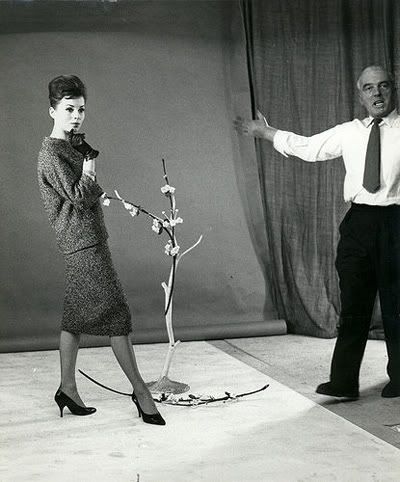
What is going on here? Its impossible to know for sure, but I like to speculate that its the fashion designer emerging from the shadows to express his robust opinion about the photoshoot (and perhaps the merits or otherwise of the photographer), just as the shutter clicks.
Although this is a generalisation, for the most part fashion designers weren't always the recognisable public figures they are today. Most people - even those with little interest in fashion - will be able to summon up a mental image of designers such as Karl Lagerfeld, Donatella Versace, John Galliano and Vivienne Westwood, partly because each has a very distinctive style and self-presentation that is instantly recognisable. But also because there is simply much more media out there now, and designers are expected to take part in the publicity machine in a way that just wasn't the case in previous decades.
However, the famous Parisian couturier Paul Poiret was decades ahead of his time, being a hugely accomplished self-publicist. His lavishly decadent costume parties were widely covered in the press, and his larger-than-life persona informed, and fed back into, the perception of his couture house. Poiret was about ostentation, exoticism, a romantic and picturesque kind of modernity and a challenge to conventions (let's not forget that he was credited with freeing women from the corset, which might or might not be true, but anyway).
This precious short film supposedly shows Poiret arriving from Paris at Hounslow airport with two of his mannequins (models), probably another stunt to attract the press since this would have been an appealing novelty item. In fact, it is Poiret himself who runs to greet the plane (look closely at that first figure to appear as it taxis to a halt), and help his models out of it, so perhaps he had arrived earlier:
PARIS FASHIONS BY AIR
There's no date given for this film, so I'm guessing early 1920s, by which time his house was already in terminal decline and, sadly, would close in 1929.
Leaping forward at least a decade, this delightful film from 1938 features the Greek-born Parisian couturier Jean Dessès, who had opened his couture house only the year before. We are invited into his busy workroom, and the salon where a fashion show is being presented. M. Dessès is shown creating a gown on a live model, and there's a painful pun by the perky narrator ("gauze and effect"!):
FASHION COMES TO PARIS!
Jean Dessès is little known these days, and the name Olive O'Neill will probably mean even less to most people. She was, in fact, a very important figure in the development of ready-to-wear clothing in Britain.
Born in Southport, she came to work for the fledgling brand Dorville in London in the 1920s, where she began designing classic and elegant clothes to supplement their primary knitwear line. Having set up her own factory, she studied and adopted American methods of manufacture, grading and sizing, and visited America every year to keep up with new developments. O'Neill was an innovator in textiles too, co-operating with fabric manufacturers to produce exclusive materials and designs. (This information was gathered from Elizabeth Ewing's History of 20th Century Fashion).
This great short film shows the creation of a new dress, from Olive O'Neill's rapid sketch to the final product. Although far less glamorous than the previous film - it was shot in the last months of the Second World War, mind you - it is a fascinating glimpse of a forgotten designer:
INEXPENSIVE DRESS
Returning to glamour and glitz, Christian Dior was perhaps the most famous designer of the 1950s. Find yourself a seat in the Savoy Hotel, London and join the well-heeled guests (including British designer Norman Hartnell) for a very exclusive fashion show from 1950:
DIOR 'CIRCUS' COMES TO TOWN
I'm charmed by M. Dior's expression - he looks captivated, like he's seeing his creations for the first time. Incidentally, that £500 gown would cost you about £12,835 in today's money (thanks to Measuring Worth for that calculation).
Another Paris luminary, and a personal favourite of mine, is Elsa Schiaparelli. This is the only film I could find of her on the British Pathé website. She is seen at a Dublin fashion show in 1953, admiring the Irish fashions on display. Sadly her own business was in trouble at this time, and was closed the following year:
AN TOSTAL FASHIONS PARADE
Last up is this clip from 1958 of a young Yves Saint Laurent presenting his collection for Dior at Blenheim Palace. Princess Margaret presides, and looks completely in her element!:
'DIOR' COMES TO BLENHEIM
Subscribe to:
Posts (Atom)


