Showing posts with label London. Show all posts

Sunday, 1 August 2010

The Story of a Dress

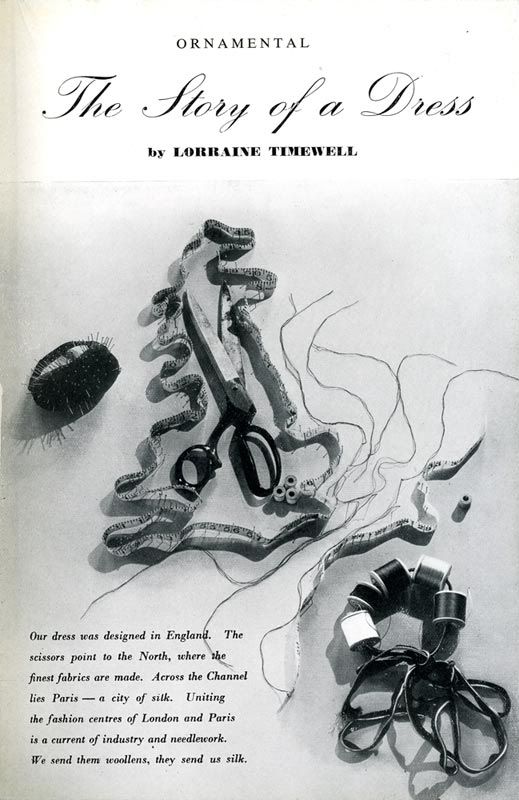
 "The Story of a Dress" by Lorraine Timewell, The Saturday Book 7, 1947, pp. 71-80.

Our dress was designed in England.  The scissors point to the North, where the finest fabrics are made.  Across the Channel lies Paris - a city of silk.  Uniting the fashion centres of London and Paris is a current of industry and needlework.  We send them woollens, they send us silk.
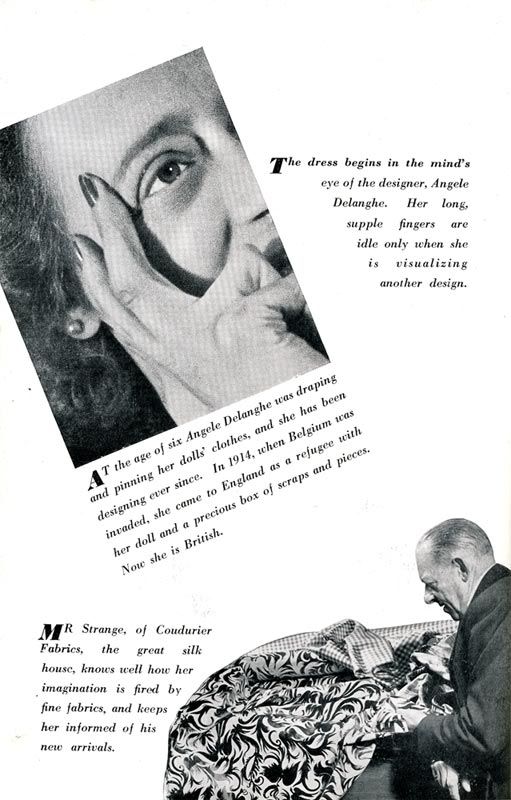


The dress begins in the mind's eye of the designer, Angele Delanghe.  Her long, supple fingers are idle only when she is visualizing another design.

At the age of six Angele Delanghe was draping and pinning her doll's clothes, and she has been designing ever since.  In 1914, when Belgium was invaded, she came to England as a refugee with her doll and a precious box of scraps and pieces.  Now she is British.

Mr Strange, of Coudurier Fabrics, the great silk house, knows well how her imagination is fired by fine fabrics, and keeps her informed of his new arrivals.


In a tiny room she works with the selected fabric straight onto the dummy, its shoulder scarred with pin-marks.  In picture one, she is concentrating her mind not on the checked silk, but on the floral printed silk lying on the table by Smuts the cat.  She knows exactly what she wants to do with it, and in picture two begins to drape and pin.  It is a fine silk in a pale oyster white, with burnt rose and grey outlined flowers scattered over it.
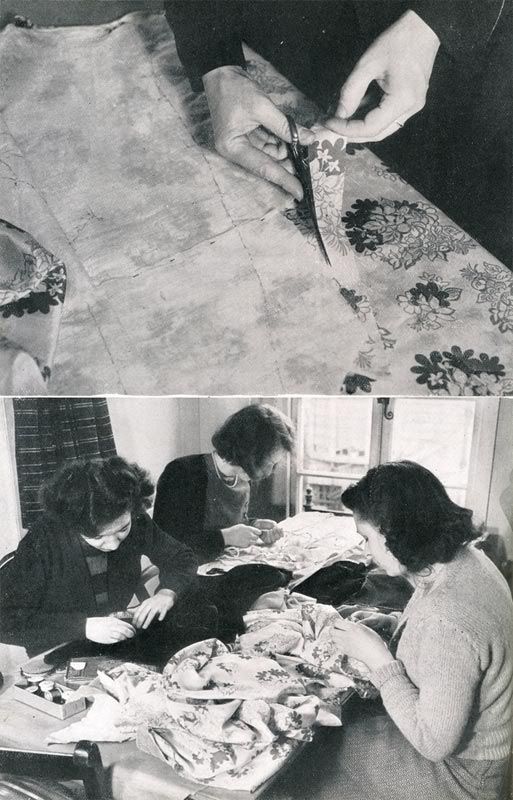
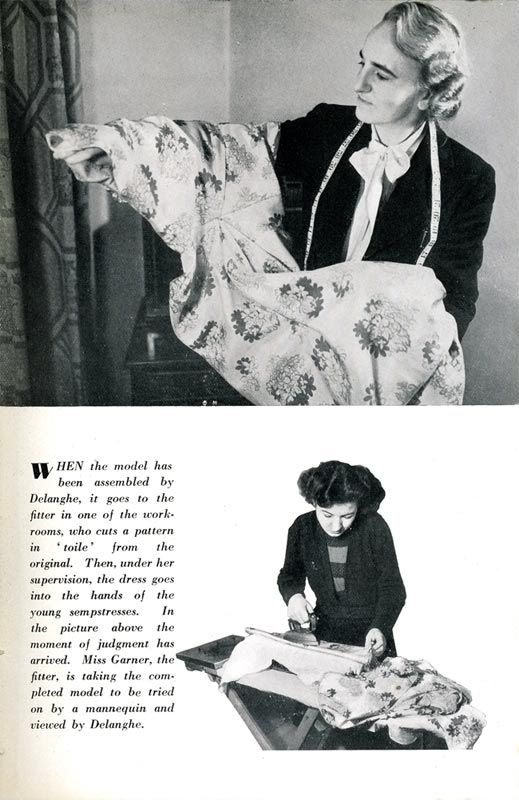


When the model has been assembled by Delanghe, it goes to the fitter in one of the workrooms, who cuts a pattern in 'toile' from the original.  Then, under her supervision, the dress goes into the hands of the young sempstresses.  In the picture above the moment of judgment has arrived.  Miss Garner, the fitter, is taking the completed model to be tried on by a mannequin and viewed by Delanghe.
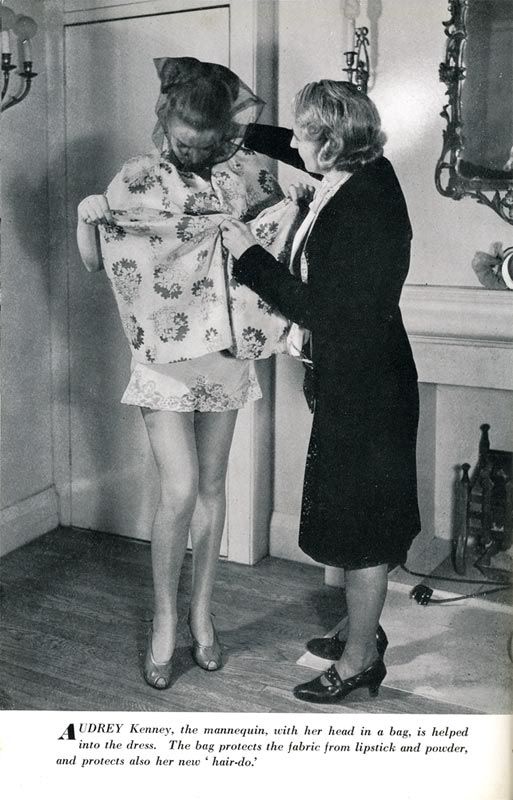


Audrey Kenney, the mannequin, with her head in a bag, is helped into the dress.  The bag protects the fabric from lipstick and powder, and protects also her new 'hair-do.'
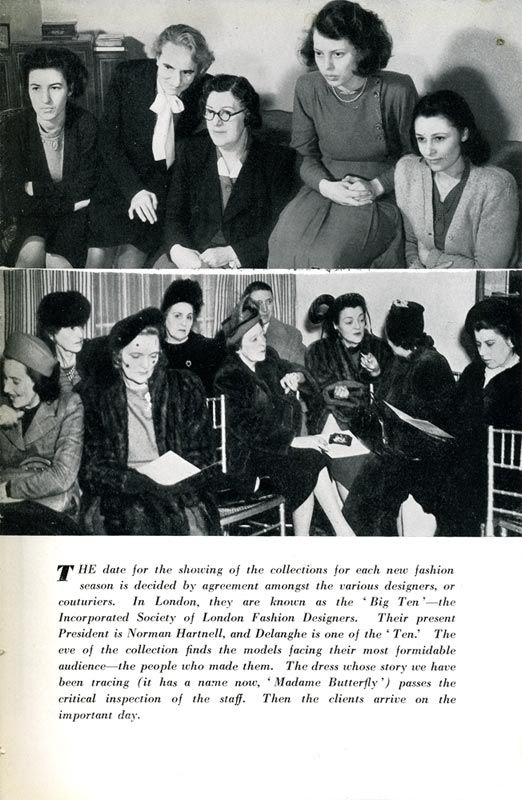


The date for the showing of the collections for each new fashion season is decided by agreement amongst the various designers, or couturiers.  In London, they are known as the 'Big Ten' - the Incorporated Society of London Fashion Designers.  Their present president is Norman Hartnell, and Delanghe is one of the 'Ten.'  The eve of the collection finds the models facing their most formidable audience - the people who made them.  The dress whose story we have been tracing (it has a name now, 'Madame Butterfly') passes the critical inspection of the staff.  Then the clients arrive on the important day.
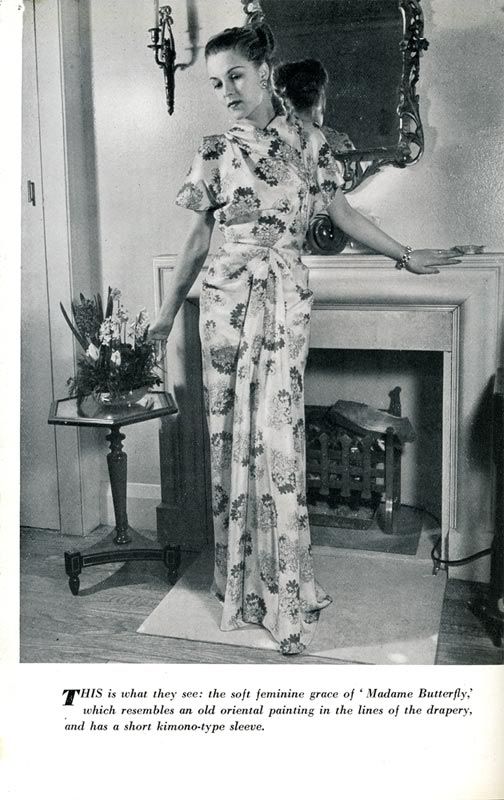


This is what they see: the soft feminine grace of 'Madame Butterfly,' which resembles an old oriental painting in the lines of the drapery, and has a short kimono-type sleeve.
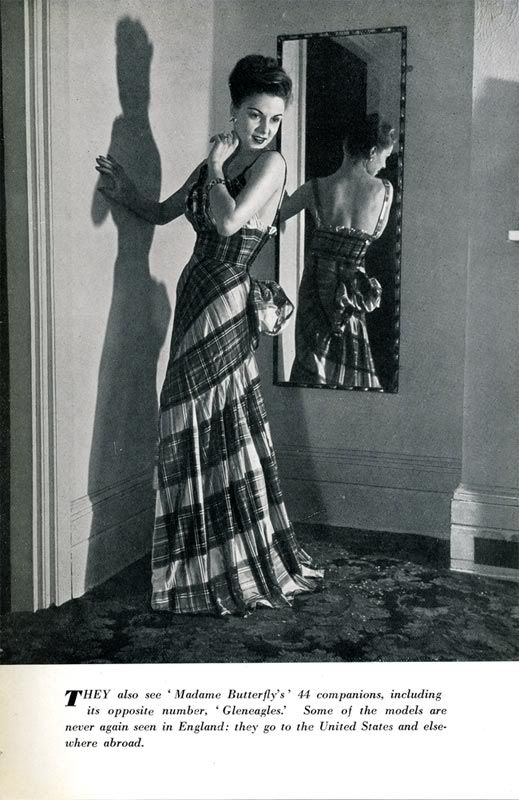


They also see 'Madame Butterfly's' 44 companions, including its opposite number, 'Gleneagles.'  Some of the models are never again seen in England: they go to the United States and elsewhere abroad.
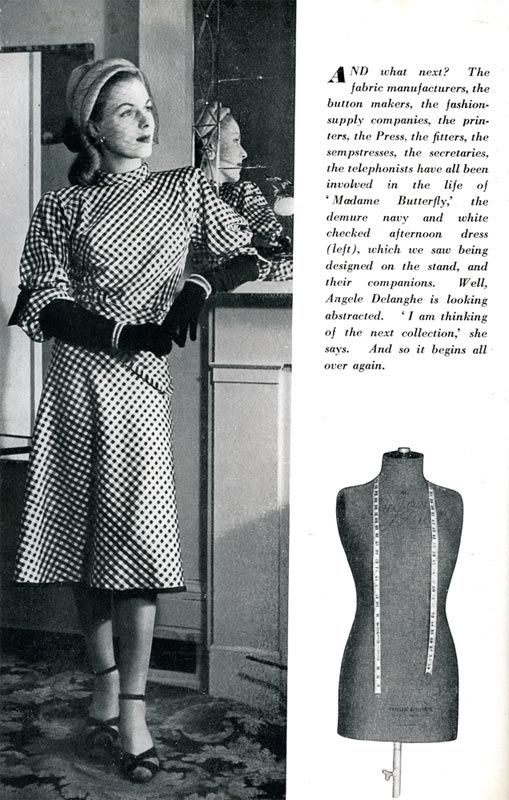


And what next?  The fabric manufacturers, the button makers, the fashion-supply companies, the printers, the Press, the fitters, the sempstresses, the secretaries, the telephonists have all been involved in the life of 'Madame Butterfly,' the demure navy and white checked afternoon dress (left), which we saw being designed on the stand, and their companions.  Well, Angele Delanghe is looking abstracted.  'I am thinking of the next collection,' she says.  And so it begins all over again.

_._._._._._._._._._._._._._._._._._._


This photo story appeared in the seventh edition of The Saturday Book - one of those compendiums of miscellany from the arts to anthropology, history and antiquities, social observation, folklore and all manner of diverting stuff - that were once so popular.

This edition was published in 1947, at pretty much the height of post-wartime austerity and a time when most women could only dream of a new evening gown made of silk, so its interesting to see that Ms Delanghe appeared to have no problem securing such scarce and valuable supplies.  But then, as the piece points out, some (most?) of her output was destined for export.

Its great to see that the author, Lorraine Timewell, chose to feature Angele Delanghe rather than one of the more well known members of the London 'Big Ten' such as Hartnell, Hardy Amies or Digby Morton.

In fact I've found precious little about her, apart from these scraps:

Delanghe was an early member of the Incorporated Society of London Fashion Designers, formed in 1942, which included the Hon. Mrs Reginald Fellowes (its first president), Norman Hartnell, Peter Russell, Worth of London, Digby Morton, Hardy Amies, Bianca Mosca, Creed, Molyneux and Michael Sherard.   (Information from In Vogue: Six Decades of Fashion by Georgina Howell and Exploring 20th Century London).

She was known for creating "soft feminine tailored clothing and beautiful romantic eveningwear and wedding gowns" (from The Cutting Edge: 50 Years of British Fashion, 1947-1997 by Amy de la Haye).

After the war she took over the Ladies' Outfitting and Ready to Wear Departments at Fortnum & Mason and "revitalized" them.

Former women's editor of the Yorkshire Post, Valerie Webster, recalls with palpable frustration that she was required to attend "the couture shows of people like Angele Delanghe and Lachasse who made tweedy suits and hefty jewel-encrusted evening gowns for the grouse moors and hunt ball scene."  To be fair, this was probably in the early 1960s, and young Valerie was more interested in Mary Quant than grouse moors and hunt balls, and perhaps Delanghe was past her prime.

This little 'backstage' story of Angele Delanghe's work at least adds a little more to our knowledge of her.

Tuesday, 1 December 2009

Slap Up Tog

A Victorian handbill found in a book by Renée Huggett called Shops published in 1969.

This marvellous Victorian promotional handbill (flyer) from London addresses the discerning working man in need of new clothing. Written in a presumably authentic slang current at the time, it has an immediacy and humour that defies its age, even though much of it is completely mystifying to the modern reader.

Let's have a go:

Mr H nabs the chance of putting his customers awake, that he has just made his escape from India, not forgetting to clap his mawleys upon some of the right sort of stuff, when on his return home he was stunned to find one of the top Manufacturers of Manchester had cut his lucky, and stepped off to the Swan Stream, leaving behind him a valuable stock of Moleskins, Cords, Velveteens, Box Cloths, Plushes, Doe Skins, Pilots &c., and having some ready in his kick--grabbed the chance--stepped home with the swag--and is now safely landed at his crib. He can turn out Toggery, very slap at the following low prices for

Ready Gilt--Tick being No go.

Upper Benjamins, built on a downy plan, a monarch to half-a-finnuff, Fishing or Shooting Togs, cut slap, 1 pound, 1 quarter, and a peg. A Fancy Sleeve Blue Plush or Pilot ditto, made very saucy, a couter. Pair of Kerseymere or Doeskin Kicksies, built very slap with the artful dodge, a canary. Pair of Bath or Worsted Cords, cut to drop down on the trotters, a quid. Pair of out and out Cords, built very serious, 9 bob and a kick. Pair of stout Broad Cords, built in the Melton Mowbray style, half a sov. Pair of Moleskins, built hanky spanky, with a double fakement down the sides and artful buttons at bottom, half a monarch.

MUD PIPES, KNEE CAPS, AND TROTTER CASES BUILT VERY LOW.

A decent allowance made to Seedy Swells, Tea Kettle Purgers, Head Robbers, and Flunkeys out of Collar
Gentlemen finding their own Broady can be accommodated.

(My thanks to flickr contact Bollops for taking the trouble to transcribe this text when I originally posted this picture there).

Many of the terms are obviously types of cloth: moleskin (a heavy, cotton cloth with a short, soft pile on one side), corduroy, velveteen, box cloth (I failed to find a definition of this), plush, doeskin (a fine, soft woollen cloth), pilot (a thick woollen cloth, often dyed blue used for overcoats and sailors' gear), kerseymere (a twilled fine woollen cloth).

Then there's prices: a monarch (a sovereign? That's one pound), half-a-finnuff (? - thanks to alan.98's comment below, I've discovered that a finnuff is Yiddish for a fiver), 1 pound, 1 quarter (a crown or five shillings? One pound was twenty shillings) and a peg (?), a couter (a sovereign, found in an excellent article on costermongers' backslang on the Victorian Web here), a canary (?), 9 bob (9 shillings) and a kick (?)

And of course, there's the garments on offer themselves: many appear to be trousers, such as the kicksies, or the cords "cut to drop down on the trotters (feet?)." Perhaps the "Upper Benjamins" and the "Fancy sleeve Blue Plush or Pilot ditto" are coats or jackets - the mention of a sleeve is a bit of a clue! "Mud pipes" might be some kind of oilskin waders or trousers, but I'm guessing here. "Knee caps" are possibly protective pads worn over the knees for labourers who have to kneel in their work, but again this is pure speculation. "Trotter cases" are likely to be boots if we can assume that trotters are feet.

The final call to "Seedy Swells, Tea Kettle Purgers, Head Robbers, and Flunkeys out of Collar" strongly suggests that Mr Harris is happy to do business with men of dubious reputation, so long as they have the ready cash of course.

This is a piece densely packed with detail and description, and deserves much more research than my desultory efforts.

But as much as its fun to try to translate this text, perhaps the most enjoyable thing about it is the way it reads. I would love to hear Bob Hoskins tackle this in his ripest Cockney growl.

Apparently Mr Harris advertised widely, or he copied a widely used format. More or less the same text, with some minor variations, appears in Mayhew's London Life and the London Poor of the mid 19th century (scroll down to the last quarter of the page or do a search for "slap up" on that page to find the passage), and in the New York Herald in 1888, which suggests that this tailor/outfitter was so familiar with the London criminal underworld that his handbill "appeals to the thieves, burglars and outcasts from society only."

This assertion is unfair I believe. Mr Harris was clearly drawing from the rich source of contemporary slang that would have been readily understood by its intended audience - working class men living in the slums of London. That's not to deny that perhaps Mr Harris was borrowing a bit of underworld cool by using terms that were not entirely respectable or correct, especially in Victorian times, but he was clearly a shrewd businessman who knew how to speak to his market. And he was aware that a more formal approach was a waste of time and expense (handbills cost money to print).

Credits are due. My sincere thanks to flickr friends Bollops and Art Nahpro for doing all the heavy leg-work to unearth most of the links that I have used in this piece.

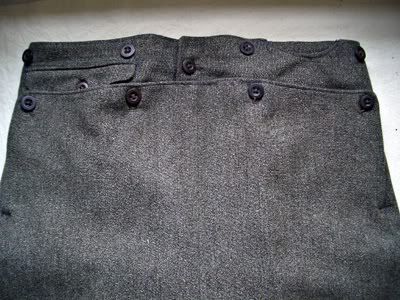
I've not finished yet! At that time (19th century), trousers would not have had the central vertical fly front we are familiar with today, but a fall front. This is a method of fastening the trousers with a flap that spanned the front waist and was fastened with buttons. Take a look at this pair of trousers which will give you the idea:


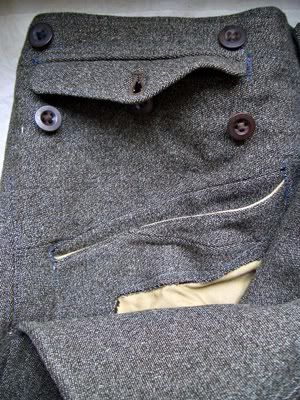
These trousers are from a suit made possibly in the early 1930s, according to the museum record, which is in the collection of the Gallery of Costume, Manchester. You can see that there are four buttons near the waistband which open to reveal:

OK, that might not be what you were expecting. This is under that front panel you saw above, and there's the pocket with a flap at the top which was visible in the first picture, and also a hidden diagonal welted pocket below it.

Sorry, this is getting complicated! So if you were getting dressed you would have to fasten two side panels of the trousers with a central button or two, and then fasten up the four buttons that secure the fall front over that.

I'm pretty sure this style was archaic by the time this suit was made, and it doesn't look like a regular "lounge suit" as it is catalogued in the museum. To be fair, I'm sure there was a note in the museum record about it being a gamekeeper's suit, which would make much more sense. This suit is very old-fashioned for the time, assuming that given date is correct, and is sturdy and warm enough for tramping through the Cheshire countryside in the depths of winter with a shotgun over your shoulder and maybe a brace of pheasants hanging off your belt.

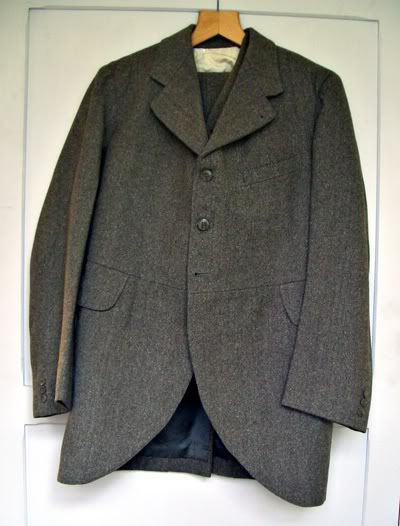
Just to complete the picture, here's the jacket of the suit:


Its beautifully curved cutaway hem, high button front fastening and waist seam speak of earlier days. The days of Mr Harris even.

There's been a dearth of film in recent posts, so this is the nearest I can get to Mr Harris's time and place - a wonderful film from 1903 of Petticoat Lane, London, from the BFI's Youtube channel. Don't you wish it had a soundtrack?: