Showing posts with label video. Show all posts

Saturday, 17 April 2010

That Tinling feeling

Advertisement for Teddy Tinling's salon from Vogue, 14th April 1937, page 120.  From the Gallery of Costume, Manchester. 

What a singular character Teddy Tinling was!  The opening line of the Wikipedia entry I just linked to does a great job of indicating as much, in its customary dry and succinct manner: "[Teddy Tinling] was an English tennis player, fashion designer, spy and author."  As a career resumé, that one is pretty hard to beat. Plus he was "openly gay" in the days when that was hardly a safe option.

These days people might recall the frilly knickers he created for the American tennis player Gertrude 'Gorgeous Gussie' Moran in 1949, and the kerfuffle those provocative undergarments caused in the media. 

Tinling made his name creating expertly tailored and glamorous tennis wear for many of the star players of his day, but his career in the rag trade began much earlier in 1931 when he opened a salon in South Kensington, London, specialising in wedding and evening gowns for the "carriage trade."  This was evidently successful because by 1937, when his nicely surreal advertisement (above) appeared in Vogue, he was plying his trade in the much posher environs of Mayfair. 

The Second World War interrupted his fashion career and prompted his drastic career switch to spying for the British Intelligence Corps.  I'm sure there's lots of interesting material about his wartime adventures, but sadly they don't appear to be online so I shall press on regardless. 

Shortages of luxury fabrics after the war saw the ever-pragmatic Tinling turning to the growing market of sportswear . . . actually this is all very well documented in the links I've added so I'm going to cut straight to my point and spare you the painful paraphrasing. 

Teddy's tennis wear suggests a fondness for flamboyance, which is certainly borne out in the British Pathé film archive.  The swelle life blog has a fabulous post about one of those films so I won't repeat it here (please visit that link to enjoy it, and don't miss this post about his tennis gear too). 

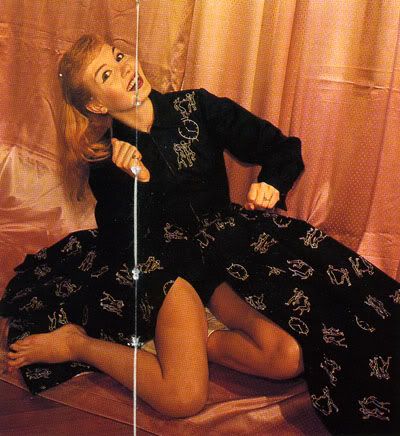
Here's more evidence.  He embraced rock'n'roll with some delightful garments for teenage fans:

"Clothes specially designed for Rock'n'Roll enthusiasts by Teddy Tinling, 1957."  From Frances Kennett (1983) The Collector's Book of Twentieth Century Fashion, London: Book Club Associates, pp. 88-89.  (Apologies for the book binding cutting through the picture - I'm not skilled, or indeed patient, enough to erase that). 

I'm really enjoying that print of clocks and jiving couples (no doubt a reference to Bill Haley's "Rock Around the Clock")

The elfin model Elizabeth Duke can also be seen modelling some "Jive Fashions" possibly from the same collection (Tinling trousers with a heart-shaped pocket printed with the immortal British rocker Tommy Steele) right here. 

Its clear that Teddy Tinling's gift for tailoring glamorous but practical tennis wear was readily transferable to the demands of energetically jiving rock'n'rollers.  Sadly there appears to be no film footage of his teen-rock'n'roll clothing available. 

But there's plenty more camp fashion delights to be found, especially at my favourite resort for vintage footage, British Pathé.  And this is one of the best, a 1958 film of Tinling's leisure fashions inspired by souvenirs from his holidays:   

TEDDY TINLING HOLIDAY FASHIONS


And this short film from 1955 features both his tennis and leisure wear:

BEACH AND TENNIS WEAR


And I'm going to have to include Tinling's spectacular South Pacific fashion show, as featured in the swelle life blog, just so you don't miss it:

TEDDY TINLING FASHIONS


Teddy Tinling's exuberant style has quite won me over.  I only wish that there was more information available about his fashion adventures, rather than just his tennis wear (as admirable as it was).  If anyone can offer any further information about this I would be overjoyed.  All I can say is that I've never come across a single garment with his label on it, and live in hope that I might - someday.

Monday, 22 March 2010

Ossie Clark in motion

Ossie's sketch of ruffled chiffon dress with tie neck, c. 1968-9, from Judith Watt, Ossie Clark 1965-74, page 79.

Ossie Clark's fashion shows have become the stuff of legend. According to Ossie's long-term friend from his student days, Norman Bain:
These were the first fashion shows that were like happenings, pop concerts and theatre. The feeling was that of a Parisian salon: everybody was there together, writers, artists, actors, dancers. (Quoted in Ossie Clark 1965-74 by Judith Watt).
Excitingly, British Pathé has three films of Ossie Clark and Alice Pollock's early fashion shows from 1968 and 1969. Alice Pollock was a fellow designer and owner of the Quorum boutique where Ossie became her business partner, and she should not be overlooked!

The earliest film has an issue date of 25 January 1968 so its quite possible it was shot in late 1967.

It starts with a fashion show at Maxim's in Paris 'by' Elizabeth Taylor, who, the narrator declares, was planning to open her own boutique there with Richard Burton. The narrator notes that this was "Mia Vicki's collection with several numbers dreamed up by Elizabeth Taylor." (I've found a couple of brief references online to 'Mia & Vicki' with no useful information).

The rather gauche sexiness of the designs is underlined by Richard Burton's approving comment "at last girls look like girls." This was fashion explicitly intended to appeal to men.

This show presents an interesting contrast with the Ossie Clark and Alice Pollock fashion show that follows it, as the commentary notes: "It seems that minis are in for a knock from maxis, from the bare truth to keeping the guys guessing." The glib narration has hit on a crucial point - Ossie Clark and Alice Pollock designed for women, not simply to make women more appealing to men.

Of course there's sexiness - sheer chiffons worn without underwear and the odd flash of a breast (sorry, maybe that's the next film, stay tuned!), - but these were garments that didn't beg for male attention and approval but kept the power and sexual autonomy with the wearer. I'm sure that only a small minority of their customers opted to wear those more revealing numbers as they were shown on the catwalk, but it was up to the customer how much they bared, which was hardly possible with the cutaway swimsuits in Liz Taylor's show.

See what you think:

FASHION SHOWS


Judith Watt notes that:
The show at the Revolution Club, just behind Berkeley Square in Mayfair, in 1968, saw Jimi Hendrix and the Rolling Stones in the audience. Patti Boyd, who only did runway shows for Quorum, wore a cream chiffon dress with a print of blue birds and irritated her husband, George Harrison, in the audience with the rest of the Beatles, by going bra-less. Cynthia Lennon was there too. (Ossie Clark 1965-74, page 84).
Well Cynthia certainly wasn't at the next Revolution fashion show - the following film is dated 11 August 1968 - because John Lennon is shown with his "friend" Yoko Ono, both looking equally bored. This might possibly be because Ossie's shows tended to run at least an hour or two later than billed, and I'm sure they were captivated once it actually started - as I hope you will be too:

'REVOLUTION' FASHION SHOW


Ossie Clark's own notes on this fashion show, written as a 'stream of consciousness' exercise in recall in 1988, are as follows:
'Revolution Number 9.' Pattie Boyd models show at the Revolution and in the press.
'Come on, mother! We're late,' - John Lennon with Yoko looking like a porcelain doll. Kay, Carol tells, a light fell over the stage, like fell over, and he steadied the chair she stepped on, JL. (The Ossie Clark Diaries, page lxiv).
Sadly, John Lennon's moment of gallantry wasn't captured by the newsreel cameras.

This last film is dated 15 May 1969 and consists of unused footage of a fashion show at the Chelsea Town Hall. Well actually, after several viewings I've worked out that there must be footage from another fashion show at another venue spliced in - watch out for the disappearing catwalk and change of decor.

I'll have to warn you that this has no soundtrack and lasts for about four minutes, but I find it mesmerising nonetheless:

( MODERN FASHION ON SHOW )


What is striking about all these fashion shows, among other things, is the charismatic personalities of the models. They all seem to be 'doing their own thing' as the now quaint 60s phrase has it. Some are live-wires, some are demure and some are theatrically vampish (indeed, some seem to be more than a bit stoned!)

You get a strong sense of a variety of distinct personalities rather than a sequence of clones stomping along like well-drilled soldiers in heels, as we're now accustomed to seeing these days.

And they were personalities, especially selected for their individual qualities and encouraged to express themselves as they saw fit - many became part of Ossie's intimate circle of friends and were valued for their character as much as their beauty.

I'll let Lady Henrietta Rous explain this more fully (she does it so well):
Ossie stated that he wanted 'to make a woman aware of her body', and in pursuit of this ideal he brought in a new style of model. They were no longer 'tall things that swayed at you as they walked down the cat walk,' but characters in their own right. Gala Mitchell, with her sculptural bone structure, big eyes and theatrical style, looked particularly good in leather jackets. Others who modelled were KariAnne Jagger (Mick's sister-in-law, whose captivating dances on the stage inspired the Hollies' song which begins "Hey Carrie-Anne, what's your name now, can anybody play?"); Amanda Lear (Salvador Dali's muse and as good a performer as KariAnne); and Lady Carina Fitzalan-Howard, daughter of the Duke of Norfolk, whom Alice had discovered walking down the street.
But perhaps what thrilled me most about seeing these films was the chance to see Ossie Clark's (and Alice Pollock's) clothes in motion.

As you can see most vividly from his sketch at the top of this post, he always thought in terms of how his clothes would work on the female body, and also in motion. Its a privilege to see them how they were intended to be seen.


A note on prices

The first film mentions a few ensembles and prices so I've used measuringworth.com to establish what they might cost (nearly) today:

The white leather suit named 'Daz,' priced at 25 guineas, would be approximately £341 at 2008 prices.

Patti Boyd's outfit called 'African Queen' at 9½ guineas, would be approximately £130 at 2008 prices.


References

Lady Henrietta Rous (ed.) (1998) The Ossie Clark Diaries: In Doze Days. London: Bloomsbury.

Judith Watt (2003) Ossie Clark 1965-1974. London: V&A Publications.

I'd also recommend:

Peter Schlesinger (2003) A Chequered Past: The 60's and 70's. London: Thames & Hudson. This book has some wonderfully candid photographs of many of Ossie's friends and favourite models, and is a visual and gossip-rich treat!

Thursday, 25 February 2010

Constructing the Teddy Boy

One of the most conspicuous aspects of the British Teddy Boy was his hair; that towering quiff carefully and regularly primped with a comb - perhaps a flick knife comb for extra posing points! - and secured with copious fistfuls of pomade.

At least since the nineteenth century, men's hair was simply cut short and combed flat, sometimes slicked with the macassar oil that gave Victorian and Edwardian housewives such headaches worrying about their stained upholstery they were forced to invent the antimacassar. The only possible variations seemed to be in the parting of the hair, and tonsorial exuberance was confined to the moustache.

Given all those long decades of modesty and simplicity in men's hair, it must have been quite a shock in the early 1950s to see young men constructing glossy (and greasy) edifices of hair and quite shamelessly preening in what was seen as an effeminate manner. There can't have been many young men who went quite to this, er, length though:

MEN'S HAIR STYLES


This 1956 film was shot at Cyril Parker's hairdressers shop in Tottenham Court Road, London. The hair 'sausage' or 'elephant trunk' seems very similar to the postiches used by Victorian and Edwardian women to pad out their hairdos - think of those voluminous bouffant styles as sported by the "Gibson Girls" which often needed substantial postiches to achieve.

There's very little footage of Teddy Boys in the British Pathé archive, although interestingly the two clips I've found focus on their hair. So here's the second film, shot at a hairdressing show in Belle Vue, Manchester, in 1955.

There's some bizarre ladies' hairdos, and a varied selection of men's haircuts including the 'Petronius' (Roman style), the 'Curled Semi-Crew Cut,' the 'Brush Cut' and the 'Tony Curtis.' You can catch a brief glimpse of Lew Starr (finessing the Brush Cut), who was the Teddy Boy hairdresser in Manchester, and - I'm told by one who remembers - always had intimidating queues of scowling, smoking ruffians outside his salon in Charles Street:

PAGEANT OF HAIR STYLES


And we all know what 'D.A.' really stands for, don't we?!

Sunday, 7 February 2010

Santos Casani - the forgotten dance master

If you've ever seen one of those archive film montages of the 'roaring twenties' in a TV documentary, there's one clip that always features. Its the one featuring a couple dancing the Charleston on top of a taxi cab driving through a London street.

That clip is at the very end of this British Pathé dance instruction film (incidentally, fashion history buffs will be delighted by Miss Jose Lennard's lower back skirt hem - a major trend in the last years of the 1920s):

THE FLAT CHARLESTON MADE EASY


The stunt was intended to demonstrate that the new 'flat' Charleston required very little space, in contrast to its original, wild form, which was a veritable whirlwind of flying heels and arms, presenting considerable danger to nearby dancers. Indeed the Charleston was banned from many dancehalls at the time.

It is ironic that this clip is now employed to symbolise the reckless, risk-taking, devil-may-care nature of the times when its original intention was actually quite the opposite.

While I could easily (and quite happily) go on about the Charleston, this post concerns the man who appeared in that film, the famous dance master - and energetic self-publicist - Santos Casani.

Mr Casani was the proprietor of "the largest school of dancing in England," wrote a column for the Daily Mail, and made numerous short dance instruction films for British Pathé's cinemagazine for women, Eve's Film Review. The film company supplied free instruction leaflets based on the dance steps Casani featured, which viewers could send off for, and as a demonstration of how popular these films were, on one occasion they had to print 20,000 leaflets to satisfy the demand (most of this information is derived from Jenny Hammerton's fascinating book For Ladies Only? Eve's Film Review Pathé Cinemagazine 1921-1933).

As an aside, its lovely to imagine a cinema audience practising dance steps under their seats as they watch the films!

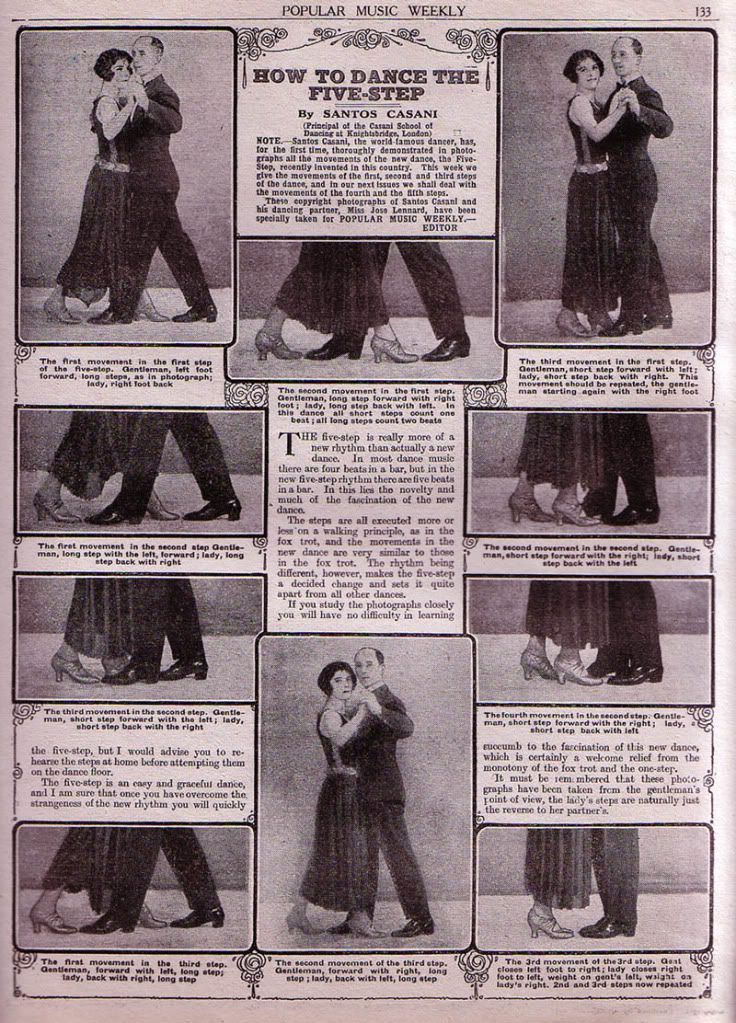
Here Casani makes an appearance in Popular Music and Dancing Weekly magazine, demonstrating the first three steps of the 'Five-Step' - steps four and five were published the following week, but unfortunately I don't have a copy of that issue (again, fashion buffs please note how remarkably long Miss Lennard's skirt was in 1924!):

"How to dance the Five-Step by Santos Casani" in Popular Music and Dancing Weekly, 7th June 1924, page 133 (click picture for a larger view).

In 1933 Casani opened his own nightclub in Imperial House, Regent Street, London and British Pathé was there to record it.

If you were to try to imagine a high-tone 1930s nightclub in the West End of London his establishment lives up to your Art Deco dreams, and this film includes footage of the renowned house band lead by pianist Charlie Kunz, a swimsuit fashion parade, an elegant rendering of the waltz by Mr Casani himself, not to mention a novelty song and a curious female contortionist. Pour yourself into a backless satin dress, shake up a cocktail and join in the fun:

LONDON'S FAMOUS CLUBS AND CABARETS NO. 10 - CASANI'S CLUB


Unlike his near contemporary Victor Silvester, Santos Casani failed to secure himself a place in dance posterity and his name is probably unknown to most people nowadays. But he was clearly a significant figure in his time - a suave, elegant man who knew how to work the media for maximum attention. In his prime, he was Mr Dance, and I'd like to salute his memory.

If you would like to see more of Santos Casani in action, there's plenty more films for you to enjoy.

Thursday, 4 February 2010

Fashion rations

Even during the dark years of the Second World War, and the long years of clothing rationing that followed it, women were expected to keep up appearances. "England's number one glamour girl" Joan Richards, a professional model, doesn't disappoint in this 1944 film where we follow Joan through a "routine day's work." From getting up in the morning with full slap (apologies to US readers - slap = makeup) and immaculate hair, through her long and busy day, she is the epitome of 1940s chic. By the way, these film links have come up as black boxes, but they will work if you click on them.

ANNE EDWARDS (aka GLAMOUR GIRL)


However, not every woman met the grade. This amusing short from September 1946 features the "Pathé Pictorial Fashion Expert" Mr Richard Buzzvine (at least, that what his name sounds like) lurking self-consciously with a newspaper on Regent Street as he casts a waspishly critical eye over young women's outfits. Although his voice isn't heard, the narrator reports his merciless judgements.

Mr Buzzvine is very hard to please, and only one girl meets with his approval, although its hard to see how she is much different from the other 'failures.' Its a useful reminder of how fraught getting dressed used to be, with all kinds of complicated rules and conventions governing what was - and was not - appropriate wear.

RIGHT AND WRONG IN FASHION

Sunday, 24 January 2010

Endorsed by Madame Schiaparelli

The fashion designer Elsa Schiaparelli presents an interesting contrast to Gabrielle 'Coco' Chanel - they were reportedly bitter rivals during the 1930s when Schiaparelli was in her prime.

Chanel, a determined social climber, was desperate to shake off the stigma of her poverty-stricken origins, whereas Schiaparelli was born into privilege as the daughter of aristocratic parents.

Chanel introduced a luxurious simplicity and practicality into high fashion, and was skilled with a needle, having trained and worked as a seamstress in her early years, whereas Schiaparelli had no formal fashion or dressmaking training but was gifted with a talent for adventurous innovation, stimulated and enhanced by her close personal association and collaboration with some of the leading avant-garde artists of her day.

There's plenty of information online (and in good, old-fashioned books!) about the careers of both designers, so there's no need to repeat it here. What interests me right now is some print evidence of Schiaparelli's commercial collaborations with two manufacturers, which perhaps present another interesting contrast with Chanel. I would have to do much more detailed research to discover if Schiap (her nickname - pronounced 'Skap') was unusual in this respect - its too late to venture to the library right now, and I'm keen to post this sooner rather than later so please forgive the lack of comparative evidence from other designers.

This 1936 advertisement for Lightning Coloured Plastic Zipp Fasteners below (manufactured by Imperial Chemical Industries - the still mighty ICI) proudly displays a brown wool dress designed by Schiaparelli with a very prominent zip running down the centre front. Dilys E. Blum, in her book Shocking: The Art and Fashion of Elsa Schiaparelli, notes that Harry Houghton, of the Canadian division of the Lightning Fastener Company had offered Schiaparelli £10,000 to use their recently developed coloured plastic zips in her clothing in 1933.

She obviously needed no further encouragement. According to most sources, Schiaparelli was the first Parisian couturier to utilise zip fasteners - indeed, to make a prominent design feature of them rather than hide them away as most functional clothing fasteners were by convention. (Apart from buttons, of course, which have been a handy way to display wealth and taste for some time).

Anyway, back to the advertisement. This conspicuous zip adds a considerable sexual charge to what is ostensibly a rather modest garment. Remember, zips are very easy and quick to open, and this dress flaunts its ability to be opened from top to bottom in seconds flat.

The juxtoposition of the model with a classical Greek-looking nude sculpture serves to underline this subliminal message, while at the same time adding a shrewdly judged gloss of 'culture' and prestige. This ad, although it doesn't look like it at first glance, was a pretty challenging and provocative proposition for the mid 1930s:

Lightning Zipp advertisement from (British) Vogue, 14th October 1936, page 19.

In her autobiography, which alternates disconcertingly between the first and third person, Schiap makes no mention of her lucrative promotional deal with Lightning Zipps but does describe the impact her use of zips made when first presented in a collection of hers. This was actually the August launch of her Winter 1935-36 collection, although this is not stated in the text:
. . . what upset the poor, breathless reporters most were the zips. Not only did they appear for the first time but in the most unexpected places, even on evening clothes. The whole collection was full of them. Astounded buyers bought and bought. They had come prepared for every kind of strange button. Indeed these had been the signature of the house. But they were not prepared for zips. They grasped the significance of the new trend even more than Schiap, and they bought and bought . . .
She must have been delighted with the overflowing order books, but then found herself facing an unanticipated problem:
On delivery day, however, our telephone started to ring viciously, and the desperate voices of all the commissionaires were raised to a pitch of indignation.
"The dresses cannot be shipped."
For some peculiar reason, still unknown to me, there was some agreement or contract between France and America whereby zippers could not be imported. Cables and radio-telephone calls were exchanged across the Atlantic and the zipper controversy reached the size of a political issue. After a few days of hair-tearing and supreme exhaustion, the zipper dresses were at last allowed into America, and ever since, like Columbus, they have remained unchallenged.
Blum records that on July 18th 1936, "The U.S. duty on imported zippers increase[d] from 45 per cent to 66 per cent, threatening to delay the export of Schiaparelli's collection."

Perhaps it was this difficulty that led Schiap, as the V&A explains, to use different zip companies depending on where her garments were to be sold: "In London she used zips from the Lightening Fastener Company of Great Britain, in Paris she used zips made by Éclair and for export to the USA, Hookless Fastener Company zips produced in the USA."

By the following year, the Lightning Zipp campaign featured more conventional illustrations of Schiaparelli's designs in a fashion show setting:

Lightning Zipp advertisement from (British) Vogue, 14th April 1937, p.65.

The copy reads:
Zipps on day suits, on evening gowns, on cocktail trouser suits. Zipps at front, side or back, in every colour of the rainbow, matching, contrasting . . . always decorative, always practical. Schiaparelli has made plastic zipps a feature of her recent collections, and continues - as do other leading couturiers - to use them for fashion fastening.
By August 1937, a subsequent Lightning Zipp ad makes no mention of Schiaparelli so perhaps that deal had run its course. However, Schiap had plenty of other irons in the fire.

As early as 1929, Schiaparelli had licensed her designs for reproduction by ready-to-wear companies and paper pattern manufacturers in America. Her fascination with textiles, and especially new developments in synthetic fibres, led her to collaborate with a number of manufacturers including Bianchini, Colcombet and Ducharne. She could see interesting textural potential even in test fabrics dismissed as 'mistakes' by their producers and was responsible for popularising a number of innovative new materials, including rayon crêpes.

During the early 1930s she endorsed a number of American-produced fabrics, not to mention hosiery and shoes, seeing these collaborations as a valuable way to develop and enhance her profile in that vast and lucrative market. But she also had strong connections with Great Britain - she regarded the country as her second home - and loved British textiles such as Scottish tweeds.

In November 1936, the British textile manufacturer William Hollins & Co. launched its new range of thirty-six 'Schiaparelli Viyella Fashion Fabrics' made of a blend of cotton and wool. She was credited with making this rather prosaic and workaday fabric fashionable, and in this following sequence of advertisements it is clear that she had some fun with this commission:

Viyella/Schiaparelli advertisement from (British) Vogue, 22nd April 1937, pp.58-59.

In this ad from April 1937, the layout makes a playful reference to pageantry, with heraldic motifs such as the shield, the crown and the ribbon. And the copy makes this explicit:
Schiaparelli herself has styled the new 'Viyella' Fashion Fabrics for this smartest, most colourful, most romantic of seasons. Bright challenging colours and subtle elusive shades. Novelty weaves. Checks, spots, stripes, and designs of entirely new character. A special heavier weight 'Viyella' for tailored suits and dresses.
A pageant of fabrics for a season of pageantry.
The Schiaparelli model photographed opposite is one of many 'Viyella' models in her latest collection, and she is featuring the new 'Viyella' Fashion Fabrics in her Paris Sportshop. These very same fabrics are now in all the shops for you to choose from . . . for that extra frock, that extra suit for this exciting season.
This was a coronation year (not Edward, ahem - he preferred a gilded and comfortable exile with his American divorcée - but his quiet brother George) so that explains all the pageantry.

Incidentally, a pasted-over addendum reluctantly adds the news of a price increase for these fabrics, from 4/11 to 5/11 per yard (in today's money, from £11.82 to £14.22, thanks Measuring Worth!)

The mannequin's curiously pointed knit hat makes her look like a chess piece, which is a happy coincidence when we consider the next advertisement, from November 1937:

Viyella/Schiaparelli advertisement in (British) Vogue, 10th November 1937, pp.18-19.

In this case, the theme isn't exactly chess, but Alice in Wonderland:
When I said "Check!" you purred!" said Alice (Through the Looking-glass) to her kitten - and when you see the new Schiaparelli-designed 'Viyellas' you'll react much like the kitten. Here are checks indeed! Unexpected, out-of-the-ordinary checks, the kind that make glorious little tops of two-pieces, spruce tailored frocks, swagger 'cow-boy' shirts, and so on. Crowds of other patterns too, embroidered spots and tricky little stripes - all in original, becoming fashionable colour schemes. The lovely blending plains are also important - Schiaparelli has used two of them for her superbly moulded jacket-blouse and skirt photographed here - Bright Rust (No. 8358) over Good Earth Brown (No. 6843). Both 'Viyella' Thirty-Sixes. Both in the shops now!
I have a fondness for old-fashioned advertising spiel, so forgive me for drafting all this text. Its wonderful!

The next ad, from September 1938, startled me because it looks as if it dates from nearly twenty years later:

Viyella/Schiaparelli advertisement in (British) Vogue, 7th September 1938, p.9.

I'd love to know if these fabrics were indeed "Unshrinkable. Fadeless" as the copy proudly declares. Are there any Schiaparelli collectors out there with examples of her late 30s sportswear who can verify this claim?

This last ad, from November 1938, looks more of its time, featuring a three-quarter length swagger coat and a wonderful 'up' hairdo of a kind that would remain in favour throughout the 1940s:

Viyella/Schiaparelli advertisement in (British) Vogue, 2nd November 1938, p.20.

Plus it has scotty dogs, which is always a good thing in my book.

Schiaparelli was obviously a very shrewd businesswoman, as well as an inspired designer, who had no snobbishly bourgeois scruples about entering into business deals with those who might be considered a little too populist - a little too 'mass market' - for an elite Parisian couturier to associate his or her name with.

As I've stated earlier, I really do have no idea to what extent other contemporary couturiers - such as Chanel - dipped their toes into that mass market (and I'm aware of her perfumes - this is a different degree of diffusion), but I will explain that I gathered these advertisements while scouring through the Gallery of Costume's bound collection of British Vogues. I noticed that no other couturier featured in ads of this kind during the 1930s. Perhaps if I had leafed through the American Vogues, I might have discovered a different story . . .

The two couture giants faced very different fates after the Second World War. Schiaparelli found herself out of step with fashion and finally closed her business in 1954 - the same year that Chanel emerged from her exile in Switzerland to relaunch her salon to widespread international acclaim (I understand that it wasn't the French who were cheering - they remembered her cosy intimacy with the Nazis too well).

As a result Chanel secured her place among the fashion immortals and her house endures, its status revived and maintained by Karl Lagerfeld. Schiap is hardly forgotten, but she gradually recedes back in time as a respected and revered figure too closely associated with her prime years in the 1930s to be considered relevant today.

And to finish, a charming short promotional film for cotton knitting yarns from the mid 1930s, which might not seem to have anything to do with Schiaparelli. You'll just have to watch it to the very end to understand why it is here:

PARIS MODES - (AKA COATS COTTON FILM)


Additional notes

Information was gathered from two books which I would recommend as essential if you have any interest in Schiaparelli -

Elsa Schiaparelli (recently republished by the V&A) Shocking Life: The Autobiography of Elsa Schiaparelli.

Dilys E. Blum, Shocking: The Art and Fashion of Elsa Schiaparelli.

Monday, 28 December 2009

A souvenir of Blackpool


I did unexpectedly well for presents this Christmas, and among them was this tiny porcelain shoe sporting the town crest of Blackpool. Judging by its style it possibly dates from the 1900s, and is clearly an imitation of the famous Goss armorial china that was developed in the 19th century and was produced in an almost endless variety of forms.

The Goss range wasn't just extensive in its inventive array of novelty shapes. According to Larch S. Garrad in A Present From . . . Holiday Souvenirs of the British Isles: "Allegedly, Goss souvenirs were produced for every town in the United Kingdom that had a coat of arms."

This example was perhaps made in Germany - the generic red 'foreign' stamp underneath being no help at all in narrowing down its origin. But this doesn't really matter since I have a fascination for British seaside resorts, and Blackpool holds a special place among them.

Blackpool has a good claim to being the world's first working-class seaside resort - a title contested primarily by New York's Coney Island - and both towns developed more or less in parallel. John K. Walton explores the development and decline of both places in his excellent article "Popular Playgrounds: Blackpool and Coney Island, c. 1880-1970" (available to download as a pdf here - scroll down to Volume 17, Number 1).

The millions of visitors who descended on Blackpool every summer holiday season were determined to have fun and spend their money, and perhaps take home a small memento or gift with their last few pennies, and this porcelain shoe was probably very cheap in its day. All the better to attract the eye of the working-class holidaymaker with limited cash.

But a shoe doesn't really say Blackpool to me, even with a fancy town crest on it. The iconic Blackpool Tower however, Lancashire's homage to Paris' Eiffel Tower which opened in 1894, does the job nicely.

This vintage Stratton tieclip features the tower rendered in vivid blue enamel - and is currently available at the time of writing in my Etsy shop, dear reader. As a seaside souvenir, I would argue that its actually pretty tasteful:


Stratton was established in 1860, and is most famous for its men's accessories such as cufflinks and tieclips, not to mention its women's powder compacts. Vintage examples attract avid collectors, but having cast an eye on their current range (Stratton is still going) I have to say I am sadly underwhelmed.

Of course we've got to return to Blackpool in its prime, with three marvellous films from the BFI (British Film Institute) showing the town in three different eras.

First is this 1904 Mitchell and Kenyon film of hordes of visitors promenading on Blackpool's Victoria Pier. This was shot around the time that I reckon my shoe souvenir dates from:


This 1926 film clip, shot by Claude Friese-Green in what looks like a two-colour green/red process, shows the 'Reel' ride at Blackpool's Pleasure Beach. There's also a very pleased "lassie from Lancashire" proudly showing off her feathered kewpie doll prize, from the 'Shalwyn' stall, at the end:


Finally, this fabulous excerpt from the 1957 film Holiday, which reveals some obvious American influence on the town (hotdogs with or without fried onions), the 'Reel' again, and some lovely 50s fashions:

Thursday, 17 December 2009

Lend me your elephant's ear - and I'll make a bag out of it

My last post was a complete failure as a viable Christmas gift idea for all kinds of reasons - let alone the fact that the fishtank was from a catalogue that was about 50 years old - so I've decided to make amends with some more promising prospects for the lady in your life.

Sadly most of these are from more or less the same date or even earlier so you've the same chance (exactly none, unless you are a very accomplished vintage buyer) of finding them.

If you've read any of the previous posts you will know that I am an ardent fan of the British Pathé film archive, so I'm happy to present a few more gems that I have gathered from their amazingly extensive collection.

First up is a delightful film from 1946 about what the narrator cheerfully refers to as "junk" jewellery, which would probably be classed as "costume" jewellery these days.

Apologies for not being able to embed these films but, trust me, they are all worth the bother of opening a new tab or window to view (you can complain in the comments if they're not!):

EAR-RINGS [sic] (aka JUNK JEWELLERY)


And continuing on the earrings theme is this film from 1955 (in glorious Technicolour!) which showcases the stock of a Soho shop called "Going Gay" and is essential viewing for anyone who appreciates 50s kitsch jewellery:

PARTY EARRINGS


There's some very dubious parallels drawn with ancient civilisations and ethnic cultures by the narrator, but they're easy to ignore with all those marvellous baubles to enjoy.

Another potential gift idea is a handbag, an item that most women can't have too many of.

In the following 1955 film you are first presented with a pink handbag made out of elephants' ears. Control your nausea - and please don't worry, there's nothing distressing shown - because this is a terrific film with some prize examples that really shouldn't be missed, including something for the dipsomaniac gentleman:

LEATHER FAIR


Spectacles might not be your first thought for a gift, but bear with me here because this is a fantastic 1955 film with some extraordinary examples of eye-wear.

Its hard not to be distracted by the flying hands of the optician who seems to swoop over every woman featured with dramatic and energetic gestures - I'm sure he's making some interesting and informative points, only we can't hear them:

SPECTACLES


Finally, if you've ever wondered what spectacles might be suitable for motoring and the beach you have your answer in the last few seconds of this film:

MODELS LEARN SPEC BEAUTY (aka SPECTACLE FASHION)


Lucie Clayton's was a finishing/modelling school in London for very posh 'gels' (Joanna Lumley among them) which has recently been amalgamated with two secretarial colleges to form Quest Business Training. I'm pretty sure classes in "Spec Beauty" aren't part of the current curriculum.

Tuesday, 15 December 2009

What could you buy for 1/9 in 1950?

Tea diffuser from the Headquarters & General Supplies Ltd catalogue, 1950.

You could purchase a "National Service" tea diffuser (now more commonly known as a tea infuser) to help eke out your tea ration.

This ingenious item was found in a 1950 catalogue produced by Headquarters & General Supplies Ltd ("Contractors to War Office, Ministry of Supply, Crown Agents for the Colonies and Education Authorities") based in London.

As you might expect from their business connections, the catalogue has plenty of military surplus clothing and accessories, such as waterproof RAF flying suits - for 45/- or 49/6 with a hood - which are recommended for motorcyclists and motorists. And "Genuine British Army Berets" for 5 shillings ("certainly a smart article for holiday use").

After the war, military surplus flooded onto the market. It was well made and good quality, durable, practical and plentiful. The catalogue makes a fine job of suggesting alternative uses for some often very specialist garments, as has been noted above, but here are some more:

Ex-Naval Torpedo Hazard Suits (17/6): "Ideal for motoring, cycling, boating, etc."

Solid Leather Army Jerkins (12/6): "Ideal for motoring, golf, or hard wear."

Merchant Navy Waterproof Suits (19/6): "For outdoor workers, cyclists, builders."


Interestingly, there are also "Solid Leather Pilots' Jackets Zip Front . . . lined throughout with pure Sheep's Wool" for £5 5s - presumably the sheepskin flying jackets that now fetch extremely high prices in the collectors' market.

Clothes rationing ended in March 1949 but tea rationing continued until 1952, making that 1/9 for a tea diffuser look like a very shrewd investment.


Additional notes

Measuring Worth provides a handy calculator for working out the equivalent prices in today's money (well, 2008 is the nearest they can get), using the Retail Price Index. So let's see:

Tea diffuser 1/9 = £2.25 (you can buy more or less the same thing today for about £3)

RAF flying suit 45/- = £57.76

British Army beret 5/- = £6.42

Ex-Naval Torpedo Hazard Suits 17/6 = £22.46

Solid Leather Army Jerkins 12/6 = £16.04

Merchant Navy Waterproof Suits 19/6 = £25.03

Solid Leather Pilots' Jackets £5 5s = £134.77

And because I seem to have wandered off the subject of tea a bit in this post, here's a stern man in a white coat (a "tea instructor") explaining more than you'll ever need to know about the dos and don'ts of tea making. This is a 1941 film from the BFI's YouTube channel:


If that's worn you out (or you can't face a full ten minutes of tea making instruction) then join Harrod's shopper Elizabeth Allan in 1955 as she introduces the wonder of the teabag. Look out for the brief appearance of a tea diffuser/infuser:

Saturday, 5 December 2009

The Toast Rack


Hollings Campus, Manchester Metropolitan University, originally uploaded by Trevira. Please click on this picture for the full view (I'm never going to use flickr's 'blog this' button again - the picture never fits!)

When I first moved up to Manchester in 2004 this building really caught my eye.

Its in Fallowfield just off the Wilmslow Road which, if you keep on heading north along it, takes you through the famous Curry Mile, and then tranforms into Oxford Road as you hit Manchester city centre. This road is one of the main arteries into Manchester, and has the multiple bus routes (and regular traffic queues) to prove it.

I was told that it is known locally as the toast-rack because of the row of swooping open parabolas at the crest of the building.

Its a building that is like Marmite - you either love it or hate it (check the comments on the original flickr page to see at least one dissenter).

Some credit is due: this marvel was designed by the architect L.C. Howitt in 1958, and opened in 1960.

By some strange twist of fate, I found myself based here about a year after my move to Manchester, so I had the chance to explore it more fully as a registered student. And I have to confess I'm still starry-eyed about it.

Its an extraordinary building, but its showing its age now and is increasingly inadequate for the volume of students that are flooding into this campus, not to mention the technical difficulties of updating an early 60s building for the demands of the 21st century.

Another problem is that in high winds those prominent ribs generate an eery and noisy howl that can compete with the most determined lecturer, and is seriously distracting for exam candidates.

I'd like to hope that it still has a future with the Manchester Metropolitan University which currently occupies it, or at least a sympathetic new owner who will respect its grade two listing.

Whatever its future holds, it remains a rare example (in the generally architecturally conservative UK) of an architect being allowed to follow his fancy and build an optimistic and ambitious vision of the space age future.

Anne of I Like fame has written a great account of it here, and there's also this fabulous film from British Pathé, made in 1961, extolling the virtues of its original tenant - the Domestic and Trades College:

COLLEGE FOR TRADES


Tuesday, 1 December 2009

Slap Up Tog

A Victorian handbill found in a book by Renée Huggett called Shops published in 1969.

This marvellous Victorian promotional handbill (flyer) from London addresses the discerning working man in need of new clothing. Written in a presumably authentic slang current at the time, it has an immediacy and humour that defies its age, even though much of it is completely mystifying to the modern reader.

Let's have a go:

Mr H nabs the chance of putting his customers awake, that he has just made his escape from India, not forgetting to clap his mawleys upon some of the right sort of stuff, when on his return home he was stunned to find one of the top Manufacturers of Manchester had cut his lucky, and stepped off to the Swan Stream, leaving behind him a valuable stock of Moleskins, Cords, Velveteens, Box Cloths, Plushes, Doe Skins, Pilots &c., and having some ready in his kick--grabbed the chance--stepped home with the swag--and is now safely landed at his crib. He can turn out Toggery, very slap at the following low prices for

Ready Gilt--Tick being No go.

Upper Benjamins, built on a downy plan, a monarch to half-a-finnuff, Fishing or Shooting Togs, cut slap, 1 pound, 1 quarter, and a peg. A Fancy Sleeve Blue Plush or Pilot ditto, made very saucy, a couter. Pair of Kerseymere or Doeskin Kicksies, built very slap with the artful dodge, a canary. Pair of Bath or Worsted Cords, cut to drop down on the trotters, a quid. Pair of out and out Cords, built very serious, 9 bob and a kick. Pair of stout Broad Cords, built in the Melton Mowbray style, half a sov. Pair of Moleskins, built hanky spanky, with a double fakement down the sides and artful buttons at bottom, half a monarch.

MUD PIPES, KNEE CAPS, AND TROTTER CASES BUILT VERY LOW.

A decent allowance made to Seedy Swells, Tea Kettle Purgers, Head Robbers, and Flunkeys out of Collar
Gentlemen finding their own Broady can be accommodated.

(My thanks to flickr contact Bollops for taking the trouble to transcribe this text when I originally posted this picture there).

Many of the terms are obviously types of cloth: moleskin (a heavy, cotton cloth with a short, soft pile on one side), corduroy, velveteen, box cloth (I failed to find a definition of this), plush, doeskin (a fine, soft woollen cloth), pilot (a thick woollen cloth, often dyed blue used for overcoats and sailors' gear), kerseymere (a twilled fine woollen cloth).

Then there's prices: a monarch (a sovereign? That's one pound), half-a-finnuff (? - thanks to alan.98's comment below, I've discovered that a finnuff is Yiddish for a fiver), 1 pound, 1 quarter (a crown or five shillings? One pound was twenty shillings) and a peg (?), a couter (a sovereign, found in an excellent article on costermongers' backslang on the Victorian Web here), a canary (?), 9 bob (9 shillings) and a kick (?)

And of course, there's the garments on offer themselves: many appear to be trousers, such as the kicksies, or the cords "cut to drop down on the trotters (feet?)." Perhaps the "Upper Benjamins" and the "Fancy sleeve Blue Plush or Pilot ditto" are coats or jackets - the mention of a sleeve is a bit of a clue! "Mud pipes" might be some kind of oilskin waders or trousers, but I'm guessing here. "Knee caps" are possibly protective pads worn over the knees for labourers who have to kneel in their work, but again this is pure speculation. "Trotter cases" are likely to be boots if we can assume that trotters are feet.

The final call to "Seedy Swells, Tea Kettle Purgers, Head Robbers, and Flunkeys out of Collar" strongly suggests that Mr Harris is happy to do business with men of dubious reputation, so long as they have the ready cash of course.

This is a piece densely packed with detail and description, and deserves much more research than my desultory efforts.

But as much as its fun to try to translate this text, perhaps the most enjoyable thing about it is the way it reads. I would love to hear Bob Hoskins tackle this in his ripest Cockney growl.

Apparently Mr Harris advertised widely, or he copied a widely used format. More or less the same text, with some minor variations, appears in Mayhew's London Life and the London Poor of the mid 19th century (scroll down to the last quarter of the page or do a search for "slap up" on that page to find the passage), and in the New York Herald in 1888, which suggests that this tailor/outfitter was so familiar with the London criminal underworld that his handbill "appeals to the thieves, burglars and outcasts from society only."

This assertion is unfair I believe. Mr Harris was clearly drawing from the rich source of contemporary slang that would have been readily understood by its intended audience - working class men living in the slums of London. That's not to deny that perhaps Mr Harris was borrowing a bit of underworld cool by using terms that were not entirely respectable or correct, especially in Victorian times, but he was clearly a shrewd businessman who knew how to speak to his market. And he was aware that a more formal approach was a waste of time and expense (handbills cost money to print).

Credits are due. My sincere thanks to flickr friends Bollops and Art Nahpro for doing all the heavy leg-work to unearth most of the links that I have used in this piece.

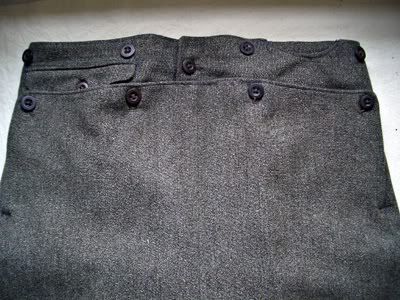
I've not finished yet! At that time (19th century), trousers would not have had the central vertical fly front we are familiar with today, but a fall front. This is a method of fastening the trousers with a flap that spanned the front waist and was fastened with buttons. Take a look at this pair of trousers which will give you the idea:


These trousers are from a suit made possibly in the early 1930s, according to the museum record, which is in the collection of the Gallery of Costume, Manchester. You can see that there are four buttons near the waistband which open to reveal:

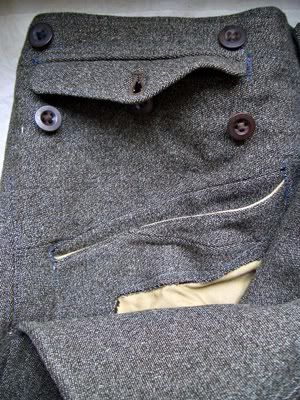
OK, that might not be what you were expecting. This is under that front panel you saw above, and there's the pocket with a flap at the top which was visible in the first picture, and also a hidden diagonal welted pocket below it.

Sorry, this is getting complicated! So if you were getting dressed you would have to fasten two side panels of the trousers with a central button or two, and then fasten up the four buttons that secure the fall front over that.

I'm pretty sure this style was archaic by the time this suit was made, and it doesn't look like a regular "lounge suit" as it is catalogued in the museum. To be fair, I'm sure there was a note in the museum record about it being a gamekeeper's suit, which would make much more sense. This suit is very old-fashioned for the time, assuming that given date is correct, and is sturdy and warm enough for tramping through the Cheshire countryside in the depths of winter with a shotgun over your shoulder and maybe a brace of pheasants hanging off your belt.

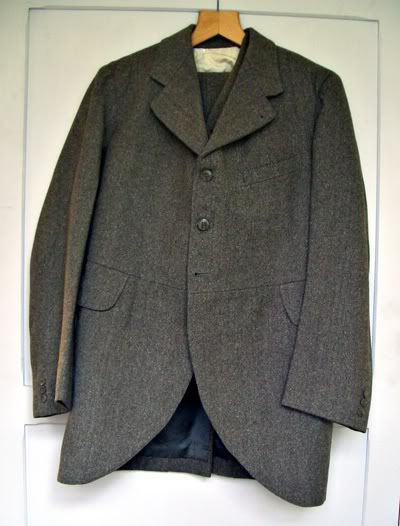
Just to complete the picture, here's the jacket of the suit:


Its beautifully curved cutaway hem, high button front fastening and waist seam speak of earlier days. The days of Mr Harris even.

There's been a dearth of film in recent posts, so this is the nearest I can get to Mr Harris's time and place - a wonderful film from 1903 of Petticoat Lane, London, from the BFI's Youtube channel. Don't you wish it had a soundtrack?: