This beautiful photograph is a hand tinted 8x10 dating from the 1940s, possibly during the Second World War. A very stylish and attractive woman sits in a picturesque country setting, surrounded by daffodils. She looks so happy.
Its only when you turn it over that this photograph zaps you with something quite unexpected and moving. On the back is written: "Looking at this now - I realise I was carrying my daughter - how I wish those times could have given me the courage to ignore the moral issues and let nature take its course."
Suddenly its hard to look at that picture in quite the same way. I imagine this woman was going through her photographs some years later and felt the need to record her regret at the loss of her daughter, perhaps for herself or for her family. Or just to memorialise her child. Her daughter was there in that photograph, only we couldn't know that by just looking at the picture, and neither did she at the time.
I found this photograph among a whole boxful from the same family, and bought as many as I could afford. Its clear that they later had a son whom they doted on, and enjoyed many happy times and holidays together as a family. I would like to add some more pictures of the family here, or at least links to them, but trying to do both things resulted in me losing all the text I had written in a mass of tangled HTML. So I daren't!
Shuffling through the pictures you would assume this was a very happy family living a very uncomplicated and picture perfect life, but that little note is a sharp reminder that things aren't always that straightforward.
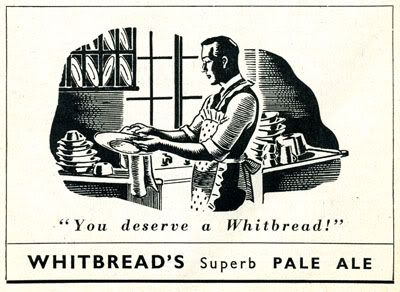
Whitbread Pale Ale advertisement in Lilliput, June 1947, page xv.
This startling advertisement appeared in Lilliput magazine's June 1947 issue. A man is pictured in a frilly apron doing the washing up, presented with no comment or indication that this is the least bit remarkable.
Taken in the context of the immediate post-war years, it did surprise me. Men were returning from fighting six long years of war and the usual story we are told is that women who had ably coped with 'men's' jobs - working in munitions and aeroplane factories during the war - were immediately pushed out of their jobs and ordered back into the home and kitchen where they belonged. It was back to 'business as usual' - the reassuring gendered division of labour with women as housekeepers and mothers, men as breadwinners, and pampered kings of the castle at home.
This ad complicates those assumptions. There's no suggestion that this man is emasculated by helping out at home, even with a frilly apron on, and the scenario is not exploited for comic effect (as it inevitably would be today). In fact he looks rather noble in his woodcut-style vignette. Perhaps gender roles in the post-war years were a little more complicated and nuanced than we have been led to believe by most popular histories.
Of course, I'm sure most women wouldn't have expected to be rewarded with a bottle of pale ale for doing household chores, so there's an indication that the man's efforts are a little bit special, although obviously not unusual.
In fact, within a few pages of the same magazine is another very similar advertisement:
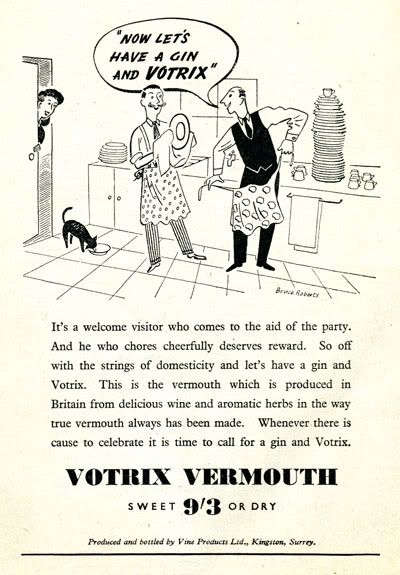
Votrix Vermouth advertisement in Lilliput, June 1947, page iii.
The occasion this time is the aftermath of a party, with two gentlemen gamely tackling the piles of dishes. They both wear feminine, patterned aprons and are again deserving of a reward in the form of an alcoholic drink. A delighted-looking wife peers through the door (and then perhaps runs off to fetch their drinks?!)
Did men do anything else around the home except the dishes, now and then? Perhaps . . .
Vactric vacuum cleaner advertisement, from Housewife, November 1947, inside back cover.
This vacuum cleaner advertisement from the same year is rather less credible ("Give him a Vactric"? Hmm) and there is a lightly ironic tone to the copy: "When the household god descends to lend a hand" is a clear indication of the 'normal' domestic power relationship, however humorously expressed.
So the idea of a man helping out with onerous domestic chores is framed in all these advertisements as a sort of special treat for their wives, who are still expected to do them most of the time. But at least its not portrayed as ridiculous or unmanly, as you might expect even to this day, and its considered unremarkable enough to be featured in mainstream advertising.
It makes me wonder how far we've progressed since then (as I contemplate the stairs that need vacuuming . . .)
This beautiful photograph in my collection came from the archive of the newspaper The San Francisco Examiner. There's a damaged relic of a pasted-on label on the reverse giving the title "Serpent of Hell" (the production title? Her character's name?) and a date of April 14th, 1923, which might be the publication date.
Ottilie Ethel Losch was born in Vienna on November 15th 1907, which would make her 15 years of age in this photograph. You can read a summary of her extraordinary life and career in that link over her full name, which details her first stage appearance as a dancer at the age of six with the Vienna Imperial Opera ballet school, her promotion to prima ballerina at the unusually young age of 15, and her subsequent work with Max Reinhardt as both dancer and choreographer (and much more, of course, but we'll come to that soon).
What is puzzling is that according to the Binghamton University Library, which holds Losch's papers, she didn't arrive in the United States until 1927.
Why, then, is she appearing in a popular American newspaper (owned by William Randolph Hearst, by the way) in 1923? In a costume that looks much more Max Reinhardt than something you might expect from the Vienna Imperial Opera, and a full four years before she was reported to have first been invited to perform for Reinhardt in 1927?
The remains of that label note that she was wearing "phosphorous tights" - and I sincerely hope they mean phosphorescent, by the way, or her health might have been seriously endangered.
I'm speculating wildly here - its a bad habit of mine - but perhaps either the photograph date is wrong, or there's something missing or incorrect in that summary of her life?
No matter, Tilly Losch's life was extraordinary anyway, and she is one of those 20th century figures who seems to have orbited around many of the most significant cultural figures of her times, like a female Zelig, only much more beautiful!
She married Edward James, the wealthy English art connoisseur who was a patron of Salvador Dali (he was the proud owner of the first iteration of the iconic Mae West lips sofa, which was installed in his surrealist country pile Monkton House, and was captured by Magritte in this famously baffling portrait). But their marriage ended in a scandalous divorce in 1934 - Tilly accused him of homosexuality, he in return cited just one of her numerous affairs.
Other names that crop up in her life that might still ring a bell to the modern ear include Noel Coward, Fred and Adele Astaire, Kurt Weill, Lotte Lenya, George Balanchine, Berthold Brecht, Jean Cocteau (an ardent fan), the Sitwells and Cecil Beaton.
Her career in Hollywood has left us with some appearances in films such as The Garden of Allah (1936) with Marlene Dietrich, The Good Earth (1937) and Duel in the Sun (1946). All of which I'm pretty sure are readily available on DVD.
Later she retired from dancing and acting and turned to painting, which apparently suited her reportedly shy nature, and was enobled by her 1939 marriage to the Earl of Carnavon to the status of countess. Despite their divorce after the Second World War, they remained on friendly terms and the Earl was one of the few mourners at her 1975 funeral.
But let's go back to the top of this post and contemplate that amazing vision of her as an accomplished teenage dancer making news across the Atlantic - wasn't she magnificent?
If you've ever seen one of those archive film montages of the 'roaring twenties' in a TV documentary, there's one clip that always features. Its the one featuring a couple dancing the Charleston on top of a taxi cab driving through a London street.
That clip is at the very end of this British Pathé dance instruction film (incidentally, fashion history buffs will be delighted by Miss Jose Lennard's lower back skirt hem - a major trend in the last years of the 1920s):
THE FLAT CHARLESTON MADE EASY
The stunt was intended to demonstrate that the new 'flat' Charleston required very little space, in contrast to its original, wild form, which was a veritable whirlwind of flying heels and arms, presenting considerable danger to nearby dancers. Indeed the Charleston was banned from many dancehalls at the time.
It is ironic that this clip is now employed to symbolise the reckless, risk-taking, devil-may-care nature of the times when its original intention was actually quite the opposite.
While I could easily (and quite happily) go on about the Charleston, this post concerns the man who appeared in that film, the famous dance master - and energetic self-publicist - Santos Casani.
Mr Casani was the proprietor of "the largest school of dancing in England," wrote a column for the Daily Mail, and made numerous short dance instruction films for British Pathé's cinemagazine for women, Eve's Film Review. The film company supplied free instruction leaflets based on the dance steps Casani featured, which viewers could send off for, and as a demonstration of how popular these films were, on one occasion they had to print 20,000 leaflets to satisfy the demand (most of this information is derived from Jenny Hammerton's fascinating book For Ladies Only? Eve's Film Review Pathé Cinemagazine 1921-1933).
As an aside, its lovely to imagine a cinema audience practising dance steps under their seats as they watch the films!
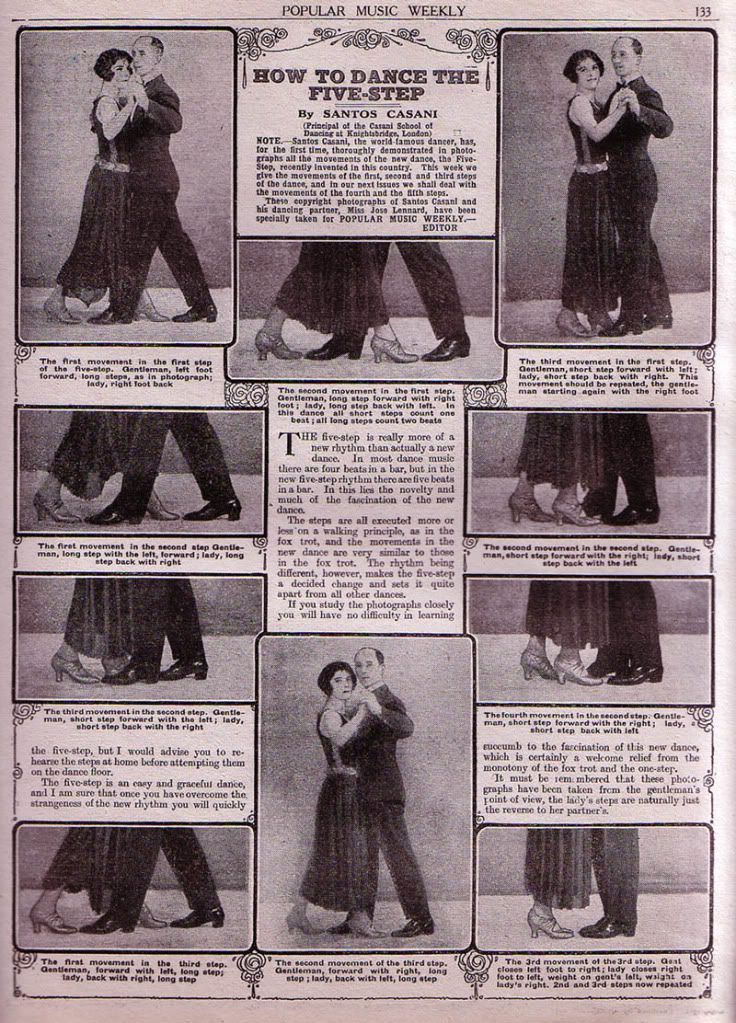
Here Casani makes an appearance in Popular Music and Dancing Weekly magazine, demonstrating the first three steps of the 'Five-Step' - steps four and five were published the following week, but unfortunately I don't have a copy of that issue (again, fashion buffs please note how remarkably long Miss Lennard's skirt was in 1924!):
"How to dance the Five-Step by Santos Casani" in Popular Music and Dancing Weekly, 7th June 1924, page 133 (click picture for a larger view).
In 1933 Casani opened his own nightclub in Imperial House, Regent Street, London and British Pathé was there to record it.
If you were to try to imagine a high-tone 1930s nightclub in the West End of London his establishment lives up to your Art Deco dreams, and this film includes footage of the renowned house band lead by pianist Charlie Kunz, a swimsuit fashion parade, an elegant rendering of the waltz by Mr Casani himself, not to mention a novelty song and a curious female contortionist. Pour yourself into a backless satin dress, shake up a cocktail and join in the fun:
LONDON'S FAMOUS CLUBS AND CABARETS NO. 10 - CASANI'S CLUB
Unlike his near contemporary Victor Silvester, Santos Casani failed to secure himself a place in dance posterity and his name is probably unknown to most people nowadays. But he was clearly a significant figure in his time - a suave, elegant man who knew how to work the media for maximum attention. In his prime, he was Mr Dance, and I'd like to salute his memory.
If you would like to see more of Santos Casani in action, there's plenty more films for you to enjoy.
I did unexpectedly well for presents this Christmas, and among them was this tiny porcelain shoe sporting the town crest of Blackpool. Judging by its style it possibly dates from the 1900s, and is clearly an imitation of the famous Goss armorial china that was developed in the 19th century and was produced in an almost endless variety of forms.
The Goss range wasn't just extensive in its inventive array of novelty shapes. According to Larch S. Garrad in A Present From . . . Holiday Souvenirs of the British Isles: "Allegedly, Goss souvenirs were produced for every town in the United Kingdom that had a coat of arms."
This example was perhaps made in Germany - the generic red 'foreign' stamp underneath being no help at all in narrowing down its origin. But this doesn't really matter since I have a fascination for British seaside resorts, and Blackpool holds a special place among them.
Blackpool has a good claim to being the world's first working-class seaside resort - a title contested primarily by New York's Coney Island - and both towns developed more or less in parallel. John K. Walton explores the development and decline of both places in his excellent article "Popular Playgrounds: Blackpool and Coney Island, c. 1880-1970" (available to download as a pdf here - scroll down to Volume 17, Number 1).
The millions of visitors who descended on Blackpool every summer holiday season were determined to have fun and spend their money, and perhaps take home a small memento or gift with their last few pennies, and this porcelain shoe was probably very cheap in its day. All the better to attract the eye of the working-class holidaymaker with limited cash.
But a shoe doesn't really say Blackpool to me, even with a fancy town crest on it. The iconic Blackpool Tower however, Lancashire's homage to Paris' Eiffel Tower which opened in 1894, does the job nicely.
This vintage Stratton tieclip features the tower rendered in vivid blue enamel - and is currently available at the time of writing in my Etsy shop, dear reader. As a seaside souvenir, I would argue that its actually pretty tasteful:
Stratton was established in 1860, and is most famous for its men's accessories such as cufflinks and tieclips, not to mention its women's powder compacts. Vintage examples attract avid collectors, but having cast an eye on their current range (Stratton is still going) I have to say I am sadly underwhelmed.
Of course we've got to return to Blackpool in its prime, with three marvellous films from the BFI (British Film Institute) showing the town in three different eras.
First is this 1904 Mitchell and Kenyon film of hordes of visitors promenading on Blackpool's Victoria Pier. This was shot around the time that I reckon my shoe souvenir dates from:
This 1926 film clip, shot by Claude Friese-Green in what looks like a two-colour green/red process, shows the 'Reel' ride at Blackpool's Pleasure Beach. There's also a very pleased "lassie from Lancashire" proudly showing off her feathered kewpie doll prize, from the 'Shalwyn' stall, at the end:
Finally, this fabulous excerpt from the 1957 film Holiday, which reveals some obvious American influence on the town (hotdogs with or without fried onions), the 'Reel' again, and some lovely 50s fashions:
My last post was a complete failure as a viable Christmas gift idea for all kinds of reasons - let alone the fact that the fishtank was from a catalogue that was about 50 years old - so I've decided to make amends with some more promising prospects for the lady in your life.
Sadly most of these are from more or less the same date or even earlier so you've the same chance (exactly none, unless you are a very accomplished vintage buyer) of finding them.
If you've read any of the previous posts you will know that I am an ardent fan of the British Pathé film archive, so I'm happy to present a few more gems that I have gathered from their amazingly extensive collection.
First up is a delightful film from 1946 about what the narrator cheerfully refers to as "junk" jewellery, which would probably be classed as "costume" jewellery these days.
Apologies for not being able to embed these films but, trust me, they are all worth the bother of opening a new tab or window to view (you can complain in the comments if they're not!):
EAR-RINGS [sic] (aka JUNK JEWELLERY)
And continuing on the earrings theme is this film from 1955 (in glorious Technicolour!) which showcases the stock of a Soho shop called "Going Gay" and is essential viewing for anyone who appreciates 50s kitsch jewellery:
PARTY EARRINGS
There's some very dubious parallels drawn with ancient civilisations and ethnic cultures by the narrator, but they're easy to ignore with all those marvellous baubles to enjoy.
Another potential gift idea is a handbag, an item that most women can't have too many of.
In the following 1955 film you are first presented with a pink handbag made out of elephants' ears. Control your nausea - and please don't worry, there's nothing distressing shown - because this is a terrific film with some prize examples that really shouldn't be missed, including something for the dipsomaniac gentleman:
LEATHER FAIR
Spectacles might not be your first thought for a gift, but bear with me here because this is a fantastic 1955 film with some extraordinary examples of eye-wear.
Its hard not to be distracted by the flying hands of the optician who seems to swoop over every woman featured with dramatic and energetic gestures - I'm sure he's making some interesting and informative points, only we can't hear them:
SPECTACLES
Finally, if you've ever wondered what spectacles might be suitable for motoring and the beach you have your answer in the last few seconds of this film:
MODELS LEARN SPEC BEAUTY (aka SPECTACLE FASHION)
Lucie Clayton's was a finishing/modelling school in London for very posh 'gels' (Joanna Lumley among them) which has recently been amalgamated with two secretarial colleges to form Quest Business Training. I'm pretty sure classes in "Spec Beauty" aren't part of the current curriculum.
Tea diffuser from the Headquarters & General Supplies Ltd catalogue, 1950.
You could purchase a "National Service" tea diffuser (now more commonly known as a tea infuser) to help eke out your tea ration.
This ingenious item was found in a 1950 catalogue produced by Headquarters & General Supplies Ltd ("Contractors to War Office, Ministry of Supply, Crown Agents for the Colonies and Education Authorities") based in London.
As you might expect from their business connections, the catalogue has plenty of military surplus clothing and accessories, such as waterproof RAF flying suits - for 45/- or 49/6 with a hood - which are recommended for motorcyclists and motorists. And "Genuine British Army Berets" for 5 shillings ("certainly a smart article for holiday use").
After the war, military surplus flooded onto the market. It was well made and good quality, durable, practical and plentiful. The catalogue makes a fine job of suggesting alternative uses for some often very specialist garments, as has been noted above, but here are some more:
Solid Leather Army Jerkins (12/6): "Ideal for motoring, golf, or hard wear."
Merchant Navy Waterproof Suits (19/6): "For outdoor workers, cyclists, builders."
Interestingly, there are also "Solid Leather Pilots' Jackets Zip Front . . . lined throughout with pure Sheep's Wool" for £5 5s - presumably the sheepskin flying jackets that now fetch extremely high prices in the collectors' market.
Clothes rationing ended in March 1949 but tea rationing continued until 1952, making that 1/9 for a tea diffuser look like a very shrewd investment.
Additional notes
Measuring Worth provides a handy calculator for working out the equivalent prices in today's money (well, 2008 is the nearest they can get), using the Retail Price Index. So let's see:
Tea diffuser 1/9 = £2.25 (you can buy more or less the same thing today for about £3)
RAF flying suit 45/- = £57.76
British Army beret 5/- = £6.42
Ex-Naval Torpedo Hazard Suits 17/6 = £22.46
Solid Leather Army Jerkins 12/6 = £16.04
Merchant Navy Waterproof Suits 19/6 = £25.03
Solid Leather Pilots' Jackets £5 5s = £134.77
And because I seem to have wandered off the subject of tea a bit in this post, here's a stern man in a white coat (a "tea instructor") explaining more than you'll ever need to know about the dos and don'ts of tea making. This is a 1941 film from the BFI's YouTube channel:
If that's worn you out (or you can't face a full ten minutes of tea making instruction) then join Harrod's shopper Elizabeth Allan in 1955 as she introduces the wonder of the teabag. Look out for the brief appearance of a tea diffuser/infuser:
A Victorian handbill found in a book by Renée Huggett called Shops published in 1969.
This marvellous Victorian promotional handbill (flyer) from London addresses the discerning working man in need of new clothing. Written in a presumably authentic slang current at the time, it has an immediacy and humour that defies its age, even though much of it is completely mystifying to the modern reader.
Let's have a go:
Mr H nabs the chance of putting his customers awake, that he has just made his escape from India, not forgetting to clap his mawleys upon some of the right sort of stuff, when on his return home he was stunned to find one of the top Manufacturers of Manchester had cut his lucky, and stepped off to the Swan Stream, leaving behind him a valuable stock of Moleskins, Cords, Velveteens, Box Cloths, Plushes, Doe Skins, Pilots &c., and having some ready in his kick--grabbed the chance--stepped home with the swag--and is now safely landed at his crib. He can turn out Toggery, very slap at the following low prices for
Ready Gilt--Tick being No go.
Upper Benjamins, built on a downy plan, a monarch to half-a-finnuff, Fishing or Shooting Togs, cut slap, 1 pound, 1 quarter, and a peg. A Fancy Sleeve Blue Plush or Pilot ditto, made very saucy, a couter. Pair of Kerseymere or Doeskin Kicksies, built very slap with the artful dodge, a canary. Pair of Bath or Worsted Cords, cut to drop down on the trotters, a quid. Pair of out and out Cords, built very serious, 9 bob and a kick. Pair of stout Broad Cords, built in the Melton Mowbray style, half a sov. Pair of Moleskins, built hanky spanky, with a double fakement down the sides and artful buttons at bottom, half a monarch.
MUD PIPES, KNEE CAPS, AND TROTTER CASES BUILT VERY LOW.
A decent allowance made to Seedy Swells, Tea Kettle Purgers, Head Robbers, and Flunkeys out of Collar Gentlemen finding their own Broady can be accommodated.
(My thanks to flickr contact Bollops for taking the trouble to transcribe this text when I originally posted this picture there).
Many of the terms are obviously types of cloth: moleskin (a heavy, cotton cloth with a short, soft pile on one side), corduroy, velveteen, box cloth (I failed to find a definition of this), plush, doeskin (a fine, soft woollen cloth), pilot (a thick woollen cloth, often dyed blue used for overcoats and sailors' gear), kerseymere (a twilled fine woollen cloth).
Then there's prices: a monarch (a sovereign? That's one pound), half-a-finnuff (? - thanks to alan.98's comment below, I've discovered that a finnuff is Yiddish for a fiver), 1 pound, 1 quarter (a crown or five shillings? One pound was twenty shillings) and a peg (?), a couter (a sovereign, found in an excellent article on costermongers' backslang on the Victorian Web here), a canary (?), 9 bob (9 shillings) and a kick (?)
And of course, there's the garments on offer themselves: many appear to be trousers, such as the kicksies, or the cords "cut to drop down on the trotters (feet?)." Perhaps the "Upper Benjamins" and the "Fancy sleeve Blue Plush or Pilot ditto" are coats or jackets - the mention of a sleeve is a bit of a clue! "Mud pipes" might be some kind of oilskin waders or trousers, but I'm guessing here. "Knee caps" are possibly protective pads worn over the knees for labourers who have to kneel in their work, but again this is pure speculation. "Trotter cases" are likely to be boots if we can assume that trotters are feet.
The final call to "Seedy Swells, Tea Kettle Purgers, Head Robbers, and Flunkeys out of Collar" strongly suggests that Mr Harris is happy to do business with men of dubious reputation, so long as they have the ready cash of course.
This is a piece densely packed with detail and description, and deserves much more research than my desultory efforts.
But as much as its fun to try to translate this text, perhaps the most enjoyable thing about it is the way it reads. I would love to hear Bob Hoskins tackle this in his ripest Cockney growl.
Apparently Mr Harris advertised widely, or he copied a widely used format. More or less the same text, with some minor variations, appears in Mayhew's London Life and the London Poor of the mid 19th century (scroll down to the last quarter of the page or do a search for "slap up" on that page to find the passage), and in the New York Herald in 1888, which suggests that this tailor/outfitter was so familiar with the London criminal underworld that his handbill "appeals to the thieves, burglars and outcasts from society only."
This assertion is unfair I believe. Mr Harris was clearly drawing from the rich source of contemporary slang that would have been readily understood by its intended audience - working class men living in the slums of London. That's not to deny that perhaps Mr Harris was borrowing a bit of underworld cool by using terms that were not entirely respectable or correct, especially in Victorian times, but he was clearly a shrewd businessman who knew how to speak to his market. And he was aware that a more formal approach was a waste of time and expense (handbills cost money to print).
Credits are due. My sincere thanks to flickr friends Bollops and Art Nahpro for doing all the heavy leg-work to unearth most of the links that I have used in this piece.
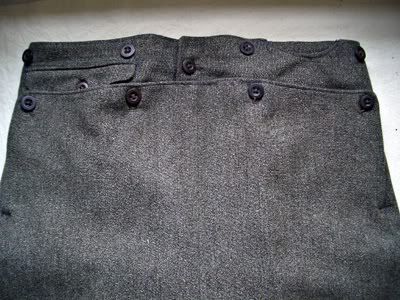
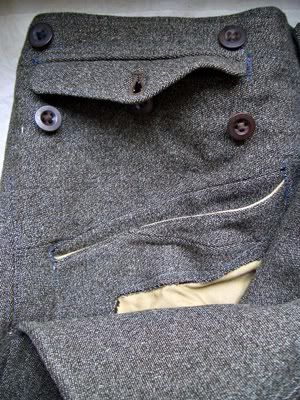
I've not finished yet! At that time (19th century), trousers would not have had the central vertical fly front we are familiar with today, but a fall front. This is a method of fastening the trousers with a flap that spanned the front waist and was fastened with buttons. Take a look at this pair of trousers which will give you the idea:
These trousers are from a suit made possibly in the early 1930s, according to the museum record, which is in the collection of the Gallery of Costume, Manchester. You can see that there are four buttons near the waistband which open to reveal:
OK, that might not be what you were expecting. This is under that front panel you saw above, and there's the pocket with a flap at the top which was visible in the first picture, and also a hidden diagonal welted pocket below it.
Sorry, this is getting complicated! So if you were getting dressed you would have to fasten two side panels of the trousers with a central button or two, and then fasten up the four buttons that secure the fall front over that.
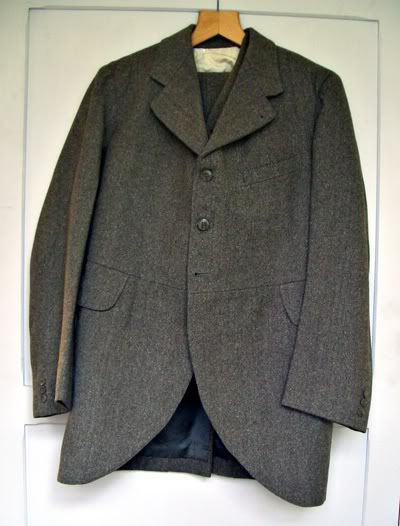
I'm pretty sure this style was archaic by the time this suit was made, and it doesn't look like a regular "lounge suit" as it is catalogued in the museum. To be fair, I'm sure there was a note in the museum record about it being a gamekeeper's suit, which would make much more sense. This suit is very old-fashioned for the time, assuming that given date is correct, and is sturdy and warm enough for tramping through the Cheshire countryside in the depths of winter with a shotgun over your shoulder and maybe a brace of pheasants hanging off your belt.
Just to complete the picture, here's the jacket of the suit:
Its beautifully curved cutaway hem, high button front fastening and waist seam speak of earlier days. The days of Mr Harris even.
There's been a dearth of film in recent posts, so this is the nearest I can get to Mr Harris's time and place - a wonderful film from 1903 of Petticoat Lane, London, from the BFI's Youtube channel. Don't you wish it had a soundtrack?:
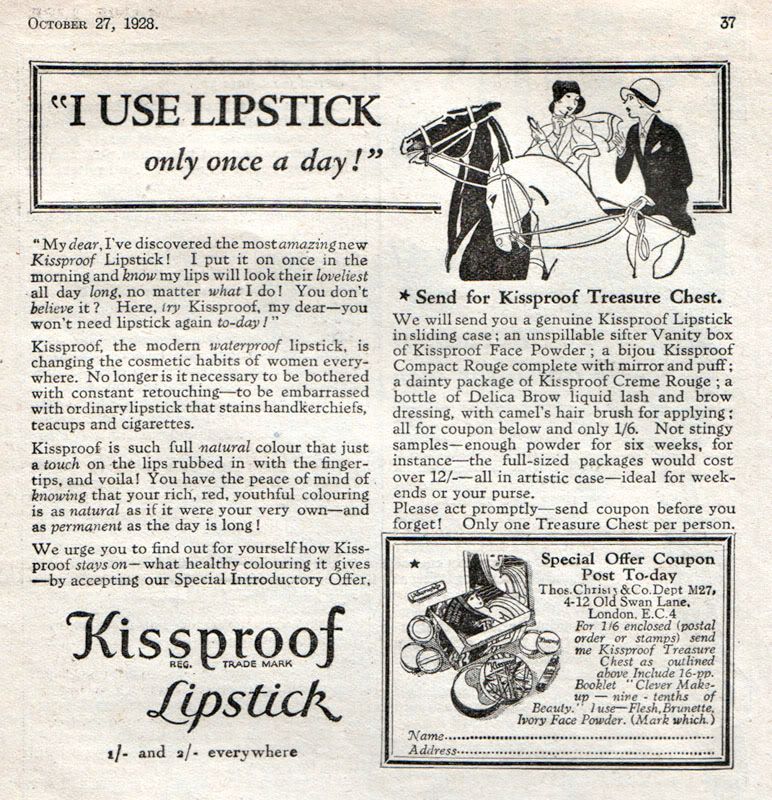
Kissproof lipstick advertisement from Woman's Life magazine, October 27th 1928.
You could buy a Kissproof lipstick in a "rich, red, youthful colouring" that is not only waterproof but requires only one application in the morning because it is "as permanent as the day is long."
Now that is quite some claim to make, because I'm sure that right at this moment there are boffins in the labs of L'Oreal still busily trying to formulate a lasting lip colour to live up to that kind of claim. Perhaps the Kissproof formula included a pigment that actually stained the lips?
According to Wikipedia that was indeed the case: "long-lasting, indelible stains were the most popular" in the 1920s.
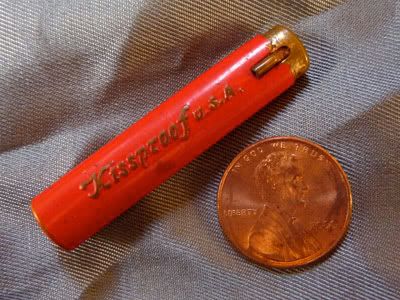
So if this lipstick (lip dye?) required only one application a day, presumably you wouldn't need much of it. In fact, the lipsticks were tiny:
Kissproof lipstick, with a cent for scale (apologies to UK viewers, the cent appears to be the universal indicator of scale - it is slightly smaller than a penny).
This example measures just under 1¾ inches (4.2 cm) long and just over ¼ inch (9 mm) wide. I can't remember how I acquired this lipstick, but I suspect it was from the days when my mother ran a vintage clothes shop and would sometimes find things (shopping lists, hair grips, handkerchiefs, no diamond rings unfortunately) in the old handbags she sold.
Its not cylindrical as you might expect, but a kind of flattened, oval shape, and it has been used right up to the nub (it was a matte, dark red colour, incidentally).
Another popular lipstick brand was Tattoo:
This has the typical cylindrical shape, but is only 1 inch (2.5 cm) in length. It is etched with dancing maidens dressed only in skimpy grass skirts.
Compared to modern lipsticks, these are absolutely tiny, and must have been a boon in the days when handbags were correspondingly petite.
Just to return to the Kissproof ad at the top for a moment: it strikes me as a rather strange advertisement for a cosmetic product. Its very brisk and English, with two posh, outdoorsy women ("My dear") conversing on horseback. This is not the kind of scenario you might associate with a lipstick - I'd imagine a night club, or fancy restaurant, or one of those newfangled cocktail bars that came over from America during the 1920s. Where's the glamour, or the sex appeal?
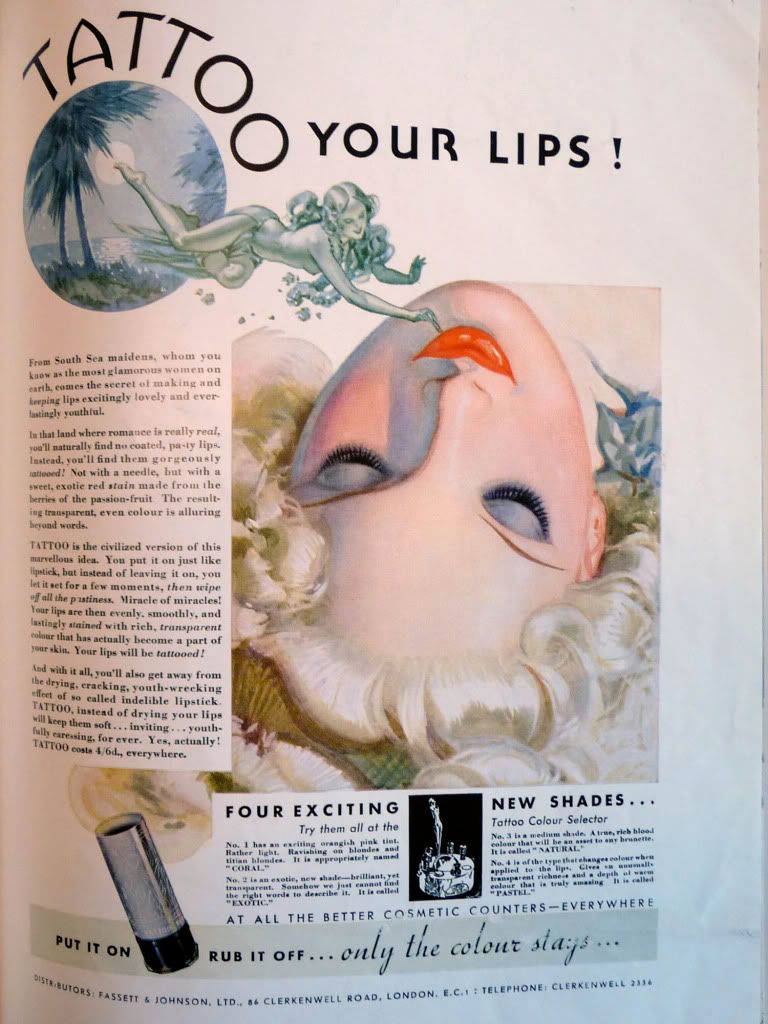
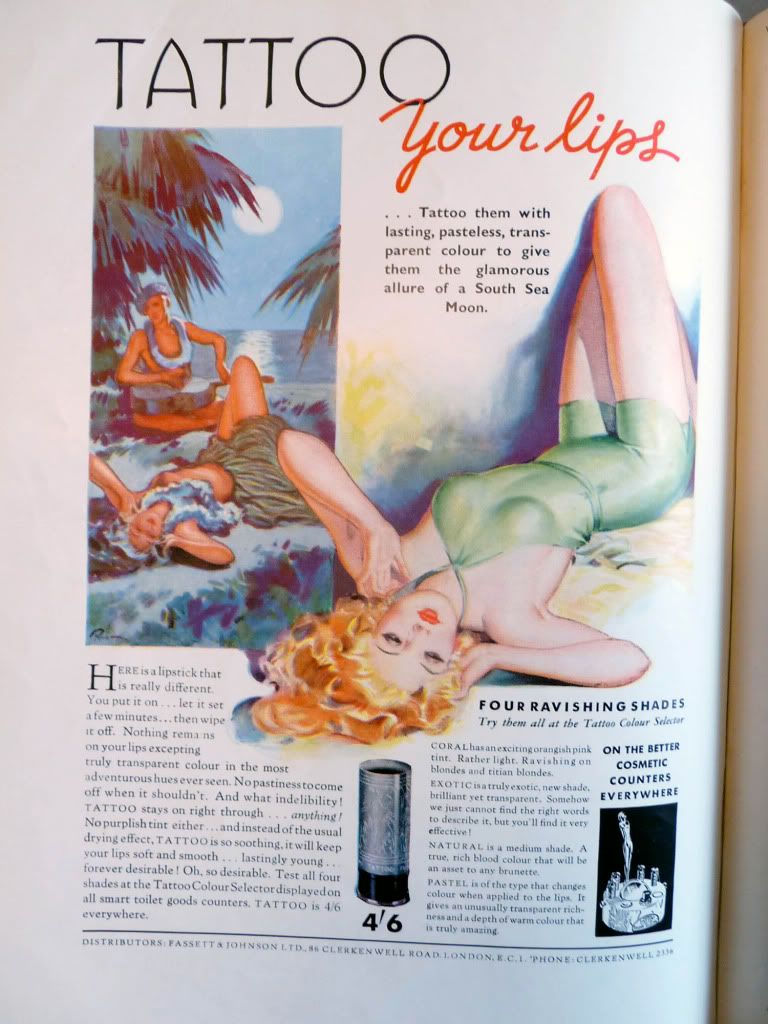
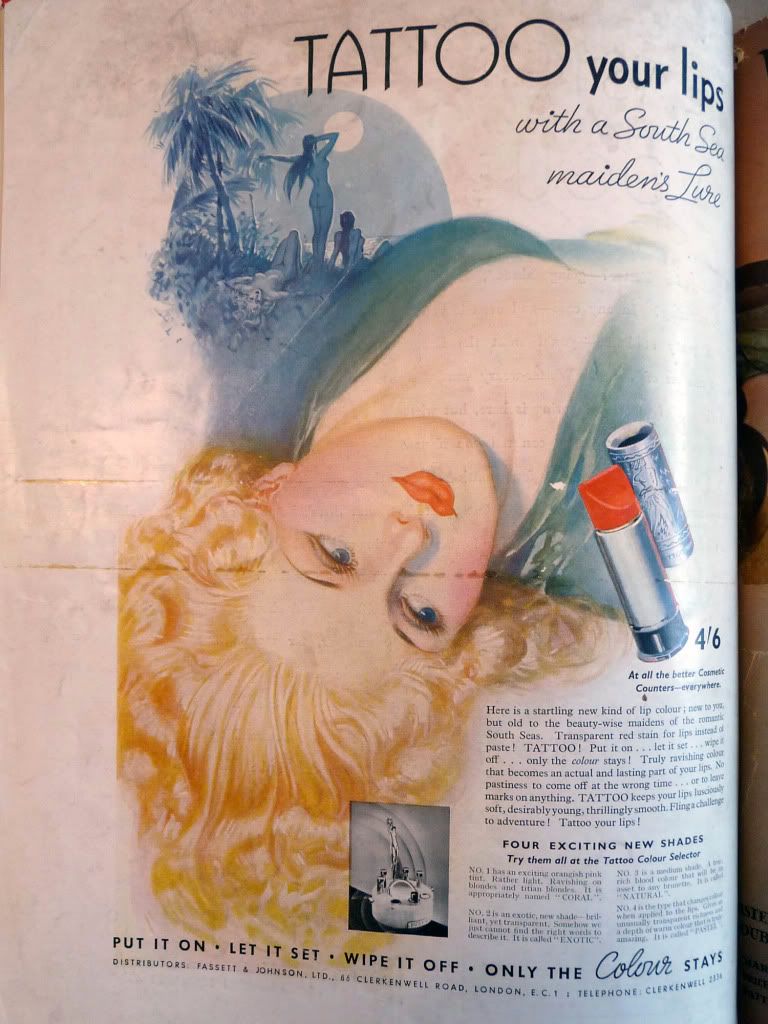
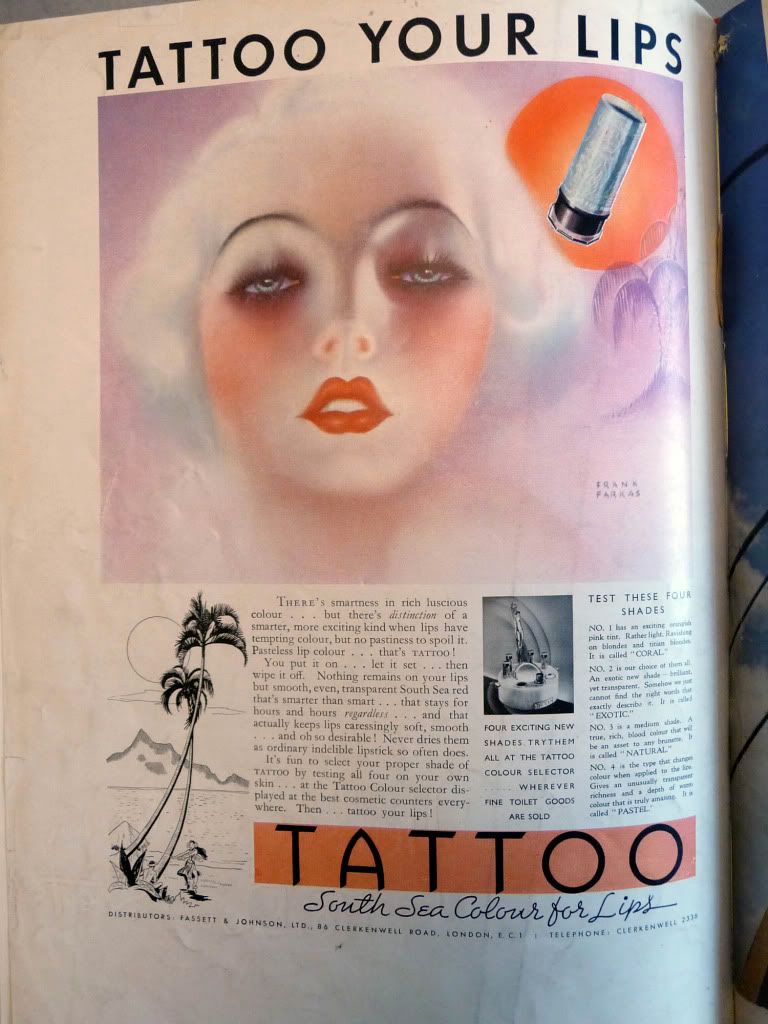
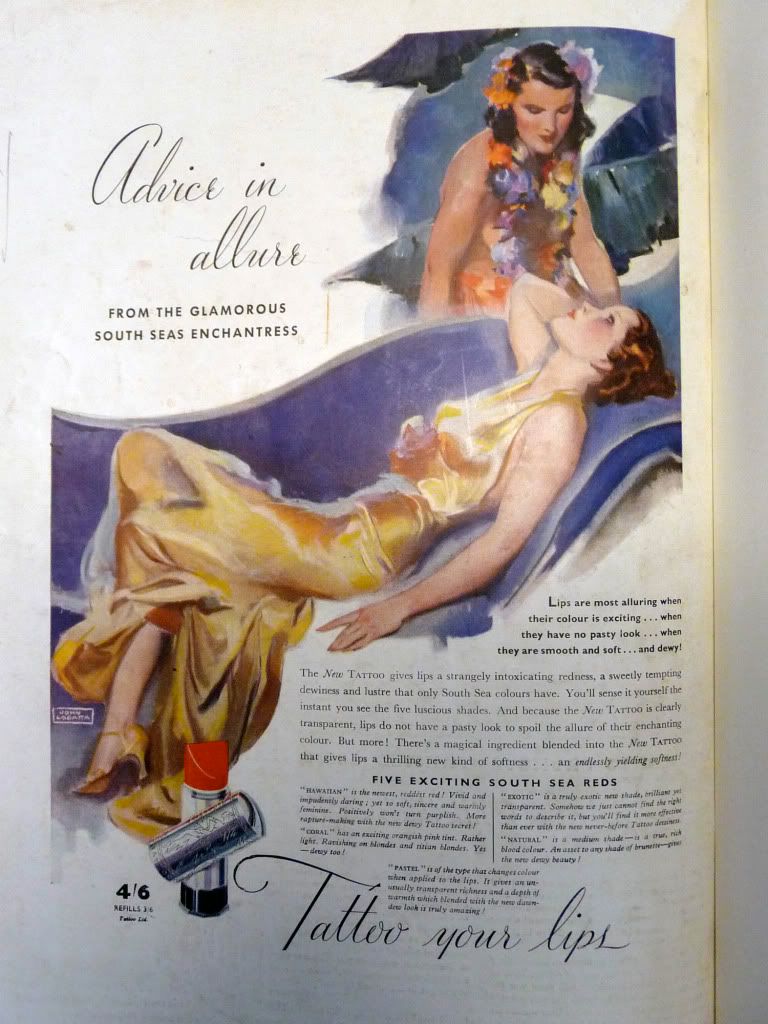
Well, the Tattoo lipstick company knew all about sex appeal, and in a series of advertisements from the 1930s they laid on the glamour and exotic sex appeal with a trowel:
Vogue, 7th August 1935, full page ad on the back cover.
"From South Sea maidens, whom you know as the most glamorous women on earth, comes the secret of making and keeping lips excitingly lovely and everlastingly youthful.
In that land where romance is really real, you'll naturally find no coated, pasty lips. Instead, you'll find them gorgeously tattooed! Not with a needle, but with a sweet, exotic red stain made from the berries of the passion-fruit. The resulting transparent, even colour is alluring beyond words."
Now that's more like it! "Really real" romance! And there's even a glimpse of bosom!
The recumbent female figure with the dewy lips was a signature feature of many of these Tattoo ads:
Vogue, 21st August 1935, full page ad inside the back cover.
Here, a modern, swimsuit-clad young lady precisely echoes the posture of her South Sea island sister, who is so transported by the dreamy guitar melodies that she's writhing on the ground!
"TATTOO is so soothing, it will keep your lips soft and smooth . . . lastingly young . . . forever desirable! Oh, so desirable."
Phew! I think we're getting the message. I'll bet these overheated, sensual ads found a receptive audience beyond their intended market.
Incidentally, they've also dropped the claim that these lipsticks are made "from the berries of the passion-fruit" which I'm sure was completely untrue, not to mention faintly ridiculous, and was probably only added because it had the word 'passion' in it. EDIT: I've re-read the copy and its clear I misunderstood it - those South Sea maidens were supposedly 'tattooing' their lips with passion-fruit - it was not claimed to be an ingredient of the lipstick. I'm not convinced that you would get much colour from a passion-fruit so the idea is still preposterous!
Vogue, 4th March 1936, full page ad on the back cover.
They must have liked that swooning posture, because you can see one of the women at the top of this ad in more or less the same position, not to mention being naked and with two other naked women.
"Fling a challenge to adventure! Tattoo yours lips!"
And what kind of adventure might that be, hmmm?
Vogue, 15th April 1936, full page ad on the back cover.
South Sea exoticism is relegated to the bottom left corner in this 1936 ad, which features an ethereal Jean Harlow type, the right way up for a change. (This illustration is signed by Frank Farkas, about whom I've failed to find out much except that he trained in Europe and worked in an ad agency called Farkas-Jensen-Farkas in Chicago).
Vogue, 7th July 1937, full page ad on the back cover.
This last Tattoo ad, illustrated by John LaGatta has a "South Seas Enchantress" whispering secrets to a languid chestnut brunette in a gloriously liquid satin gown. Its perhaps a little more restrained (if you ignore the hint of lesbian eroticism, that is), although the copy is anything but:
"There's a magical ingredient blended into the New TATTOO that gives lips a thrilling new kind of softness . . . an endlessly yielding softness!"
Well, really. I can feel my inner brisk Englishwoman losing patience now. That's quite enough of that!
[Note: the Tattoo advertisements were found in bound copies of British Vogue, held at the Gallery of Costume, Manchester].
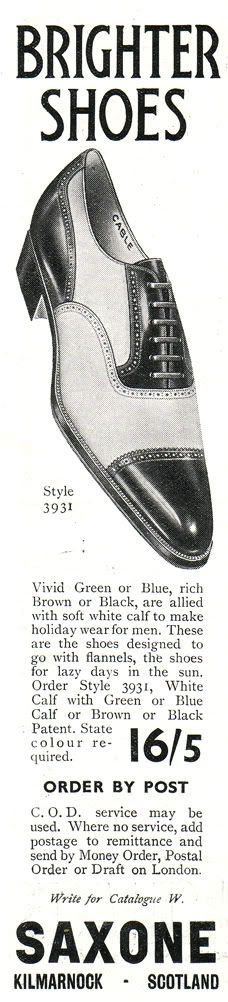
You could treat yourself to a smart pair of co-respondent shoes from Saxone, delivered to your door.
But wait! I always picture this type of shoe in cream and brown, or possibly black and white if you're a bit of a flash Harry. These shoes betray their elegant half-tone illustration by being proudly offered in "Vivid green or blue" and white kid, along with those more conventional options. Can you imagine?
This advertisement was found in the July 1933 edition of The Wide World: The Magazine For Men, which is full of manly adventure stories about vicious head-hunting tribes in Ecuador, bank hold-ups in Canada, and shooting rogue elephants in the British Cameroons.
I suspect you'd have to be a particularly adventurous type of man (foolhardy, even) to wear "vivid green" and white co-respondent shoes in 1933. Or at any other time for that matter.
Well perhaps not buy outright, since 6d is your deposit on "a delightful Spring Frock in Fashion's latest style," and you would in fact be obliged to make fortnightly payments of 1/6 (1 shilling and 6 pence) until the balance of 12/11 was reached.
Oh, and there's 6d for postage too.
But you do get a free pair of black patent leather shoes, so its looking more like a bargain. J.A. Davis was one of a number of mail order clothing companies advertising in the issue of Picturegoer magazine (June 2nd, 1934) that this ad appeared in, and it was certainly the cheapest.
Corot, of 33 Old Bond Street, London, was the dearest. It offered two models: "miss innocence," a pure silk crepe de chine frock for 3½ guineas cash or 10/6 monthly (a guinea was one pound and one shilling - 21 shillings - the 'posh' pound!), and "fresh as the morning," a linen sun frock with matching cape for 2½ guineas cash or 7/6 monthly.
Doing some sums - "miss innocence" is effectively 73s 6d and nearly six times the price of J.A. Davis' frock (with its rather less romantic title of "model 12").
This disparity in prices points to the wide readership of Picturegoer magazine, although even Corot would not have been considered a 'high end' clothing retailer at the time. Prestigious department stores were offering couture copy model gowns for up to 25 guineas, which gives some perspective on the market.
There's lots to pick over here - I always enjoy the fortuitous abbreviation of 'artificial' into 'art' when referring to synthetic fabrics, which makes them sound much more prestigious and appealing.
And I am always brought up short by the colour options listed, with the quite customary use of a derogatory racial term for shades of brown. Nobody would have turned a hair at that term in those days, and within my memory I recall seeing coloured pencils being labelled the same way.
If I'm ever lured by the warm appeal of cosy nostalgia - "things were so much better in the old days, you could leave your door unlocked, kids had respect for their elders" and all that nonsense - that's something to bring me right back down to earth with a bump.
In principal its ALL good, but having recently joined Etsy I've had reason to give it some more thought.
There's a lot of people busily remaking new garments out of vintage ones, and some of them are remarkably inventive and stylish. But I do have qualms about using, and drastically altering, vintage items that are perfectly wearable and undamaged as they are.
In their original state, they are authentic survivors of their era, and often have some value as collector's items or potential museum pieces. Once they have undergone such alterations, they are no longer authentic, and have lost that intrinsic value accrued by age, rarity and desirability - but on the other hand, they may have gained in appeal for the modern buyer who isn't the least bit interested in history or authenticity.
Of course, reusing and remaking clothing is nothing new. For centuries, people have plundered old, secondhand garments - unpicked silk dresses to remake the valuable fabric into something new; removed lace collars and trimmings to adorn another blouse or dress; snipped off buttons and saved them for the next suitable sewing project.
As fashions changed, garments might be altered to conform to the newest styles. When paisley cashmere shawls fell out of favour in the nineteenth century, for example, some of them ended up as neat little jackets or mantles. Here's a late example from the 1920s, held at the Gallery of Costume, Manchester.
In the days before 'vintage' became the lucrative marketing term it is today (something I've discussed rather pompously here), nobody was sentimental about secondhand clothing, regarding it as raw material to be used as they saw fit.
So perhaps I shouldn't be bothered. But the historian in me can't help but mourn the loss of items that have survived the years intact, only to be destroyed at the hands of some unsympathetic maker who is perhaps blind to its merits. (There is a case to be made, I suppose, that the 'new' items made from old ones become authentic artefacts of the current era).
That said, I find it hard to care about mass produced 1980s garments - they're not that old, they're plentiful and most of them are pretty dreadful (I'm being unforgivably subjective here!). Perhaps in twenty years I might feel differently.
My parameters for justified reuse are: badly damaged and/or worn out garments - or ones less than twenty years old - that have no particular qualities, uniqueness or style to them are fair game.
Admittedly, this is probably still ridiculously irrational and sentimental of me. Especially since I have quite a number of vintage clothes in my wardrobe that I wear on a regular basis and will eventually wear out and (effectively) destroy myself!
The era most associated with reusing and remaking garments is that of the Second World War - when 'make do and mend' was an imperative that no-one could afford to ignore. Goodness knows how many potentially valuable 'vintage' items ended up chopped up or altered (like my first ever vintage dress, which got off relatively lightly) during that time.
Anne Edwards, fashion editor of Woman magazine, provides some ingenious tips on how to decimate your poor husband's wardrobe while he is off fighting the war, in this 1942 British Pathé clip (this film might account for the relative scarcity of 1930s menswear!):
HATS (aka MAKE AND MEND HATS)
Even women's wardrobes weren't safe from the scissors! An evening dress is transformed into a becoming day dress (and turban):
EVENING AND DAY FROCK (issue title is HI-DE-HI)
And finally, "great grandma's priceless old lace" is turned into some attractive household decor items:
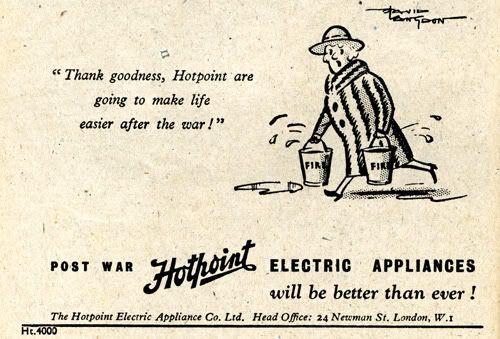
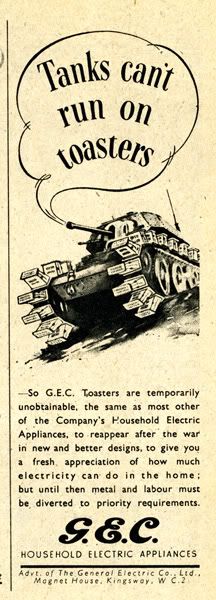
Leafing through a copy of Modern Woman magazine from January 1944, I noticed that a number of the advertisements weren't promoting actual goods, but the promise of them after the war.
The frazzled lady above with the fire buckets is presumably doing the weekly wash, and couldn't wait until she was able to buy a new Hotpoint washing machine, something that I'm sure a lot of women at the time could relate to.
G.E.C. (below) used an arresting illustration to make the point that their production lines were diverted to munitions work for the duration:
Clothing manufacturers, such as Healthguard knitwear, were busy supplying the troops with uniforms and (presumably in this case) cosy and durable knitted sweaters and undergarments, although in this industry, unlike that of the electrical manufacturers, a small proportion of their output was devoted to the domestic market:
The tone is sympathetic but encouraging - acknowledging that their products will be scarce and probably require a concerted effort to hunt around numerous retailers to source - "annoying, perhaps, but well worth the bother." (I can't see that phrase catching on in the same way as "Keep calm and carry on," somehow).
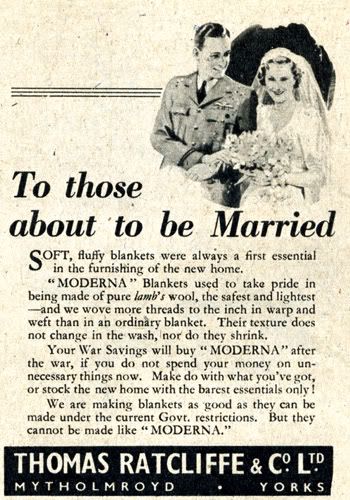
Thomas Ratcliffe & Co. Ltd., makers of Moderna wool blankets, appear concerned to preserve their image as producers of high quality goods:
After explaining what makes their blankets so special - "pure lamb's wool . . . more threads to the inch in warp and weft than in an ordinary blanket" - they are obliged to confess that their wartime blankets, produced "under the current Govt. restrictions," aren't quite so special. In fact, its clear they really don't want to sell you their current, substandard blankets at all and instead urge wartime brides who are setting up their new homes to save their money for the (better) post-war Moderna blankets and in the meantime "make do with what you've got"!
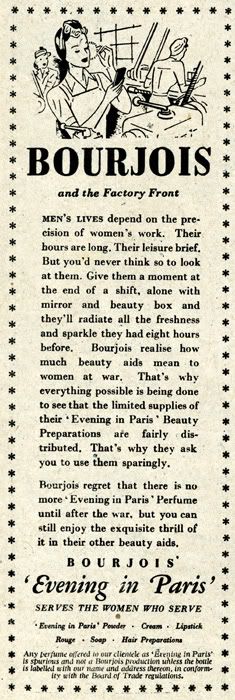
Bourjois, the cosmetics manufacturer, congratulates women on maintaining their feminine allure whilst engaged in arduous war work, but urges them to use their scarce products sparingly:
In small print at the bottom, after expressing regret that their Evening in Paris perfume will not be available during the war, is this warning: "Any perfume offered to our clientele as 'Evening in Paris' is spurious and not a Bourjois production unless the bottle is labelled with our name and address thereon, in conformity with the Board of Trade regulations."
It seems that shoddy, counterfeit goods were another hazard of wartime life.
All these adverts appeared in a single magazine in 1944, five years into the Second World War, and their message must have been repeated throughout countless publications during the conflict. Although manufacturers engaged in essential war production were probably not suffering unduly, with their lucrative Government contracts, they were evidently anxious to maintain public goodwill and the future customer base that would ensure their post war prosperity.
For consumers, it must have been constantly frustrating to be repeatedly reminded about what they didn't have and couldn't get. Everything had to wait until after the war.
But what nobody seemed to realise (or perhaps didn't dare admit) was that all these enticing goods wouldn't suddenly appear in the shops once victory was declared in 1945. In fact, shortages and rationing got much worse! The government had huge wartime debts and just about anything worth selling was exported to help pay it off.
After six long years of deprivation, not to mention the stress and heartbreak of living through a long and bitter world war, the patient and enduring British consumers were faced with a further nine years wait before all rationing finally ended in 1954.
Of course, they weren't necessarily that patient and enduring (who would be?) If you want to learn more about the 'ordinary' British person's experience of the immediate post war years, you can't do better than Simon Garfield's book Our Hidden Lives. Garfield skilfully and sensitively edits the Mass Observation diaries of five people to illustrate how this largely overlooked era affected those five individuals, and it makes surprisingly vivid and compelling reading.
An aspect of wartime advertising I haven't mentioned yet, is the manufacturers' awareness of the limits of that assumed patience. An Atkinsons Eau de Cologne ad pleads: "Supplies are scarce though, so please don't be cross if the shopkeeper is out of stock." A Parozone bleach ad urges: "Don't blame your suppliers if you can't get all the Parazone you want. Bear with us please - we are doing everything possible to maintain supplies."
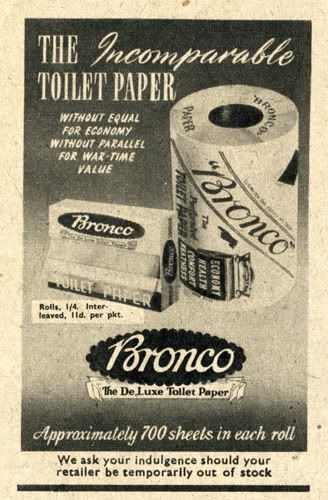
There's a clear hint of the daily, small-scale conflicts that poor, hard-pressed shop staff had to face from frustrated and enraged shoppers. But, I ask you, could you tolerate this?:
At the bottom of this advertisement it says: "We ask your indulgence should your retailer be temporarily out of stock." My memories of Bronco are of the waxy, stiff and resolutely non-absorbent toilet paper that no-one would buy or use out of choice. To have only Bronco toilet paper available is torture enough. To have no toilet paper at all is beyond comprehension!
As my grandmother (and probably yours too) always said - we don't know we're born!
Meet the lovely Connie, captured some time in the 1910s (quite possibly during the First World War), with her tumbling tresses, huge bows and pretty pale silk dress with pearl beading.
Hollywood buffs might be reminded of "America's Sweetheart" Mary Pickford, at that time the most famous woman in the world.
And Connie was transformed! She's bobbed her hair, and wears a simple day dress with a Peter Pan collar.
Not only that, but her inscribed greeting on the photographs has changed from the rather formal and restrained 'with love Connie' to the brash and informal 'tons of love Con.' Its not just her hair that has changed!
After I uploaded these two pictures on Flickr I got some interesting responses, including one from anniebee drawing parallels with F.Scott Fitzgerald's 1920 short story Bernice Bobs Her Hair (there's a link to the full text of the story on that page too).
And magpie-moon claimed to prefer the pre-bob Connie, which led me to wonder about the modern appeal of these two different aspects of femininity. Both play on the 'girlish' - the older style a flowery, frilly and wistful look of an adolescent who can't wait to grow up, put her hair 'up' and become a proper lady; the 'newer' style, although it looks more modern to our eyes, actually references the kind of haircut and dress that pre-pubertal girls wore at that time, and suggests a wish never to grow up!
As a rough indication of the relative popularity of these looks, the 1910s Connie photograph has been 'favourited' 23 times and the 1920s Connie has 21 'favourites' - 1910s Connie is ahead by a narrow margin.
I can't let this one pass without the now obligatory British Pathé gem, so here's a young lady getting her hair shingled (a later variant of the bob) in 1924 by the eminent hairdresser Emile Long:
Of course they weren't all much smaller in the old days, but its surprising how often I'll hear that repeated. Madame, above, photographed in 1909, is a particularly good answer to that lazy generalisation.
When I first uploaded this picture on Flickr I had no idea who this woman was, and hadn't a hope of deciphering the pencilled autograph across it. She wears a 1920s knitted swimming costume, which turned out to be a bit of clue.
A Flickr contact, alan.98, succeeded in identifying her as Mercedes Gleitze - a well-known endurance swimmer in the 1920s and 1930s who was the first English woman to swim the English Channel in 1927. This incredible feat, completed in just over 15 hours on a bitterly cold day in October, was, within days, beaten by Dr. Dorothy Cochrane Logan. Unfortunately Dr. Logan's 13 hour crossing was soon revealed as a hoax, which led people to doubt Mercedes' own achievement.
Determined to prove her case, Mercedes insisted she would swim the Channel again. Meanwhile, the prestigious watch company Rolex saw this new attempt - and the guaranteed attendant glare of publicity - as a golden opportunity to promote their recently patented waterproof watch, the Rolex Oyster. Miss Gleitze agreed, and wore the watch hung round her neck with a ribbon for her 'Vindication Swim.'
Unfortunately, her attempt at the crossing failed in waters that were even colder than her previous successful swim and she was pulled from the sea almost unconscious after enduring it for nearly 10½ hours. However, she had proved her stamina and endurance, the Rolex Oyster survived and kept perfect time, and Miss Gleitze supplied a glowing testimonial and was featured in subsequent advertisements for the watch. You can read a much more comprehensive account of this storyhere.
Mercedes Gleitze had the kind of sturdy figure that must have been perfectly suited for this kind of swimming. Although she looks 'big' she was obviously incredibly fit, not to mention incredibly brave and resolute. A thoroughly modern woman in the 1920s, and a name to admire to this day.
I can't help but notice that although she was 'modern' in her pioneering activities, her personal style was actually quite old-fashioned. Her long hair proves that not every woman in the 1920s chopped their hair into a short bob - even though it would have been even more practical for her as a long-distance swimmer. Footage shows that she wore her hair in two plaits which were then coiled round over her ears - Princess Leia style! - which was a popular strategy to avoid actually cutting your hair whilst still approximating the neat, short, fashionable look of a bob.
Miss Gleitze went on to complete marathon swims across the world - including being the first person (not woman, person) to swim across the Straits of Gibraltar in 1928. As if there aren't enough reasons to admire her, she used the money earned from her swims to open the Mercedes Gleitze Home for the Homeless in Leicester in 1933.
The fantastic British Pathé has come up with the goods again! This film supposedly shows Mercedes Gleitze shortly after her failed Channel crossing, although she looks rather too perky to have just been pulled from the waves to me:
A SPLENDID FAILURE
And here she is in action, setting off from Folkestone in 1926 on one of her failed attempts to cross the Channel: