
Showing posts with label British Pathé. Show all posts
Showing posts with label British Pathé. Show all posts
Wednesday, 4 August 2010


Saturday, 17 April 2010
That Tinling feeling

Advertisement for Teddy Tinling's salon from Vogue, 14th April 1937, page 120. From the Gallery of Costume, Manchester.
What a singular character Teddy Tinling was! The opening line of the Wikipedia entry I just linked to does a great job of indicating as much, in its customary dry and succinct manner: "[Teddy Tinling] was an English tennis player, fashion designer, spy and author." As a career resumé, that one is pretty hard to beat. Plus he was "openly gay" in the days when that was hardly a safe option.
These days people might recall the frilly knickers he created for the American tennis player Gertrude 'Gorgeous Gussie' Moran in 1949, and the kerfuffle those provocative undergarments caused in the media.
Tinling made his name creating expertly tailored and glamorous tennis wear for many of the star players of his day, but his career in the rag trade began much earlier in 1931 when he opened a salon in South Kensington, London, specialising in wedding and evening gowns for the "carriage trade." This was evidently successful because by 1937, when his nicely surreal advertisement (above) appeared in Vogue, he was plying his trade in the much posher environs of Mayfair.
The Second World War interrupted his fashion career and prompted his drastic career switch to spying for the British Intelligence Corps. I'm sure there's lots of interesting material about his wartime adventures, but sadly they don't appear to be online so I shall press on regardless.
Shortages of luxury fabrics after the war saw the ever-pragmatic Tinling turning to the growing market of sportswear . . . actually this is all very well documented in the links I've added so I'm going to cut straight to my point and spare you the painful paraphrasing.
Teddy's tennis wear suggests a fondness for flamboyance, which is certainly borne out in the British Pathé film archive. The swelle life blog has a fabulous post about one of those films so I won't repeat it here (please visit that link to enjoy it, and don't miss this post about his tennis gear too).
Here's more evidence. He embraced rock'n'roll with some delightful garments for teenage fans:
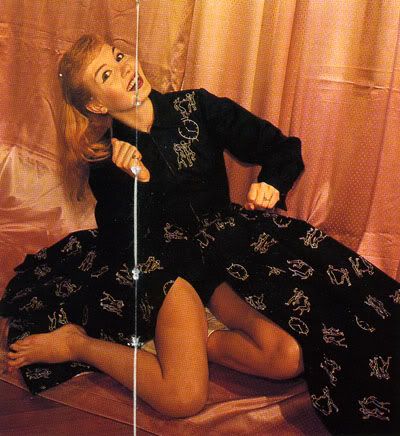
"Clothes specially designed for Rock'n'Roll enthusiasts by Teddy Tinling, 1957." From Frances Kennett (1983) The Collector's Book of Twentieth Century Fashion, London: Book Club Associates, pp. 88-89. (Apologies for the book binding cutting through the picture - I'm not skilled, or indeed patient, enough to erase that).
I'm really enjoying that print of clocks and jiving couples (no doubt a reference to Bill Haley's "Rock Around the Clock")
The elfin model Elizabeth Duke can also be seen modelling some "Jive Fashions" possibly from the same collection (Tinling trousers with a heart-shaped pocket printed with the immortal British rocker Tommy Steele) right here.
Its clear that Teddy Tinling's gift for tailoring glamorous but practical tennis wear was readily transferable to the demands of energetically jiving rock'n'rollers. Sadly there appears to be no film footage of his teen-rock'n'roll clothing available.
But there's plenty more camp fashion delights to be found, especially at my favourite resort for vintage footage, British Pathé. And this is one of the best, a 1958 film of Tinling's leisure fashions inspired by souvenirs from his holidays:
TEDDY TINLING HOLIDAY FASHIONS
And this short film from 1955 features both his tennis and leisure wear:
BEACH AND TENNIS WEAR
And I'm going to have to include Tinling's spectacular South Pacific fashion show, as featured in the swelle life blog, just so you don't miss it:
TEDDY TINLING FASHIONS
Teddy Tinling's exuberant style has quite won me over. I only wish that there was more information available about his fashion adventures, rather than just his tennis wear (as admirable as it was). If anyone can offer any further information about this I would be overjoyed. All I can say is that I've never come across a single garment with his label on it, and live in hope that I might - someday.
Thursday, 25 February 2010
Constructing the Teddy Boy
One of the most conspicuous aspects of the British Teddy Boy was his hair; that towering quiff carefully and regularly primped with a comb - perhaps a flick knife comb for extra posing points! - and secured with copious fistfuls of pomade.
At least since the nineteenth century, men's hair was simply cut short and combed flat, sometimes slicked with the macassar oil that gave Victorian and Edwardian housewives such headaches worrying about their stained upholstery they were forced to invent the antimacassar. The only possible variations seemed to be in the parting of the hair, and tonsorial exuberance was confined to the moustache.
Given all those long decades of modesty and simplicity in men's hair, it must have been quite a shock in the early 1950s to see young men constructing glossy (and greasy) edifices of hair and quite shamelessly preening in what was seen as an effeminate manner. There can't have been many young men who went quite to this, er, length though:
This 1956 film was shot at Cyril Parker's hairdressers shop in Tottenham Court Road, London. The hair 'sausage' or 'elephant trunk' seems very similar to the postiches used by Victorian and Edwardian women to pad out their hairdos - think of those voluminous bouffant styles as sported by the "Gibson Girls" which often needed substantial postiches to achieve.
There's very little footage of Teddy Boys in the British Pathé archive, although interestingly the two clips I've found focus on their hair. So here's the second film, shot at a hairdressing show in Belle Vue, Manchester, in 1955.
There's some bizarre ladies' hairdos, and a varied selection of men's haircuts including the 'Petronius' (Roman style), the 'Curled Semi-Crew Cut,' the 'Brush Cut' and the 'Tony Curtis.' You can catch a brief glimpse of Lew Starr (finessing the Brush Cut), who was the Teddy Boy hairdresser in Manchester, and - I'm told by one who remembers - always had intimidating queues of scowling, smoking ruffians outside his salon in Charles Street:
And we all know what 'D.A.' really stands for, don't we?!
At least since the nineteenth century, men's hair was simply cut short and combed flat, sometimes slicked with the macassar oil that gave Victorian and Edwardian housewives such headaches worrying about their stained upholstery they were forced to invent the antimacassar. The only possible variations seemed to be in the parting of the hair, and tonsorial exuberance was confined to the moustache.
Given all those long decades of modesty and simplicity in men's hair, it must have been quite a shock in the early 1950s to see young men constructing glossy (and greasy) edifices of hair and quite shamelessly preening in what was seen as an effeminate manner. There can't have been many young men who went quite to this, er, length though:
MEN'S HAIR STYLES
This 1956 film was shot at Cyril Parker's hairdressers shop in Tottenham Court Road, London. The hair 'sausage' or 'elephant trunk' seems very similar to the postiches used by Victorian and Edwardian women to pad out their hairdos - think of those voluminous bouffant styles as sported by the "Gibson Girls" which often needed substantial postiches to achieve.
There's very little footage of Teddy Boys in the British Pathé archive, although interestingly the two clips I've found focus on their hair. So here's the second film, shot at a hairdressing show in Belle Vue, Manchester, in 1955.
There's some bizarre ladies' hairdos, and a varied selection of men's haircuts including the 'Petronius' (Roman style), the 'Curled Semi-Crew Cut,' the 'Brush Cut' and the 'Tony Curtis.' You can catch a brief glimpse of Lew Starr (finessing the Brush Cut), who was the Teddy Boy hairdresser in Manchester, and - I'm told by one who remembers - always had intimidating queues of scowling, smoking ruffians outside his salon in Charles Street:
PAGEANT OF HAIR STYLES
And we all know what 'D.A.' really stands for, don't we?!
Sunday, 7 February 2010
Santos Casani - the forgotten dance master
If you've ever seen one of those archive film montages of the 'roaring twenties' in a TV documentary, there's one clip that always features. Its the one featuring a couple dancing the Charleston on top of a taxi cab driving through a London street.
That clip is at the very end of this British Pathé dance instruction film (incidentally, fashion history buffs will be delighted by Miss Jose Lennard's lower back skirt hem - a major trend in the last years of the 1920s):
The stunt was intended to demonstrate that the new 'flat' Charleston required very little space, in contrast to its original, wild form, which was a veritable whirlwind of flying heels and arms, presenting considerable danger to nearby dancers. Indeed the Charleston was banned from many dancehalls at the time.
It is ironic that this clip is now employed to symbolise the reckless, risk-taking, devil-may-care nature of the times when its original intention was actually quite the opposite.
While I could easily (and quite happily) go on about the Charleston, this post concerns the man who appeared in that film, the famous dance master - and energetic self-publicist - Santos Casani.
Mr Casani was the proprietor of "the largest school of dancing in England," wrote a column for the Daily Mail, and made numerous short dance instruction films for British Pathé's cinemagazine for women, Eve's Film Review. The film company supplied free instruction leaflets based on the dance steps Casani featured, which viewers could send off for, and as a demonstration of how popular these films were, on one occasion they had to print 20,000 leaflets to satisfy the demand (most of this information is derived from Jenny Hammerton's fascinating book For Ladies Only? Eve's Film Review Pathé Cinemagazine 1921-1933).
As an aside, its lovely to imagine a cinema audience practising dance steps under their seats as they watch the films!
Here Casani makes an appearance in Popular Music and Dancing Weekly magazine, demonstrating the first three steps of the 'Five-Step' - steps four and five were published the following week, but unfortunately I don't have a copy of that issue (again, fashion buffs please note how remarkably long Miss Lennard's skirt was in 1924!):
 "How to dance the Five-Step by Santos Casani" in Popular Music and Dancing Weekly, 7th June 1924, page 133 (click picture for a larger view).
In 1933 Casani opened his own nightclub in Imperial House, Regent Street, London and British Pathé was there to record it.
If you were to try to imagine a high-tone 1930s nightclub in the West End of London his establishment lives up to your Art Deco dreams, and this film includes footage of the renowned house band lead by pianist Charlie Kunz, a swimsuit fashion parade, an elegant rendering of the waltz by Mr Casani himself, not to mention a novelty song and a curious female contortionist. Pour yourself into a backless satin dress, shake up a cocktail and join in the fun:
Unlike his near contemporary Victor Silvester, Santos Casani failed to secure himself a place in dance posterity and his name is probably unknown to most people nowadays. But he was clearly a significant figure in his time - a suave, elegant man who knew how to work the media for maximum attention. In his prime, he was Mr Dance, and I'd like to salute his memory.
If you would like to see more of Santos Casani in action, there's plenty more films for you to enjoy.
That clip is at the very end of this British Pathé dance instruction film (incidentally, fashion history buffs will be delighted by Miss Jose Lennard's lower back skirt hem - a major trend in the last years of the 1920s):
THE FLAT CHARLESTON MADE EASY
The stunt was intended to demonstrate that the new 'flat' Charleston required very little space, in contrast to its original, wild form, which was a veritable whirlwind of flying heels and arms, presenting considerable danger to nearby dancers. Indeed the Charleston was banned from many dancehalls at the time.
It is ironic that this clip is now employed to symbolise the reckless, risk-taking, devil-may-care nature of the times when its original intention was actually quite the opposite.
While I could easily (and quite happily) go on about the Charleston, this post concerns the man who appeared in that film, the famous dance master - and energetic self-publicist - Santos Casani.
Mr Casani was the proprietor of "the largest school of dancing in England," wrote a column for the Daily Mail, and made numerous short dance instruction films for British Pathé's cinemagazine for women, Eve's Film Review. The film company supplied free instruction leaflets based on the dance steps Casani featured, which viewers could send off for, and as a demonstration of how popular these films were, on one occasion they had to print 20,000 leaflets to satisfy the demand (most of this information is derived from Jenny Hammerton's fascinating book For Ladies Only? Eve's Film Review Pathé Cinemagazine 1921-1933).
As an aside, its lovely to imagine a cinema audience practising dance steps under their seats as they watch the films!
Here Casani makes an appearance in Popular Music and Dancing Weekly magazine, demonstrating the first three steps of the 'Five-Step' - steps four and five were published the following week, but unfortunately I don't have a copy of that issue (again, fashion buffs please note how remarkably long Miss Lennard's skirt was in 1924!):
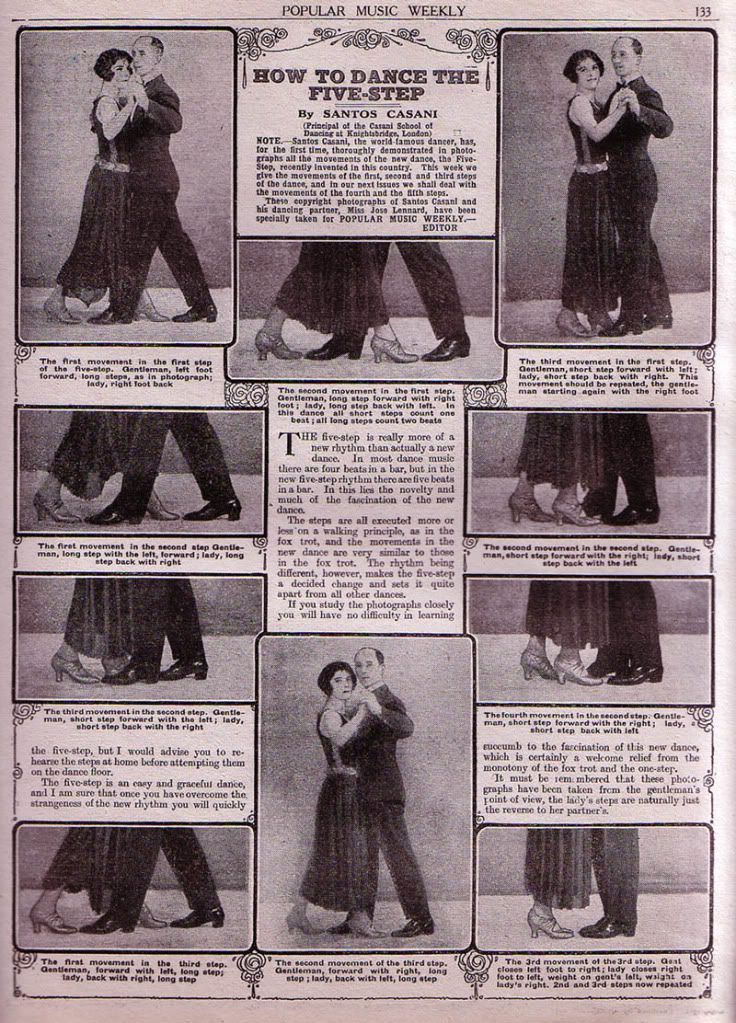 "How to dance the Five-Step by Santos Casani" in Popular Music and Dancing Weekly, 7th June 1924, page 133 (click picture for a larger view).
 In 1933 Casani opened his own nightclub in Imperial House, Regent Street, London and British Pathé was there to record it.
If you were to try to imagine a high-tone 1930s nightclub in the West End of London his establishment lives up to your Art Deco dreams, and this film includes footage of the renowned house band lead by pianist Charlie Kunz, a swimsuit fashion parade, an elegant rendering of the waltz by Mr Casani himself, not to mention a novelty song and a curious female contortionist. Pour yourself into a backless satin dress, shake up a cocktail and join in the fun:
LONDON'S FAMOUS CLUBS AND CABARETS NO. 10 - CASANI'S CLUB
Unlike his near contemporary Victor Silvester, Santos Casani failed to secure himself a place in dance posterity and his name is probably unknown to most people nowadays. But he was clearly a significant figure in his time - a suave, elegant man who knew how to work the media for maximum attention. In his prime, he was Mr Dance, and I'd like to salute his memory.
If you would like to see more of Santos Casani in action, there's plenty more films for you to enjoy.
Thursday, 4 February 2010
Fashion rations
Even during the dark years of the Second World War, and the long years of clothing rationing that followed it, women were expected to keep up appearances. "England's number one glamour girl" Joan Richards, a professional model, doesn't disappoint in this 1944 film where we follow Joan through a "routine day's work." From getting up in the morning with full slap (apologies to US readers - slap = makeup) and immaculate hair, through her long and busy day, she is the epitome of 1940s chic. By the way, these film links have come up as black boxes, but they will work if you click on them.
However, not every woman met the grade. This amusing short from September 1946 features the "Pathé Pictorial Fashion Expert" Mr Richard Buzzvine (at least, that what his name sounds like) lurking self-consciously with a newspaper on Regent Street as he casts a waspishly critical eye over young women's outfits. Although his voice isn't heard, the narrator reports his merciless judgements.
Mr Buzzvine is very hard to please, and only one girl meets with his approval, although its hard to see how she is much different from the other 'failures.' Its a useful reminder of how fraught getting dressed used to be, with all kinds of complicated rules and conventions governing what was - and was not - appropriate wear.
ANNE EDWARDS (aka GLAMOUR GIRL)
However, not every woman met the grade. This amusing short from September 1946 features the "Pathé Pictorial Fashion Expert" Mr Richard Buzzvine (at least, that what his name sounds like) lurking self-consciously with a newspaper on Regent Street as he casts a waspishly critical eye over young women's outfits. Although his voice isn't heard, the narrator reports his merciless judgements.
Mr Buzzvine is very hard to please, and only one girl meets with his approval, although its hard to see how she is much different from the other 'failures.' Its a useful reminder of how fraught getting dressed used to be, with all kinds of complicated rules and conventions governing what was - and was not - appropriate wear.
RIGHT AND WRONG IN FASHION
Sunday, 24 January 2010
Endorsed by Madame Schiaparelli
The fashion designer Elsa Schiaparelli presents an interesting contrast to Gabrielle 'Coco' Chanel - they were reportedly bitter rivals during the 1930s when Schiaparelli was in her prime.
Chanel, a determined social climber, was desperate to shake off the stigma of her poverty-stricken origins, whereas Schiaparelli was born into privilege as the daughter of aristocratic parents.
Chanel introduced a luxurious simplicity and practicality into high fashion, and was skilled with a needle, having trained and worked as a seamstress in her early years, whereas Schiaparelli had no formal fashion or dressmaking training but was gifted with a talent for adventurous innovation, stimulated and enhanced by her close personal association and collaboration with some of the leading avant-garde artists of her day.
There's plenty of information online (and in good, old-fashioned books!) about the careers of both designers, so there's no need to repeat it here. What interests me right now is some print evidence of Schiaparelli's commercial collaborations with two manufacturers, which perhaps present another interesting contrast with Chanel. I would have to do much more detailed research to discover if Schiap (her nickname - pronounced 'Skap') was unusual in this respect - its too late to venture to the library right now, and I'm keen to post this sooner rather than later so please forgive the lack of comparative evidence from other designers.
This 1936 advertisement for Lightning Coloured Plastic Zipp Fasteners below (manufactured by Imperial Chemical Industries - the still mighty ICI) proudly displays a brown wool dress designed by Schiaparelli with a very prominent zip running down the centre front. Dilys E. Blum, in her book Shocking: The Art and Fashion of Elsa Schiaparelli, notes that Harry Houghton, of the Canadian division of the Lightning Fastener Company had offered Schiaparelli £10,000 to use their recently developed coloured plastic zips in her clothing in 1933.
She obviously needed no further encouragement. According to most sources, Schiaparelli was the first Parisian couturier to utilise zip fasteners - indeed, to make a prominent design feature of them rather than hide them away as most functional clothing fasteners were by convention. (Apart from buttons, of course, which have been a handy way to display wealth and taste for some time).
Anyway, back to the advertisement. This conspicuous zip adds a considerable sexual charge to what is ostensibly a rather modest garment. Remember, zips are very easy and quick to open, and this dress flaunts its ability to be opened from top to bottom in seconds flat.
The juxtoposition of the model with a classical Greek-looking nude sculpture serves to underline this subliminal message, while at the same time adding a shrewdly judged gloss of 'culture' and prestige. This ad, although it doesn't look like it at first glance, was a pretty challenging and provocative proposition for the mid 1930s:
 Lightning Zipp advertisement from (British) Vogue, 14th October 1936, page 19.
In her autobiography, which alternates disconcertingly between the first and third person, Schiap makes no mention of her lucrative promotional deal with Lightning Zipps but does describe the impact her use of zips made when first presented in a collection of hers. This was actually the August launch of her Winter 1935-36 collection, although this is not stated in the text:
Perhaps it was this difficulty that led Schiap, as the V&A explains, to use different zip companies depending on where her garments were to be sold: "In London she used zips from the Lightening Fastener Company of Great Britain, in Paris she used zips made by Éclair and for export to the USA, Hookless Fastener Company zips produced in the USA."
By the following year, the Lightning Zipp campaign featured more conventional illustrations of Schiaparelli's designs in a fashion show setting:
 Lightning Zipp advertisement from (British) Vogue, 14th April 1937, p.65.
The copy reads:
As early as 1929, Schiaparelli had licensed her designs for reproduction by ready-to-wear companies and paper pattern manufacturers in America. Her fascination with textiles, and especially new developments in synthetic fibres, led her to collaborate with a number of manufacturers including Bianchini, Colcombet and Ducharne. She could see interesting textural potential even in test fabrics dismissed as 'mistakes' by their producers and was responsible for popularising a number of innovative new materials, including rayon crêpes.
During the early 1930s she endorsed a number of American-produced fabrics, not to mention hosiery and shoes, seeing these collaborations as a valuable way to develop and enhance her profile in that vast and lucrative market. But she also had strong connections with Great Britain - she regarded the country as her second home - and loved British textiles such as Scottish tweeds.
In November 1936, the British textile manufacturer William Hollins & Co. launched its new range of thirty-six 'Schiaparelli Viyella Fashion Fabrics' made of a blend of cotton and wool. She was credited with making this rather prosaic and workaday fabric fashionable, and in this following sequence of advertisements it is clear that she had some fun with this commission:
 Viyella/Schiaparelli advertisement from (British) Vogue, 22nd April 1937, pp.58-59.
In this ad from April 1937, the layout makes a playful reference to pageantry, with heraldic motifs such as the shield, the crown and the ribbon. And the copy makes this explicit:
Incidentally, a pasted-over addendum reluctantly adds the news of a price increase for these fabrics, from 4/11 to 5/11 per yard (in today's money, from £11.82 to £14.22, thanks Measuring Worth!)
The mannequin's curiously pointed knit hat makes her look like a chess piece, which is a happy coincidence when we consider the next advertisement, from November 1937:
 Viyella/Schiaparelli advertisement in (British) Vogue, 10th November 1937, pp.18-19.
In this case, the theme isn't exactly chess, but Alice in Wonderland:
The next ad, from September 1938, startled me because it looks as if it dates from nearly twenty years later:
 Viyella/Schiaparelli advertisement in (British) Vogue, 7th September 1938, p.9.
I'd love to know if these fabrics were indeed "Unshrinkable. Fadeless" as the copy proudly declares. Are there any Schiaparelli collectors out there with examples of her late 30s sportswear who can verify this claim?
This last ad, from November 1938, looks more of its time, featuring a three-quarter length swagger coat and a wonderful 'up' hairdo of a kind that would remain in favour throughout the 1940s:
 Viyella/Schiaparelli advertisement in (British) Vogue, 2nd November 1938, p.20.
Plus it has scotty dogs, which is always a good thing in my book.
Schiaparelli was obviously a very shrewd businesswoman, as well as an inspired designer, who had no snobbishly bourgeois scruples about entering into business deals with those who might be considered a little too populist - a little too 'mass market' - for an elite Parisian couturier to associate his or her name with.
As I've stated earlier, I really do have no idea to what extent other contemporary couturiers - such as Chanel - dipped their toes into that mass market (and I'm aware of her perfumes - this is a different degree of diffusion), but I will explain that I gathered these advertisements while scouring through the Gallery of Costume's bound collection of British Vogues. I noticed that no other couturier featured in ads of this kind during the 1930s. Perhaps if I had leafed through the American Vogues, I might have discovered a different story . . .
The two couture giants faced very different fates after the Second World War. Schiaparelli found herself out of step with fashion and finally closed her business in 1954 - the same year that Chanel emerged from her exile in Switzerland to relaunch her salon to widespread international acclaim (I understand that it wasn't the French who were cheering - they remembered her cosy intimacy with the Nazis too well).
As a result Chanel secured her place among the fashion immortals and her house endures, its status revived and maintained by Karl Lagerfeld. Schiap is hardly forgotten, but she gradually recedes back in time as a respected and revered figure too closely associated with her prime years in the 1930s to be considered relevant today.
And to finish, a charming short promotional film for cotton knitting yarns from the mid 1930s, which might not seem to have anything to do with Schiaparelli. You'll just have to watch it to the very end to understand why it is here:
Additional notes
Information was gathered from two books which I would recommend as essential if you have any interest in Schiaparelli -
Elsa Schiaparelli (recently republished by the V&A) Shocking Life: The Autobiography of Elsa Schiaparelli.
Dilys E. Blum, Shocking: The Art and Fashion of Elsa Schiaparelli.
Chanel, a determined social climber, was desperate to shake off the stigma of her poverty-stricken origins, whereas Schiaparelli was born into privilege as the daughter of aristocratic parents.
Chanel introduced a luxurious simplicity and practicality into high fashion, and was skilled with a needle, having trained and worked as a seamstress in her early years, whereas Schiaparelli had no formal fashion or dressmaking training but was gifted with a talent for adventurous innovation, stimulated and enhanced by her close personal association and collaboration with some of the leading avant-garde artists of her day.
There's plenty of information online (and in good, old-fashioned books!) about the careers of both designers, so there's no need to repeat it here. What interests me right now is some print evidence of Schiaparelli's commercial collaborations with two manufacturers, which perhaps present another interesting contrast with Chanel. I would have to do much more detailed research to discover if Schiap (her nickname - pronounced 'Skap') was unusual in this respect - its too late to venture to the library right now, and I'm keen to post this sooner rather than later so please forgive the lack of comparative evidence from other designers.
This 1936 advertisement for Lightning Coloured Plastic Zipp Fasteners below (manufactured by Imperial Chemical Industries - the still mighty ICI) proudly displays a brown wool dress designed by Schiaparelli with a very prominent zip running down the centre front. Dilys E. Blum, in her book Shocking: The Art and Fashion of Elsa Schiaparelli, notes that Harry Houghton, of the Canadian division of the Lightning Fastener Company had offered Schiaparelli £10,000 to use their recently developed coloured plastic zips in her clothing in 1933.
She obviously needed no further encouragement. According to most sources, Schiaparelli was the first Parisian couturier to utilise zip fasteners - indeed, to make a prominent design feature of them rather than hide them away as most functional clothing fasteners were by convention. (Apart from buttons, of course, which have been a handy way to display wealth and taste for some time).
Anyway, back to the advertisement. This conspicuous zip adds a considerable sexual charge to what is ostensibly a rather modest garment. Remember, zips are very easy and quick to open, and this dress flaunts its ability to be opened from top to bottom in seconds flat.
The juxtoposition of the model with a classical Greek-looking nude sculpture serves to underline this subliminal message, while at the same time adding a shrewdly judged gloss of 'culture' and prestige. This ad, although it doesn't look like it at first glance, was a pretty challenging and provocative proposition for the mid 1930s:
 Lightning Zipp advertisement from (British) Vogue, 14th October 1936, page 19.
 In her autobiography, which alternates disconcertingly between the first and third person, Schiap makes no mention of her lucrative promotional deal with Lightning Zipps but does describe the impact her use of zips made when first presented in a collection of hers. This was actually the August launch of her Winter 1935-36 collection, although this is not stated in the text:
. . . what upset the poor, breathless reporters most were the zips. Not only did they appear for the first time but in the most unexpected places, even on evening clothes. The whole collection was full of them. Astounded buyers bought and bought. They had come prepared for every kind of strange button. Indeed these had been the signature of the house. But they were not prepared for zips. They grasped the significance of the new trend even more than Schiap, and they bought and bought . . .She must have been delighted with the overflowing order books, but then found herself facing an unanticipated problem:
On delivery day, however, our telephone started to ring viciously, and the desperate voices of all the commissionaires were raised to a pitch of indignation.Blum records that on July 18th 1936, "The U.S. duty on imported zippers increase[d] from 45 per cent to 66 per cent, threatening to delay the export of Schiaparelli's collection."
"The dresses cannot be shipped."
For some peculiar reason, still unknown to me, there was some agreement or contract between France and America whereby zippers could not be imported. Cables and radio-telephone calls were exchanged across the Atlantic and the zipper controversy reached the size of a political issue. After a few days of hair-tearing and supreme exhaustion, the zipper dresses were at last allowed into America, and ever since, like Columbus, they have remained unchallenged.
Perhaps it was this difficulty that led Schiap, as the V&A explains, to use different zip companies depending on where her garments were to be sold: "In London she used zips from the Lightening Fastener Company of Great Britain, in Paris she used zips made by Éclair and for export to the USA, Hookless Fastener Company zips produced in the USA."
By the following year, the Lightning Zipp campaign featured more conventional illustrations of Schiaparelli's designs in a fashion show setting:
 Lightning Zipp advertisement from (British) Vogue, 14th April 1937, p.65.
The copy reads:
Zipps on day suits, on evening gowns, on cocktail trouser suits. Zipps at front, side or back, in every colour of the rainbow, matching, contrasting . . . always decorative, always practical. Schiaparelli has made plastic zipps a feature of her recent collections, and continues - as do other leading couturiers - to use them for fashion fastening.By August 1937, a subsequent Lightning Zipp ad makes no mention of Schiaparelli so perhaps that deal had run its course. However, Schiap had plenty of other irons in the fire.
As early as 1929, Schiaparelli had licensed her designs for reproduction by ready-to-wear companies and paper pattern manufacturers in America. Her fascination with textiles, and especially new developments in synthetic fibres, led her to collaborate with a number of manufacturers including Bianchini, Colcombet and Ducharne. She could see interesting textural potential even in test fabrics dismissed as 'mistakes' by their producers and was responsible for popularising a number of innovative new materials, including rayon crêpes.
During the early 1930s she endorsed a number of American-produced fabrics, not to mention hosiery and shoes, seeing these collaborations as a valuable way to develop and enhance her profile in that vast and lucrative market. But she also had strong connections with Great Britain - she regarded the country as her second home - and loved British textiles such as Scottish tweeds.
In November 1936, the British textile manufacturer William Hollins & Co. launched its new range of thirty-six 'Schiaparelli Viyella Fashion Fabrics' made of a blend of cotton and wool. She was credited with making this rather prosaic and workaday fabric fashionable, and in this following sequence of advertisements it is clear that she had some fun with this commission:
 Viyella/Schiaparelli advertisement from (British) Vogue, 22nd April 1937, pp.58-59.
In this ad from April 1937, the layout makes a playful reference to pageantry, with heraldic motifs such as the shield, the crown and the ribbon. And the copy makes this explicit:
Schiaparelli herself has styled the new 'Viyella' Fashion Fabrics for this smartest, most colourful, most romantic of seasons. Bright challenging colours and subtle elusive shades. Novelty weaves. Checks, spots, stripes, and designs of entirely new character. A special heavier weight 'Viyella' for tailored suits and dresses.This was a coronation year (not Edward, ahem - he preferred a gilded and comfortable exile with his American divorcée - but his quiet brother George) so that explains all the pageantry.
A pageant of fabrics for a season of pageantry.
The Schiaparelli model photographed opposite is one of many 'Viyella' models in her latest collection, and she is featuring the new 'Viyella' Fashion Fabrics in her Paris Sportshop. These very same fabrics are now in all the shops for you to choose from . . . for that extra frock, that extra suit for this exciting season.
Incidentally, a pasted-over addendum reluctantly adds the news of a price increase for these fabrics, from 4/11 to 5/11 per yard (in today's money, from £11.82 to £14.22, thanks Measuring Worth!)
The mannequin's curiously pointed knit hat makes her look like a chess piece, which is a happy coincidence when we consider the next advertisement, from November 1937:
 Viyella/Schiaparelli advertisement in (British) Vogue, 10th November 1937, pp.18-19.
In this case, the theme isn't exactly chess, but Alice in Wonderland:
When I said "Check!" you purred!" said Alice (Through the Looking-glass) to her kitten - and when you see the new Schiaparelli-designed 'Viyellas' you'll react much like the kitten. Here are checks indeed! Unexpected, out-of-the-ordinary checks, the kind that make glorious little tops of two-pieces, spruce tailored frocks, swagger 'cow-boy' shirts, and so on. Crowds of other patterns too, embroidered spots and tricky little stripes - all in original, becoming fashionable colour schemes. The lovely blending plains are also important - Schiaparelli has used two of them for her superbly moulded jacket-blouse and skirt photographed here - Bright Rust (No. 8358) over Good Earth Brown (No. 6843). Both 'Viyella' Thirty-Sixes. Both in the shops now!I have a fondness for old-fashioned advertising spiel, so forgive me for drafting all this text. Its wonderful!
The next ad, from September 1938, startled me because it looks as if it dates from nearly twenty years later:
 Viyella/Schiaparelli advertisement in (British) Vogue, 7th September 1938, p.9.
I'd love to know if these fabrics were indeed "Unshrinkable. Fadeless" as the copy proudly declares. Are there any Schiaparelli collectors out there with examples of her late 30s sportswear who can verify this claim?
This last ad, from November 1938, looks more of its time, featuring a three-quarter length swagger coat and a wonderful 'up' hairdo of a kind that would remain in favour throughout the 1940s:
 Viyella/Schiaparelli advertisement in (British) Vogue, 2nd November 1938, p.20.
Plus it has scotty dogs, which is always a good thing in my book.
Schiaparelli was obviously a very shrewd businesswoman, as well as an inspired designer, who had no snobbishly bourgeois scruples about entering into business deals with those who might be considered a little too populist - a little too 'mass market' - for an elite Parisian couturier to associate his or her name with.
As I've stated earlier, I really do have no idea to what extent other contemporary couturiers - such as Chanel - dipped their toes into that mass market (and I'm aware of her perfumes - this is a different degree of diffusion), but I will explain that I gathered these advertisements while scouring through the Gallery of Costume's bound collection of British Vogues. I noticed that no other couturier featured in ads of this kind during the 1930s. Perhaps if I had leafed through the American Vogues, I might have discovered a different story . . .
The two couture giants faced very different fates after the Second World War. Schiaparelli found herself out of step with fashion and finally closed her business in 1954 - the same year that Chanel emerged from her exile in Switzerland to relaunch her salon to widespread international acclaim (I understand that it wasn't the French who were cheering - they remembered her cosy intimacy with the Nazis too well).
As a result Chanel secured her place among the fashion immortals and her house endures, its status revived and maintained by Karl Lagerfeld. Schiap is hardly forgotten, but she gradually recedes back in time as a respected and revered figure too closely associated with her prime years in the 1930s to be considered relevant today.
And to finish, a charming short promotional film for cotton knitting yarns from the mid 1930s, which might not seem to have anything to do with Schiaparelli. You'll just have to watch it to the very end to understand why it is here:
PARIS MODES - (AKA COATS COTTON FILM)
Additional notes
Information was gathered from two books which I would recommend as essential if you have any interest in Schiaparelli -
Elsa Schiaparelli (recently republished by the V&A) Shocking Life: The Autobiography of Elsa Schiaparelli.
Dilys E. Blum, Shocking: The Art and Fashion of Elsa Schiaparelli.
Sunday, 17 January 2010
The elusive fashion designer caught on film
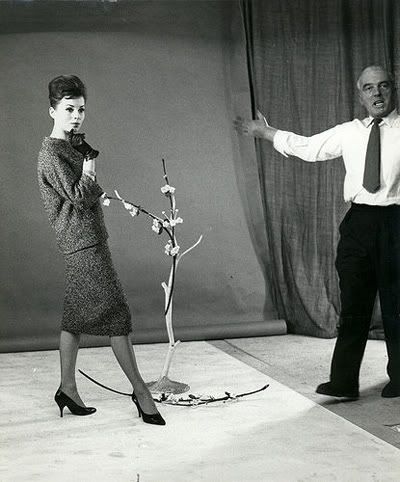
What is going on here? Its impossible to know for sure, but I like to speculate that its the fashion designer emerging from the shadows to express his robust opinion about the photoshoot (and perhaps the merits or otherwise of the photographer), just as the shutter clicks.
Although this is a generalisation, for the most part fashion designers weren't always the recognisable public figures they are today. Most people - even those with little interest in fashion - will be able to summon up a mental image of designers such as Karl Lagerfeld, Donatella Versace, John Galliano and Vivienne Westwood, partly because each has a very distinctive style and self-presentation that is instantly recognisable. But also because there is simply much more media out there now, and designers are expected to take part in the publicity machine in a way that just wasn't the case in previous decades.
However, the famous Parisian couturier Paul Poiret was decades ahead of his time, being a hugely accomplished self-publicist. His lavishly decadent costume parties were widely covered in the press, and his larger-than-life persona informed, and fed back into, the perception of his couture house. Poiret was about ostentation, exoticism, a romantic and picturesque kind of modernity and a challenge to conventions (let's not forget that he was credited with freeing women from the corset, which might or might not be true, but anyway).
This precious short film supposedly shows Poiret arriving from Paris at Hounslow airport with two of his mannequins (models), probably another stunt to attract the press since this would have been an appealing novelty item. In fact, it is Poiret himself who runs to greet the plane (look closely at that first figure to appear as it taxis to a halt), and help his models out of it, so perhaps he had arrived earlier:
PARIS FASHIONS BY AIR
There's no date given for this film, so I'm guessing early 1920s, by which time his house was already in terminal decline and, sadly, would close in 1929.
Leaping forward at least a decade, this delightful film from 1938 features the Greek-born Parisian couturier Jean Dessès, who had opened his couture house only the year before. We are invited into his busy workroom, and the salon where a fashion show is being presented. M. Dessès is shown creating a gown on a live model, and there's a painful pun by the perky narrator ("gauze and effect"!):
FASHION COMES TO PARIS!
Jean Dessès is little known these days, and the name Olive O'Neill will probably mean even less to most people. She was, in fact, a very important figure in the development of ready-to-wear clothing in Britain.
Born in Southport, she came to work for the fledgling brand Dorville in London in the 1920s, where she began designing classic and elegant clothes to supplement their primary knitwear line. Having set up her own factory, she studied and adopted American methods of manufacture, grading and sizing, and visited America every year to keep up with new developments. O'Neill was an innovator in textiles too, co-operating with fabric manufacturers to produce exclusive materials and designs. (This information was gathered from Elizabeth Ewing's History of 20th Century Fashion).
This great short film shows the creation of a new dress, from Olive O'Neill's rapid sketch to the final product. Although far less glamorous than the previous film - it was shot in the last months of the Second World War, mind you - it is a fascinating glimpse of a forgotten designer:
INEXPENSIVE DRESS
Returning to glamour and glitz, Christian Dior was perhaps the most famous designer of the 1950s. Find yourself a seat in the Savoy Hotel, London and join the well-heeled guests (including British designer Norman Hartnell) for a very exclusive fashion show from 1950:
DIOR 'CIRCUS' COMES TO TOWN
I'm charmed by M. Dior's expression - he looks captivated, like he's seeing his creations for the first time. Incidentally, that £500 gown would cost you about £12,835 in today's money (thanks to Measuring Worth for that calculation).
Another Paris luminary, and a personal favourite of mine, is Elsa Schiaparelli. This is the only film I could find of her on the British Pathé website. She is seen at a Dublin fashion show in 1953, admiring the Irish fashions on display. Sadly her own business was in trouble at this time, and was closed the following year:
AN TOSTAL FASHIONS PARADE
Last up is this clip from 1958 of a young Yves Saint Laurent presenting his collection for Dior at Blenheim Palace. Princess Margaret presides, and looks completely in her element!:
'DIOR' COMES TO BLENHEIM
Tuesday, 22 December 2009
Are you dancing? Are you asking?
Christmas is the prime party season, and parties often involve dancing. Which gives me another opportunity to plunder the vaults of British Pathé for some vintage treasures on that very theme.
Ballroom dancing is fraught with dangers - where do I put my hands? What frock should I wear? Which foot goes first? - so here's a helpful, unnamed dance instructor to put you right in a very prim short filmed at the Empress Room, Kensington, London in 1938.
Watch out for the swing step that's "hot from Harlem" but, the narrator warns, is "rather too hot for English ballrooms":
The "English style" mentioned was developed by English dance teachers' organisations to regulate and tame the wild new dances coming from the United States, and was explicitly intended to eliminate any aberrant moves such as kicks or swinging hips, or indeed anything that smacked of self-expression, sexuality or spontaneity.
In the crowded conditions of most English dancehalls at this time, it could be argued that some control was needed to preserve the smooth rotation of dancing couples around the floor without things ending up in fisticuffs over collisions and painfully stomped feet. But the efforts of the dance instructors drained nearly all the personality and unique appeal (not to mention the fun) of these dances to the extent that it was difficult to discern one dance from the other.
We need an antidote to all that prim English reserve. And Earl and Josephine Leach, in this 1937 film demonstrating an hilarious version of the Big Apple, are here to supply it. They gleefully break all the rules:
This was precisely the time - the late 1930s - when dance hall managers realised that the sterling efforts of those dance instructors had succeeded in making many patrons scared of taking to the floor in case they committed a dreadful faux pas and showed themselves up. Dancing was in danger of becoming a difficult exercise only to be attempted by trained experts.
As a result, dance hall proprietors (including the dominant Mecca Ballroom chain) actively encouraged the development of easy dances that anyone could do after watching a short demonstration.
Watch this short film, shot at the Streatham Locarno (south London) in 1938, and you too will be able to do the Lambeth Walk with confidence:
Of course, what was around the corner was the all-conquering Jitterbug, which ruled British dance floors during the Second World War, and wasn't actually that easy to do well. But we had a useful influx of US servicemen to teach us how to do it properly.
This fun film - from Youtube rather than British Pathé this time - shows MGM's comic take on the dance craze in 1944:
Make sure you clear away all furniture and breakables before you attempt this at home.
Additional notes
This post neglects the original pioneers of most of these dances, the African-American community, which is sorely under-represented in the British Pathé archive. OK, that's probably understandable since it was a UK based operation. This post shows how their dances were interpreted on this uptight little island. But I can't let this pass without some acknowledgement, so here goes.
My all-time favourite dance sequence of all time is this clip from the 1941 film Hellzapoppin' featuring Slim and Slam and the Harlem Congaroos (I'm sure its many other people's favourite too, but it doesn't hurt to repeat it) which is approximately five minutes of pure joy. If you've never seen it before, prepare to be amazed:
Ballroom dancing is fraught with dangers - where do I put my hands? What frock should I wear? Which foot goes first? - so here's a helpful, unnamed dance instructor to put you right in a very prim short filmed at the Empress Room, Kensington, London in 1938.
Watch out for the swing step that's "hot from Harlem" but, the narrator warns, is "rather too hot for English ballrooms":
DANCING
The "English style" mentioned was developed by English dance teachers' organisations to regulate and tame the wild new dances coming from the United States, and was explicitly intended to eliminate any aberrant moves such as kicks or swinging hips, or indeed anything that smacked of self-expression, sexuality or spontaneity.
In the crowded conditions of most English dancehalls at this time, it could be argued that some control was needed to preserve the smooth rotation of dancing couples around the floor without things ending up in fisticuffs over collisions and painfully stomped feet. But the efforts of the dance instructors drained nearly all the personality and unique appeal (not to mention the fun) of these dances to the extent that it was difficult to discern one dance from the other.
We need an antidote to all that prim English reserve. And Earl and Josephine Leach, in this 1937 film demonstrating an hilarious version of the Big Apple, are here to supply it. They gleefully break all the rules:
THE BIG APPLE
This was precisely the time - the late 1930s - when dance hall managers realised that the sterling efforts of those dance instructors had succeeded in making many patrons scared of taking to the floor in case they committed a dreadful faux pas and showed themselves up. Dancing was in danger of becoming a difficult exercise only to be attempted by trained experts.
As a result, dance hall proprietors (including the dominant Mecca Ballroom chain) actively encouraged the development of easy dances that anyone could do after watching a short demonstration.
Watch this short film, shot at the Streatham Locarno (south London) in 1938, and you too will be able to do the Lambeth Walk with confidence:
NEW DANCES FOR EVERYBODY
Of course, what was around the corner was the all-conquering Jitterbug, which ruled British dance floors during the Second World War, and wasn't actually that easy to do well. But we had a useful influx of US servicemen to teach us how to do it properly.
This fun film - from Youtube rather than British Pathé this time - shows MGM's comic take on the dance craze in 1944:
Make sure you clear away all furniture and breakables before you attempt this at home.
Additional notes
This post neglects the original pioneers of most of these dances, the African-American community, which is sorely under-represented in the British Pathé archive. OK, that's probably understandable since it was a UK based operation. This post shows how their dances were interpreted on this uptight little island. But I can't let this pass without some acknowledgement, so here goes.
My all-time favourite dance sequence of all time is this clip from the 1941 film Hellzapoppin' featuring Slim and Slam and the Harlem Congaroos (I'm sure its many other people's favourite too, but it doesn't hurt to repeat it) which is approximately five minutes of pure joy. If you've never seen it before, prepare to be amazed:
Thursday, 17 December 2009
Lend me your elephant's ear - and I'll make a bag out of it
My last post was a complete failure as a viable Christmas gift idea for all kinds of reasons - let alone the fact that the fishtank was from a catalogue that was about 50 years old - so I've decided to make amends with some more promising prospects for the lady in your life.
Sadly most of these are from more or less the same date or even earlier so you've the same chance (exactly none, unless you are a very accomplished vintage buyer) of finding them.
If you've read any of the previous posts you will know that I am an ardent fan of the British Pathé film archive, so I'm happy to present a few more gems that I have gathered from their amazingly extensive collection.
First up is a delightful film from 1946 about what the narrator cheerfully refers to as "junk" jewellery, which would probably be classed as "costume" jewellery these days.
Apologies for not being able to embed these films but, trust me, they are all worth the bother of opening a new tab or window to view (you can complain in the comments if they're not!):
And continuing on the earrings theme is this film from 1955 (in glorious Technicolour!) which showcases the stock of a Soho shop called "Going Gay" and is essential viewing for anyone who appreciates 50s kitsch jewellery:
There's some very dubious parallels drawn with ancient civilisations and ethnic cultures by the narrator, but they're easy to ignore with all those marvellous baubles to enjoy.
Another potential gift idea is a handbag, an item that most women can't have too many of.
In the following 1955 film you are first presented with a pink handbag made out of elephants' ears. Control your nausea - and please don't worry, there's nothing distressing shown - because this is a terrific film with some prize examples that really shouldn't be missed, including something for the dipsomaniac gentleman:
Spectacles might not be your first thought for a gift, but bear with me here because this is a fantastic 1955 film with some extraordinary examples of eye-wear.
Its hard not to be distracted by the flying hands of the optician who seems to swoop over every woman featured with dramatic and energetic gestures - I'm sure he's making some interesting and informative points, only we can't hear them:
Finally, if you've ever wondered what spectacles might be suitable for motoring and the beach you have your answer in the last few seconds of this film:
Lucie Clayton's was a finishing/modelling school in London for very posh 'gels' (Joanna Lumley among them) which has recently been amalgamated with two secretarial colleges to form Quest Business Training. I'm pretty sure classes in "Spec Beauty" aren't part of the current curriculum.
Sadly most of these are from more or less the same date or even earlier so you've the same chance (exactly none, unless you are a very accomplished vintage buyer) of finding them.
If you've read any of the previous posts you will know that I am an ardent fan of the British Pathé film archive, so I'm happy to present a few more gems that I have gathered from their amazingly extensive collection.
First up is a delightful film from 1946 about what the narrator cheerfully refers to as "junk" jewellery, which would probably be classed as "costume" jewellery these days.
Apologies for not being able to embed these films but, trust me, they are all worth the bother of opening a new tab or window to view (you can complain in the comments if they're not!):
EAR-RINGS [sic] (aka JUNK JEWELLERY)
And continuing on the earrings theme is this film from 1955 (in glorious Technicolour!) which showcases the stock of a Soho shop called "Going Gay" and is essential viewing for anyone who appreciates 50s kitsch jewellery:
PARTY EARRINGS
There's some very dubious parallels drawn with ancient civilisations and ethnic cultures by the narrator, but they're easy to ignore with all those marvellous baubles to enjoy.
Another potential gift idea is a handbag, an item that most women can't have too many of.
In the following 1955 film you are first presented with a pink handbag made out of elephants' ears. Control your nausea - and please don't worry, there's nothing distressing shown - because this is a terrific film with some prize examples that really shouldn't be missed, including something for the dipsomaniac gentleman:
LEATHER FAIR
Spectacles might not be your first thought for a gift, but bear with me here because this is a fantastic 1955 film with some extraordinary examples of eye-wear.
Its hard not to be distracted by the flying hands of the optician who seems to swoop over every woman featured with dramatic and energetic gestures - I'm sure he's making some interesting and informative points, only we can't hear them:
SPECTACLES
Finally, if you've ever wondered what spectacles might be suitable for motoring and the beach you have your answer in the last few seconds of this film:
MODELS LEARN SPEC BEAUTY (aka SPECTACLE FASHION)
Lucie Clayton's was a finishing/modelling school in London for very posh 'gels' (Joanna Lumley among them) which has recently been amalgamated with two secretarial colleges to form Quest Business Training. I'm pretty sure classes in "Spec Beauty" aren't part of the current curriculum.
Saturday, 5 December 2009
The Toast Rack

Hollings Campus, Manchester Metropolitan University, originally uploaded by Trevira. Please click on this picture for the full view (I'm never going to use flickr's 'blog this' button again - the picture never fits!)
When I first moved up to Manchester in 2004 this building really caught my eye.
Its in Fallowfield just off the Wilmslow Road which, if you keep on heading north along it, takes you through the famous Curry Mile, and then tranforms into Oxford Road as you hit Manchester city centre. This road is one of the main arteries into Manchester, and has the multiple bus routes (and regular traffic queues) to prove it.
I was told that it is known locally as the toast-rack because of the row of swooping open parabolas at the crest of the building.
Its a building that is like Marmite - you either love it or hate it (check the comments on the original flickr page to see at least one dissenter).
Some credit is due: this marvel was designed by the architect L.C. Howitt in 1958, and opened in 1960.
By some strange twist of fate, I found myself based here about a year after my move to Manchester, so I had the chance to explore it more fully as a registered student. And I have to confess I'm still starry-eyed about it.
Its an extraordinary building, but its showing its age now and is increasingly inadequate for the volume of students that are flooding into this campus, not to mention the technical difficulties of updating an early 60s building for the demands of the 21st century.
Another problem is that in high winds those prominent ribs generate an eery and noisy howl that can compete with the most determined lecturer, and is seriously distracting for exam candidates.
I'd like to hope that it still has a future with the Manchester Metropolitan University which currently occupies it, or at least a sympathetic new owner who will respect its grade two listing.
Whatever its future holds, it remains a rare example (in the generally architecturally conservative UK) of an architect being allowed to follow his fancy and build an optimistic and ambitious vision of the space age future.
Anne of I Like fame has written a great account of it here, and there's also this fabulous film from British Pathé, made in 1961, extolling the virtues of its original tenant - the Domestic and Trades College:
COLLEGE FOR TRADES
Sunday, 15 November 2009
Upcycling, recycling, remaking, reusing

hand made antique dolly peg, originally uploaded by Trevira. This is made of a strip cut from an old tin, wound round a split stick.
In principal its ALL good, but having recently joined Etsy I've had reason to give it some more thought.
There's a lot of people busily remaking new garments out of vintage ones, and some of them are remarkably inventive and stylish. But I do have qualms about using, and drastically altering, vintage items that are perfectly wearable and undamaged as they are.
In their original state, they are authentic survivors of their era, and often have some value as collector's items or potential museum pieces. Once they have undergone such alterations, they are no longer authentic, and have lost that intrinsic value accrued by age, rarity and desirability - but on the other hand, they may have gained in appeal for the modern buyer who isn't the least bit interested in history or authenticity.
Of course, reusing and remaking clothing is nothing new. For centuries, people have plundered old, secondhand garments - unpicked silk dresses to remake the valuable fabric into something new; removed lace collars and trimmings to adorn another blouse or dress; snipped off buttons and saved them for the next suitable sewing project.
As fashions changed, garments might be altered to conform to the newest styles. When paisley cashmere shawls fell out of favour in the nineteenth century, for example, some of them ended up as neat little jackets or mantles. Here's a late example from the 1920s, held at the Gallery of Costume, Manchester.
In the days before 'vintage' became the lucrative marketing term it is today (something I've discussed rather pompously here), nobody was sentimental about secondhand clothing, regarding it as raw material to be used as they saw fit.
So perhaps I shouldn't be bothered. But the historian in me can't help but mourn the loss of items that have survived the years intact, only to be destroyed at the hands of some unsympathetic maker who is perhaps blind to its merits. (There is a case to be made, I suppose, that the 'new' items made from old ones become authentic artefacts of the current era).
That said, I find it hard to care about mass produced 1980s garments - they're not that old, they're plentiful and most of them are pretty dreadful (I'm being unforgivably subjective here!). Perhaps in twenty years I might feel differently.
My parameters for justified reuse are: badly damaged and/or worn out garments - or ones less than twenty years old - that have no particular qualities, uniqueness or style to them are fair game.
Admittedly, this is probably still ridiculously irrational and sentimental of me. Especially since I have quite a number of vintage clothes in my wardrobe that I wear on a regular basis and will eventually wear out and (effectively) destroy myself!
The era most associated with reusing and remaking garments is that of the Second World War - when 'make do and mend' was an imperative that no-one could afford to ignore. Goodness knows how many potentially valuable 'vintage' items ended up chopped up or altered (like my first ever vintage dress, which got off relatively lightly) during that time.
Anne Edwards, fashion editor of Woman magazine, provides some ingenious tips on how to decimate your poor husband's wardrobe while he is off fighting the war, in this 1942 British Pathé clip (this film might account for the relative scarcity of 1930s menswear!):
HATS (aka MAKE AND MEND HATS)
Even women's wardrobes weren't safe from the scissors! An evening dress is transformed into a becoming day dress (and turban):
EVENING AND DAY FROCK (issue title is HI-DE-HI)
And finally, "great grandma's priceless old lace" is turned into some attractive household decor items:
LACE (issue title is GIVE AND TAKE)
Tuesday, 10 November 2009
Connie bobs her hair

Meet the lovely Connie, captured some time in the 1910s (quite possibly during the First World War), with her tumbling tresses, huge bows and pretty pale silk dress with pearl beading.
Hollywood buffs might be reminded of "America's Sweetheart" Mary Pickford, at that time the most famous woman in the world.
But then the 1920s arrived:

the new modern Connie, originally uploaded by Trevira.
And Connie was transformed! She's bobbed her hair, and wears a simple day dress with a Peter Pan collar.
Not only that, but her inscribed greeting on the photographs has changed from the rather formal and restrained 'with love Connie' to the brash and informal 'tons of love Con.' Its not just her hair that has changed!
After I uploaded these two pictures on Flickr I got some interesting responses, including one from anniebee drawing parallels with F.Scott Fitzgerald's 1920 short story Bernice Bobs Her Hair (there's a link to the full text of the story on that page too).
And magpie-moon claimed to prefer the pre-bob Connie, which led me to wonder about the modern appeal of these two different aspects of femininity. Both play on the 'girlish' - the older style a flowery, frilly and wistful look of an adolescent who can't wait to grow up, put her hair 'up' and become a proper lady; the 'newer' style, although it looks more modern to our eyes, actually references the kind of haircut and dress that pre-pubertal girls wore at that time, and suggests a wish never to grow up!
As a rough indication of the relative popularity of these looks, the 1910s Connie photograph has been 'favourited' 23 times and the 1920s Connie has 21 'favourites' - 1910s Connie is ahead by a narrow margin.
I can't let this one pass without the now obligatory British Pathé gem, so here's a young lady getting her hair shingled (a later variant of the bob) in 1924 by the eminent hairdresser Emile Long:
"SHINGLED" - A CUTTING LITTLE EPISODE IN ONE ACT
Monday, 9 November 2009
Everyone was so much smaller in the old days

With love to dear Gwenn, originally uploaded by Trevira.
Of course they weren't all much smaller in the old days, but its surprising how often I'll hear that repeated. Madame, above, photographed in 1909, is a particularly good answer to that lazy generalisation.
And here's another:

now identified: Mercedes Gleitze, champion swimmer, originally uploaded by Trevira.
When I first uploaded this picture on Flickr I had no idea who this woman was, and hadn't a hope of deciphering the pencilled autograph across it. She wears a 1920s knitted swimming costume, which turned out to be a bit of clue.
A Flickr contact, alan.98, succeeded in identifying her as Mercedes Gleitze - a well-known endurance swimmer in the 1920s and 1930s who was the first English woman to swim the English Channel in 1927. This incredible feat, completed in just over 15 hours on a bitterly cold day in October, was, within days, beaten by Dr. Dorothy Cochrane Logan. Unfortunately Dr. Logan's 13 hour crossing was soon revealed as a hoax, which led people to doubt Mercedes' own achievement.
Determined to prove her case, Mercedes insisted she would swim the Channel again. Meanwhile, the prestigious watch company Rolex saw this new attempt - and the guaranteed attendant glare of publicity - as a golden opportunity to promote their recently patented waterproof watch, the Rolex Oyster. Miss Gleitze agreed, and wore the watch hung round her neck with a ribbon for her 'Vindication Swim.'
Unfortunately, her attempt at the crossing failed in waters that were even colder than her previous successful swim and she was pulled from the sea almost unconscious after enduring it for nearly 10½ hours. However, she had proved her stamina and endurance, the Rolex Oyster survived and kept perfect time, and Miss Gleitze supplied a glowing testimonial and was featured in subsequent advertisements for the watch. You can read a much more comprehensive account of this story here.
Mercedes Gleitze had the kind of sturdy figure that must have been perfectly suited for this kind of swimming. Although she looks 'big' she was obviously incredibly fit, not to mention incredibly brave and resolute. A thoroughly modern woman in the 1920s, and a name to admire to this day.
I can't help but notice that although she was 'modern' in her pioneering activities, her personal style was actually quite old-fashioned. Her long hair proves that not every woman in the 1920s chopped their hair into a short bob - even though it would have been even more practical for her as a long-distance swimmer. Footage shows that she wore her hair in two plaits which were then coiled round over her ears - Princess Leia style! - which was a popular strategy to avoid actually cutting your hair whilst still approximating the neat, short, fashionable look of a bob.
Miss Gleitze went on to complete marathon swims across the world - including being the first person (not woman, person) to swim across the Straits of Gibraltar in 1928. As if there aren't enough reasons to admire her, she used the money earned from her swims to open the Mercedes Gleitze Home for the Homeless in Leicester in 1933.
The fantastic British Pathé has come up with the goods again! This film supposedly shows Mercedes Gleitze shortly after her failed Channel crossing, although she looks rather too perky to have just been pulled from the waves to me:
A SPLENDID FAILURE
And here she is in action, setting off from Folkestone in 1926 on one of her failed attempts to cross the Channel:
THE CHANNEL WINS AGAIN
Thursday, 5 November 2009
What could you do for £2 2s in 1933?

Advertisement from the Davis Standard (a Croydon cinema newsheet), November-December 1933. Eugène permanent wave, originally uploaded by Trevira.
You could perm your 'whole head' at Ede, hairdresser to the ladies and gentlemen of Purley. Or half your head for 25 shillings, if you were a bit strapped for cash.
You could perm your 'whole head' at Ede, hairdresser to the ladies and gentlemen of Purley. Or half your head for 25 shillings, if you were a bit strapped for cash.
£2 2s in 1933 would be equivalent to £111.09 these days, according to the handy calculator on measuringworth and using the Retail Price Index alone. This was a considerable sum to invest in a process that might last a couple of months before it grew out.
Ede of Purley favoured the Eugène system of permanent waving, developed by the Swiss Eugene Suter and his Spanish technical whizz Isidoro Calvete in London in 1917. There's some marvellously alarming photographs of their perming machines in the Wikipedia entry on the Perm (hairstyle), including this example from 1923:

Ede of Purley favoured the Eugène system of permanent waving, developed by the Swiss Eugene Suter and his Spanish technical whizz Isidoro Calvete in London in 1917. There's some marvellously alarming photographs of their perming machines in the Wikipedia entry on the Perm (hairstyle), including this example from 1923:

Photograph from Louis Calvete, son of Isidoro Calvete, used under CC license.
It might look terrifying, but it must have worked, and indeed worked very well. So well that Eugene's name became "synonymous with permanent waving throughout the world," and you don't achieve that by electrocuting your clients!
And this little film from 1935, courtesy of British Pathé, shows a later system which used heated clamps allowing the permee [??] to wander about rather than being tethered by the hair to an electrical contraption:
FEMININE PICTORIALITIES NO. 42 - A HAIR NOVELTY
Sunday, 1 November 2009
Scarves and buckles
Not long ago, I showed a visiting friend a British Pathé film (forgive the regular British Pathé references and links - I'm officially obsessed with it) from 1942 demonstrating some ingenious ways to wear headscarves. We were both filled with enthusiasm and inspiration so I dug out some old scarves for us to experiment with.
First the film, which is well worth the link leap:
My friend tried the 'natty little pussycat' with just one long scarf rather than the two recommended, and was so taken with it she left it on. Some of the other variants were possibly a little too complicated and involved pins so we left those alone (particularly prudent after a couple of glasses of wine).
First the film, which is well worth the link leap:
TURBANS (issue title is WAYS AND MEANS)
My friend tried the 'natty little pussycat' with just one long scarf rather than the two recommended, and was so taken with it she left it on. Some of the other variants were possibly a little too complicated and involved pins so we left those alone (particularly prudent after a couple of glasses of wine).
What could you do for 2/6 in 1924?
 Where to dance, originally uploaded by Trevira.
You could go dancing in one of the palatial new dance halls that were appearing all over the country, the first of which was the (recently demolished) Hammersmith Palais de Danse, built in 1919.
The murky newsprint photographs don't give much idea of their scale and splendour, but you can make out the huge, 'oriental' style lanterns that became a signature feature of many of these Palais.
H.V. Morton made a visit to 'A Suburban Dance' recounted in his book Nights of London, published in 1926. His account helps fill those murky little photos with the people and life that is absent from them:
You give eighteenpence to a young woman who is imprisoned behind a brass grille, and you enter the dance hall.
The floor is covered with young men and girls fox-trotting to the music of an excellent band. The hall is large. Big yellow lanterns hang from the roof. Your first impression is that the girls are extraordinarily pretty and the men surprisingly ordinary. The girls have dressed for the dance; the men do not possess evening clothes. Here and there a star dancer has changed into a special kind of trousers, grey or black Oxford trousers as a rule, which billow over very pointed brown shoes. With these trousers he wears the coat and waistcoat of his lounge suit. Young men who do not dance linger in vague, drifting groups on the outskirts of the floor, smoking cigarettes and making comment. Pretty little wallflowers sit out by the dozen. Now and again two girls rise and dance together.
The music ends, the lights go up. Then a surprising thing occurs. In an instant men and girls have parted! The girls go over to one end of the room to sit on chairs ranged against the wall; the men group themselves in bands and coteries around the floor and light up the cigarettes which they had left parked on the radiator!
You look at the girls with interest. Most of them work in the big shops in the district. Each one wears a knee-short, tasteful evening frock and light stockings. You look along the rows of chairs and realise that here are seen the prettiest, neatest legs in London. In the Ritz, the Savoy, Claridge's, the pretty woman is easily picked out from the crowd; in this eighteenpenny suburban dance 'hop' a new beauty dawns on the sight of each minute; the girls are all between the ages of sixteen and twenty-five. Perhaps that is the secret; they have abundant vitality and youth. They also have abundant lip-stick and powder, and one or two have Eton-cropped their heads.
It strikes you again and again that they are too vital and brilliant for the dull youths who lean against the wall and smoke cigarettes and whisper.
And if you'd like to see a glimpse of possibly 'the prettiest, neatest legs in London' the British Pathé film archive has a short clip of the Wimbledon Palais (the dance hall at the top of the advert) filmed in 1926:
DANCE TIME
Subscribe to:
Posts (Atom)


