Sunday, 13 June 2010

NME fashions, 1980

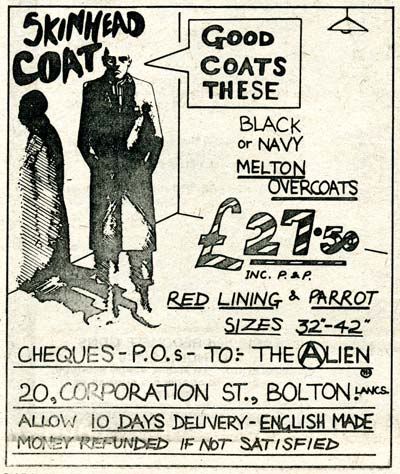
'The Alien' advertisement, NME, 20th December 1980, page 72. 

A brisk canter now through the NME clothing advertisements from my three surviving copies dating from 1980.  Starting with an authentically menacing hand-drawn ad for skinhead coats (presumably Crombie style) with a nicely no-nonsense tag line: "Good Coats These."


Fab-Gear advertisement, NME, 20th December 1980, page 72. Click image for a bigger view.

Fab-Gear of Leeds have the new wave angle covered, and their ad indicates that their retail outlet was X Clothes, an alternative clothing business that started in Manchester.  Music trivia fans will be delighted to learn that Johnny Marr worked in that Manchester branch just prior to forming the Smiths.
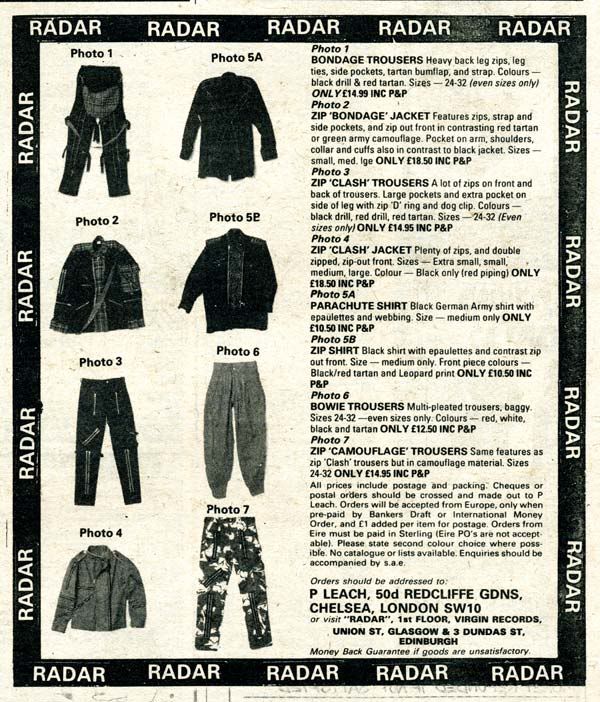

'Radar' advertisement, NME, 20th December 1980, page 73.  Click image for a bigger view.

Radar appears to be a Scottish retailer with shops in Glasgow and Edinburgh, but mail orders are referred to 'P. Leach' of Chelsea, which must be the same company as (possibly misprinted) 'B. Leach' whose bondage trouser ad from 1979 featured in the previous post.

You'll notice that multi-pleated 'Bowie Trousers' were a firm favourite around this time and several  advertisers (in this and the subsequent blog post coming soon) provide their own version of them. 


'Baxby Fashion House' advertisement, NME, 20th December 1980, page 72.  Click image for a bigger view.

Baxby's lamentable line drawings inspire little confidence, especially that Crombie in the bottom right corner.  Oh dear.

These days we routinely expect online retailers to provide full colour photographs from every angle, eye-popping zooms and even rotating 360º views, and it makes you realise what a considerable leap of faith it must have been to have sent off your cross-signed postal order based on a tiny, mis-shapen sketch that gives only the vaguest idea of what the garment might actually look like.


'J. Holdsworth' advertisement, NME, 29th March 1980, page 48.  Click image for a bigger view.

J. Holdsworth's drawings aren't much better, but at least there's a bit more detail. 


'Printout Promotions' advertisement for punk gear, NME, 29th March 1980, page 47.  Click image for a bigger view.

With some of these advertisers you get a sense that there might be some enthusiasm or at least interest in the culture they are exploiting catering for, but Printout Promotions isn't one of them.  They are just happy to produce whatever seems to be in demand.  And there's nothing wrong with that at all, in fact I admire their versatility.

So above, you'll see the punk range, and coming up below is the rock selection:


'Printout Promotions' Giant Rock Sew Ons advertisement, NME, 29th March 1980, page 48.  Click image for a bigger view.

Heavy Metal wasn't really the NME's turf (that was more Sounds territory) and this is the only specifically rock-related merchandise ad I found in my small and highly unrepresentative survey.

Mind you, I can't help warming to that slogan: "Rock on your Chest!"
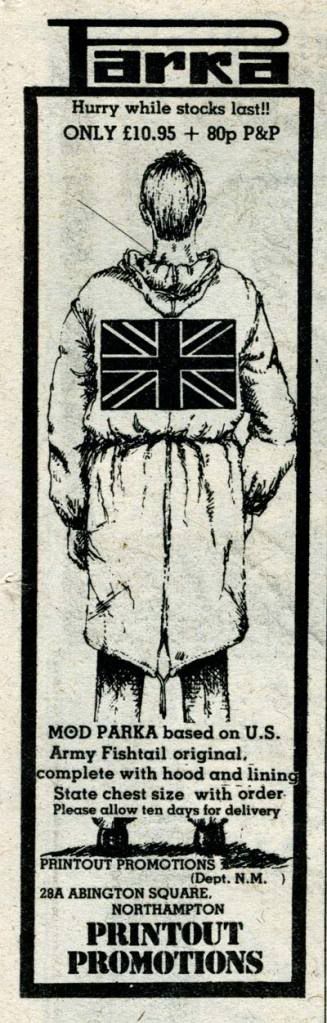

'Printout Promotions' parka advertisement, NME, 29th March 1980, page 48.  Click image for a bigger view.

And here Printout turns its hand to mod styles with Union Jack emblazoned parka.  In fact, I'm sure there were plenty of other subcultural fields that Printout Promotions trained their sights on.  An online search turned up a scanned copy of CB World magazine from April/May 1981 featuring a full page ad of theirs with the proud message: "Leaders in the field of personalised CB wear," which presents merchandise including everything from bodywarmers to car sunstrips.

From versatility to extreme specialisation, let's welcome the self-styled "most exciting Company in the Universe":


'Punters Choice by Cadiss' slim ties advertisement, NME, 27th September 1980, page 53.  Click image for a bigger view.

Punters Choice by Cadiss want to help those of you with overly wide ties, and their Asteroids tie certainly sounds tempting.  Interestingly, they accept Access credit cards - the only NME clothing advertiser I've found that does so - but without a telephone number it looks like those ties will remain "Hard To Find."


'Boy' mail order punk advertisement, NME, 27th September 1980, page 53.

Boy were one of the, er, big boys of punk clothing and I dearly wish I'd sent off for one of those full colour catalogues.

This ad has proved useful to me, though, by way of the mention of Kitsch 22.  I have an old sleeveless t-shirt with a picture of Sid Vicious on tv (printed sideways) that has a perversely black on black woven label.  After much squinting and angling to catch the light on this mystifying label I've discovered that it reads "Kitsch London" and probably came from Boy.

The t-shirt had been featured in a fashion magazine piece showcasing new t-shirt designs and I must have sent off for it, although I have no memory of doing so.  But I kept that clipped picture of the t-shirt (indeed it may still be around, somewhere . . .) and the garment remains in my wardrobe nearly 30 years later.

Steering back to the business in hand, the blog Planet Mondo has some pictures from the 1981 Boy Blackmail catalogue that are definitely worth a look.
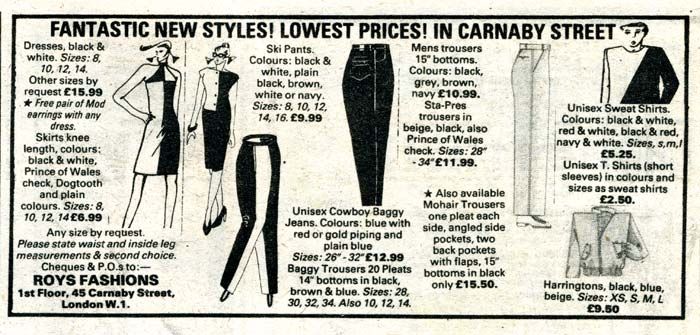

'Roy's Fashions' advertisement, NME, 29th March 1980, page 48.  Click image for a bigger view.

I have a soft spot for Roy's ad, which has a lot to do with that black and white block panel mod dress.
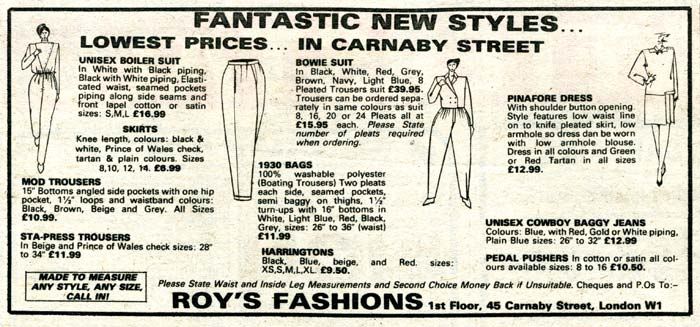

'Roy's Fashions' advertisement, NME, 20th December 1980, page 73.  Click image for a bigger view.

And here's Roy in December 1980 offering not just Bowie trousers but a full Bowie suit for £39.95.


Finally, its heartening to see that the Teds, Britain's oldest and most venerable youth subculture, were not forgotten in 1980.  The General Franchise Company was there to dress them in Polyester Viscose Gaberdine:

'The General Franchise' Drapes and Drainpipes advertisement, NME, 29th March 1980, page 47.  Click image for a bigger view.

The next post will gather up the remaining NME clothing ads scanned from issues dating from 1981 to 1985, and I'll include a handy directory of all the advertisers just to keep up the nerd quotient.  Stay tuned . . .

Friday, 11 June 2010

What could you buy for £6.90 in 1979?

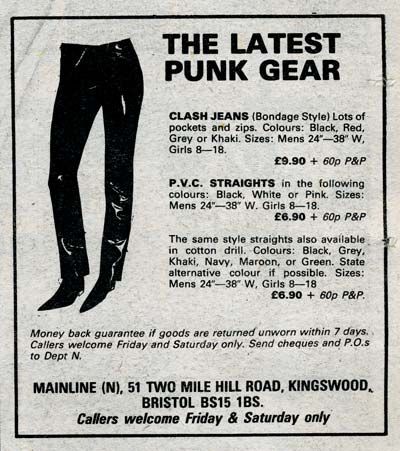
'Mainline' advertisement from the New Musical Express, 29th September 1979, page 63.  

You could treat yourself to some P.V.C. straights - in black, white or *gasp!* pink - as illustrated here in an advertisement by Mainline of Bristol.

I know punks were supposed to be skinny, but the smallest men's size offered here is an extraordinary 24" waist. This might suggest the target market included some very young punks indeed. 

On my recent browse through what little remains of my NME collection, I was drawn to the clothing ads that featured regularly in its back pages and seemed to cater for nearly every youth culture tribe active at the time.

Personally, I wouldn't have dreamed of ordering anything from them because I instinctively mistrusted those monochrome line art drawings and assumed that the garments would be shoddy and disappointing.  I'm sure this was most unfair in some cases, but when you're school-age and pocket money is tight, you tend to be ultra-cautious about where you spend your money. 

That said, I'd like to hope they would have provided a valuable service to provincial (and especially rural) teenagers, keen to express their tribal preferences in sartorial form, who lived more than a tube ride away from Camden Market or the King's Road. 

So, back in 1979, punks were pretty well catered for as you might expect:

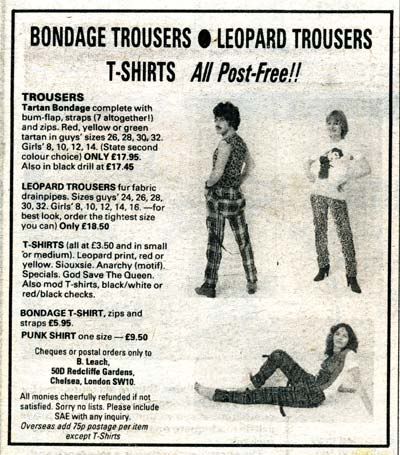
'B. Leach' advertisement, NME, 22nd December 1979, page 73.  

B. Leach of Chelsea offers tartan bondage trousers at £17.95 (bum flap and 7 straps included), and suggests that you order your fur fabric leopard drainpipes in "the tightest size you can."  Those models might have the requisite skinny figures, but they're just not trying hard enough with their hair.  Bondage-trouser-man looks like one of Harry Enfield's scousers, and the two women could be Nolan sisters.

However, it is still the 1970s and the hippies haven't yet been scared away by all those young punks in super tight trousers.

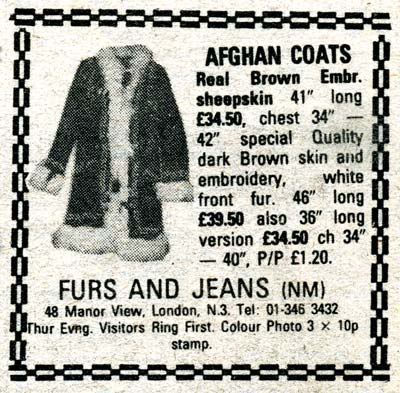
'Furs and Jeans' advertisement, NME, 22nd December 1979, page 73.  

It looks like its much more expensive to be a hippy than a punk.  £34.50 could get you nearly two pairs of B. Leach's bondage strides, or exactly five pairs of Mainline's P.V.C straights, not including p&p of course. 

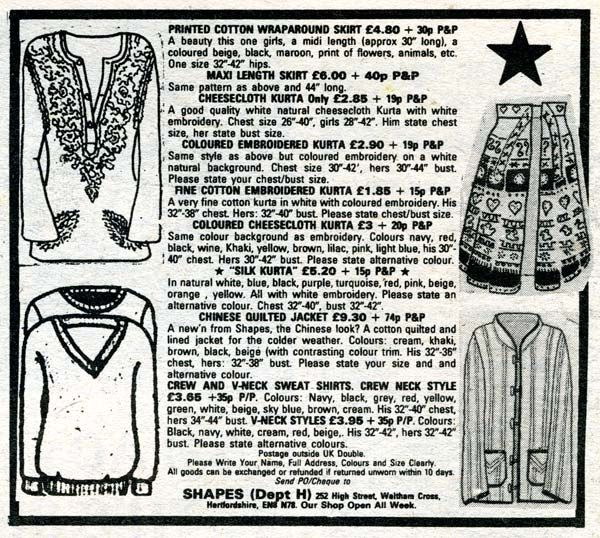
'Shapes' advertisement, NME, 29th September 1979, page 64.  

Maybe its not that expensive being a hippy after all, since Shapes of Waltham Cross, Hertfordshire, is providing printed cotton wraparound skirts for £4.80 and white cheesecloth Kurtas for £2.85. 

But if anyone's known for excessive spending on their wardrobe, its the mods.

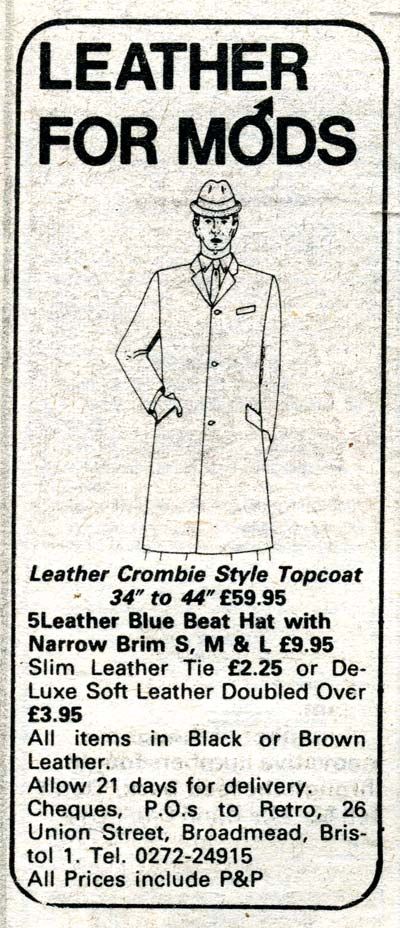
'Retro' advertisement, NME, 22nd December 1979, page 73.  

This leather "Crombie Style Topcoat," from Retro of Bristol, costs an impressive £59.95, and I'm sure I don't remember seeing any late-70s-mod-revival mods wearing one.  Leather ties, certainly, and possibly the odd leather "Blue Beat" hat, but the coat was probably not a big seller given that price. Plus, maybe I'm a bit conservative, but the idea of a Crombie in leather sounds pretty naff to me. 

That's about it from my two surviving copies of the NME from 1979.  There's plenty more ads coming as we plough on through into the 1980s and I'm determined to share them all! 

Authentic punk clothing - with the 'right' labels such as Seditionaries/Sex, Boy and so on - is now fetching big money from enthusiastic collectors.  I would argue that the other contemporary youth culture styles are interesting too, not least because very little of it seems to survive.

People grow out of their teenage enthusiasms and are often quick to bin those embarrassing reminders of their youth as they grow up, start thinking of their careers and/or their new young families, and decide that Pink Floyd were actually amazing despite what Johnny Rotten scrawled on his famous t-shirt.  

The mail-order retailers featured above weren't exactly authentic, but they provided cheaper copies for the majority of people who couldn't afford the originals.  I won't get into the arguments about whether this was piracy or not, or about quality issues - it was inevitable.

You might come across some of this old gear, and some of it might have labels sewn in (this isn't a given - many don't).  With my collector/vintage dealer head on, I reckon these ads might be a useful resource for finding out about those garments.

If you've still got something from one of these companies, or you remember ordering furry leopard print drainpipes from the NME, I'd genuinely love to hear about it.

Tuesday, 11 May 2010

Better Badges

I've been thinking about badges recently, and about how important they were to me in my early teenage years.

As a pupil at a school that required a uniform, badges were one of the few ways to broadcast your sophisticated taste and esoteric musical enthusiasms, and political/ethical concerns if you had any.  Of course, there were also the exuberantly biro'ed pencil cases and army surplus canvas bags but that's another story.

Crucially, they were also very cheap and made ideal pocket money purchases.

There were important distinctions in the style of badges dependent on your musical preferences.  I remember pop music badges in the 70s tended to be large and full colour - a photograph of a beaming David Essex as big as a coaster, for example.  Heavy metal fans favoured enamelled metal badges, or the later cheaper versions which were basically a metal square with a shiny plastic sticker, and the obligatory sew-on patches for their frayed denim waistcoats.

Punk and New Wave fans were more austere in their badge preferences (this was probably a result of limitations in budget and manufacturing capabilities as much as aesthetics).  Monochrome tended to be the rule, or maybe two colours at a push, and they were always small.  Bold graphic band logos tended to work best at this scale, PiL's being a particularly successful example which worked at every size from button badge to shoulder-spanning back-of-the-leather-jacket artwork. 

I filled up my school blazer lapels from a small record retailer in Lincoln called Sanctuary records, which had a black felt-covered board covered in tiny, ¾" badges from which I made my careful selections.

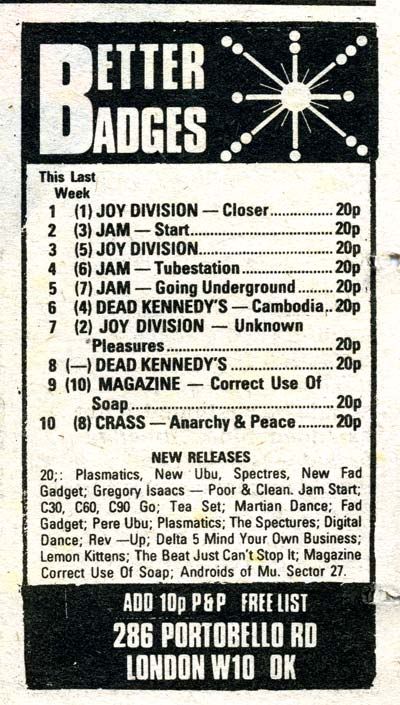
Around the same time, I began reading the NME which had a regular advertiser - Better Badges.  They placed their tiny box ad on the inside last page, always in the bottom right corner.  Happily, I've just found the remains of my NME collection (now reduced to about a dozen copies in total) dating from 1979 to 1985.  And the early ones do indeed have Better Badges ads.

Better Badges ad, NME 27th September 1980.

As you can see, they presented their top sellers in a weekly chart and it gives a wonderfully concise snapshot of the popular underground (if that's not a clumsy oxymoron) music scene of the time.  Apart from the Jam, who weren't underground at all really (despite that song title, yes I see it!)

I can imagine little teen mods satisfying their fan worship by stocking up on badges whilst they save up to buy some black and white bowling shoes, just like Paul Weller's.

Schoolkids usually don't have much money to spend.  You might buy a badge of a record before you bought the record itself.  Or you might buy the badge instead of the record, and satisfy yourself with a fuzzy tape recording of the track off John Peel.  At least you knew about it, and you could let everyone else know you knew about it too.

Better Badges was great because it was right on the money, producing little mascots of nerdy fandom exactly when you needed them.  Before 'everyone else' had heard of them.


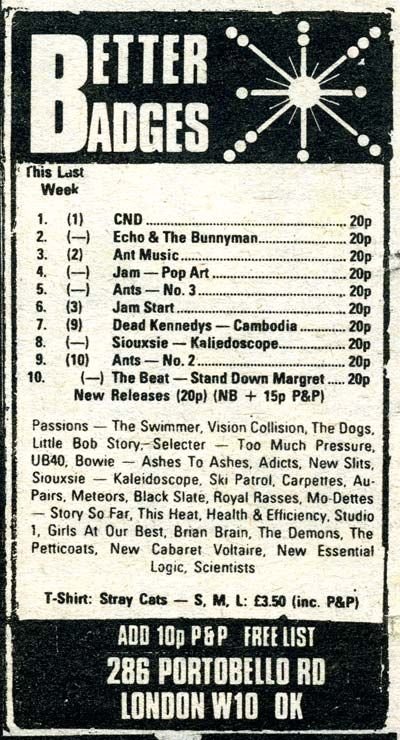
Better Badges, NME 3rd January 1981.  

This ad from January 1981 indicates a rising political awareness with the CND badge (Campaign for Nuclear Disarmament) topping the chart.  I'm sure it was around this time that I sent off for my copy of the CND booklet Protest and Survive, which scared me witless.

I honestly can't remember if I ordered badges directly from Better Badges.  Being isolated in a village in rural Lincolnshire, I regularly sent off postal orders for records and fanzines, and then raced to beat the dog to the post before she tore the packages to shreds (I still have a few records with teeth marks).  The company was also an important producer and distributor of fanzines and its very likely that some of my postal orders went to them, but I'm hazy on this.  At any rate, its certain that I wore their badges.


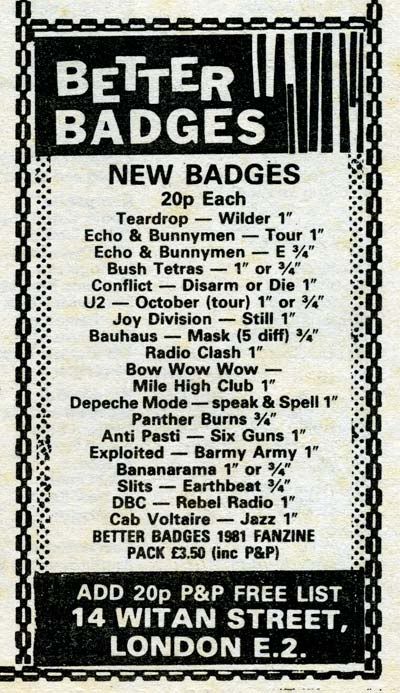
Better Badges ad, NME 19th December 1981.

By December 1981, Better Badges had dropped the chart and just listed their new productions, and the P&P had doubled to 20p.

The next year - 1982 - I left school and went to art college, and I think my badge-wearing years ended at around the same time.  Perhaps I considered them a little gauche and immature now I was a grown-up student (oh dear).  It looks like Better Badges stopped advertising in the NME shortly after this too, since my few later copies don't have their ads.

This enjoyable trawl through old NMEs has lead to a day-long scanning session because I was drawn to the clothing ads in the back pages.  So my next few posts will explore the delights of the mail order clothing companies that sold through my (then) favourite music weekly.  


Further reading

I've been very slack about doing research for this post, in fact I haven't done any in my rush to post something after quite a lull.

If you would like to learn more about Better Badges, check these links:

A short history of Better Badges and its role in badge and fanzine production and distribution.

An article by Joly MacFie, founder of Better Badges, which explores how the emergence of cheaper reproduction technologies enabled the DIY/anyone-can-do-it ethos of punk. 

A Village Voice article about Joly MacFie and punkcast.com.

Saturday, 17 April 2010

That Tinling feeling

Advertisement for Teddy Tinling's salon from Vogue, 14th April 1937, page 120.  From the Gallery of Costume, Manchester. 

What a singular character Teddy Tinling was!  The opening line of the Wikipedia entry I just linked to does a great job of indicating as much, in its customary dry and succinct manner: "[Teddy Tinling] was an English tennis player, fashion designer, spy and author."  As a career resumé, that one is pretty hard to beat. Plus he was "openly gay" in the days when that was hardly a safe option.

These days people might recall the frilly knickers he created for the American tennis player Gertrude 'Gorgeous Gussie' Moran in 1949, and the kerfuffle those provocative undergarments caused in the media. 

Tinling made his name creating expertly tailored and glamorous tennis wear for many of the star players of his day, but his career in the rag trade began much earlier in 1931 when he opened a salon in South Kensington, London, specialising in wedding and evening gowns for the "carriage trade."  This was evidently successful because by 1937, when his nicely surreal advertisement (above) appeared in Vogue, he was plying his trade in the much posher environs of Mayfair. 

The Second World War interrupted his fashion career and prompted his drastic career switch to spying for the British Intelligence Corps.  I'm sure there's lots of interesting material about his wartime adventures, but sadly they don't appear to be online so I shall press on regardless. 

Shortages of luxury fabrics after the war saw the ever-pragmatic Tinling turning to the growing market of sportswear . . . actually this is all very well documented in the links I've added so I'm going to cut straight to my point and spare you the painful paraphrasing. 

Teddy's tennis wear suggests a fondness for flamboyance, which is certainly borne out in the British Pathé film archive.  The swelle life blog has a fabulous post about one of those films so I won't repeat it here (please visit that link to enjoy it, and don't miss this post about his tennis gear too). 

Here's more evidence.  He embraced rock'n'roll with some delightful garments for teenage fans:

"Clothes specially designed for Rock'n'Roll enthusiasts by Teddy Tinling, 1957."  From Frances Kennett (1983) The Collector's Book of Twentieth Century Fashion, London: Book Club Associates, pp. 88-89.  (Apologies for the book binding cutting through the picture - I'm not skilled, or indeed patient, enough to erase that). 

I'm really enjoying that print of clocks and jiving couples (no doubt a reference to Bill Haley's "Rock Around the Clock")

The elfin model Elizabeth Duke can also be seen modelling some "Jive Fashions" possibly from the same collection (Tinling trousers with a heart-shaped pocket printed with the immortal British rocker Tommy Steele) right here. 

Its clear that Teddy Tinling's gift for tailoring glamorous but practical tennis wear was readily transferable to the demands of energetically jiving rock'n'rollers.  Sadly there appears to be no film footage of his teen-rock'n'roll clothing available. 

But there's plenty more camp fashion delights to be found, especially at my favourite resort for vintage footage, British Pathé.  And this is one of the best, a 1958 film of Tinling's leisure fashions inspired by souvenirs from his holidays:   

TEDDY TINLING HOLIDAY FASHIONS


And this short film from 1955 features both his tennis and leisure wear:

BEACH AND TENNIS WEAR


And I'm going to have to include Tinling's spectacular South Pacific fashion show, as featured in the swelle life blog, just so you don't miss it:

TEDDY TINLING FASHIONS


Teddy Tinling's exuberant style has quite won me over.  I only wish that there was more information available about his fashion adventures, rather than just his tennis wear (as admirable as it was).  If anyone can offer any further information about this I would be overjoyed.  All I can say is that I've never come across a single garment with his label on it, and live in hope that I might - someday.

Thursday, 1 April 2010

My April Fool

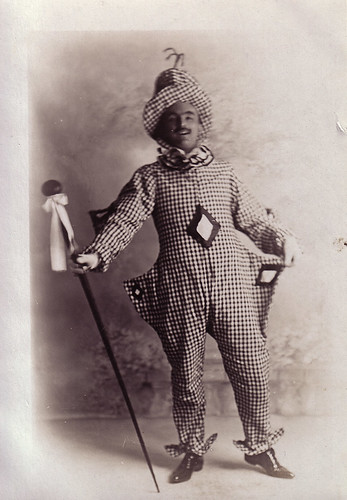
gingham man, originally uploaded by Trevira.

In celebration of today's tradition of ruining someone else's morning with a prank* here's an authentic April Fool for you.** 

He certainly looks as if he's up to no good, and the criminal use of one of my favourite fabrics - gingham - only adds to the offence. 

Let this serve as a warning to you.  Be on your guard for strange men in crazy gingham outfits today because its likely they will be planning some very unfunny practical joke to inflict on you.  They have until 12 pm, so you should be able to relax after that time (everyone knows that April Fool 'jokes' committed after midday mean that the joke's on them, although that's no consolation).

* Can you tell that I'm not a fan of practical jokes?

** This is a complete lie.  I've no idea if this man is an April Fool - its an old photograph, possibly dating from the 1910s, which seemed appropriate for the day.  My sincere apologies for any distress or trauma it may have caused you.

Wednesday, 31 March 2010

Daffodils and memories

1940s lady - hand tinted photograph, originally uploaded by Trevira.  

This beautiful photograph is a hand tinted 8x10 dating from the 1940s, possibly during the Second World War.  A very stylish and attractive woman sits in a picturesque country setting, surrounded by daffodils.  She looks so happy. 

Its only when you turn it over that this photograph zaps you with something quite unexpected and moving.  On the back is written: "Looking at this now - I realise I was carrying my daughter - how I wish those times could have given me the courage to ignore the moral issues and let nature take its course." 

Suddenly its hard to look at that picture in quite the same way.  I imagine this woman was going through her photographs some years later and felt the need to record her regret at the loss of her daughter, perhaps for herself or for her family.  Or just to memorialise her child.  Her daughter was there in that photograph, only we couldn't know that by just looking at the picture, and neither did she at the time. 

I found this photograph among a whole boxful from the same family, and bought as many as I could afford.  Its clear that they later had a son whom they doted on, and enjoyed many happy times and holidays together as a family.  I would like to add some more pictures of the family here, or at least links to them, but trying to do both things resulted in me losing all the text I had written in a mass of tangled HTML.  So I daren't! 

Shuffling through the pictures you would assume this was a very happy family living a very uncomplicated and picture perfect life, but that little note is a sharp reminder that things aren't always that straightforward. 

Monday, 22 March 2010

Ossie Clark in motion

Ossie's sketch of ruffled chiffon dress with tie neck, c. 1968-9, from Judith Watt, Ossie Clark 1965-74, page 79.

Ossie Clark's fashion shows have become the stuff of legend. According to Ossie's long-term friend from his student days, Norman Bain:
These were the first fashion shows that were like happenings, pop concerts and theatre. The feeling was that of a Parisian salon: everybody was there together, writers, artists, actors, dancers. (Quoted in Ossie Clark 1965-74 by Judith Watt).
Excitingly, British Pathé has three films of Ossie Clark and Alice Pollock's early fashion shows from 1968 and 1969. Alice Pollock was a fellow designer and owner of the Quorum boutique where Ossie became her business partner, and she should not be overlooked!

The earliest film has an issue date of 25 January 1968 so its quite possible it was shot in late 1967.

It starts with a fashion show at Maxim's in Paris 'by' Elizabeth Taylor, who, the narrator declares, was planning to open her own boutique there with Richard Burton. The narrator notes that this was "Mia Vicki's collection with several numbers dreamed up by Elizabeth Taylor." (I've found a couple of brief references online to 'Mia & Vicki' with no useful information).

The rather gauche sexiness of the designs is underlined by Richard Burton's approving comment "at last girls look like girls." This was fashion explicitly intended to appeal to men.

This show presents an interesting contrast with the Ossie Clark and Alice Pollock fashion show that follows it, as the commentary notes: "It seems that minis are in for a knock from maxis, from the bare truth to keeping the guys guessing." The glib narration has hit on a crucial point - Ossie Clark and Alice Pollock designed for women, not simply to make women more appealing to men.

Of course there's sexiness - sheer chiffons worn without underwear and the odd flash of a breast (sorry, maybe that's the next film, stay tuned!), - but these were garments that didn't beg for male attention and approval but kept the power and sexual autonomy with the wearer. I'm sure that only a small minority of their customers opted to wear those more revealing numbers as they were shown on the catwalk, but it was up to the customer how much they bared, which was hardly possible with the cutaway swimsuits in Liz Taylor's show.

See what you think:

FASHION SHOWS


Judith Watt notes that:
The show at the Revolution Club, just behind Berkeley Square in Mayfair, in 1968, saw Jimi Hendrix and the Rolling Stones in the audience. Patti Boyd, who only did runway shows for Quorum, wore a cream chiffon dress with a print of blue birds and irritated her husband, George Harrison, in the audience with the rest of the Beatles, by going bra-less. Cynthia Lennon was there too. (Ossie Clark 1965-74, page 84).
Well Cynthia certainly wasn't at the next Revolution fashion show - the following film is dated 11 August 1968 - because John Lennon is shown with his "friend" Yoko Ono, both looking equally bored. This might possibly be because Ossie's shows tended to run at least an hour or two later than billed, and I'm sure they were captivated once it actually started - as I hope you will be too:

'REVOLUTION' FASHION SHOW


Ossie Clark's own notes on this fashion show, written as a 'stream of consciousness' exercise in recall in 1988, are as follows:
'Revolution Number 9.' Pattie Boyd models show at the Revolution and in the press.
'Come on, mother! We're late,' - John Lennon with Yoko looking like a porcelain doll. Kay, Carol tells, a light fell over the stage, like fell over, and he steadied the chair she stepped on, JL. (The Ossie Clark Diaries, page lxiv).
Sadly, John Lennon's moment of gallantry wasn't captured by the newsreel cameras.

This last film is dated 15 May 1969 and consists of unused footage of a fashion show at the Chelsea Town Hall. Well actually, after several viewings I've worked out that there must be footage from another fashion show at another venue spliced in - watch out for the disappearing catwalk and change of decor.

I'll have to warn you that this has no soundtrack and lasts for about four minutes, but I find it mesmerising nonetheless:

( MODERN FASHION ON SHOW )


What is striking about all these fashion shows, among other things, is the charismatic personalities of the models. They all seem to be 'doing their own thing' as the now quaint 60s phrase has it. Some are live-wires, some are demure and some are theatrically vampish (indeed, some seem to be more than a bit stoned!)

You get a strong sense of a variety of distinct personalities rather than a sequence of clones stomping along like well-drilled soldiers in heels, as we're now accustomed to seeing these days.

And they were personalities, especially selected for their individual qualities and encouraged to express themselves as they saw fit - many became part of Ossie's intimate circle of friends and were valued for their character as much as their beauty.

I'll let Lady Henrietta Rous explain this more fully (she does it so well):
Ossie stated that he wanted 'to make a woman aware of her body', and in pursuit of this ideal he brought in a new style of model. They were no longer 'tall things that swayed at you as they walked down the cat walk,' but characters in their own right. Gala Mitchell, with her sculptural bone structure, big eyes and theatrical style, looked particularly good in leather jackets. Others who modelled were KariAnne Jagger (Mick's sister-in-law, whose captivating dances on the stage inspired the Hollies' song which begins "Hey Carrie-Anne, what's your name now, can anybody play?"); Amanda Lear (Salvador Dali's muse and as good a performer as KariAnne); and Lady Carina Fitzalan-Howard, daughter of the Duke of Norfolk, whom Alice had discovered walking down the street.
But perhaps what thrilled me most about seeing these films was the chance to see Ossie Clark's (and Alice Pollock's) clothes in motion.

As you can see most vividly from his sketch at the top of this post, he always thought in terms of how his clothes would work on the female body, and also in motion. Its a privilege to see them how they were intended to be seen.


A note on prices

The first film mentions a few ensembles and prices so I've used measuringworth.com to establish what they might cost (nearly) today:

The white leather suit named 'Daz,' priced at 25 guineas, would be approximately £341 at 2008 prices.

Patti Boyd's outfit called 'African Queen' at 9½ guineas, would be approximately £130 at 2008 prices.


References

Lady Henrietta Rous (ed.) (1998) The Ossie Clark Diaries: In Doze Days. London: Bloomsbury.

Judith Watt (2003) Ossie Clark 1965-1974. London: V&A Publications.

I'd also recommend:

Peter Schlesinger (2003) A Chequered Past: The 60's and 70's. London: Thames & Hudson. This book has some wonderfully candid photographs of many of Ossie's friends and favourite models, and is a visual and gossip-rich treat!