Showing posts with label publicity. Show all posts

Sunday, 17 January 2010

The elusive fashion designer caught on film

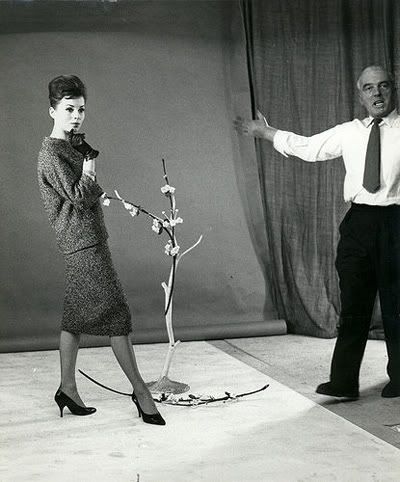
1950s fashion shoot, originally uploaded by Trevira.

What is going on here? Its impossible to know for sure, but I like to speculate that its the fashion designer emerging from the shadows to express his robust opinion about the photoshoot (and perhaps the merits or otherwise of the photographer), just as the shutter clicks.

Although this is a generalisation, for the most part fashion designers weren't always the recognisable public figures they are today. Most people - even those with little interest in fashion - will be able to summon up a mental image of designers such as Karl Lagerfeld, Donatella Versace, John Galliano and Vivienne Westwood, partly because each has a very distinctive style and self-presentation that is instantly recognisable. But also because there is simply much more media out there now, and designers are expected to take part in the publicity machine in a way that just wasn't the case in previous decades.

However, the famous Parisian couturier Paul Poiret was decades ahead of his time, being a hugely accomplished self-publicist. His lavishly decadent costume parties were widely covered in the press, and his larger-than-life persona informed, and fed back into, the perception of his couture house. Poiret was about ostentation, exoticism, a romantic and picturesque kind of modernity and a challenge to conventions (let's not forget that he was credited with freeing women from the corset, which might or might not be true, but anyway).

This precious short film supposedly shows Poiret arriving from Paris at Hounslow airport with two of his mannequins (models), probably another stunt to attract the press since this would have been an appealing novelty item. In fact, it is Poiret himself who runs to greet the plane (look closely at that first figure to appear as it taxis to a halt), and help his models out of it, so perhaps he had arrived earlier:

PARIS FASHIONS BY AIR


There's no date given for this film, so I'm guessing early 1920s, by which time his house was already in terminal decline and, sadly, would close in 1929.


Leaping forward at least a decade, this delightful film from 1938 features the Greek-born Parisian couturier Jean Dessès, who had opened his couture house only the year before. We are invited into his busy workroom, and the salon where a fashion show is being presented. M. Dessès is shown creating a gown on a live model, and there's a painful pun by the perky narrator ("gauze and effect"!):

FASHION COMES TO PARIS!


Jean Dessès is little known these days, and the name Olive O'Neill will probably mean even less to most people. She was, in fact, a very important figure in the development of ready-to-wear clothing in Britain.

Born in Southport, she came to work for the fledgling brand Dorville in London in the 1920s, where she began designing classic and elegant clothes to supplement their primary knitwear line. Having set up her own factory, she studied and adopted American methods of manufacture, grading and sizing, and visited America every year to keep up with new developments. O'Neill was an innovator in textiles too, co-operating with fabric manufacturers to produce exclusive materials and designs. (This information was gathered from Elizabeth Ewing's History of 20th Century Fashion).

This great short film shows the creation of a new dress, from Olive O'Neill's rapid sketch to the final product. Although far less glamorous than the previous film - it was shot in the last months of the Second World War, mind you - it is a fascinating glimpse of a forgotten designer:

INEXPENSIVE DRESS


Returning to glamour and glitz, Christian Dior was perhaps the most famous designer of the 1950s. Find yourself a seat in the Savoy Hotel, London and join the well-heeled guests (including British designer Norman Hartnell) for a very exclusive fashion show from 1950:

DIOR 'CIRCUS' COMES TO TOWN


I'm charmed by M. Dior's expression - he looks captivated, like he's seeing his creations for the first time. Incidentally, that £500 gown would cost you about £12,835 in today's money (thanks to Measuring Worth for that calculation).


Another Paris luminary, and a personal favourite of mine, is Elsa Schiaparelli. This is the only film I could find of her on the British Pathé website. She is seen at a Dublin fashion show in 1953, admiring the Irish fashions on display. Sadly her own business was in trouble at this time, and was closed the following year:

AN TOSTAL FASHIONS PARADE


Last up is this clip from 1958 of a young Yves Saint Laurent presenting his collection for Dior at Blenheim Palace. Princess Margaret presides, and looks completely in her element!:

'DIOR' COMES TO BLENHEIM

Tuesday, 1 December 2009

Slap Up Tog

A Victorian handbill found in a book by Renée Huggett called Shops published in 1969.

This marvellous Victorian promotional handbill (flyer) from London addresses the discerning working man in need of new clothing. Written in a presumably authentic slang current at the time, it has an immediacy and humour that defies its age, even though much of it is completely mystifying to the modern reader.

Let's have a go:

Mr H nabs the chance of putting his customers awake, that he has just made his escape from India, not forgetting to clap his mawleys upon some of the right sort of stuff, when on his return home he was stunned to find one of the top Manufacturers of Manchester had cut his lucky, and stepped off to the Swan Stream, leaving behind him a valuable stock of Moleskins, Cords, Velveteens, Box Cloths, Plushes, Doe Skins, Pilots &c., and having some ready in his kick--grabbed the chance--stepped home with the swag--and is now safely landed at his crib. He can turn out Toggery, very slap at the following low prices for

Ready Gilt--Tick being No go.

Upper Benjamins, built on a downy plan, a monarch to half-a-finnuff, Fishing or Shooting Togs, cut slap, 1 pound, 1 quarter, and a peg. A Fancy Sleeve Blue Plush or Pilot ditto, made very saucy, a couter. Pair of Kerseymere or Doeskin Kicksies, built very slap with the artful dodge, a canary. Pair of Bath or Worsted Cords, cut to drop down on the trotters, a quid. Pair of out and out Cords, built very serious, 9 bob and a kick. Pair of stout Broad Cords, built in the Melton Mowbray style, half a sov. Pair of Moleskins, built hanky spanky, with a double fakement down the sides and artful buttons at bottom, half a monarch.

MUD PIPES, KNEE CAPS, AND TROTTER CASES BUILT VERY LOW.

A decent allowance made to Seedy Swells, Tea Kettle Purgers, Head Robbers, and Flunkeys out of Collar
Gentlemen finding their own Broady can be accommodated.

(My thanks to flickr contact Bollops for taking the trouble to transcribe this text when I originally posted this picture there).

Many of the terms are obviously types of cloth: moleskin (a heavy, cotton cloth with a short, soft pile on one side), corduroy, velveteen, box cloth (I failed to find a definition of this), plush, doeskin (a fine, soft woollen cloth), pilot (a thick woollen cloth, often dyed blue used for overcoats and sailors' gear), kerseymere (a twilled fine woollen cloth).

Then there's prices: a monarch (a sovereign? That's one pound), half-a-finnuff (? - thanks to alan.98's comment below, I've discovered that a finnuff is Yiddish for a fiver), 1 pound, 1 quarter (a crown or five shillings? One pound was twenty shillings) and a peg (?), a couter (a sovereign, found in an excellent article on costermongers' backslang on the Victorian Web here), a canary (?), 9 bob (9 shillings) and a kick (?)

And of course, there's the garments on offer themselves: many appear to be trousers, such as the kicksies, or the cords "cut to drop down on the trotters (feet?)." Perhaps the "Upper Benjamins" and the "Fancy sleeve Blue Plush or Pilot ditto" are coats or jackets - the mention of a sleeve is a bit of a clue! "Mud pipes" might be some kind of oilskin waders or trousers, but I'm guessing here. "Knee caps" are possibly protective pads worn over the knees for labourers who have to kneel in their work, but again this is pure speculation. "Trotter cases" are likely to be boots if we can assume that trotters are feet.

The final call to "Seedy Swells, Tea Kettle Purgers, Head Robbers, and Flunkeys out of Collar" strongly suggests that Mr Harris is happy to do business with men of dubious reputation, so long as they have the ready cash of course.

This is a piece densely packed with detail and description, and deserves much more research than my desultory efforts.

But as much as its fun to try to translate this text, perhaps the most enjoyable thing about it is the way it reads. I would love to hear Bob Hoskins tackle this in his ripest Cockney growl.

Apparently Mr Harris advertised widely, or he copied a widely used format. More or less the same text, with some minor variations, appears in Mayhew's London Life and the London Poor of the mid 19th century (scroll down to the last quarter of the page or do a search for "slap up" on that page to find the passage), and in the New York Herald in 1888, which suggests that this tailor/outfitter was so familiar with the London criminal underworld that his handbill "appeals to the thieves, burglars and outcasts from society only."

This assertion is unfair I believe. Mr Harris was clearly drawing from the rich source of contemporary slang that would have been readily understood by its intended audience - working class men living in the slums of London. That's not to deny that perhaps Mr Harris was borrowing a bit of underworld cool by using terms that were not entirely respectable or correct, especially in Victorian times, but he was clearly a shrewd businessman who knew how to speak to his market. And he was aware that a more formal approach was a waste of time and expense (handbills cost money to print).

Credits are due. My sincere thanks to flickr friends Bollops and Art Nahpro for doing all the heavy leg-work to unearth most of the links that I have used in this piece.

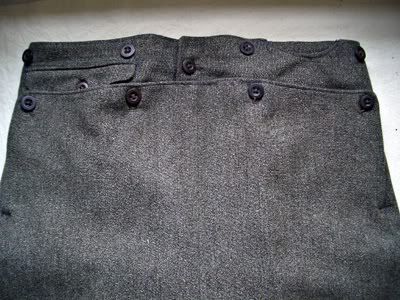
I've not finished yet! At that time (19th century), trousers would not have had the central vertical fly front we are familiar with today, but a fall front. This is a method of fastening the trousers with a flap that spanned the front waist and was fastened with buttons. Take a look at this pair of trousers which will give you the idea:


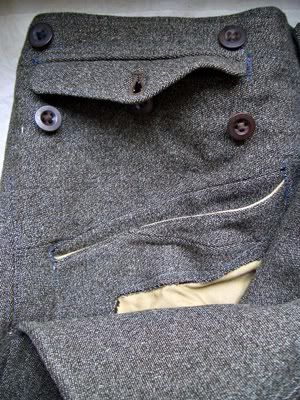
These trousers are from a suit made possibly in the early 1930s, according to the museum record, which is in the collection of the Gallery of Costume, Manchester. You can see that there are four buttons near the waistband which open to reveal:

OK, that might not be what you were expecting. This is under that front panel you saw above, and there's the pocket with a flap at the top which was visible in the first picture, and also a hidden diagonal welted pocket below it.

Sorry, this is getting complicated! So if you were getting dressed you would have to fasten two side panels of the trousers with a central button or two, and then fasten up the four buttons that secure the fall front over that.

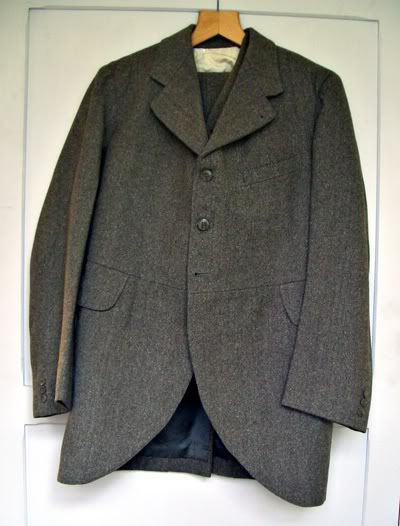
I'm pretty sure this style was archaic by the time this suit was made, and it doesn't look like a regular "lounge suit" as it is catalogued in the museum. To be fair, I'm sure there was a note in the museum record about it being a gamekeeper's suit, which would make much more sense. This suit is very old-fashioned for the time, assuming that given date is correct, and is sturdy and warm enough for tramping through the Cheshire countryside in the depths of winter with a shotgun over your shoulder and maybe a brace of pheasants hanging off your belt.

Just to complete the picture, here's the jacket of the suit:


Its beautifully curved cutaway hem, high button front fastening and waist seam speak of earlier days. The days of Mr Harris even.

There's been a dearth of film in recent posts, so this is the nearest I can get to Mr Harris's time and place - a wonderful film from 1903 of Petticoat Lane, London, from the BFI's Youtube channel. Don't you wish it had a soundtrack?: