Monday, 28 December 2009

A souvenir of Blackpool


I did unexpectedly well for presents this Christmas, and among them was this tiny porcelain shoe sporting the town crest of Blackpool. Judging by its style it possibly dates from the 1900s, and is clearly an imitation of the famous Goss armorial china that was developed in the 19th century and was produced in an almost endless variety of forms.

The Goss range wasn't just extensive in its inventive array of novelty shapes. According to Larch S. Garrad in A Present From . . . Holiday Souvenirs of the British Isles: "Allegedly, Goss souvenirs were produced for every town in the United Kingdom that had a coat of arms."

This example was perhaps made in Germany - the generic red 'foreign' stamp underneath being no help at all in narrowing down its origin. But this doesn't really matter since I have a fascination for British seaside resorts, and Blackpool holds a special place among them.

Blackpool has a good claim to being the world's first working-class seaside resort - a title contested primarily by New York's Coney Island - and both towns developed more or less in parallel. John K. Walton explores the development and decline of both places in his excellent article "Popular Playgrounds: Blackpool and Coney Island, c. 1880-1970" (available to download as a pdf here - scroll down to Volume 17, Number 1).

The millions of visitors who descended on Blackpool every summer holiday season were determined to have fun and spend their money, and perhaps take home a small memento or gift with their last few pennies, and this porcelain shoe was probably very cheap in its day. All the better to attract the eye of the working-class holidaymaker with limited cash.

But a shoe doesn't really say Blackpool to me, even with a fancy town crest on it. The iconic Blackpool Tower however, Lancashire's homage to Paris' Eiffel Tower which opened in 1894, does the job nicely.

This vintage Stratton tieclip features the tower rendered in vivid blue enamel - and is currently available at the time of writing in my Etsy shop, dear reader. As a seaside souvenir, I would argue that its actually pretty tasteful:


Stratton was established in 1860, and is most famous for its men's accessories such as cufflinks and tieclips, not to mention its women's powder compacts. Vintage examples attract avid collectors, but having cast an eye on their current range (Stratton is still going) I have to say I am sadly underwhelmed.

Of course we've got to return to Blackpool in its prime, with three marvellous films from the BFI (British Film Institute) showing the town in three different eras.

First is this 1904 Mitchell and Kenyon film of hordes of visitors promenading on Blackpool's Victoria Pier. This was shot around the time that I reckon my shoe souvenir dates from:


This 1926 film clip, shot by Claude Friese-Green in what looks like a two-colour green/red process, shows the 'Reel' ride at Blackpool's Pleasure Beach. There's also a very pleased "lassie from Lancashire" proudly showing off her feathered kewpie doll prize, from the 'Shalwyn' stall, at the end:


Finally, this fabulous excerpt from the 1957 film Holiday, which reveals some obvious American influence on the town (hotdogs with or without fried onions), the 'Reel' again, and some lovely 50s fashions:

Tuesday, 22 December 2009

Are you dancing? Are you asking?

Christmas is the prime party season, and parties often involve dancing. Which gives me another opportunity to plunder the vaults of British Pathé for some vintage treasures on that very theme.

Ballroom dancing is fraught with dangers - where do I put my hands? What frock should I wear? Which foot goes first? - so here's a helpful, unnamed dance instructor to put you right in a very prim short filmed at the Empress Room, Kensington, London in 1938.

Watch out for the swing step that's "hot from Harlem" but, the narrator warns, is "rather too hot for English ballrooms":

DANCING


The "English style" mentioned was developed by English dance teachers' organisations to regulate and tame the wild new dances coming from the United States, and was explicitly intended to eliminate any aberrant moves such as kicks or swinging hips, or indeed anything that smacked of self-expression, sexuality or spontaneity.

In the crowded conditions of most English dancehalls at this time, it could be argued that some control was needed to preserve the smooth rotation of dancing couples around the floor without things ending up in fisticuffs over collisions and painfully stomped feet. But the efforts of the dance instructors drained nearly all the personality and unique appeal (not to mention the fun) of these dances to the extent that it was difficult to discern one dance from the other.

We need an antidote to all that prim English reserve. And Earl and Josephine Leach, in this 1937 film demonstrating an hilarious version of the Big Apple, are here to supply it. They gleefully break all the rules:

THE BIG APPLE


This was precisely the time - the late 1930s - when dance hall managers realised that the sterling efforts of those dance instructors had succeeded in making many patrons scared of taking to the floor in case they committed a dreadful faux pas and showed themselves up. Dancing was in danger of becoming a difficult exercise only to be attempted by trained experts.

As a result, dance hall proprietors (including the dominant Mecca Ballroom chain) actively encouraged the development of easy dances that anyone could do after watching a short demonstration.

Watch this short film, shot at the Streatham Locarno (south London) in 1938, and you too will be able to do the Lambeth Walk with confidence:

NEW DANCES FOR EVERYBODY


Of course, what was around the corner was the all-conquering Jitterbug, which ruled British dance floors during the Second World War, and wasn't actually that easy to do well. But we had a useful influx of US servicemen to teach us how to do it properly.

This fun film - from Youtube rather than British Pathé this time - shows MGM's comic take on the dance craze in 1944:


Make sure you clear away all furniture and breakables before you attempt this at home.


Additional notes

This post neglects the original pioneers of most of these dances, the African-American community, which is sorely under-represented in the British Pathé archive. OK, that's probably understandable since it was a UK based operation. This post shows how their dances were interpreted on this uptight little island. But I can't let this pass without some acknowledgement, so here goes.

My all-time favourite dance sequence of all time is this clip from the 1941 film Hellzapoppin' featuring Slim and Slam and the Harlem Congaroos (I'm sure its many other people's favourite too, but it doesn't hurt to repeat it) which is approximately five minutes of pure joy. If you've never seen it before, prepare to be amazed:

Thursday, 17 December 2009

Lend me your elephant's ear - and I'll make a bag out of it

My last post was a complete failure as a viable Christmas gift idea for all kinds of reasons - let alone the fact that the fishtank was from a catalogue that was about 50 years old - so I've decided to make amends with some more promising prospects for the lady in your life.

Sadly most of these are from more or less the same date or even earlier so you've the same chance (exactly none, unless you are a very accomplished vintage buyer) of finding them.

If you've read any of the previous posts you will know that I am an ardent fan of the British Pathé film archive, so I'm happy to present a few more gems that I have gathered from their amazingly extensive collection.

First up is a delightful film from 1946 about what the narrator cheerfully refers to as "junk" jewellery, which would probably be classed as "costume" jewellery these days.

Apologies for not being able to embed these films but, trust me, they are all worth the bother of opening a new tab or window to view (you can complain in the comments if they're not!):

EAR-RINGS [sic] (aka JUNK JEWELLERY)


And continuing on the earrings theme is this film from 1955 (in glorious Technicolour!) which showcases the stock of a Soho shop called "Going Gay" and is essential viewing for anyone who appreciates 50s kitsch jewellery:

PARTY EARRINGS


There's some very dubious parallels drawn with ancient civilisations and ethnic cultures by the narrator, but they're easy to ignore with all those marvellous baubles to enjoy.

Another potential gift idea is a handbag, an item that most women can't have too many of.

In the following 1955 film you are first presented with a pink handbag made out of elephants' ears. Control your nausea - and please don't worry, there's nothing distressing shown - because this is a terrific film with some prize examples that really shouldn't be missed, including something for the dipsomaniac gentleman:

LEATHER FAIR


Spectacles might not be your first thought for a gift, but bear with me here because this is a fantastic 1955 film with some extraordinary examples of eye-wear.

Its hard not to be distracted by the flying hands of the optician who seems to swoop over every woman featured with dramatic and energetic gestures - I'm sure he's making some interesting and informative points, only we can't hear them:

SPECTACLES


Finally, if you've ever wondered what spectacles might be suitable for motoring and the beach you have your answer in the last few seconds of this film:

MODELS LEARN SPEC BEAUTY (aka SPECTACLE FASHION)


Lucie Clayton's was a finishing/modelling school in London for very posh 'gels' (Joanna Lumley among them) which has recently been amalgamated with two secretarial colleges to form Quest Business Training. I'm pretty sure classes in "Spec Beauty" aren't part of the current curriculum.

Wednesday, 16 December 2009

Stuck for Christmas gift ideas?


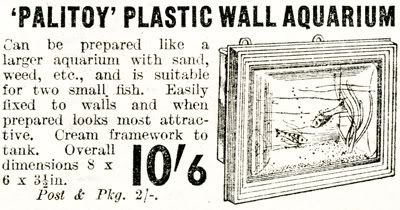
How about this mesmerising plastic wall aquarium, found in an undated Gamages catalogue? It probably dates from the late 1950s judging by the women's fashions featured in the middle pages. The men's fashions are no help at all, indeed some of the garment illustrations look like they've been used for at least 15 years.

Although I like the idea in principal, I'm troubled by the small dimensions of the tank and the evident lack of space and oxygen. Not to mention the lack of structures for the fish to hide and shelter from the glare of human scrutiny. I dread to think that it might have had lights built in too.

Granted I know little or nothing about keeping fish, but I'm sure this Plastic Wall Aquarium is guaranteed to traumatise them before it gently simmers then suffocates them, and they end up doing that listless backstroke on the surface (hopefully screened from view by the generously proportioned frame).

All in all, it suggests a high turnover of guppies, and possibly some equally traumatised children.

Perhaps its not the best suggestion for a Christmas gift. Apologies.


Additional notes

Using Measuring Worth's marvellous calculator, 10/6 would be equivalent to about £9.47 today. (I've taken a complete guess and used 1957 as the original year).

Tuesday, 15 December 2009

What could you buy for 1/9 in 1950?

Tea diffuser from the Headquarters & General Supplies Ltd catalogue, 1950.

You could purchase a "National Service" tea diffuser (now more commonly known as a tea infuser) to help eke out your tea ration.

This ingenious item was found in a 1950 catalogue produced by Headquarters & General Supplies Ltd ("Contractors to War Office, Ministry of Supply, Crown Agents for the Colonies and Education Authorities") based in London.

As you might expect from their business connections, the catalogue has plenty of military surplus clothing and accessories, such as waterproof RAF flying suits - for 45/- or 49/6 with a hood - which are recommended for motorcyclists and motorists. And "Genuine British Army Berets" for 5 shillings ("certainly a smart article for holiday use").

After the war, military surplus flooded onto the market. It was well made and good quality, durable, practical and plentiful. The catalogue makes a fine job of suggesting alternative uses for some often very specialist garments, as has been noted above, but here are some more:

Ex-Naval Torpedo Hazard Suits (17/6): "Ideal for motoring, cycling, boating, etc."

Solid Leather Army Jerkins (12/6): "Ideal for motoring, golf, or hard wear."

Merchant Navy Waterproof Suits (19/6): "For outdoor workers, cyclists, builders."


Interestingly, there are also "Solid Leather Pilots' Jackets Zip Front . . . lined throughout with pure Sheep's Wool" for £5 5s - presumably the sheepskin flying jackets that now fetch extremely high prices in the collectors' market.

Clothes rationing ended in March 1949 but tea rationing continued until 1952, making that 1/9 for a tea diffuser look like a very shrewd investment.


Additional notes

Measuring Worth provides a handy calculator for working out the equivalent prices in today's money (well, 2008 is the nearest they can get), using the Retail Price Index. So let's see:

Tea diffuser 1/9 = £2.25 (you can buy more or less the same thing today for about £3)

RAF flying suit 45/- = £57.76

British Army beret 5/- = £6.42

Ex-Naval Torpedo Hazard Suits 17/6 = £22.46

Solid Leather Army Jerkins 12/6 = £16.04

Merchant Navy Waterproof Suits 19/6 = £25.03

Solid Leather Pilots' Jackets £5 5s = £134.77

And because I seem to have wandered off the subject of tea a bit in this post, here's a stern man in a white coat (a "tea instructor") explaining more than you'll ever need to know about the dos and don'ts of tea making. This is a 1941 film from the BFI's YouTube channel:


If that's worn you out (or you can't face a full ten minutes of tea making instruction) then join Harrod's shopper Elizabeth Allan in 1955 as she introduces the wonder of the teabag. Look out for the brief appearance of a tea diffuser/infuser:

Saturday, 5 December 2009

The Toast Rack


Hollings Campus, Manchester Metropolitan University, originally uploaded by Trevira. Please click on this picture for the full view (I'm never going to use flickr's 'blog this' button again - the picture never fits!)

When I first moved up to Manchester in 2004 this building really caught my eye.

Its in Fallowfield just off the Wilmslow Road which, if you keep on heading north along it, takes you through the famous Curry Mile, and then tranforms into Oxford Road as you hit Manchester city centre. This road is one of the main arteries into Manchester, and has the multiple bus routes (and regular traffic queues) to prove it.

I was told that it is known locally as the toast-rack because of the row of swooping open parabolas at the crest of the building.

Its a building that is like Marmite - you either love it or hate it (check the comments on the original flickr page to see at least one dissenter).

Some credit is due: this marvel was designed by the architect L.C. Howitt in 1958, and opened in 1960.

By some strange twist of fate, I found myself based here about a year after my move to Manchester, so I had the chance to explore it more fully as a registered student. And I have to confess I'm still starry-eyed about it.

Its an extraordinary building, but its showing its age now and is increasingly inadequate for the volume of students that are flooding into this campus, not to mention the technical difficulties of updating an early 60s building for the demands of the 21st century.

Another problem is that in high winds those prominent ribs generate an eery and noisy howl that can compete with the most determined lecturer, and is seriously distracting for exam candidates.

I'd like to hope that it still has a future with the Manchester Metropolitan University which currently occupies it, or at least a sympathetic new owner who will respect its grade two listing.

Whatever its future holds, it remains a rare example (in the generally architecturally conservative UK) of an architect being allowed to follow his fancy and build an optimistic and ambitious vision of the space age future.

Anne of I Like fame has written a great account of it here, and there's also this fabulous film from British Pathé, made in 1961, extolling the virtues of its original tenant - the Domestic and Trades College:

COLLEGE FOR TRADES